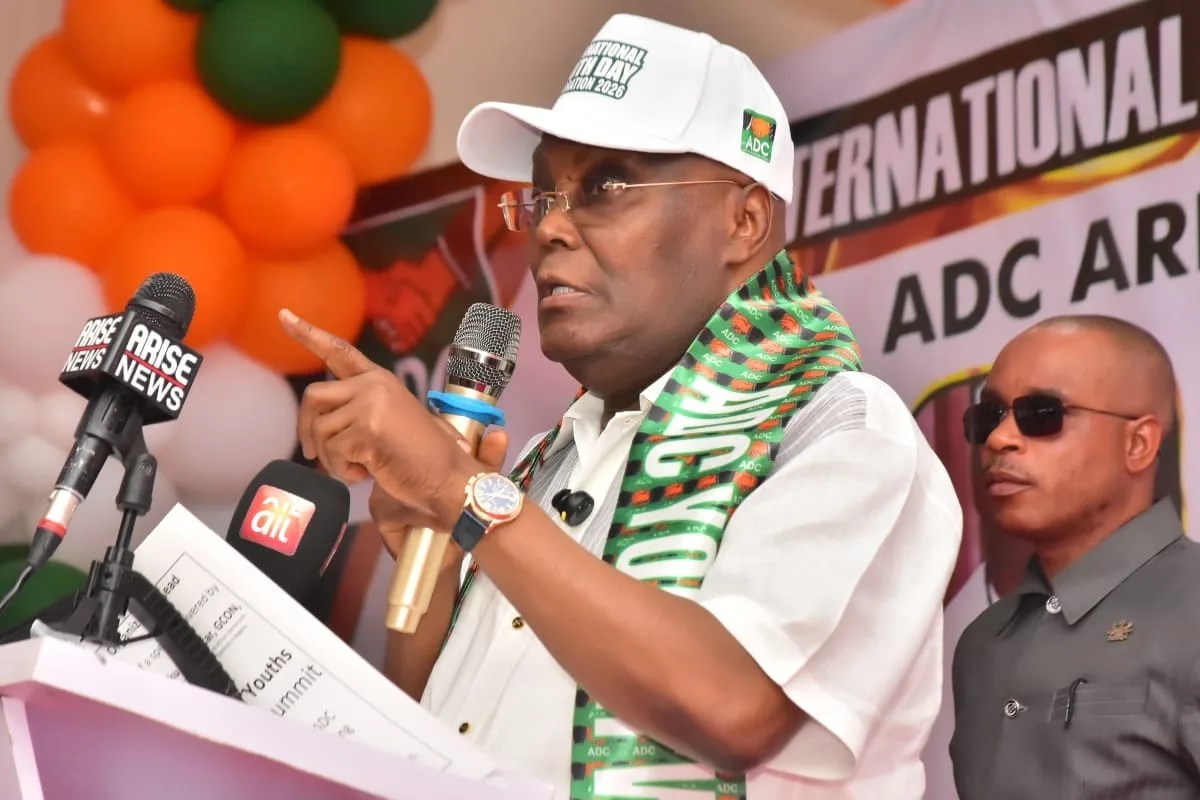
Atiku Abubakar Vows to Develop Southern Ports, Reopen Land Borders if Elected
By Sabiu Abdullahi
Former Vice-President Atiku Abubakar has pledged to reopen Nigeria’s land borders with neighbouring countries if elected president in 2027.
Atiku, the presidential candidate of the African Democratic Congress (ADC), made the promise in a video shared online by ADC chieftain Dele Momodu on Friday.
He argued that restrictions at the country’s land borders had harmed cross-border commerce and contributed to job losses, particularly among young Nigerians.
Atiku pointed out that several northern states share borders with neighbouring countries, where many Nigerians depend on cross-border trade for their livelihoods.
“The Northern states is bordering Cameroon, Chad, Niger, Benin Republic.
“And you close all those borders. All our young men who are doing trading between these countries, they carry goods across, they do this and that, all what we call transborder trade is a legitimate business,” Atiku said.
He said the border restrictions had pushed some young entrepreneurs out of business after their investments collapsed.
“All the upcoming young men and women who used to have a capital of 10 million, 20 million, and they were employing two, three other people, and then all of them went bankrupt and unemployed. How can there be security?” he asked.
“So I said I am going to reopen the borders and I will,” he added.
Atiku Plans Southern Port Expansion
The former vice-president also disclosed plans to improve port infrastructure in the southern part of the country if he wins the presidency.
He said he had previously held discussions with shipping companies and other stakeholders in Europe about expanding ports in the South and South-East.
“During the last campaign, I went across to Europe to discuss with shippers and ship development companies how we can together develop South and South-Eastern ports so that there is balance as far as importation of goods and transportation of goods are concerned,” he said.
According to Atiku, stronger port facilities in the southern region would make it easier and cheaper to move imported goods to northern parts of the country.
He used the transportation of containers from Lagos to Yola, Adamawa State, as an example, noting that he has a factory in the city.
“So when, if I drop my container in Calabar or in Uyo or in Port Harcourt, it will just take me 24 hours to take the container to Yola.
“But right now, it takes me not less than two months to take my container from Lagos because you have to cross over from South-West, you go to North-East, and then there is even no road,” Atiku said.
He said the proposal reflected concerns over the movement of goods and the need for balanced development of the country’s ports.
Background To Border Closures
Nigeria’s land borders were closed in August 2019 under the administration of former President Muhammadu Buhari.
The Federal Government at the time said the measure was aimed at tackling large-scale smuggling of rice, poultry products, petroleum products and other commodities. The government also cited concerns over the movement of weapons and drugs and sought to promote domestic agricultural production.
In December 2020, Buhari directed the reopening of four border posts: Seme in Lagos State, Illela in Sokoto State, Maigatari in Jigawa State and Mfun in Cross River State.
The administration of President Bola Tinubu later reopened the Tsamiya border with the Benin Republic in Kebbi State and the Kamba corridor linking Nigeria with Niger Republic in February 2026.