Kano

Mother protests treatment of Kano TikToker at psychiatric centre

By Sabiu Abdullahi

The controversy surrounding the arrest and trial of Kano-based social media influencer, Murja Kunya, has escalated with her mother, Hadizatul Kubra, vehemently rejecting what she perceives as the inhumane treatment of her daughter at the Federal Neuro Psychiatric Hospital in Kano. 

Murja Kunya, currently held in custody by the Kano State Hisbah Board, faced a Shari’a Court order to undergo medical evaluation at the government-owned psychiatric hospital ahead of her impending trial.

Charges including indecency, public nuisance, and promoting prostitution were leveled against her by the Hisba Board. 

Expressing concern over her daughter’s treatment, Murja’s lawyer, A.U. Haji, criticised the hospital for allegedly attempting to administer unidentified substances without informing her about her health status, branding it a violation of her human rights.

According to Leadership newspaper, Murja’s combative behaviour towards healthcare personnel has further complicated her situation. 

In a widely circulated audio interview, Hadizatul Kubra voiced dissatisfaction with her daughter’s alleged maltreatment, asserting Murja’s sound mental health but dramatic disposition.

She recounted being urgently summoned to the hospital, where Murja was reportedly distressed, and denounced what she perceived as mistreatment. 

In the audio, Kubra appealed to the state government for leniency while opposing psychiatric evaluation or treatment for her daughter, adamantly refusing any injections, stating, “I know they are doing this to kill my daughter, and I will never allow her to be injected with anything, no matter what.” 

She highlighted Murja’s familial support, particularly towards her and her ailing father. 

The court hearing is slated to resume on May 20, 2024, following the completion of the psychiatric evaluation as ordered by the trial judge, amid continued contention surrounding Murja Kunya’s case.

Day Science College: Sustainability in Interventions 

By Mahmud Aminu Dambazau

The renewed interest in the state of infrastructure at Day Science College, Kano, by its alumni is highly commendable. When I was admitted thirteen years back, the school was one of the best in Kano State. No student sat on the ground; teaching materials were adequate; the library was full of books; the Physics, Chemistry, Biology and  Agric laboratories were well-equipped and functional. There was a Technical drawing studio, a weather station and even a computer lab provided by MTN. 

A large generator and school bus provided by the Malam Ibrahim Shekarau administration were well-maintained and functional. The toilets were clean and accessible. We even had a mini farm utilised by the agricultural students; water was never scarce. The school mosque had enough mats. That was then!

The academics, discipline and respect were topnotch. We wouldn’t have been one of the best if we had not been so lucky to have some of the best teachers across all disciplines. The current intervention proposed by the school’s old students might solve or at least reduce the present infrastructural gap. Below are  suggestions I think would help in sustaining or maintaining such and future interventions. 

A report by the 2012 chapter of The Old Students in 2021 revealed that there wasn’t even one classroom fully equipped with infrastructure and several classes without a single seat! The situation is worse at the moment. This is despite the interventions by corporate bodies, NGOs, CBOs, alumni, individuals and probably even the government. Maintaining infrastructure and equipment is impossible without funding. This decay might have been contributed by the pronouncement of free education by the government without providing alternative funding for these maintenances and other costs. 

I, therefore, propose a meeting with parents, teachers and representatives of chapters of the old students. Parents should be made to understand the importance of quality education and the present state of the schools in the absence of a stable funding option. The parents should, therefore, pay the sum of just five hundred naira (500) per student each term, which will, of course, not be school fees but meant for the provision and maintenance of physical and learning infrastructure. The individual chapters from the alumni should similarly pledge and contribute an annual fee of ten thousand naira (10,000) to be utilised for the same purpose.  

A friend of mine, Engr. Mustapha Tukur founded an initiative initially meant to consist of one hundred individuals in the Gadon kaya area of Kano who contribute the sum of one thousand naira monthly. I still can’t believe the number of interventions we have made through the voluntary contributions, which now involve other friends of his, even outside Gadon Kaya. With thousands of us as old students of Day Science College, if we could get just one thousand volunteers who could contribute one thousand naira per term (3-4 months),  we would be getting a million naira each term, which will go a long way in solving these issues raised in both short and long term.  

These funds can be managed by a committee with representatives from the parents, teachers,  school management, the school’s alumni and a representative of the KASSOSA national body.  The committee could be named Day Science Development Fund with clear guidelines, objectives, terms, timelines and deliverables.  

The above recommendations should not stop future government,  individual, chapter, or corporation interventions.  

While interventions have almost always been focused on physical infrastructure, there is a need to pay similar attention to the quality of education rendered. I was present at a debate organised by the pioneer administration of the KASSOSA BUK chapter among science school students. Day Science emerged second to the last, even though it was among sister science schools. The school, KASSOSA, or any respective chapter did not care to collect, analyse and report students’ performances at SSCE or similar examinations. While it is possible to excel academically without infrastructure,  it is impossible without quality education, even with the best infrastructure.  

On this note, I suggest an assessment be conducted to determine the number of teachers currently available for each course. Where the teachers are inadequate, Kassosites, with emphasis on those from Day science, should be engaged on contract to supplement the shortage. 

We have numerous alumni who have graduated yet are unemployed. If monies could be realised, an allowance which can cover their transportation and possibly feeding should be given to them. With that, we would have helped the school, its students, and the members of the old students who would ordinarily have been idle. With these interventions, I believe the past glories of Day Science College, now Mukhtar Adnan Day Science College, will be renewed.  

Mahmud Aminu Dambazau is a graduate of KASSOSA DSCK Class 2013. He sent this article via madambazau@gmail.com.

30 women graduate from entrepreneurship training in Jigawa

By Uzair Adam Imam

The program, which was designed to foster economic empowerment and gender equality, was launched on Wednesday in Jigawa State by Blue Sapphire Hub in collaboration with the US Embassy in Abuja as part of its transformative Women on Wednesday (WOW) initiative.

The initiative had made significant strides in Kano and Sokoto states.

It aims to equip women entrepreneurs with essential entrepreneurial and digital skills and also alleviate poverty.

The inaugural cohort in Jigawa State comprised 30 women-led small businesses with limited entrepreneurial and digital skills.

Through a series of workshops, mentoring sessions, and networking opportunities, participants were immersed in a supportive environment designed to enhance their business acumen and market reach.

However, key institutions such as the Small and Medium Enterprises Development Agency of Nigeria (SMEDAN), Corporate Affairs Commission (CAC), Federal Inland Revenue Service (FIRS), National Agency for Food and Drug Administration and Control (NAFDAC), and Jaiz Bank collaborated closely with Blue Sapphire Hub to ensure the success of the program.

The participants report increased sales, improved financial management practices, and expanded market opportunities.

The graduation ceremony for the first cohort of WOW 2024 was held on January 25, 2024, with notable dignitaries in attendance, including the Honorable Commissioner of Women’s Affairs, Hajiya Hadiza Abdulwahab, and the Principal Private Secretary to the Jigawa State Governor, Alhaji Adamu Muhammad Garun Gabas.

A highlight of the ceremony was the generous pledge of N1.5 million made by Hajiya Hadiza Abdulwahab on behalf of her ministry and the Jigawa State Government to support the businesses of the WOW participants.

The Jigawa State Government has demonstrated unwavering support for the initiative, actively engaging in its implementation and expansion.

The WOW program is not merely a one-time initiative but rather a year-long commitment comprising four cohorts.

This sustained approach promises continued empowerment and growth for women entrepreneurs throughout Jigawa State.

TikToker remanded by Kano Sharia court for alleged lesbian claims

By Sabiu Abdullahi 

Ramlat Princess, a TikTok skit maker, has been remanded in a correctional centre by a Sharia Court in Kano State following her arrest by the Kano State Hisbah Board. 

Reports show that Ms. Ramlat was apprehended after a video clip surfaced online, where she purportedly proclaimed herself as a lesbian. 

Operatives of the Hisbah command arrested Ms. Ramlat on Thursday, prompted by the viral clip that sparked outrage among social media users, leading to calls for her arrest. 

Upon her arraignment at the Sharia Court, Ms. Ramlat, who reportedly pleaded guilty to charges of sharing explicit material on social media and inciting public outrage, was remanded in prison custody by Judge Sani Tanimu Hausawa.

The judge scheduled a summary judgement for Monday, February 19, 2024. 

Ms. Ramlat, originally from Ghana and residing in Taraba State, claimed she was visiting her elder sister in Kano when she was arrested about a month ago. 

In the controversial video, Ms. Ramlat declared her lesbian identity, stating that any man wishing to marry her must consent to her marrying a woman as well. 

“I am a full-fledged lesbian. Lesbianism is a beautiful act that I can’t do without,” she proclaimed in the video. 

During questioning by Hisbah officials, Ms. Ramlat confirmed her involvement in the video and reiterated her stance on marriage requirements. 

The arrest of Ms. Ramlat follows a similar incident involving another TikToker, Murja Kunya, who was also arrested by the Hisbah Board and remanded in prison. 

It’s important to note that same-sex relationships, including homosexuality and lesbianism, are illegal in Nigeria, with offenders facing a minimum of 14 years in jail if convicted. 

Ms. Ramlat’s case highlights the ongoing enforcement of laws against same-sex relationships in Nigeria and the swift actions taken by authorities in response to perceived violations.

“Mine is bigger than yours”, professorial count, that is!

By Prof. Abdalla Uba Adamu

The recent Facebook ribbing about the number of professors from states and localities in various northern cities with universities reminds me of the male adolescent macho posturing of “mine is bigger/thicker than yours” game played behind classrooms! I am even mentioned as a trophy — “yes but WE are the ones with a double professor!” referring to my being from Bayero University, Kano (BUK), in Kano State (Daneji in Kano Municipal).

The whole thing was ignited by an infographic with its origin in ₦airaland Forum where one Zafsy75 posted the graphic. Right away a fierce debate ensured on the forum with many commentors disputing the figure. Zafsy75 themselves did not provide additional scientific methodology on how they arrived at the figures. Nevertheless, they infographic became viral — and started the prideful ‘mine is bigger than yours’ ribbing.

The infographic was from Statisense which uses Generative Artificial Intelligence to generate its data! A search on its site revealed another graphic of “most professors” in Nigerian universities, in September 2023, with the University of Jos leading with 530 professors. BUK had 434 professors which included 10 women. I can personally count more than 20 women professors in BUK in 2021, not 2023! No methodology was provided as to how the figures for the universities were arrived at.

People should be aware that AI generated data is based on what the engine can find — it does not create the data. Thus, it is actually not possible to accurately determine the number of professors per state or local government even based on the much-quoted NUC Directory of Full Professors, 2021 (link to the publication attached below).

This is because the directory lists professors by DISCIPLINE in order to promote research collaboration and networking amongst Nigerian academics. Also, the Directory was not based on official submissions by various universities, but voluntarily by INDIVIDUALS which was synthesized and summarized by NUC. Additional source for the AI was personal websites where a professor proclaims to come from a particular university.

Thus, not EVERY professor agreed to submit their details to be captured. With this, it therefore becomes very difficult to accurately determine the number of professors from each state, as that was not the focus of the Director (or NUC’s intentions).

You can only get the official number of professors from individual universities. As of October 2023, BUK had 381 professors with the largest category being in Medical Sciences. All the professors were, however, not listed by their States or Local Governments, but their DEPARTMENTS or specializations.

So, I can’t see how the game of ‘mine is bigger than yours’ started. I believe; however, it was started by the infographic floating around showing the number of professors per UNIVERSITIES in the various states. The graphic was not providing the number of professors per state of origin, but per the universities IN the state. It made it clear by stating it is “by state where the school is located.”

Thus, if you are from Anambra and are a professor in BUK, this infographic will capture you as being from a university in Kano, but you will not be captured in any university in Anambra. In this way, it does not tell you the number of professors from indigenous to Anambra.

Right away, it is faulty (or fake). As of October 2023, BUK had 381 professors. Last week another 11 were announced bring the total to 392 as of February 2024. So how can Kano have 428 professors in 2022? Granted there are many universities in Kano, but the main prominent ones — Aliko Dangote University of Science and Technology, Yusuf Maitama Sule University — are basically tributaries of BUK. Indeed, most of the others rely on BUK professors as ‘visiting’ to their faculties.

Kaduna State where Ahmadu Bello University is located has at least eight universities — and you want me to believe the entire universities in the State have 62 professors? I am sure Kaduna State University (KASU) alone had either more than or close to that.

While the ribbing was fun while it lasted, at least it wakes us up to the idea of fake data and weaknesses of Generative Artificial intelligence.

As promised, below is the link to the authentic number of professors voluntarily submitted to NUC as of 2021. BTW, yours truly is listed TWICE on page 836. They still pay me single salary, though!

Directory of Full Professors in the Nigerian University System, 2021: https://shorturl.at/yKV34

Kano Emir urges first lady to advocate for hunger relief, address insecurity

By Uzair Adam Imam 

During a courtesy visit by Nigeria’s First Lady, Senator Oluremi Tinubu, to the Emir of Kano, Alhaji Aminu Ado Bayero, the Emir appealed to her to convey the pressing concerns of the populace regarding hunger and starvation in the country to the President. 

The Emir affirmed that while various channels exist for communication with the government, the First Lady’s direct access offers a vital avenue to highlight the severity of the situation. 

He stressed the urgent need for attention to address the escalating hunger crisis and also raised concerns about the prevailing insecurity, urging for more decisive action to tackle the threats. 

Additionally, Emir Bayero called for clarity on issues such as the rumoured relocation of government agencies like the Central Bank of Nigeria (CBN) and the Federal Airports Authority of Nigeria (FAAN) to Lagos. 

He also stated the importance of transparent communication with the Nigerian people to ensure understanding and trust in government actions.

Fire fighters rescue man attempting to take own life over N2 million debt in Kano

By Uzair Adam Imam 

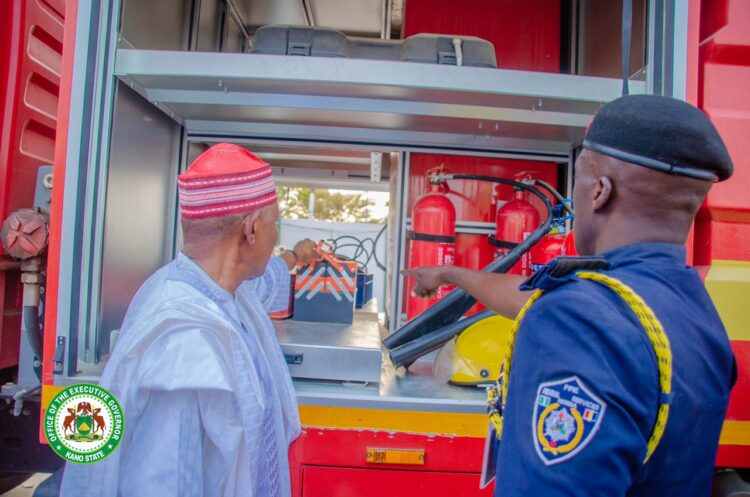
The Kano State Fire Service successfully intervened on Thursday to save a 37-year-old man, Saifullah Rabiu, who was on the verge of hanging himself from a tree. 

The rescue came following a distressing suicide note left by Rabiu, attributing his extreme action to a staggering debt of N2 million incurred during the process of obtaining a foreign visa. 

The Kano State Fire Service spokesperson, Saminu Abdullahi, confirmed the incident in a statement to the media. 

The emergency unfolded when the fire service’s Central Control Room received a call around 10:07 a.m. from the Ministry of Works and Housing in Kano State.

The location reported was State Road, near Nasarawa Emir’s house. 

Swiftly responding to the call, the fire department mobilised its standby personnel, reaching the scene by 10:10 a.m. 

There, they discovered Saifullah Rabiu in a critical condition, poised to carry out his tragic decision. 

In his suicide note, Rabiu detailed the overwhelming debt he owed, revealing that he had already repaid a significant portion of the borrowed amount, approximately N500,000. 

The note narrated the distressing impact of the creditor’s actions, which had driven him to contemplate suicide. 

Following the successful rescue, Saifullah Rabiu was handed over to Divisional Crime Officer Zaharaddini of the Farm Centre Police Division for further investigation. 

The incident sheds light on the profound consequences of financial struggles and the urgent need for mental health support in addressing such crises.

Vigilantes face death sentence for ‘extrajudicial’ killing in Kano 

By Sabiu Abdullahi 

A ruling was passed in Kano as Chief Judge Justice Dije Aboki sentenced five vigilante group members to death by hanging.

The verdict stemmed from their involvement in the tragic extra-judicial killing of 17-year-old Ahmed Musa on January 22, 2022, at Sabon Titi, Panshekara, Kumbotso Local Government Area. 

The convicted individuals, associated with Sani Abacha Youth Centre, were identified as Emmanuel Korau, Elisha Ayuba, Irimiya Timothy, Auwalu Jafar, and Mustapha Haladu.

Counsel Lamido Dinki led the prosecution, unveiling a harrowing tale of a vicious attack on Musa as he crossed Sabon Titi, Panshekara Road. 

Descending from a tricycle armed with a wooden club, the defendants brutally assaulted Musa.

Attempting to evade the attack, Musa suffered a fatal stab wound to his neck from the first defendant’s sharp knife.

Subsequently, the assailants forcibly dragged him into their waiting tricycle, leaving Musa fatally injured. 

Despite prompt efforts, Ahmed Musa succumbed to his injuries upon arrival at the Murtala Muhammad Specialist Hospital Kano. 

Prosecutor Lamido Dinki built a compelling case with the testimony of five witnesses, establishing the culpability of the defendants.

The defence, under Ahmad Muhammad, presented the convicted individuals and an additional person, all of whom vehemently denied the charges. 

The defendants asserted they approached Musa for arrest based on a complaint lodged against him.

However, Justice Aboki, presiding over the case, expressed satisfaction with the prosecution’s evidence and praised the diligent work of Lamido Abba Soron Dinki.

“The prosecution has presented its case beyond reasonable doubt. I, hereby, sentence the five defendants to death by hanging,” declared Justice Aboki. 

This ruling sends a powerful message against extra-judicial violence, noting the court’s commitment to upholding justice and preserving the sanctity of human life.

In need for collective battle against drug abuse

By Nusaiba Ibrahim Na’abba

We continue to lose a part of us – our brothers, sisters, friends and colleagues – to drug abuse. It keeps getting scarier, forcing all of us to have bleak thoughts about the future. For us to win this war against drug abuse, we need to do the following and, perhaps, more.

Communality: Our common fight against the pervasiveness of these substances was long lost here. Achieving common goals is now a bizarre thing of the past. When problems happen at family or community levels, we begin playing blame games. And to those who think their wards are ‘righteous’, they’ve done an impeccable parenting job. They describe people who are facing the heartbreak of child-related drug abuse as being incapable, too strict or too loving to their kids to let that happen. They then hop on the trend of gentle parenting as the key to having upright children. But reality shows that some parents who battle these problems possess proper parenting skills.

Now, in the case of the neighbourhood or larger community engagements, menial signs of danger are being neglected. Often, these drug dealings and businesses flourish where there is community negligence. The drug lords are purposeful enough to select urban areas where families live low-key lives. There, they conduct their sales without much or any attention from the communities, using selected morning hours for their exchanges. Quickly, a business of millions will happen in front of your house, and you will forever not know.

We must work together to be more vigilant. I am confident that the power of our communal efforts supersedes a few bad eggs that vow to torment the lives of our beloved youths with harmful substances. This battle is beyond a one-man thing. I’m also not generalising the drug dealings to happen in all urban areas in Kano, but there are several allegations about that.

Sustainable Income Options: About four years ago, the BBC Africa Eye gave staggering statistics of codeine consumption in Kano and Jigawa States in their investigative report titled Sweet Sweet Codeine. Well, the situation has only gotten worse with shisha parlours and other unthinkable substances aimed at destroying us in total. The mere imagination of how much is invested in this business is inconceivable. Unlike food, illicit substance addiction does not embrace sorry as an answer. Even in the eyes of the storm, addicts must get their day’s share. And this is why its market keeps expanding and thriving. Before you start arguing, they never fail in their businesses because they always have a market.

Unless a robust, sustainable income generation mechanism is found and proliferated in the minds of young adults into this business, we will continue to lose hope. It is extremely difficult to convince a young adult who has discovered the ropes of this illegal business to start a legal business with a low income. Their state of growth is one, and the reality you cannot overlook is difficult. Adding to the complexity of the already bad situation, you would find it difficult to neglect how politicians spend money lavishly, which is widely spread on social media.

This is one of the most difficult tools that must be deployed in this fight.

Women Groups: I’m 100% supporting creating women groups who can keenly monitor community levels. Women possess an indispensable role in upbringing, and they receive the largest share of agony when they lose their child to drug abuse. When they are part of decision-making, they can contribute immensely to the patterns they notice in their wards, and finally, they own the collective action.

Nonetheless, they must be trained rigorously on the processes they can use to fact-check drug abuse in their kids. It has been an issue that women do not understand the change in eating, sleeping, or engagement habits of their kids, which is drug-related. With the training, the problem can be tackled early before it escalates.

I can vividly recall when a mature lady entered our house some years ago. She came in with deep red eyes, along with a young girl who was 7 to 8 years old. It was in the evening, around 5 p.m., when we were seated in our compound, chatting. The woman, whose age I cannot ascertain, said she needed help with some money to buy foodstuff. By Allah, her appearance and language did not show she needed help. In fact, she appeared to be more of a well-to-do individual. But you could tell she was desperate for something, and the little girl kept giving her looks of disbelief with every sentence she made.

My mother said she had no money to help her. After a moment, she gathered momentum and said goodbye, leaving with the kid. It was only months after the encounter that my mother explained that she was sure that the woman was high on a substance and that she desperately needed money to keep going.

This world is a scary place.

Language and Codes: People who are associated with illicit substance abuse or business create codes for interaction so that they cannot be easily identified. It is usually only the people in their circle who can understand them.

There must be a way of breaking down their language and codes to identify them quickly. It creates a massive gap in understanding the context of discussions; hence, meeting points and business dealings can be set up effortlessly without anybody noticing. In community kiosks where these exchanges happen, they are facilitated by a unique language and code.

We need to break that language barrier to dissect the problem better so we can address it appropriately.

Nusaiba Ibrahim Na’abba wrote from Kano. She can be reached via nusaibaibrahim66@gmail.com.

No political maneuvering: APC clarifies supreme court decision on Kano governorship

By Uzair Adam Imam 

The All Progressives Congress (APC) has refuted speculations suggesting a deliberate concession of the governorship seat in Kano State. 

The party emphasized that the recent Supreme Court ruling was a matter of law, strictly decided by esteemed justices, and not part of any orchestrated plan to avert post-adjudication violence. 

Nze Chidi Duru, the Deputy National Organising Secretary of the APC, stated this in an interview with journalists on Sunday. 

He stated that while the party would have preferred to secure victory in Kano, it respects and abides by the decisions of the courts.  

He highlighted the importance of the judiciary’s role in the legal process, acknowledging the tiered system that includes trial courts, the Court of Appeal, and the Supreme Court. 

Duru explained, “Law is what it is. Law is based on law and then on facts.”  He also commended the judiciary for its impartiality and its ability to interpret the law independently, providing confidence to political actors that electoral disputes can be resolved through a fair and square legal process. 

The Deputy National Organising Secretary stated the significance of reaching out to the electorate and presenting manifestos to win elections, reinforcing the importance of an independent judiciary in upholding justice for all parties involved.