Kano

Open letter to Kano State governor on possible Coronavirus outbreak in Kwari market

Dear Sir,

This is to draw your attention and that of NCDC to the ongoing controversy over the cluttering of Kwari Market. We hope you will temper the issue with compassion and shrewdness befitting your sage, administrative excellence and political dexterity. Sir, if you solemnly declared that Kano will become a megacity in the very near future, which you did as reported on Blueprint Newspaper, August 21, 2020, why do you now allow our markets, especially Kwari to be congested? You made the declaration “on the eve of the Kano Economic and Investment Summit (KanInvest) which held in May, 2017, where stakeholders and bigwigs in the business sector converged to share ideas concerning issues affecting the economy, especially as it concerns Kano state”. There you rightly observed that the crowded population of Kano of about 20 million people will multiply in 5 years time. With Coronavirus threatening our lives, now is the time to decongest the city or else risk spreading the virus like wildfire.

In the process of affirming your declaration, you continue with the construction of the new Economic City of Kano located at Dangwauro Town along Kano -Zaria federal highway. However, your construction of a mall at the popular Kantin Kwari textile market named ‘Yan Tebura Mall has opened a dangerous door of congesting the market. What follows the mall are structures being erected on Taambo and Bayajidda Streets in the market. Unfortunately they are becoming a greater bone of contention because they stand on the way and so will endanger our hygiene, your excellency. After the recent rainfalls in Kano, the market was always flooded as the main waterways there happen to be on these streets. With the buildings being erected on them, the ancient market is seriously damaged, congested and so the megacity target is defeated.

Moreover, the damage brought about by the new buildings includes blockage of the former known 16 entries to the market which were serving as good ventilation and escape exits in case of a stampede. Still, the structures have saturated almost all the streets in the market, whereas the frontage of every shop is also “officially” being choked with iron stalls which would lead to disaffection, disharmony and clashes between the shop owners and stallers. To make matters worse, the installers of these iron stalls are damaging some newly tarred roads as they fix the stalls on the edge of the roads to larger part of the roadside drainage. Therefore, as the whole pathways are narrowed to almost nothing, people have to be squeezing around, highly vulnerable to Coronavirus infection.

These problems are not far from the government’s sidelining of the market people in the activities of the market, especially on strategies to improve the government’s revenue. This way, the outsiders brought in to supervise and advise on such affairs, as in the case of an administrator appointed from the head of service, come to enrich themselves only at the expense of anything good in the market. They never protect the interests of the market but theirs and sometimes end up starting a fire of enmity among business friends. It is a wonder how an outsider could tell an owner of a house where roofing leaks. Instead of looking at what is good for the market, those people look at what could bring them money no matter how damaging they appear to the good people of Kano. In that respect, owners of shops have to pay 200 thousand Naira to buy their shop front if they do not want that iron stall stationed there for sale.

Worse still, over five thousand labourers stand the risk of losing their livelihood if the contentious buildings continue. As a politician who is committed to forestall the increasing poverty-induced insecurity in the State, we are sure that you would not take this risk. Notwithstanding, the already erected structures have no accessibly enough toilets as those available are far upstairs and so women customers going to the market suffer super shame when they want to ease themselves in the centre of a Shari’a compliant state, under you, Khadimul Islam. In case of a fire accident like that of Sabon Gari Market, God forbid, the large fire fighting vehicles that need room for manoeuvre would never get entry as the ways are now being blocked. So against this background, all concerned persons in the market say no to the project and even go to court.

Following on from that, the State High Court, on 12th August, presided by Justice Suleiman Baba Namallam, has restrained the Government of Kano State from blocking or erecting structures at any part of Taambu and Bayajidda Streets at the popular market, pending the hearing and determination of the motion on notice. Nonetheless, It has never been our intention, your excellency, to be at loggerheads with your government over this issue. We are only after decongesting the market especially to observe the Coronavirus protocol; to help the government, on the other hand, in spacing the already jam-packed market in preparation to reaching the megacity status and to target the recent Federal Government’s campaign of “Ease of Doing Business”.

Nevertheless, Your excellency, we appreciate your effort towards making Kano a megacity as you ease traffic congestion by finishing the construction of the Sabon Gari axis 2km bridge inland flyover (named after the Kano business mogul Alhaji Aminu Alhassan Dantata) along Murtala Muhammad Way, which is the longest in West Africa; the Sharada/Panshekara Junction Underpass; the Bukavu Barracks underpass; the Underpass, Flyover and Roundabout at Dangi road connecting Zaria road-Zoo road and Silver Jubilee road as well as the now-under construction Hotoro NNPC (Muhammadu Buhari) bridge among others. These justify your administration’s commitment to the safe development of the sprawling city of Kano. In spite of that, we also need our existing markets to be spacious, uncrowded and comfortable so as to have good standards of health and hygiene regulations, especially Covid-19 protocol.

It is our fervent hope that Kano will continue to benefit from the wealth of your immense administrative experience and astuteness in politics, especially in this much worrying matter. Show the world that you are an ace politician, agreeable to the yearnings and aspirations of your people by justifying the confidence collectively reposed on your administration and unselfish persona.

We pray that may Allah Subhanahu wata’ala strengthen your resolve in elevating the status of Kano to compete with other megacities around the world. May you be successful in your future political endeavour. May Kano remain peaceful forever! Amin thumma Amin!

Yours,
Concerned Citizens!
08067444787

VAT: Between common sense and critical observation

By MA Iliasu

The chart showing the performance of Nigerian State governments in internal revenue generation has done its part in unveiling the mixed performances of the state economies. As expected, the public reactions, which to me are warranted, carry both the weight of reason and emotion. And maybe for the first time in the history of the Nigerian political economy debates aren’t taken over by regionalism and ethnic jingoism. Instead, it seems that consciousness has succumbed after realising how laziness and incompetence have been fairly distributed among both the northern and southern ruling classes, governors mainly.

Having learnt the flow of sentiments from the day the revenue rankings were released to date, I conclude that the discussions around Internally Generated Revenue (IGR) and Value Added Tax (VAT) are more skewed toward the search for self-actualisation rather than exclusive state independence. For which I’m hoping to be correct. Because if I’m wrong, that’ll mean most of the commentaries are not more than unwarranted emotional outbursts on how the economy really works.

Critical observation will tell that states like Kano are painfully underachieving. Possibly because the government ignores countless taxable entities and many other revenue streams, or it doesn’t care to investigate the conduct of the revenue agencies, it’s very self inclusive. For it’s a fact that the government source massive revenue not only from taxation but from the sales of valuable assets, among others.

On the other hand, without even mentioning Lagos that no economy has come close to compete with, you’ve Kaduna and Rivers states. The economies that can quickly be agreed to be of similar strength if not inferior to Kano’s. Yet with the astronomical difference in IGR. The defining factor in that dilemma lies in their respective self-actualisation and economic competence. The same can be said on the other high-earning states against their low-earning counterparts. And where that’s concerned, questions are right to be asked on why should a state enjoy a sizable share of other state’s hard work when in itself it’s in a unique position to contribute as much if not more.

The way I see it, that’s where the conversation becomes critical. The high-earners think every state should enjoy as it earns. While the low-earners think the economic union should not be dissolved because they’re geographically and industrially rigged by nature. The indigenes of high-earners agree with their state’s notion. As do that of low-earners who think isolating their state expenditure with its earned revenue will awake them from the shameless slumber and make them more creative. The important of all is, does the economy work that way?

To begin with, governors who believe nature hinders their income stream must know that geography in an economic context is either an advantage or a symbol of unique opportunity. For example, it’s a fact that Lagos and Rivers, as the custodians of Nigerian ports, have found it easy, therefore, advantageous to source revenue. But it’s the same with Jigawa, that’s strategically positioned to be a massive tech-hub and schooling environment across Sahara, Yobe that’s agriculturally equipped to grow the most unique seeds and Delta that’s attracted to the non-fossils industry. Therefore, using nature as an excuse is beyond lazy.

Nevertheless, no matter what any state does to achieve economic supremacy, one state must earn more than another. Thus, one state must record a deficit in trade with another. It’s a simple law of nature that’s very sensitive in economic policy, especially in accounting internal trade.

For instance, it makes sense that Kano, the largest textiles market and importer in Africa, pays more to Lagos and Rivers, who are the custodians of ports than it receives. Likewise, if Kano, as the distributor of the shipment, receives more from Bauchi, a retailer, than it pays. The same line of argument can be asserted to the states that own what other states need more than it needs from them. And so, recording deficit by the paying state is inevitable because needs and economies of scale can never be the same.

Due to that vivid notion, the famous British economist John Maynard Keynes argued that economies must be bound together to solve the inevitable rigidities that’ll be caused by the unavoidable deficit bred by such economic interdependence. According to Keynes, crises can be redemptive and non-redemptive crises. The redemptive crisis is the type of crisis that’s capable of becoming its own medicine. In short, any problem that can paradoxically become its own solution qualifies as redemptive. While the non-redemptive crisis is the type of crisis that can’t solve itself.

For example, the ever prophetic General Theory explained how a trade-off exists between inflation and unemployment. That’s to say, by compromising inflation, unemployment often rises, which give rise to another wave of cyclical negativity. Meanwhile, inflation can be risked to reduce the level of unemployment. And the lower level of unemployment means higher employment which can help eliminate inflation. That way, inflation has laid the very foundation of its demise. The very redemptive crisis that Keynes had explained concisely.

The phenomenon with our state economies is that the internal trade between those respective states records deficit in the books of payers and surplus in the books of the receivers. The receivers are often the highest-earning in the ranking of VAT, while the payers are mostly the low ranking. And the intriguing dilemma is that where deficit and surplus are concerned, a serious tension occurs to the market flexibility that’ll need cohesive effort by those states to be released. And if they’re isolated from one another by warranting each state only to enjoy as it earns, it won’t be possible.

It’s like two siblings in a family of three. The older is a farmer who therefore is discharged with buying food and consumables. While the younger is an engineer, who’s charged with water and electricity bills. It was agreed that none should interfere with any’s responsibility. Interestingly a period of bumper harvest keeps taking place for the older. But sadly, the younger hasn’t been able to secure a job. Food has been available. But no water and electricity. The family eats, but it reaches the level where there’s neither the water to boil the food nor the electricity to power the oven. The bathrooms are inept too. Their mother becomes worried. Things begin to fall apart because the house has gone insane, and a family meeting gets summoned. A tension of similar magnitude will happen if state economies are left to their own mercy.

Firstly, in an economic context, Nigeria is a single-family because the states are bound by a single currency and enjoy free trade with one another. Secondly, the states must collectively pay for one another’s incapabilities like beloved siblings because they live within the same family. The flaw of one can devastate the situation of the other. Just like what happened when the above younger sibling couldn’t secure a job while the older enjoyed bumper harvests. Thirdly, all that has been mentioned doesn’t need to be accepted or agreed upon but must be complied with, whether one side is lazy or hardworking because it poses a direct threat to the economic stability of Nigeria. Moreover, it’s compensation for inflicting deficit in the event of a trade, which was why the US and its dollar have been more stable than Europe and its Euro; all because the same currency binds them.

It’s from that, therefore, that I learnt when Gov. Wike of Rivers suggested exclusive state supremacy on VAT, he was totally ignoring or ignorant of how the remittances among those states become what enables the highest-ranking states to record the surplus that they’re boasting about. It’s simple logic. As the lowest in the ranking, Bayelsa State is isolated with its small Internally Generated Revenue (IGR), its purchasing power would decline severely. And state’s purchasing power is the consumer’s purchasing power. If it drops, it’ll mean no buyers for the available commodities in the Bayelsa market, which will hinder restocking from the industries in Lagos and Anambra. When it persists, the commodity market will die. Deflation will strike, and consequently, the investment will disappear. Small enterprises will become bankrupt.

Trade deficit goes hand in hand with governments that are also in deficit. If an economic crisis occurs within any among the economies that are bound by the same currency, the fall in demand will trickle down to the deficit economies. Once the crisis began, whether in a surplus state or not, it would inevitably soon reach both the surplus and deficit states. Even if it arrived in the form of a slight downturn, some debtors would be made to feel that they were carrying too much debt. Keen to reduce their exposure, they would cut spending. But since, at the level of the national economy, society’s overall demand is the sum of private and public expenditure, when a large segment of the business community tries to reduce debt (by cutting expenditure), overall demand declines, sales drop, businesses close their doors, unemployment rises, and prices fall. As prices fall, consumers decide to wait for them to fall further before buying costly items. A vicious debt-deflation cycle thus takes hold.

Now that’s the question the Nigerian state economies must sit down and ask themselves; is this where we want to go?

From what we’ve learnt, recycling mechanisms are necessary to avoid the bubble from bursting. Likewise, it’ll be absurd to allow lazy economies to keep enjoying off the hard work of others. The best response, in my opinion, is to set a minimum threshold, one that each state must abide by. An evaluation of the state’s income streams must be made so that no state should source less than it should. Gubernatorial candidates must adequately explain henceforth how they intend to fund ambitious capital and recurrent projects. Both to the voters and intellectuals. Because the days of off-head projections are over. The truth is Nigeria is broke. And most states are lazy. While cutting them off will destroy the economy as a whole. The room for politicians who dreamt of becoming governors when they’re young is no longer there. What’s there is a capacity for difference makers. Policymaking bodies can no longer be filled with empty-headed pot-belly carrying nepotists. Trained economists must be engaged. For now, everything is up to the central authority; we shall see if it’ll tame the situation or sink the economy further.


MA Iliasu writes from Kano State. He can be reached via his email muhada102@gmail.com.

National Board for Technology Incubation DG visits Engausa Global Technology Hub

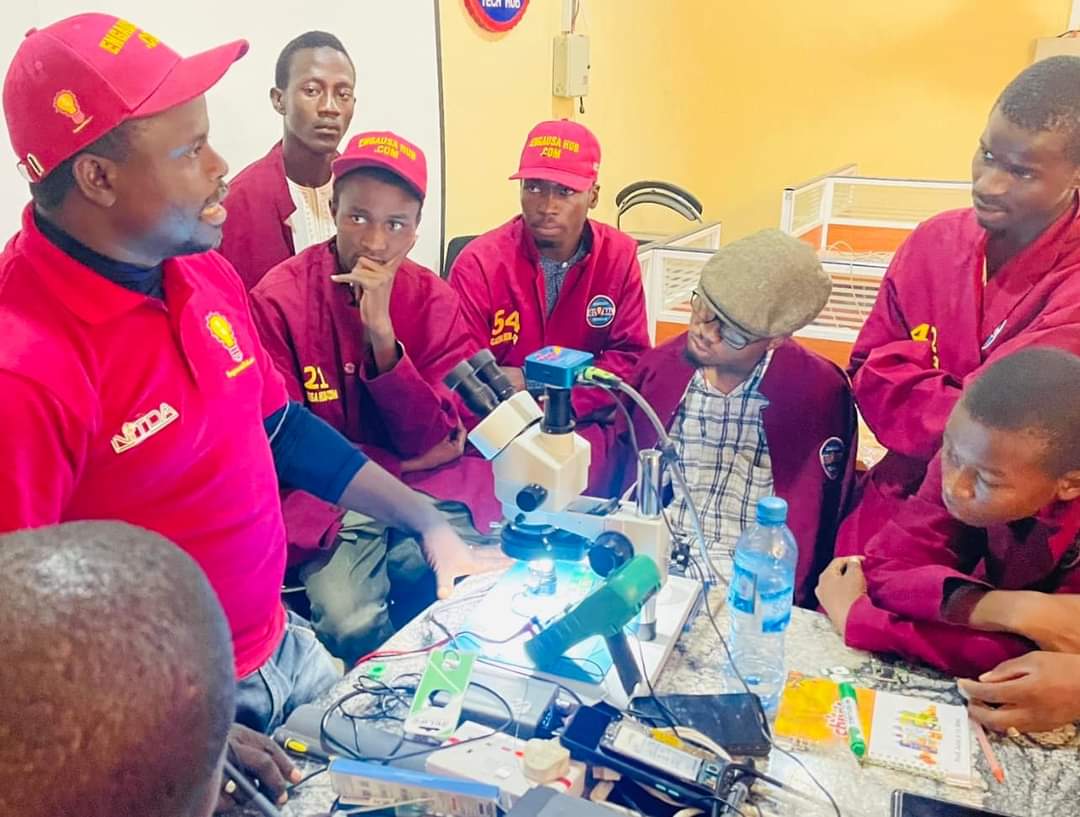
The Director-General, National Board for Technology Incubation, Engr. Dr Muhammad Jibril paid a special visit to Engausa Global Tech Hub, Kano, on September 11, 2021. The Engausa Management warmly welcomed the DG.

As the DG frequently does, the purpose of the visit was to monitor and ascertain the level of commitment of the business under the centre towards human capital development, skill development, and youths empowerment.

On his part, the Founder/CEO of Engausa, Engr Mustapha Habu Ringim, profoundly thanked the Federal Government, the Federal Ministry of Science and Technology (through the National Board for Technology Incubation) and the Federal Ministry Communications and Digital Economy ( through National Information Technology Development Agency) for providing a favourable business environment for Engausa Global Tech. Hub

The CEO noted that, if not for this elderly support and guidance from the Agencies, Engausa would not have recorded the successes so far.

Furthermore, the CEO briefed the DG NBTI about the 47 businesses harvested out by the hub and 1000 graduated apprentices powerfully trained in digital technology to bridge the digital skill gaps we have in the North and Nigeria at large.

The DG heartily applauded Engausa’s impact across the country and pledged to support the hub’s goals to cover more milestones. The DG added that they would do whatever it takes to help businesses and grow them to withstand any business tides through his office. He said that people who have business ideas, especially technology and innovation related ones, should put those ideas to work because the government will always be there to support innovative businesses like Engausa.

The DG was taken around the hub and ascertained the quality of the training tools, equipment, and bilingual education system deployed to ameliorate teeming youths’ learning difficulties.

Kannywood: consumer’s or producer’s market?

Northern Nigeria’s Hausa film industry, Kannywood, has been at the centre of brainstorming discussions over the years. One of the most interesting is why film consumers are attracted to the industry and otherwise. So often, the analysis of such magnitude is drawn concerning the industry’s foreign and domestic rivals because they provide an alternative to what the industry produces, which directly affects its local market. And like in any other industrial conglomerate, the sustainable conduct and development of Kannywood as an industry thrive on the quality, affordability and viability of its products.

As the so-called king of the arrangement, it’s impossible to conquer any market without exploring the psychological drivers of consumer’s preferences. That said, the primary concern of the teeming film consumers who boycott Kannywood movies revolves around the appeal, quality and uniqueness of storylines and whether it connects with the inner cravings of a modern watcher. A film consumer demands an illusion, one that not only tells him “this is the movie he wants to watch” but also if “it’s the one he should be watching”. An illusion that challenges his status quo creates a reception for the new order and paves the way for a route to escapism. Arguably, many people watch films to escape from their core reality. This occurs either by consuming movies that aim to rediscover an old order. Such order seeks to reflect on the current order or ones that wish to rewrite the order itself in the forms of fantasy movies, futuristic science-fiction movies, historical fiction and nonfiction movies, among others.

In the case of Kannywood, it has done reasonably well in producing movies that reflect greatly on the dynamics of the current order. But then that’s an order of which its potential consumers happen to be physically part. In which case, most of the content would appear familiar and cheap, which will bore the consumers and hand them the warranty to look elsewhere. Meanwhile, Kannywood competitors have religiously developed the culture of challenging the essence of everything a watcher stands for. This makes them more viable, even if more costly than Kannywood, because they satisfy consumer’s utility.

Interestingly, Kannywood’s content has been profiled as the one that agrees with its watchers’ demand. This is indifferent to saying the industry produces only the content which its watchers want to consume. But if that’s any good, why has the industry been economically stagnating and remain vulnerable to its rivals’ invasion? To be fair, Kannywood and its competitors aren’t of the same financial muscle. This plays a vital role in the distinction of their products. However, it is equally valid to mention that all other industries rivalling Kannywood have, at some point, been where it is today. So the most crucial point is how did they move forward?

Revenue, which is the excuse of Kannywood in comparison to its rivals, in the context of production, is a bi-product of the initial measures that a producer put in place to ensure the success of his product. That’s to say, as far as the producer has the initial capital, what happens next is dependent on him. And start-up capital is hardly the problem of Kannywood producers. The actual problem is recouping the expenses and profiting from the venture.

If indeed, Kannywood produces only the films that’ll appeal to its watchers for fear of losing revenue, then it’s vivid that the industry perceives the film market as a consumer’s market rather than a producer’s market. This is perhaps why they produce movies that watchers ‘want rather than the ones the watchers’ think they want. And there’s a big difference between the two. Failure to dissect this difference creates a dilemma that’s so sensitive; it makes or breaks the possibility of any market dominance.

For instance, the romantic, singing and dancing genres that Kannywood produce at a more regular rate is what Hausa watchers want. But the more adventurous and dynamic content being delivered in other film industries are what Hausa watchers think they want – hence they rush to. And the ability to deviate the latter from the former ensures whether a consumer illusion is created or not. Illusion is vital in production because it makes people consume something believing that it’ll satisfy their utility when it won’t. But, instead, it’ll only make them crave for more. And the more is being craved, the better is the chance of getting addicted, and that’s the trap of every capitalist producer.

Hollywood and Bollywood industries come from well-equipped capitalist societies where consumer psychology is conquered. Down there, it’s a producer’s market. Hence, the curve of their revenue never stops rising. Their movies are regularly subjected to sequels and prequels, defending what the producer wants. In the build-up to the preface of his critically acclaimed novel, “The Godfather”, the great author Mario Puzo confessed that a producer’s girlfriend could demand a movie scene to be filtered out. And the consumers would watch nonetheless. In my opinion, there’s no bigger evidence of control. Which greatly unlocks creativity and unhindered filmmaking viscosity.

Kannywood, on the contrary, produces what annihilates the utility of the consumer instead of what’ll make him crave more. Capitalist experts assert that if a consumer gets what he asks for, he’ll be satisfied. And if he gets satisfied, he’ll not need the product again. That’s why a wise producer never allows consumers to ask for products. Instead, he creates the product questions for them. And in turn, answer the questions in a way that’ll make them even more curious. Kannywood does the opposite. Producers obeying the trend of narrowly imaginative consumers is why the watchers don’t find the films as unique as the foreign ones, which is also why the industry is painfully stagnating.

To clear doubts, how the dubbed versions of foreign movies are being consumed at an equal if not higher rate than Kannywood movies in its native domain should erase any iota of doubt on film market being producer’s market rather than consumer’s. For if it was consumer’s, who researched the interest of a villager in Kano before making a movie in Hyderabad, India, that enables him to watch the film with keen interest?

In the end, movie producers need to conquer the fear of losing the market. The film market is a producer’s market contrary to their belief. Agreeing with that would be a new phase for creative filmmaking. They should sharpen and unlock their imagination to produce what watchers would marvel at. Hausa-Fulani society is rich with contents that can create consumer illusion—ranging from history, culture, geography, economy, politics, anthropology, etc.

MA Iliasu writes from Kano State. He can be reached through his email: muhada102@gmail.com.

Another cinema for Kannywood is a welcome development

By Habibu Maaruf Abdu

Since its inception, the Hausa film industry, aka Kannywood, has not been cinema-oriented. This is primarily due to the filmmakers’ lack of technology to make cinema-compliant productions and the negative perceptions of the cinemas by the industry’s immediate/target audience (the Muslim Hausa populace). Therefore, video film media (i.e. cassettes and CDs) became the cinema equivalent in Kannywood and remained its sole market. However, the industry later crashed after the scourge of piracy and the emergence of online video-viewing platforms, like Youtube, forced those video film media out of business.

Subsequently, many reputable production companies had to close shop or remain practically inactive. In contrast, some low-class and Chamama (comedy) producers kept on as their films are mostly cheaply made and targeted the masses who are less conscious of modern viewing facilities. It was until the establishment of Filmhouse Cinema at the Kano Shoprite that the film business starts sprouting up again. Big budgeted Kannywood movies, made with state-of-the-art technology, began to overflow the only multiplex cinema.

Also, as people accept and patronise the cinema more, comes a realisation of the need to enhance film shows. Thus, the industry signed a deal with some cinema owners in Kano to show some selected films during the 2018 Eid festival. However, there is a more profound development recently. Platinum, another multiplex cinema for screening Kannywood movies, was opened in Kano.

The emergence of these multiplex cinemas is a welcome development for Kannywood. We all know that it’s on the cinemas that film industries stand. If the mighty Hollywood and Bollywood, for instance, still retain cinemas as the prime platforms for releasing their films, there is no other way for the embattled yet up-and-coming film industry. TV stations and online platforms (Netflix, Amazon Prime, iRokoTV, Northflix, etc.) should be more beneficial for the audience in Diaspora, as proposed by a Kannywood scholar, Muhsin Ibrahim.

In addition, it’s high time we disregarded our anachronistic views against cinemas. These newly opened cinemas are, after all, modern and standard for all and sundry. Nor is it for thugs and whores. There is no smoking and drugs. They are multiplex, with each room having stylishly arranged rows of comfortable padded seats. They are peaceful places to get entertained and have fun in a completely different way from the open-air, single-screens we had before.

Our religious clerics should stop denouncing these cinemas. They should, instead, promote Kannywood in general for more decent and educated people to join the industry. Their bashings, often based on unfounded rumours, will never help matters. Kannywood has come to stay, and it’s better to have them in Kano, a more Islamic state, for the government to regulate their activities than elsewhere.

Finally, I emphasise what Muhsin Ibrahim suggests to our big men: instead of building a state of the art filling stations all around Kano, why don’t they construct cinema(s)? The market is there. They should conduct some feasibility research and invest in this business.

Habibu Maaruf Abdu writes from Kano, Nigeria. He can be reached at habibumaaruf11@gmail.com.

Prof. Maqari disrespects DSS’ reconciliation – lawyer

By Muhammad Abdurrahman

On July 23, 2021, Dr Abdallah Uthman Gadon-Kaya delivered a Friday sermon in one of the mosques he leads prayers in Kano State. That sermon did not go down well with Prof. Ibrahim Maqari. Thus, he appeared in a video threatening Dr Abdallah to withdraw parts of the statement, or they would meet in court. On July 26, Dr Abdallah received a letter from Prof. Maqari’s lawyers, giving him a 7-day ultimatum to withdraw those “remarks” or face legal action.

Many media organisations, including online newspapers, reported the recent development. But no media reported Dr Abdallah’s side of the story. So the Daily Reality (TDR) spoke with one of his lawyers, Ibrahim Umar Abere.

Barrister Abere told TDR that “We initially received a letter from Prof. Maqari stating that his lawyers were charging Dr Abdallah for defamation. And he was given seven days to withdraw his utterances against Prof. Maqari. If not, he must appear before the court to stand a trial.

“In the letter he sent, his lawyer said that he knew Dr Abdallah had not mentioned Prof. Maqari’s name, but it was clear to them that the things said were directly referring to Prof. Maqari. [This means they were the ones who said that to their client]. We wanted to reply to them instantly. All of a sudden, the Department of State Service (DSS) from Abuja intervened, asking the two parties to sheath their sword and that both parties should report to the DSS office in Kano for reconciliation.”

“We went to the DSS office. I was there; Dr Abdallah was there, and Prof. Maqari, represented by his lawyer, was there. They said that Dr Abdallah must go and withdraw his utterances publicly on his pulpit. We said this is impossible because what happened was that Prof. Maqari spoke, and Dr Abdallah also spoke in their sermons about the things happening. Though some clerics already asked Dr Abdallah to withdraw those remarks that some people felt were harsh. He did so and apologised to all and sundry.

“The DSS stated that they were aware Dr Abdallah had apologised to anybody who misunderstood his sermon or felt any pain. We were satisfied with that. For this, there’s no reason for Abdallah to go and apologise for the second time.

By Allah, this was what happened. The DSS personnel also reminded us that both Abdallah and Maqari have followers; therefore, unless handled cautiously, the issue might become a grave conflict. That was why we did not respond to their letter. Because we take what authority said seriously, that was how our sitting ended,” said Abere.

On August 24, a copy of a summons showing that Prof. Maqari sued Dr Abdallah in an Upper Sharia Court at Rijiyar Lemo, Kano State, trended on social media.

In reaction to that, Abere told TDR that “We have seen that. It means they disagreed with the reconciliation made by the DSS a few weeks ago. That was why they went to court. On hearing that, we had to call the DSS and told them that these people took the case to court despite the fact the dispute had been resolved. For this reason, we had replied to their letter for them to know our stand. We told them that we were also charging Maqari with defamation and other things.

“In our reply on July 30 to Prof. Maqari’s lawyers, Dr Abdallah unreservedly denied all the allegations forwarded by Prof. Maqari. We also gave the lawyers a 7-day ultimatum to withdraw some defamatory remarks in their demand letter. They call Dr Abdallah derogatory names such as liar, lawless, mischievous, reckless, heartless, penchant for hate speech, high-handed and threat to public peace. Otherwise, he [Prof. Maqari] too will face a legal battle,” he lamented.

Surprisingly, Prof. Maqari appeared in yet another video on Saturday, August 28 2021, telling the public that some prominent personalities in the country had intervened on the matter. Therefore he left the case in their hands. This means there would be no court case against Dr Abdallah.

“We have thoroughly prepared to appear before the court on September 6, 2021. All our defences and counter-charges or claims are ready. Then we suddenly saw Prof. Maqari again on social media in another video saying that some people talked to him and now the case is with them.

Does that mean he had withdrawn his charges against Dr Abdallah? If that is the case, that is now how it is done. For Prof. Maqari to withdraw his charges against Dr Abdallah, it should be in a written form. Until now, we have not received any official letter. We just heard about it on social media. People should not seriously regard what has been said on social media or in a video,” concluded barrister Abere.

The misfortune of Tsangaya students in Nigeria

By Lawi Auwal Yusuf

The Tsangaya system in northern Nigeria started more than a century ago. It is a traditional and informal system of Islamic education where male children are taken to a far place from home to memorise the Qur’an and study other religious books. This will help them to concentrate more on their studies than in the comfort of their homes. They can be seen in every part of the region, and they mostly come from rural areas and are predominantly taken to the cities, while some come from neighbouring countries.

It has taken a parallel dimension in the last decades as there has been a massive influx of these young children into the urban areas.

This rural-urban migration is exacerbated by rising poverty in the countryside, dilapidated infrastructures, unemployment, rising cost of living and a corresponding decline in the standard of living. Moreover, monetisation of the rural economy, desertification, effects of climate change and lack of social amenities worsen the situation.

Similarly, this mass movement has its repercussions on the metropolitan areas such as overcrowding, squalor housing and homelessness, poverty, the spread of diseases, starvation, poor sanitation, joblessness, criminal activities and fanaticism.

The pitiful and awful plight of these vulnerable children, including minors of about five, is very sorrowful, disheartening, and sympathetic. These oppressed kids below the legal age of responsibility and accountability roam in nooks and crannies of cities hungrily begging for food wearing tattered, shabby and ragged clothes without shoes in the scorching heat. They wander from house to house, in marketplaces, on the streets, motor parks/stations, mosques, traffic intersections and social gatherings in search of livelihood. They scavenge through refuse and garbage, looking for food and other valuable materials. These miserable children sleep on the roadsides, under bridges, marketplaces, uncompleted buildings and other unfortunate places under intense bites of mosquitoes and other insects.

Moreover, they defecate in the open as there are no toilets to use. They equally lack access to safe drinking water, prophylaxes, vaccines and immunisations that can help to prevent them against dangerous diseases.

Some of them are not much acquainted with their parents, siblings and other extended family members. They know little about their hometowns. They depart home when they are too young and are rarely visited or go home to reunite with their families, while others never return. Some years ago, I overheard one of them narrating his ordeal that there were only two rooms in their mud house. One was for the parents and the other for the children. The father wanted to marry a second wife while there was no vacant room to accommodate the bride. So he enrolled them in Tsangaya school and arranged the children’s room for her. This is why tribal and political bigots revile and vilify the Northerners on this savage and barbaric behaviour.

These filthy children are left to fend for themselves as no one cares about them. Everyone abandons them. They do not get the psychological support, love and affection of their parents and the bond of kinship ties. They live their entire unwholesome lives away from home. In addition, they also fall victim to child labour, exploitation and abuse. Hence, the teachers and other older co-students ruthlessly maltreat the younger ones and confiscate the food and money they get.

They have equal rights to benefit from the state resources and the public treasury like every citizen. They have equal rights with the children of the so-called prominent personalities, the President, governors, ministers, lawmakers and traditional rulers whose kids are taken to Europe and America to study. They also have the rights to normal life, adequate healthcare, decent shelter, and qualitative education with the requisite skills to make them marketable in the labour market and equal opportunities. Unfortunately, they have been deprived of these constitutional rights and are treated in their fatherland as sub-humans.

In their teenage, they spend much of their time on the course of their subsistence than their studies. Therefore, only a few of them receive the desired education. The unfortunate ones grow up without adequate knowledge, socialisation, professional training, and skills that necessitate them to wander the street and do menial jobs. Appallingly, some end up in theft, mugging, thuggery, drug dealing/addiction, sexual and other street offences.

It is very irritating that these vibrant, vigorous and exuberant youths are not made very productive to our nation. It vexes me to see them idle, redundant and wandering freely without a specific purpose or destination. Had they been adequately trained and made more productive to the society, they would have become professionals in different fields and therefore facilitate its development. It would have been more advanced than it is now. Sadly, all the intelligence, talent and youthful exuberance are being squandered negligently and not made helpful for their benefit and the whole society.  This is why Nigeria still lags behind its peers.

This mindlessness of the Nigerian authorities resulted in the December 1980 fracas in Kano. Maitatsine took advantage of this and brainwashed thousands of his students into extremism and fundamentalism. The conflict, which lasted for almost three weeks, put the city at an impasse and led to the loss of nearly 5,000 lives, including Maitatsine himself and enormous property worth millions were destroyed. The survived students initiated another tumultuous disturbance in the subsequent years, whereas in Bulumkuttu, Maiduguri and Kaduna in October 1982, over 3,000 lives were lost. Other riots broke out in Yola in 1984, where over 1,000 people were killed, and more than 60,000 people were displaced. And it also took place in Gombe in 1985.  

Furthermore, Boko Haram is more destructive, disastrous, and catastrophic that analysts see as an offshoot of the Maitatsine sect re-emerged with similar ideologies, putting the country in a war for more than a decade. Maiduguri has the largest concentration of these students, where you can find a Tsangaya school with thousands of students. Since the beginning of their offensive attacks in 2009, tens of thousands of lives were lost, and more than 2.3 million people were displaced, and roughly 250,000 fled to the neighbouring countries. The Global Terrorism Index declared it the world’s deadliest terror organisation in 2010. They have engaged in mass kidnappings of innocent civilians, including schoolgirls in Dapchi and Chibok and aggravated famines and food insecurity.  

The government should reinvigorate the Nigerian educational system to meet international standards. Similarly, there is a need to introduce an integrated educational system that will completely uproot the dichotomy between Islamic and Western education that will correspond with our religion and culture. A system that will give room for the memorisation of the Qur’an, Islamic subjects alongside the other conventional subjects to be acceptable to all. This was what Muslim countries like Sudan, Libya, Malaysia, Pakistan, Saudi Arabia, Egypt and many others have done. A similar provision should be put in place for Christians to be fair and just to all. In addition, primary education should be entirely free, compulsory and accessible to all.  

The governments at all levels should make genuine efforts to eradicate poverty in the villages, combat desert encroachment and revamp agriculture which will help tremendously improve the income of the rural dwellers. And also provide adequate and effective infrastructures and social amenities to make their lives better and easier.

Apart from all these, the government should urgently evacuate and return them all to their homes and enact a statute that will be strictly and rigorously enforced outlawing this incessant desertion. The legislation should also oblige the parents to be responsible for their children’s custody, supervision, and safekeeping.

There is a difference between a man and a father. The latter is a title of birth and guard. So, it is natural to take up the mandate; it is unnatural not to.

Lawi Auwal Yusuf writes from Kano, Nigeria. He can be reached via laymaikanawa@gmail.com.

Kano Drug Agency trains 80 students on quality control

Aishatu Aliyu

The Kano state Drugs and Medical Consumable Supply Agency has trained 80 students on mandatory industrial practical training at its office.

Presenting certificates at the graduation ceremony of the training, the Director-General of the Agency, Pharmacist Husham Imamiddeen, tasked the students to utilise their skills.

He said, “Amongst the responsibilities of the Drugs Medical Consumable Supply Agency is the production of qualitative and Affordable Drugs to the people of Kano State.”

The DG also stated that the Agency has a quality control unit, whereby tests were conducted before the release of drugs.

Pharmacist Imamudeen added that the students conducted their mandatory six months training on quality control, after which they were certified.

The trainees then commended the Agency for equipping them with the acquired skills and support during the training period.

Gov. Ganduje frees 3,717 inmates from Correctional Centres in Kano

By Abdullahi A Alkasim

Governor Abdullahi Umar Ganduje of Kano State frees 3,717 inmates of Correctional Centres in Kano from 2015 to 2021, all in an effort to decongest these Centres, as requested by President Muhammadu Buhari a few years back. The President urged state governors to help decongest Correctional Centres nationwide.

He made the disclosure when he received, in a courtesy call, members of the Presidential Committee on Correctional Centres Reform and Decongestion, at his office, Thursday, under the Chairmanship of Justice Ishaq Bello.

“President Muhammadu Buhari thought it right when he called for the decongestion of our Correctional Centres. Looking at the happenings in those Centres. That, we should respect life and we should have hope in our inmates,” he stated.

He disclosed that “We adopted two major strategies to answer the call of President Muhammadu Buhari, for decongesting Correctional Centres.

We put in place the Committee on the Prerogative of Mercy, under which we release inmates two times a year. All during Sallah festivities. Sallah-El-Fitr and Sallah-El-Kabir. So far we have released 3,717 inmates from 2015 to date.

We paid for them, fees they were not able to pay that landed them in those Centres. We also give them transport money after they regained freedom. We recruit some of them in the state civil service.

We are also keen on the administration of justice. Many at times it is not all about releasing those inmates, but we still have a greater percentage of those in these Centres as awaiting trials individuals.”

Justice Bello, who led the Committee, commended governor Ganduje’s “…demonstration of interest and passion when it comes to issues of justice.”

Explaining to the governor, “We have gotten into files and received cases today when over 28 people regained freedom.”

“Furthermore it is crucial to mention that with the support of the Kano state government, the Committee was able to secure the release of about 368 inmates from various correctional centres in Kano state at the of the first visit,” he disclosed.

Social media users celebrate 7th anniversary of World Hausa Day

By Muhammad Sabiu

The Hausa-speaking community on social media, especially Facebook and Twitter, is today celebrating World Hausa Day for the seventh time.

However, Nigeria’s Twitter ban early this year has reduced much of the day’s celebration on the microblogging site.

The day was first introduced and celebrated in 2015, courtesy of concerned social media users such as Jamila Kabiru Fagge, Abdulbaki Jari, Bashir Ahmad, Salihu Tanko Yakasai, Faisal Abdullahi, Ila Bappa, Maryam Ado, others. The objective was to promote the Hausa language, its development and the challenges it faces as one of the major languages in West Africa.

The day allows Hausa users to come up and post witty Hausa sayings and make corrections as to how the language is used in conformity with its orthographical rules.

Hausa is one of the most spoken languages in Africa. It is spoken in about 30 African countries, with over 100 million speakers.

The language gathers momentum each day as several renowned media organisations broadcast in it. For example, media houses like the BBC, VOA, DW, Radio France International and the like broadcast in the Hausa language.

However, some social media users lament some challenges that the Hausa language and its people face today.

For example, Nurudeen Dauda wrote the following in his article: “Our people almost regarded begging as [a] profession. All well-meaning Hausas should and or must make [a] serious effort towards discouraging our people from begging. After all, we are not the only people suffering from poverty in Nigeria. It is among all!”