Kano State

Outrage trails brutal flogging of Almajiri in Kano 

By Uzair Adam Imam 

Many people reacted with shock over a viral video showing an eight-year-old Almajiri beaten mercilessly by his ‘Tsangaya’ Quranic teacher.

The Daily Reality gathered that punishment was due to the kid’s failure to bring food to the teacher, which is an age-old practice in many Tsangaya schools.

A source told our correspondent that the kid was found roaming the street after running away from the school.

The source added that a relative brought the victim to Kano from Magamar Gumau Local Government Area of Bauchi State for Qur’anic studies after his mother’s demise.

“I don’t want to go back to the school. The teacher will kill me. I want to return to my father,” said the kid.

Begging outlawed in Kano

Kano State is becoming a haven for beggars, despite the state government’s ban on street begging and subsequent measures the government to enforce the order.

In 2019, the Ganduje administration banned street begging, introducing new approaches to improving the education of the almajiri system.

In a statement, the Chief Press Secretary to Governor Abdullahi Umar Ganduje, Malam Abba Anwar, said the effort was to consolidate the free and compulsory primary and secondary education fully.

“If an Almijiri teacher thinks he cannot accept the new policy, he has to leave the state. 

“When Almajiri are caught begging, it is not only that beggar is caught but also his parents or guardians. Such parents or guardians would be taken to court to face the wrath of the law,” the governor threatened,” the statement said.

But despite the ban, street begging has held to its position in the state, as beggars are still on the state’s streets. 

Citizens blame government 

Some people blame the government for not consolidating its position of improving the  Almajiri education system to mitigate the menace of bagging in the state.

A former president of Foundation Against Child Abuse, Abdulmalik Shu’aibu Sani, blamed the government for playing politics with the menace. 

Abdulmalik Shu’aibu said, “Government decides to play politics in handling this issue. If the government had actually banned or changed the Almajiri education system in the state, this boy wouldn’t have been beaten like a slave.”

“I believe this will surely be a joyous and celebratory idea if the government could implement the new system or at least tax parents to pay for school fees. With that money, their children will be fed.”

Amina Shu’aibu said, “I know the government will not do this. Anything about it is political.”

Some concerned citizens described the punishment as disheartening, stating that the system is not what it used to be.

Abdulmalik Shu’aibu Sani said such heartless people should be brought before the law to reap what they sow while calling on the government to take action.

He lamented that the kid was too small for that brutal beating, saying he could not take responsibility for himself and his teacher. 

Adam Zahraddeen, one of the active members of the Almajiri Foundation in the state, said that in the past, Almajiri parents paid a certain amount of money and “that money will be used to feed his child by the Malam.

“It is heart-touching to see such forsaken small kids wandering on streets searching for what to eat. 

“The government should by now end the Almajiri system of education and rethink how to reform the system. 

Amina Adamu, who said she almost cried on watching the video, stated that she felt sorry for the boy.

She said, “Seeing the picture of this boy in this situation, I feel bad, sad, and sorry for the kid. He looks so pathetic. I feel like no matter what this boy has done, he doesn’t deserve to be beaten mercilessly like this.”

We are not heartless 

Auwal Ilyas, one of the senior students at an Almajiri school in the state, said what happened was entirely contrary to what is obtainable in the system. 

He stated, “The person who did this beating was very wrong. I believe a true teacher who answers his name will not do the same. So it must be a gardi (a senior Almajiri) that committed such a pathetic and regretful thing. I know gardi used to ask for food but not Malam.

“How will a teacher ask this very small kid to bring him food? In our school, our teacher, my father, take responsibility for any Almajiri. Malam provides two square meals for them, breakfast and lunch,” Auwalu added.

Special Report: Kano witnesses more divorce than wedding

By Uzair Adam Imam

Marriage break-up is perceived as one of the major challenges bedevilling relationships in Kano State, a development that leaves a severe psychological impact on the windows. A report by the BBC Network African Programme in collaboration with the Kano State disclosed that there were over one million divorcées in the state.

The research disclosed that 32% of marriages in Kano State survives only a period of three to six months; and that many young people between the age of 20-25 years are said to have gone through three marriages at least.

The Executive Director National Association of Divorcees/Widows and Orphans, Hajiya Altine Abdullahi, decried the rate of divorce in the state. She had once threatened to protest the menace. This menacing issue of marriage break-up has continued to witness a steep increment in Kano State more recently, making it a serious problem needing mitigation.

The Daily Reality had reported materialism as one of the contributing factors militating against marriages these days.

Divorce, how abrupt it occurs

As though a competition, many husbands partake in the race for divorce. The issue has now graduated to a national problem in dire need of mitigation.

A photographer, Aminu A. Gambo, recounted the harrowing tale of how a one-week-old marriage crashed.

He said, “I once covered a wedding. The wedding took us almost a week, as they started the events from Tuesday throughout Thursday the following week and had a break on Friday.

“The events continued on Saturday and Sunday was wedding Fatiha, which concluded with conveyance of bride late evening that day.

“In the subsequent week, on a fateful Wednesday, the groom called me as early as 6 am and told me to calculate my balance and send my account number. As I did, he then transferred the amount to my account and told me that their marriage was no more,” he stated.

Also, Abubakar Umar confided in our reporter that he was rather perplexed on hearing that the marriage he attended just a week ago had broken up.

Umar said the marriage had broken up even before some relatives who attended the wedding from far places returned to their various destinations.

He added, “it came to me as a surprise that a week-old marriage had broken up just abruptly like this despite the bond between the couple.”

Understanding the root cause

Many concerned citizens argued that there are no tangible reasons behind the increased marriage dissolution.

Hashim Ibrahim described the menacing issue as a problematic phenomenon that defies every explanation.

He said, “The problem is that what triggers Mr A to divorce his wife might not be the same reason for Mr B to end his marriage.”

Muhammad Tasi’u stated that: “There are only two things that lead to the marriage breaking up; the exaltation of men and the ignorance of women.”

Aisha Mujitaba looked at the issue from a different angle, saying guys pretend to be rich in order to woo girls.

“Nowadays, both loves and marriages are based on materialism; that is how equivocation and deception have chipped in in the process of getting married.

“Guys pretend to be wealthy in order to win girls’ hearts. Consequently, when they are joined in matrimony, the true nature of what the person is will be revealed. This leads to the breakdown of relationships,” Aisha said.

Fatima Sha’aibu also believed that lying was one of the contributing factors leading to the marriage break up.

She said, “Mostly guys lie to win affections. Then after the marriage, when the truth was revealed, the girl might feel she can’t resist living with a life-faking husband.”

Law and the evil of lawyers

By Tijani  Hassan Abdulkarim

This may sound a bit controversial, but I’ve not seen a profession that promotes evil in the open like the legal profession. With the wig on, lawyers stand before the judge in defence of evildoers and plotters with a mandate of seeking their acquittal, using superior cunning arguments by looking for loopholes in the legal system and twisting the law for the sole purpose of earning monetary reward from their clients.

Doing the above is, of course, attributed to their training. I presume the training lawyers receive in the law school before being called to bar involves teaching them how to play down on their inherent personal conscience directly or otherwise. This leaves me pondering over the degree of good conscience left in the legal practitioners. Don’t get it twisted; many morally sound lawyers are equally in the profession across different chambers within the country.

Unfortunately, close discerning will reveal how the profession thrives best in deceit and feasting on the miscalculations of the appellant seeking justice before a competent court of jurisdiction.

Please permit me to cite two recent instances: one of a criminal offence and the other of a Shariah case, all in Kano State, Nigeria. We will need to pay close ear to discern how lawyers in the defence team are attempting to remodel the course of justice by dragging the cases to secure the release of the accused on all grounds.

It is no longer news that  Sheikh Abdul-Jabbar Nasiru Kabara, the controversial Kano preacher, has been charged to court by the state government for offence bordering on blasphemy according to Islamic law. However, knowing full well the gravity of the (expected) outcome of the judgement, lawyers got in to ensure the acquittal of the accused despite the volume of evidence against him.

Upon discovering the hidden antics of the lawyers who have promised to defend and clear him of all charges, Abdul-Jabbar rescinded their counsel, protesting that they were insincere to their pledge of seeking justice on his behalf. His vituperation was that the lawyers were capitalising on his ordeal to enrich their chambers through the series of legal bottlenecks they’re cracking. The infamous Sheikh opted to stand in self-defence. All this drama unfolded after his defence team’s complete assurance of being victorious at the commencement of the hearing. Though, the possibility is highly impossible.

The second scenario from the same Kano is connected to the late five-year-old Haneefa, whose teacher Abdulmalik Tanko kidnapped and murdered in cold blood. Again, the details are everywhere on the web. Therefore, it is no longer news that the culprit openly confessed on camera and before the whole public of conniving with his accomplices to commit the crime and even went further to seek the forgiveness of the mourning parents.

Fortunately unfortunate, when the case came up for mention before the court, the same accused pleaded not guilty to the charges of kidnapping, culpable homicide, and murder read against him. Guess who advised him to claim innocence after the entire nation and the international community condemned his evil action? The lawyers – his defence counsel.

I am sure it is now visible to you to connect the obvious dots between the law profession, self-centeredness, injustice, deceit and outright evil against society. It is further appalling to see that most of these legal minds who wore the mask of innocence always go with the slogan of protecting the accused from being deprived of their human rights. This beg the question of what now happens to the fundamental human rights of the victims who have been deprived of their right to life by these evildoers?

Moreover, what is the fate of the society and its members who have been thrown into a theatre of evil because evildoers have the guarantee of going free by the antics of lawyers who are trained in using the constitution for the good of themselves; nay the society.

My submission is not an over-generalisation. There are good lawyers, and the opposite ones are also in abundance. However, the current reality will require the good to rise to the defence of the common good to save the society from the evil of their colleagues. To do that, our justice system needs to be remodelled to guarantee quick justice delivery. Remember, justice delayed is justice denied.

Post Scriptum: Without prejudice, this is my sincere sentiment on the practices of lawyers who are bent on defiling the legal profession in Nigeria and the world over. This will not interrupt the fact that I admire the job and aspire to study and practice as a legal luminary, but it has to be for good.

Tijani  Hassan Abdulkarim is a graduate of Mass Communication from Ahmadu Bello University, Zaria.

Open letter to Jigawa State Governor: Before the whirlwind blow

By Umar Farouk

Your Excellency, I am writing you this letter with indubitable respect to your humble personality. Unfortunately, I am obliged to address you openly since personal access to you may be barred by your bureaucratic and routine security protocol. Hence, people like me can’t get access to meet you privately.

My joy is neither limited to the letter’s content nor the means of satisfying my professional conscience. It is rather vested in my utmost trust that you have a listening ear. It is on this that I implore that you gracefully through to be mention perception consider the actualisation of the message therein.

I, therefore, pray that this letter meets you well and that God would grant you the grace, wisdom and the presence of mind to accept this for what it is. It’s an honest attempt at giving you a perspective on handling the existential crisis facing Jigawa state and its people.

On many occasions, your administration claimed to be transparent, accountable, and respect the commoner, especially young people. I believe we have to grow beyond sentiments about those that govern us if we really want to move in the right direction, but I think your administration has performed below our expectations. 

Your Excellency, you may kindly wish to recall that the youths have been at the forefront of every struggle since the creation of this state. Also, most of the protagonists for the emancipation of Jigawa from Kano State were young people. 

Sir, youths’ trust deficit and loss of faith in you as the governor of our esteemed state is in dire need of rebuilding and assurance. I am particularly hoping you do this in earnest so that it won’t go down in history as one governor who lost his fort to secure his people out of obscurity and perpetual distrust in governance.

The younger generations have no patience for long messages; their understanding outstrips speeches and press statements lacking facts and pragmatism. They want today a vital social ideal for which to live and labour in. A system that will ensure their voices count while the equitable distribution of wealth and resources is guaranteed now and in the future.

My dear Governor, please note this, our youths, who graduated recently, are in large numbers, and many cannot find means for a decent livelihood. Many who desire to advance their education further cannot do so. Many of them, due to pressure, fall prey to employment scammers. The challenging life experience pushed many into drug peddling, organised groups engaged in stealing and all sorts of crimes. 

It would be a great thing if His Excellency’s administration would avoid lip service to youth’s plights but work concretely with them, not just with celebrities and most opinionated social media activists alone. We must also not forget to accommodate the army of young people that do not possess any skill and therefore would not fit into any formal employment description

The resourcefulness of Jigawa youths is enormous, of which I know your Excellency is very much aware of going by the information at your disposal as our governor.

About 65% of our population are young people between 18-42. Therefore, the need to invest heavily in developing this energetic group can never be overemphasised. Therefore, youth empowerment and development should have been the cornerstone of your administration. 

Your Excellency, after the end of your first term and second year into your second and final term, many believe you have not done well on those matters, and others think you can do better. The unemployment rate in Jigawa is simply worrisome and should not be taken lightly. Furthermore, the NBS reports for three consecutive years have shown we are not doing well in job creation.

I am, however, aware of the various intervention measures your administration has initiated to engage our young people in gainful ventures. Still, they are a far cry from addressing the hydra-headed problem. They need more opportunities to discover their capabilities and an encouraging environment to grow and innovate. For this reason, the government needs to develop initiatives to train and retrain the youth and create awareness about new and emerging fields of entrepreneurship. 

Sir, Your top aides, political leaders within your party and your friends may not tell you the truth even when they complain bitterly within their closets and are quietly compiling a list of your sins they will use against you at the appropriate time.

You must understand that a leader who takes delight or cares less about his people’s disturbing condition is not worth being called a leader. Jack Welch said, “Great Leaders love to see people grow. The day you are afraid of them being better than you is the day you fail as a person” John Maxwell added that “Leaders become great, not because of their power, but because of their ability to empower others.”

Sir, this clamour is not in any way aimed at attacking you, as I remain ruthless in our support to ensure the State of Virtues rise above the shackles limiting it to a desirable standard that places it in the heart of all and sundry, but it’s just as important to speak against the repression of this sort, as I believe and stand convinced that the price of unflinching loyalty shouldn’t be undue abandonment. 

Mr Governor, have my best wishes as you reform and initiate programmes and policies that have positive effects on our State and people. 

Best wishes. Thank you.

Umar writes from Jigawa, and he can be reached via umarrfarouk2015@gmail.com

The untold story of Kano’s special education school (I)

By Aminu Adamu Naganye

Established as the centre for juvenile delinquents in 1958 and later converted to Special Education School in 1977, it is Kano’s premier and most important school for Persons with Special Needs from Kano and beyond. In part one of this special report, the Daily Reality reporter, Aminu Adamu Naganye presents the general condition of school from classes, furniture to hostels. And how the shortage of learning materials hampers the learning process of the students.

PICTURE 1

Approaching of classrooms in the junior secondary school section of Kano Special Education School, Tudun Maliki, The Daily Reality observed how a teacher was trying hard to obviously settle a fight between two hearing-impaired students. “Judging and settling fights are a daily routine here,” said a smiling teacher who likened their work to that of judges.

Special Education School, Tudun Maliki, Kumbotso Local Government Area of Kano state is a combined boarding school with multiple sections or parts serving the educational needs of persons with special needs (disability) from different parts of Nigeria.

Established prior to Nigeria’s independence in 1958 as a centre for keeping juvenile delinquents, it was later transformed into a school for hearing and visually impaired pupils in 1977. At the inception, the special school “started with four (4) visually impaired students and seven (7) teachers.”

“There are currently about 1500 pupils and students comprising both male and female from different parts of Nigeria,” said our tour guide who teaches at the secondary section of the school. “It has a primary section, junior secondary and senior secondary sections” he added.

“Special Education School Tudun Maliki is a sort of a unity school because its students aren’t only from Kano state. It is a kind of unity school because we have students from all the neighbouring states such as Jigawa, Kaduna, Katsina, and Bauchi. We have students also from Yobe, Taraba, Abuja and even Lagos we have students from there… there are students from different places in this school” narrated a teacher while briefing an NGO team that distributed items to the students.

Although the school director and teachers do not entertain journalists in the school for apparent fear of possible backlash from the authorities who often deny or trivialise the problem, the school accepts NGOs who support the school with learning and teaching materials in addition to supporting the pupils with detergent and laundry stuff. TDR relied on an NGO’s visit to file this report.

It can be recalled that recently the school became a public sensation, especially on social media when some visitors posted dilapidated conditions of the students’ toilets which prompted the Kumbotso Local Government Chairman to come to their rescue by renovating one toilet and constructing another in the school; another philanthropist also built a toilet for the students as shown by a teacher. 

Although there are other special education schools at the primary level for the persons with special needs in Kano, this particular school is actually unique as it allows them to culminate into senior secondary school. “There are primary school sections of this type established by some metropolitan LGAs in Kano. So after their primary education there, they come here to continue to secondary school” said a teacher.

Dilapidated classrooms and hostels, in need of renovation

Considering the fact that there are few special education schools of this type that impart knowledge to persons with special needs in the state, it is expected that this very school should have standard classrooms and hostels for this unique breed of students. However, classrooms at the school were anything but befitting for learning and teaching. “It is not conducive for learning and teaching the state of the classrooms, especially the primary section,” said a teacher, “there are no seats in the classes, and the students sit on a bare floor. The windows and even the doors to the classes are all broken” narrated the teacher as he ushered our reporter into primary six class.

PICTURE 2

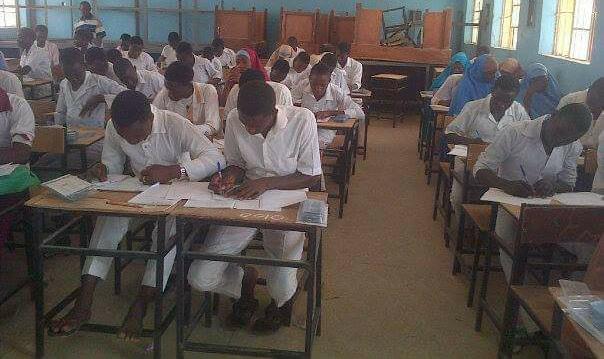
The sign language/gesture with which they greeted our reporter tells the fertile minds, hearts and brains eager to learn and expand frontiers of knowledge not just in the hearing impaired community but also in the larger society. With their complete white uniforms, the hearing-impaired pupils look dirty and untidy for obviously having constant contact with bare floor due to the absence of desks and chairs in the class. What is startling is the apparent joyous and smiling faces of these innocent souls full of hopes and dreams as they welcome us into their supposedly learning vicinity. In most of the primary school classes, there was no single chair or desk for the students’ learning convenience. In a class where few desks were available, they were broken and not convenient for sitting, writing and learning. “That is how all of us manage the situation. The teachers and pupils are doing their best in this environment,” said one teacher.

Passing through the students’ hostel blocks, the story is the same. The sorry condition of the dormitory is visible from any angle. Most of the windows are broken and the doors are not any better. “It is terrible when it is very cold because the windows as you can see are broken,” said the teacher in whose company our reporter moved around the school. Similarly, it is terrifying the condition of both the hostels and the beds for the students; the beds are grossly inadequate, leaving many students to sleep on the floor with mattresses alone due to a shortage of bunk. The teacher guide said they pity the students, especially in cold weather but there is nothing they could do personally to help the situation.

Despite our reporter’s inability to get into the hostels but peeping through the broken windows reveals their dilapidated conditions ranging from shattered windows, scratched and cracked walls to badly spoiled ceilings.

A teacher whose identity could not be revealed appealed thus “Government owns the school and it’s doing its best. But I still call on the government to do more. I also call on NGOs and affluent people to come and help, to support government efforts. There are a lot of things to do here. A lot of problems to solve especially in classrooms because you can’t learn in an unconducive learning environment. As you have seen in the primary section of the school, they sit and learn on a bare floor. There are no seats. The windows are broken”  

“We need additional hostels. There is a shortage of even beds. Some students are sleeping on the bare floor of course with either a mattress or mat. We have a lot of students but the accommodation isn’t enough. We need both bunks and a hostel block. Especially during cold weather. If you check the hostel, they need to be renovated. But as the saying goes a ‘single tree cannot make a forest.’ “We hope people and organisations should come and support the government,” he added.

Dearth of teaching and learning materials

The peculiarity of the kind of students of the Special Education School requires unique learning instruments to impart knowledge to them successfully. Although it was relatively easier to teach hearing-impaired students using sign language, a blackboard and chalk-like conventional students, it is more challenging to teach visually impaired students how to write and subsequently read their writings. A teacher corroborated this when he said, “Honestly, we don’t have the material for teaching and learning on the ground…if you take the hearing impaired students there is a little problem because they use learning materials like everyone such as chalk, blackboard, textbook etc. Even though we don’t have textbooks but their parents buy for them.” 

But for the visually impaired students, he explained that “That is where we have a very big problem. Previously, NGOs used to bring learning materials. Now they don’t bring such things. And their (visually impaired) learning materials are expensive, especially if you want to enrol them in primary school you have to buy what is called “slate and stylus” which currently cost around N10, 000. And this slate and stylus is a must if you want your child to study because it is the first learning instrument. So some parents because they cannot afford to buy such material, prefer to keep their children at home and refuse to enrol them in school.”  The teacher however acknowledges that the government supplies exercise books for the students.

TDI came to the rescue, donates hundreds of textbooks

As part of its effort to support and empower adolescents, a Kano-based NGO called Teens Development Initiative (TDI) made a commitment to addressing some of the challenges in the school, especially on learning materials.

Fadhila Nuraddeen Muhammad, Founder and Executive Director, of TDI, told the Daily Reality that they are currently working with the school authority to establish a library for the school. She said they discovered that science-based subjects were not taught in the school because of the absence of instructional materials but the students were eager to learn, hence their commitment to support with the necessary materials, especially textbooks.

She said TDI donated about one thousand books to the school that will be put to the library to make it functional.

“We have already delivered the books to the school. We are planning to raise some funds for the shelves in the library,” she noted.

Our students don’t starve, they have nutritious meals

Despite the challenges confronting the school, the students are not left to starve as one of the visually impaired students revealed. The student, Abdullahi Adamu, confirmed that: “They give us food in the morning, in the afternoon and at night.” In the same vein, a teacher in the school told our reporter that “They get good food here. Some of them cannot get what they get here in their parents’ houses. They are served three meals, three good meals a day. The government provide their breakfast, lunch and dinner. Some of us as their teachers cannot afford what they are being served in our houses.” Another teacher explained further: “In their breakfast, for instance, they are served bread, tea and egg. In the afternoon, they are given food with chicken. It is not everyone that can afford that nowadays. Every Wednesday, they eat a fish meal. In the past, after every two weeks, cows used to be slaughtered. They hardly eat food without meat.”

To be continued in part (II)

Are you wasting time or wasting data – or both?

By Engr. Mustapha Habu Ringim

There is a significant thing for university students doing nothing at home, in their neighbourhoods, or going from one town to another town. Still, some of these students just waste their precious time on social media, which can be described as a “waste of data.” Thanks to the students’ lack of the mindset to learn a skill or handwork.

Learning skills will benefit them even after graduating from university. Therefore, the fruitful result is that they will become employed or employers, instead of moving up and down looking for an even non-existent job, just like everyone following events in Nigeria knows today.

Engausa Global Tech. Hub hereby welcomes all enlightened students who have realised that we are now in the age of “Digital Technology”. Thus, because we know of such challenges and joblessness, we established EngausaHub.com, whose main aim is “Breaking Barriers and Bridging Gaps.”

Before suspending the ongoing ASUU strike, students can gain a lot. And even afterwards, what they must have learnt will benefit them, in and outside the university. In fact, it’s ridiculously unwise for a young person not to have where he acquires a modern skill or handwork. Otherwise, he would just be going to the university with an empty pocket, with nothing to buy anything they desire.

The universities themselves should have skills acquisition centres because it has become pervasive for graduates—sometimes, including master’s and PhD holders—to finish school and never get a job. They would just “enmesh” themselves in the so-called “Labour Market” without any fruitful result in the end.

Hence, I advise the ASUU, federal and state governments to establish vocational training centres in our universities and other tertiary institutions. Most of these sustainably developed countries also adopted this same method of getting exceptionally good young people. The Vice-chancellor of Skyline University, an Indian, confirmed this assertion to me when he recently paid us a familiarisation visit at ENGAUSA HUB. 

We seek Allah’s guidance.

Engr. Mustapha Habu Ringim is the Founder/CEO Engausa Global Tech. Hub, Kano. He can be reached via ringims@gmail.com or 070383224643. Their websites are www.engausahub.com and www.chosenglobalech.com.

ASUU Strike: Students protest in Kano, other cities

By Uzair Adam Imam

The National Association of Nigerian Students (NANS) has stormed Kano State roads to protest against the ongoing nationwide strike by the Academic Staff Union of Universities (ASUU).

The association that has frowned upon the incessant strike in the country is protesting to tell the world the situation they are facing in the country regarding their education.

The students who converged on the Kofar Nassarawa bridge in Kano City decried over delays in academics.

Singing solidarity songs against ASUU’s action with their hands clinking placards, the students said the menacing issue of the strike should by now be put to an end.

They also called on the federal government to intervene and call off the strike.

Recall that the Vice President of the Union, Comrade Yazid Tanko Muhammad, disclosed their intention to protest on Monday.

Comrade Yazid added, “So, it is a protest which, if we start, will not stop until the issues are resolved, and the lecturers resume work.

Kano Emir calls on Katsina counterpart for closed-door meeting

By Uzair Adam Imam 

The Emir of Kano, Alhaji Aminu Ado Bayero, has called on his Katsina counterpart, Alh. Abdulmumini Kabir Usman, this afternoon for a closed-door meeting.

Reports disclosed that the meeting, which started at 12:30 pm at the palace of the Katsina Emir, lasted for more than one and half hours.

Although the details of the meeting were not made public at the time of filing this report, there were speculations that it was about the resignation of Wazirin Katsina,  Prof. Sani Abubakar Lugga.

Recall that Prof Lugga signed his resignation after responding to the query by the Katsina State Emirate Council over statements he made about the menacing security challenge in the North.

Lugga, in a statement to the Katsina State Emirate Council, argued that he did not speak on the matter on behalf of the emirate council but as a citizen of the country.

2023: Kano South Forum endorses Alhassan Rurum for governor

By Uzair Adam Imam

With the 2023 general election approaching, the Kano South Concern Citizens Forum (KSCCF) has called on Alhassan Rurum to succeed Governor Abdullahi Umar Ganduje in the state.

A communiqué issued to journalists on Sunday by the forum immediately after its sitting in Kano disclosed the endorsement.

The chairpersons of the forum, Sen Masud Eljibrin Doguwa, former Senator Kano South and Alhaji Musa Salihu, said Kano South deserves a fair share of the exalted political post.

They also stated that the Kano South has a vital role to play in building Kano State, saying the zone is ready to give its best for the purpose.

Rurum is a former speaker of the Kano State House of Assembly during Ganduje’s first tenure and is currently a member representing Rano, Kibiya and Bunkure Federal constituency and the Chairman House Committee on pension.

The forum had also endorsed Hon. Kawu Sumaila for Senator Kano South and Hon. Alhassan Ado Doguwa to be re-elected as the Member Tudun Wada/Doguwa so that he will have a chance to become the Speaker of the house.

Also lamenting, the from stated that Kano South has not had a chance to produce a governor for the state since 1992, saying, “Kano South has largest local government councils among others in Kano with 16.”

Alh. Musa Salihu said, “Kano north and Kano Central produced governors. In 2023 the governorship position should be zoned to Kano South for it to have a fair share of the exalted political post.

“We, therefore, endorse Alhassan Rurum for governor in 2023 to succeed Governor Abdullahi Umar Ganduje.

“And since we are basing our argument on competency, Hon. Kawu Sumaila should be elected Senator Kano South and Hon. Alhassan Ado Doguwa be re-elected as the Member Tudunwada Doguwa so that he will have a chance to become the Speaker of the house,” he added.

However, the sitting that hosted many important personalities said the forum would soon convene a meeting with the endorsees to tell them their position.

Harmful effects of skin bleaching

By Tijjani Muhammad Nura

Bleaching has been in practice for a long time worldwide. However, it doesn’t specifically side with one gender, although women are more than men. Nonetheless, in a report referred to by the World Health Organisation in 2016, Nigeria was reported as the country with the highest number of women that bleach their skin in the whole of Africa. 

While there is no reliable data to confirm which state bleaches the most in northern Nigeria, we cannot deny that Kaduna, Abuja, Taraba, and, most importantly, Kano will top the list in Nigeria. In addition, a few Nigerians are naturally light-skinned, while some are naturally raven. To this end, bleaching is more prevalent among women than among men.

In (northern) Nigeria’s meaning of the word “bleaching,” it’s a process where people apply skin-lightened products to their skins, regardless of the route through which they are administered, intending to change their complexion or skin colour to impress or comfort themselves. From most people’s viewpoints, this bleaching as a thing is influenced by the victims’ desire to impress and attract attention to their opposite gender, from women to men and men to women.

Bleaching products are available in different forms, and some come in the form of creams, oils, serums, and lotions. It still comes in tablets, and some bleaching products are also available in injectable form. The lightening creams encompass a broader spectrum of products designed to bleach and lighten the skin. The effect occurs by targeting cells producing melanin, thereby reducing its functions. The majority of the creams are made available to treat abnormal conditions like acne scars on the skin, not for bleaching the skin.

However, many users are ignorant of the damaging effects of the products on their health. They are dangerous to their skin and a threat to their health in general by affecting the functions of the kidney, liver, and immune system because they work by reducing a pigment called melanin in the skin.

Most bleaching products have an active ingredient called mercury, making them more dangerous because mercury is a toxic agent that can cause serious psychiatric, neurological, and kidney problems. In addition, pregnant women who use a skin lightener with mercury can pass it to their unborn children.

Nonetheless, there are several healthy ways to maintain healthy skin. And that includes avoiding using bleaching creams, using baby’s soap that does not damage the skin, using moisturizing creams during the harmattan seasons. Other ways involve applying sun creams that can boost skin protection from the sunny sun, drinking enough water daily, eating well-balanced food in its diet, and stopping applying perfumes to the skin. These, among others, would help maintain good, healthy, and super bright skin.

With all the above being said, this article aims to notify people about the dangers associated with using creams or any other bleaching products to bleach the body, especially the facial skin. It, therefore, aims at calling the attention of parents to caution their children to avoid it or order them to immediately stop using it if they have already started using it.

Tijjani Muhammad Nura holds a bachelor’s degree in Pharmacology. He writes from the Hardawa district of Bauchi State and can be reached via tijjanimnura@gmail.com.