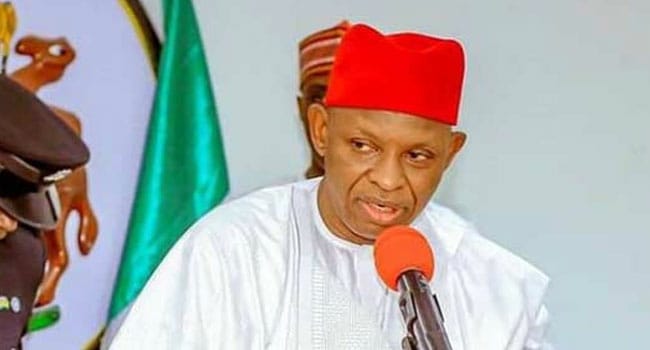
The Deputy Senate President, Barau I. Jibrin, has received prominent members of the Kwankwasiyya Ulama Forum and other political groups into the All Progressives Congress (APC).
Jibrin, in a post on his verified social media handle on Saturday, announced that Malam Yahaya Abdulkadir Aliyu, Secretary of the Kwankwasiyya Ulama Forum, alongside 23 executive members, had officially joined the APC.
Similarly, Mahbub Nuhu Wali, a relative of Kano State Governor Abba Kabir Yusuf, also defected to the ruling party.
During their Friday visit to Jibrin at the National Assembly, the new APC members removed their symbolic red caps associated with the Kwankwasiyya Movement.
From his office, they accompanied him to the A-Class Event Centre, where they joined a coalition of Atiku Abubakar’s 2023 election support groups from across the 19 Northern states.
Following the event, APC National Chairman, Dr. Abdullahi Umar Ganduje, formally welcomed the defectors into the party.
Among those who joined were Mahmoud Salisu Gwale and Farouk Ahmed Gwale, two chieftains of the New Nigeria Peoples Party (NNPP) from the Gwale Local Government Area of Kano State.
While welcoming the new members, Jibrin reiterated his commitment to serving the people of Kano North Senatorial District and beyond, regardless of political affiliations.
“As Deputy Senate President, I want to emphasise that I’m a senator for all. Regardless of your political affiliation—whether PDP, LP, Kwankwasiyya, or APGA—I am here for you.
“My doors are open to all. If you wish to join our party, the APC, the people’s party, you are welcome. The more, the merrier!” he stated.
Kano State Governor, Alhaji Abba Kabir Yusuf, has urged the State House of Assembly to prioritize laws that promote significant development and improve citizens’ well-being. This call came during a special breakfast meeting with members of the State and National Assemblies from Kano.
In a statement by his spokesperson, Sunusi Bature Dawakin Tofa, Governor Yusuf emphasized the need for collaboration between the executive and legislative branches to enhance governance and address challenges in infrastructure, education, healthcare, and security. He urged lawmakers to align their agendas with the administration’s vision for a prosperous Kano.
Speaker of the Kano State House of Assembly, Rt. Hon. Jibril Ismail Falgore commended the governor for his commitment to inclusive governance and cooperation with the legislature. He highlighted the recent signing of a ₦719 billion appropriation bill for the 2025 fiscal year, reflecting the governor’s dedication to enhancing education and healthcare.
Also attending, Hon. Hassan Hussain, representing the National Assembly Caucus of the NNPP, noted that Kano representatives are actively facilitating strategic constituency projects to boost development.
The meeting provided a vital platform to discuss governance and strategies for accelerating development in Kano State, with a strong commitment from all parties to work collaboratively for the benefit of the citizens.
For some weeks, I had been involved in judging a photo competition themed “Spirit of Kano”. One way or another, I was made the “Chief Judge” by the Curator, Dr. Shuaib Sani Shuaib, Executive Director, Makuba Center for Arts and Culture, Kano. He is also the Curator for Global Shapers Community, Kano Hub. Overall financial support was also provided by Engr. Anas Yazid Balarabe, who is also the founder of the cooperative.
As an amateur photographer with a deep and intense interest in art and the aesthetics of the environment, coupled with a fanatical advocacy for the best State on this side of the Milky Way Galaxy, I was honored to be appointed the Chief Judge. However, since it was an open competition and open voting, I designed the judgement criteria for the photos,which were used to judge the 100 or so entries by other judges. Photographers were urged to send pictures that, in their view, capture the “Spirit of Kano”. Many people participated, and many photos were sent.
These entries were beautifully shot and captured the Spirit of Kanawa and Kananci. They were all beautiful. However, I judged them based on what the images conveyed about Kano in various visual ways—history, architecture, food, clothing, urban life, historiography, etc. For me, choosing the best three was really difficult because there was so much beauty and talent in each photograph—faces, places, spaces. The entire collection was a riot of colorful visual poetry that describes Kano.
Each picture in the entries has unique features and communicates the dynamism of both urban and rural Kano. Thousands of words could be woven around each picture that communicate the vibrancy of Kano. My selection cuts across history, trade and lived-in experiences. I would have loved to see some architectural shots – the ones I saw were mainly Emir of Palace pictures (Ƙofar Kudu or thereof). A few shots of ‘mansions’ and ‘haciendas’ would have given an evolutionary trajectory of the Spirit of Kano, in addition to the alleyways and gidan kara.
Four judges trudged through the 100 or so entries and made their choices. These were then further pooled by common choice from each judge to pare down the selection to six, on which the final judgment of three was made. To ensure a fair and transparent selection process, the top three winners were chosen based on a combination of judges’ evaluations and public voting. The final ranking was determined by taking an average of the judges’ scores and the public vote ranking in which the winners emerged. Very transparent. Further, everything was done online.
The final judgment of the top three (shown here) truly deserves it. The winners, based on the highest scores, along with their prizes, were:
1- Muhamad Sani Abbas (₦250,000)
2- Alamin Mohammed (₦150,000)
3- Aisha Suleiman Halili (₦100,000)
Muhammad Sani Abbas’s best picture was of a young greengrocer measuring a customer’s order in a local market. The intensity of his face captured everyone’s imagination and admiration. The photo of the boy is a bookmark on Kano and its commerce—never too young to start. It was indeed a beautiful shot.
Alamin Mohammed took second place. Interestingly, the picture also shows another young lad galloping on a horse in full ‘royal’ regalia. Frozen in time, the horse rider captures Kano’s ancient tradition and royal heritage.
Third place went to a composite study of the Kano Emir’s palace guards (Dogarai) from a truly sensitive POV. The winner, Aisha Halilu’s portrait of a shadowed Dogari, makes the maximum use of light and shadows to accentuate the beauty of the setting. The Dogari, with his back to the camera, clearly was not the focus of the shot but the far houses he was gazing at—a contrast between the traditional Hausa architecture of the palace and the post-modern bungalows he was gazing at.
A picture by Ahmad Sufi, which I voted for, did not win, but that’s alright; after all, it was aggregate scores that mattered. I didn’t place it number one, but I had expected it to be at least number three. The outcome only highlights the high quality of the visual appeal of the photos entered in the competition.
The one that did not make it on my list was a market scene with an Arab (at least the guy looks like an Arab but dressed in Babbar Riga) holding on to a camel. Far in the distance is a communication tower. To me, the pictures talk volumes about migration, cultural adaptation, trans-Saharan road networks and contemporary communication – all visually encapsulating what Kano has been for centuries and those to come.
I think it is wonderful that an NGO of young, committed individuals could come up with this. It should be the purview of the Kano State History and Culture Bureau. A letter was sent to the Kano State Government requesting partnership/sponsorship, but there was no response at all. Even the prize money was sourced by Dr. Shuaibu, showing a commitment to Kano far greater than many of us.
What could the next steps be? Perhaps an annual event? Or a regionalisation of the competition? For instance, it would be fantastic to see the “Spirit of Zazzau”, followed by Rano, Daura, Katsina, Gobir, and so on, all the way to Niamey. This way, we could have an annual Spirit of Hausa Kingdoms as visual poetry, encouraging young people to appreciate the historical, cultural, and aesthetic qualities of their environment.
On Sunday, the Deputy President of the Senate, Senator Barau I. Jibrin, distributed 61 cars and 1,137 motorcycles to leaders of the All Progressives Congress (APC) in Kano State.
The distribution, held at Meena Event Centre on Lugard Road near the Kano State Government House, was attended by key party stakeholders, including the APC National Chairman, Dr Abdullahi Umar Ganduje.
The vehicles and motorcycles were allocated to party chairmen in the 44 local government areas and 484 wards of the state as part of efforts to strengthen the APC’s grassroots structure.
Speaking at the event, the Kano State APC Chairman, Abdullahi Abbas, lauded Barau for consistently supporting the party since the New Nigeria People’s Party (NNPP) took over the state in 2023.
He emphasized that ahead of the 2027 elections, aspirants would be assessed based on their contributions to the party’s development.
Similarly, the Chairman of the House of Representatives Committee on Petroleum Resources (Upstream), Rep. Alhassan Ado Doguwa, expressed confidence in the APC’s resurgence, predicting that the NNPP would be defeated before 1 p.m. on election day in 2027.
In his remarks, APC National Chairman Dr Ganduje commended Barau for the initiative, describing it as a step towards consolidating the party and improving the livelihoods of its members.
He also highlighted the increasing defections from the NNPP to the APC, suggesting that the opposition party’s influence in Kano was waning.
Senator Barau, while addressing the gathering, described the empowerment initiative as just the beginning of a broader program targeting various sectors, including youths, students, farmers, women, traders, and clerics.
He reaffirmed his commitment to expanding the initiative and urged continued support for President Bola Ahmed Tinubu’s administration.
He noted that Tinubu’s policies were beginning to yield positive results, citing the gradual reduction in fuel prices, stabilization of the Naira, and improvements in food prices.
“This is just the tip of the iceberg. We will empower all spheres of society. Let’s continue to support Mr. President for the success of his programs,” Barau said.
The Federal Road Safety Corps (FRSC) Kano Sector Command has intensified efforts to curb the dangerous practice of mixed overloading of trailers with goods, animals, and human passengers.
It was gathered that the initiative aims to enhance road safety and prevent fatal crashes resulting from unsafe transportation practices.
In a statement on Friday, FRSC Kano Public Relations Officer CRC Abdullahi Labaran disclosed that the sector command, led by Sector Commander CC UM Masa’udu, in collaboration with the Nigeria Police Force, conducted a special public sensitization campaign on February 20, 2025.
The exercise took place along Kano-Maiduguri Road, near the Muhammadu Buhari Interchange Flyover, Hotoro, from 4:00 PM to 6:00 PM.
The campaign was prompted by the tragic road crash on February 13, 2025, at the same location, which claimed 23 lives and left 48 others injured.
Investigations revealed that the accident was caused by a dangerously overloaded trailer, a practice that significantly increases the risk of fatal accidents.
During the sensitization exercise, CC UM Masa’udu warned drivers, transport operators, and stakeholders about the severe dangers of mixed overloading and emphasized the need for strict compliance with safety regulations.
He reiterated that the FRSC will not tolerate traffic violations that put lives at risk.
The campaign was attended by representatives of key transport unions, including the National Association of Road Transport Owners (NARTO) and the Road Transport Employers Association of Nigeria (RTEAN), who pledged their commitment to raising awareness among their members and ensuring safer road transport practices.
The FRSC Kano Sector Command reassured the public of its continued efforts to promote road safety awareness and strict enforcement to prevent further tragedies.
It urged road users to cooperate with authorities and adopt safer transportation practices for the well-being of all.
In a generous move to support education, AA Rano, on behalf of himself, his family, and the AA Rano Group of Companies, has announced a donation of ₦150 million to Bayero University Kano (BUK).
“We are confident that the university will utilize these resources to enhance its academic performance,” AA Rano stated.
The donation comes just days after BUK conferred an honorary doctorate on AA Rano in recognition of his philanthropic contributions to the state and the country.
University officials have expressed gratitude for the donation, noting that it will significantly impact academic and infrastructural development at the institution.
Kano State Government has inaugurated a High-Powered Committee to profile and regulate Non-Governmental Organizations (NGOs) and donor organizations operating within the state. The move aims to ensure transparency, accountability, and alignment with the state’s development priorities.
Speaking at the inauguration, the Secretary to the State Government (SSG), Umar Faruk Ibrahim, emphasized the crucial role of NGOs in sectors such as health, education, and governance. However, he noted growing concerns about unregulated activities, necessitating a structured oversight framework.
The committee has been mandated to profile all NGOs and donor organizations, investigate their funding sources, assess their activities, and recommend a regulatory framework. It has also been granted the authority to suspend or shut down any organization found engaging in suspicious or unauthorized activities. Additionally, it can escalate cases to security agencies for further investigation and prosecution if necessary.
The committee is chaired by Comrade Ibrahim Abdullahi Waiya, the Commissioner for Information and Internal Affairs, with Mallam Tijjani Auwal, the Commissioner for Religious Affairs, serving as Vice Chairman. Other members include key government officials, security agencies, civil society representatives, and religious groups.
In his remarks, Waiya assured that the committee would carry out its mandate with diligence and fairness to ensure NGOs operate within legal and ethical boundaries while contributing to Kano’s development agenda.
The committee is expected to work closely with stakeholders to enhance transparency and accountability in the operations of NGOs and donor organizations in the state.
Popular Kannywood actor Mustapha Badamasi Nabraska has defected from the New Nigeria People’s Party (NNPP) and the Kwankwasiyya Movement to the All Progressives Congress (APC).
Senator Barau Jibril, representing Kano North, announced the defection on social media, revealing that Nabraska visited his residence in Abuja, where he symbolically discarded his red cap—an emblem of the Kwankwasiyya Movement. Senator Ibrahim Lamido (Sokoto East) and Political Adviser Hon. Yusuf Tumfafi were also present to receive him.
Nabraska, known for his shifting political allegiances, previously worked under the APC-led government of former Kano governor Dr. Abdullahi Umar Ganduje. However, after the NNPP’s victory in the 2023 Kano governorship election, he switched sides, only to return to APC now.
The actor’s latest move has drawn mixed reactions. Many social media users mock his frequent party changes, suggesting they are motivated by personal gain rather than ideology.
Bayero University Kano (BUK) celebrated its 39th Convocation by conferring Emeritus Professorships on Professor Garba Dahuwa Azare, Professor Julius Afolabi Falola, and Professor Musa Borodo for their significant contributions to academia.
The ceremony featured President Bola Ahmed Tinubu, who was represented by Minister of State for Education Professor Suwaiba Ahmad Sa’id. Before her appointment, Sa’id was also a member of the Bayero University, Kano, staff.
Tinubu congratulated the honourees and graduates, emphasised the importance of education in fostering national progress, and assured ongoing support for the education sector to boost global competitiveness.
BUK Vice Chancellor, Professor Sagir Adamu Abbas, praised the awardees as influential figures in shaping the nation and celebrated the graduation of 3,400 students, including 176 who achieved First Class Honours.
Pro-Chancellor Dr. Nasiru Yusuf Gawuna encouraged graduates to become ambassadors of the university, noting BUK’s recent ranking of 43rd among African universities. The conferral of Emeritus Professorships reaffirms BUK’s commitment to honouring excellence in education.
The European Parliament has passed a resolution condemning the continued detention and possible execution of Nigerian singer Yahaya Sharif-Aminu on blasphemy charges. The resolution, adopted on Thursday, urges the Nigerian government to immediately release Sharif-Aminu and abolish blasphemy laws that violate human rights.
Sharif-Aminu was sentenced to death by an Upper Sharia Court in Kano State on August 10, 2020, for allegedly composing a song with lyrics deemed derogatory to the Prophet Muhammad. His trial was conducted without legal representation, and his family has reportedly faced harassment and persecution since his arrest.
Although the Kano State High Court ordered a retrial in January 2021 and later upheld by the Court of Appeal in August 2022, the constitutionality of Sharia-based blasphemy laws was affirmed, raising fears that the death sentence might still be enforced. His appeal to the Supreme Court, filed in November 2022, remains pending.
The European Parliament highlighted that Sharif-Aminu’s health is deteriorating due to inadequate access to food, clothing, and medical care while in detention. The resolution calls for his unconditional release, guarantees for his safety, and an expedited and fair appeals process at the Supreme Court.
The Parliament further criticised Nigeria’s blasphemy laws, stating that they contravene international human rights commitments, the African Charter, and Nigeria’s own constitution, which upholds freedom of expression and religion. It also highlighted that blasphemy accusations frequently lead to mob violence and extrajudicial killings, putting religious minorities at risk.
In addition to demanding Sharif-Aminu’s release, the European Parliament urged the Nigerian government to abolish blasphemy laws, impose a nationwide moratorium on executions, and take concrete steps to prevent impunity for those inciting or perpetrating violence over alleged blasphemy cases. It also called on the European Union and its member states to raise human rights concerns with Nigerian authorities and observe future legal proceedings related to blasphemy cases.
The resolution commended the recent acquittal of Rhoda Jatau and the release of Mubarak Bala, both previously detained on blasphemy-related charges. It reaffirmed that blasphemy laws should be abolished to protect fundamental freedoms in Nigeria.
The European Parliament’s President has been instructed to forward the resolution to the European Commission, the European Council, the European External Action Service, and the Nigerian government and parliament for immediate action.