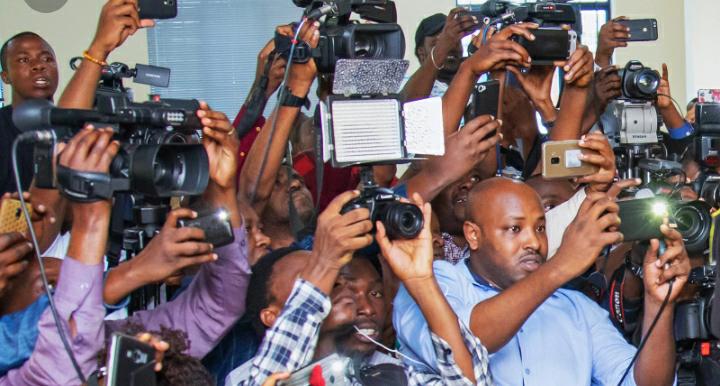
Journalists

Journalism is beyond sitting behind a microphone…

By Nasir Yusuf Jibril Kufa

It is a common misconception, especially among those with low literacy levels, that the difference between professional practitioners and assistants or technicians is not understood. Professional fields require specialised training and proper qualifications before a person can be recognised as a professional. Examples of such fields include Medicine, Law, Engineering, Journalism, etc.

However, many people often confuse professionals with assistants. For instance, in Law, some people believe that studying Law automatically makes someone a lawyer, without knowing that Law School is also required. In Medicine, many people believe that all healthcare workers are doctors, even though nurses, laboratory technicians, and pharmacists are distinct from physicians. 

The same misunderstanding also exists in Engineering, where people sometimes call anyone who repairs electrical appliances or vehicles an engineer. 

Sadly, this misunderstanding also affects Journalism, which is the main focus of my piece. 

Many people believe that journalism simply means sitting behind a microphone, reading the news, or talking on the radio. This misconception has made some assume that anyone who can speak confidently or operate studio equipment is automatically a journalist. In reality, journalism goes far beyond studio presentation. It is a professional field that requires training, ethical responsibility, critical thinking, and commitment.

 A professional, well-trained journalist is someone who has acquired formal education or structured training in journalism or mass communication. Such a journalist understands news values, reporting techniques, media ethics, and the laws guiding the profession. Their work begins long before they appear behind a microphone or camera. They research issues, verify facts, interview credible sources, cross-check information, and ensure balance and fairness in their reports. Because Journalism is about truth, accuracy, and accountability, not just voice delivery or public appearance.

Professional journalists are guided by ethical principles such as objectivity, accuracy, fairness, and responsibility. They know the consequences of misinformation, malinformation, and disinformation and are trained to avoid sensationalism, hate speech, and unverified reports. 

Their role is to inform, educate, and, at times, challenge society responsibly, and to hold power to account. This means protecting sources, respecting privacy, and understanding the social impact of every story they publish or broadcast.

What truly surprised and saddened me is that even someone I consider intelligent has this incorrect understanding. A friend of mine recently started anchoring a program on an online TV channel, and he now believes he is a professional journalist. Unfortunately, he failed to distinguish between a program presenter, a producer, and a journalist, which deeply concerned me. If educated individuals still fail to understand what journalism truly means, what should we expect from the general public? This shows how widespread this misunderstanding has become.

I wrote this piece not to criticise anyone, but to raise awareness and promote knowledge. Journalism is not just about speaking on camera or presenting a program;  it is a profession built on training, ethics, and responsibility. Understanding this will help society respect the profession and those who practice it properly.

Not everyone working in a radio station is a journalist. Radio stations employ technicians, presenters, producers, marketers, and program assistants. A presenter may have an attractive voice and strong communication skills, but may not be trained in news reporting, investigative journalism, or media ethics. Sitting behind a microphone or hosting a program does not automatically make one a journalist. 

Journalism is defined by the process of gathering, analysing, and presenting verified information in the public interest, not by physical presence in a studio. It is important to understand that journalism involves fieldwork, research, critical questioning, and responsibility to society. So,  journalism is far beyond sitting behind a microphone. It is a serious profession that demands training, discipline, ethical conduct, and a strong sense of responsibility.

I hope this message helps readers understand what a real journalist is and why journalistic professionalism should be respected.

Nasir Yusuf Jibril Kufa wrote via nasirjibril2018@gmail.com.

Kano disease control agency chief tasks journalists on responsible emergency health reporting

By Uzair Adam

The Director General of the Kano State Centre for Disease Control (KNCDC), Prof. Muhammad Adamu Abbas, has urged journalists to prioritise responsible and ethical reporting during public health emergencies to prevent the spread of misinformation and public panic.

Prof. Abbas made the call during a two-day Emergency Risk Communication workshop organised to strengthen media engagement and information management during disease outbreaks and other health emergencies.

He stated that the workshop followed the identification of critical gaps in Risk Communication and Community Engagement during recent Joint External Evaluation and multi-hazard preparedness assessments conducted in the state.

“This workshop was designed to address the gaps identified during the Joint External Evaluation and multi-hazard preparedness assessment,” Prof. Abbas said, adding that the media remains a key partner in managing public health emergencies.

The Daily Reality reports that the workshop, with support from the FCDO–Lafiya Programme, revolved around improving media engagement during outbreaks, ethical emergency reporting, managing misinformation, strengthening collaboration between journalists and health authorities, and developing a media-focused Emergency Risk Communication plan for Kano State.

The DG further stated that journalists have a responsibility to prevent the spread of false information, correct myths and harmful practices, and promote evidence-based decision-making that strengthens public trust in official health guidance.

He added that responsible media engagement should also encourage preventive behaviours such as hand hygiene, vaccination, safe food practices and environmental sanitation, while reinforcing official public health advisories.

The workshop was attended by journalists from print, broadcast and online media organisations, alongside public health officials and communication experts.

The powerless power of the Nigerian journalist

By Zekeri Idakwo Laruba 

‎In every thriving democracy, journalists are the soul of public accountability, the guardians of truth, and the voice of the voiceless. In Nigeria, the people won independence without a single bullet being fired. 

‎But decades later, the same pens have become symbols of struggle, silence, and survival. The Nigerian journalist today is overworked, underpaid, and largely forgotten.

‎From the courage of Dele Giwa to the frontline sacrifices made during military regimes, Nigerian journalists have risked, and even lost, their lives in service to the nation. But rather than being celebrated, many of them now live in poverty, working without insurance, health care, decent pay, or professional protection.

‎The profession that once produced national heroes is now filled with invisible men and women, reporters who go out daily with no transport allowance, editors who cannot afford basic medication, and photojournalists who cover events on empty stomachs. 

‎At some press events, journalists are reduced to scrambling for food or transport stipends. The humiliation is not just individual; it is institutional. In 2020, the nation witnessed the public verbal assault of Eyo Charles, a Daily Trust journalist, by a former minister, Femi Fani-Kayode. 

‎His only crime? Asking a legitimate question. That moment, broadcast across the country, exposed the vulnerability of journalists and how little value some political elites attach to press freedom. Many media professionals now survive on meagre and inconsistent pay. 

‎In some private media organisations, reporters work for months without a salary and still carry personal costs to cover assignments. Few private media organisations provide welfare and accommodation for their staff, despite struggling to maintain steady revenue streams. Government-owned outlets, while slightly better, still offer limited welfare support in the face of inflation and economic downturns.

‎The Nigeria Union of Journalists (NUJ), Nigerian Guild of Editors (NGE), and other professional bodies have become mainly toothless. While they occasionally issue press statements in moments of outrage, their long-term effectiveness remains questionable. 

‎Advocacy is weak, reforms are slow, and protection is minimal. Journalists are left to fend for themselves in a system that no longer honours them. What is even more tragic is that many journalists report every day on injustice and neglect, yet rarely report their own. 

‎The irony is cruel. And so is the silence. Yet, the survival of Nigeria’s democracy depends on the survival of journalism. If journalists are weak, the truth is endangered. If they are compromised, the nation drifts into ignorance. 

‎It is not enough to speak about press freedom; we must act to protect the people behind the stories. To restore dignity and professionalism in the Nigerian media space, urgent reforms must be pursued. First, the Federal Government, in collaboration with media owners and unions, must establish a National Media Welfare Fund. 

‎This fund should provide emergency support, health insurance, and affordable housing for journalists. It will serve as a safety net for media workers in distress. Second, there must be legislative protection through the passage of a Journalist Protection and Welfare Bill, which will address workplace rights, ethical standards, job security, and compensation for risks undertaken in the line of duty.

‎Third, an independent Press Freedom and Redress Commission should be established to investigate harassment, unlawful detention, and abuse of journalists. This commission will serve as a watchdog against both state and private offenders.

‎Fourth, support for independent media startups and community-based journalism should be expanded. Through grants, training, and infrastructure, we can nurture new media platforms that prioritise public interest over politics or profit.

‎Lastly, the NUJ and NGE must reform themselves. They must earn back the trust of their members by becoming more transparent, democratic, and responsive. The time for docile leadership in journalism is over.

‎Of course, journalists must also hold themselves accountable. Ethical journalism is not optional. They must resist the temptation of brown envelopes, fact-check relentlessly, and report with clarity, compassion, and courage. The profession must regain its honour by defending the truth, not selling it.

‎The pen that once won our independence still holds the power to shape our future. But only if it is wielded with integrity, and supported with justice. Until we build a media system where journalists can live with dignity, we remain a country that praises democracy while neglecting those who protect it. 

‎A free press without empowered journalists is an illusion. And Nigeria deserves better.

‎‎Zekeri Idakwo Laruba is the Assistant Editor of PRNigeria and Economic Confidential. He can be reached via idakwozekeri93@gmail.com.

Media expert tasks journalists on ethics, professionalism, integrity

By Uzair Adam, Anwar Usman and Anas Abbas

Malam Aisar Fagge, a renowned media personality, has urged journalists to prioritize what is best for their audience during reportage to avoid chaos and unnecessary tensions.

Fagge, who is also a lecturer at the Department of Mass Communication, Kano State Polytechnic, made this call during a one-day workshop held at the NUJ Secretariat, Kano state on Saturday.

As the discussant, Fagge lamented the tendency of journalists to focus on negative stories, emphasizing that not all truths are publishable.

He cautioned that journalists should consider their religious and cultural values and only report what is significant and does not conflict with those values.

“Journalists should know that even if something is true, it is not all truths that should be reported, as we have publishable and unpublishable truth,” he said.

He also called on journalists to consider the interests of the owners of their organizations, stating, “However, you need to also consider the interest of the owners of your organisation so that it will not affect you.”

Additionally, Fagge stressed the significance of following up on events, as they can provide valuable insights and information for reporting.

“Journalists should be following such events as they will help them significantly,” he added.

Journalists ‘urged’ to avoid stories that strike fear among people

By Uzair Adam Imam 

The Coordinator, National Counter-Terrorism Centre, Office of the National Security Adviser (NCTC-ONSA), Rear Admiral Yaminu Musa (Rtd), has called on journalists to avoid inaccurate and sensational reporting. 

Musa also urges journalists not to be used to create fear and enhance kidnappers’ evil narratives. 

He said that such stories could often be detrimental to public trust, exacerbate fear and anxiety, and even hinder counterterrorism efforts. 

Speaking on Wednesday during the `Anti-Kidnap Multi-Agency Fusion Cell Media and Communication Workshop’, organised by ONSA in collaboration with the British High Commission, Musa made this call. 

He stated, “The agenda setting role of the media cannot be over emphasised in the fight against terrorism and other associated crimes like kidnapping. 

He further said that the large volume of kidnappings taking place in the country and the proceeds generated through ransom payments are being used to fuel terrorism. 

He said, “Kidnapping for ransom has been identified as one of the means of funding terrorism. Thus, carnage unleashed by kidnappers in affiliation with terrorist groups all over the world leading to loss and disruption of lives and properties, is a major concern. 

“Evidently, the kidnapping menace requires concerted and sustained efforts by every citizen, government at all levels, international community and the media which of course is the Fourth Estate of the Realm. 

“You will agree with me that proceeds of kidnap for ransom enterprise have continued to serve as a platform for financing terrorism not only in Nigeria but across the Sahel. 

“Hence the need for collective efforts in advancing measures to check the threat,” Musa added.

Journalists work may lead to mental shutdown, death – doctor

By Uzair Adam Imam

A psychiatrist, Dr. Adeoyo Oyewole, said the physical and mental stress journalists are exposed to daily has psychological effect on them that could lead to mental shutdown.

The doctor said the pressure used to create a mental disequilibrium which manifests psychologically and phphysically.

Dr. Oyewole, who is a consultant at the Ladoke Akintola University Teaching Hospital, also added that lack of proper stress management killed journalists discreetly.

He made this shocking revelation on Monday at a seminar organised by Fountain University for practising journalists and final year Mass Communication students of the institution.

The seminar was themed: Effect of Poor Stress Management among Nigerian Journalists on Mental Health Productivity, at its campus, Osogbo.

The doctor further stated that Nigerian journalists carry Nigeria on their shoulders at a mental cost, and struggle daily to gather information in spite of humiliating cultural and bureaucratic bottlenecks.

He added, “There is a need for journalists to be proactive in managing time, value relationships and posses the will to break through barriers to achieve daily goals.

“Financial freedom is also essential. No journalists should be underpaid in discharging their responsibility as a professional in order to meet their daily demands both personally and as a family.

“A journalist must be able to meet his daily diet and supplement demand to be physically and mentally ready for the rigours of the job”, he said.