Hausa Films

Kannywood Movie Review: Gari Guda

Director: Sufyan Lawal Kabo

Language: Hausa

Release date: 26-11-2021

Company: Islamic Film Empire

Cast: Musa Lawal, Ibrahim Hassan, Mahmoud Mukhtar, Fatima Lawal, Binta Miko, etc.

Most of the criticisms around Kannywood are rooted in its personnels’ attitude towards filmmaking. They seem to focus on irrelevant, modern love stories, neglecting serious topics. Their films are therefore accused of cultural aberration and promoting moral decadence. However, as the criticisms became louder, a production company, Islamic Film Empire, came to change the narrative with its movie titled Gari Guda.

Set in Northwestern Nigeria, Gari Guda explores social vices like banditry and kidnappings that bedevil the region. It commences with a scene of a bandit attack on a village, where they kidnap many people, including its Chief Imam, and take them to their hideout in Dunguru Forest.

There is Abdul (played by Musa Lawal) on another side. He is a family man who, after losing his job, becomes bankrupt and cannot cater for them. His fruitless search for another job gets him increasingly frustrated with life, and he decides to end it all. He goes far away to Dunguru for the execution but eventually finds himself in the bandits’ camp. However, after hearing his story, their kingpin, Jalo (played by Ibrahim Hassan), asks him to work as their cyber-man.

Would Abdul accept the offer or turn it down? Find out in the cinemas!

Gari Guda is, indeed, a powerful film, not only for dealing with a pressing issue but for doing that effectively. It is shot in suitable locations that perfectly capture Northern Nigeria’s ecology. This makes it a realistic portrayal of the region and its current condition.

The film is a socio-political critique of the Northern political elites. It depicts their abuse of power as the posits that as the primary cause of the terrible mess the region faces. This is suggested when Jalo tells Abdul that he holds an LL.B degree, and his inability to afford “Law School” makes him resort to kidnapping. The intention of Abdul to commit suicide also reiterates the misconducts unemployed citizens could engage in.

The film is, in addition, overtly didactic. Its portrayal of Abdul, who encounters troubles for throwing his parents away, clearly symbolizes the consequence of parental disobedience. There are also many instances where the director incorporates moral teaching into the dialogue. I salute him for the job well done, together with all the cast and crew members.

Nonetheless, the film’s plot progresses too slowly. And while some scenes are lengthy with unnecessary details, some important points are missed. For example, what transpired with the people kidnapped at the beginning remains unknown. The director also fails to strike a balance between education and entertainment. Except for Abdul’s comical father character, there is no comic relief – something to allow the audience to recover from the tensions and excessive gunshots – in the film.

In conclusion, Gari Guda enlightens and educates. It is typical of what you would expect from the “Islamic Film Empire”. Therefore, I recommend it for the serious-minded—rating 3/5.


Reviewer:

Habib Ma’aruf

habibumaaruf11@gmail.com

Kannywood producer apes Davido, appeals for donation on social media

By Muhammad Sabiu

In style similar to that of the popular Nigerian musician Davido, a Kannywood producer Lawal Ahmad also took to his Instagram and Facebook pages to announce his appeal for donations from his fans.

He said, “Today, I also want to be honoured by my fans courtesy of Prophet Muhammad (SAW),” He afterwards stated his account details, comprising the account number, account name and bank.

You may recall that Davido on Monday was able to raise more than one hundred million naira in less than 24 hours after asking, jovially, those whom he had given a “hit song” to send him money. As of the time of filing this report, money still hits his account.

The famous musician has been sharing his bank account dashboard screenshots, displaying his name and account balance, which significantly increases whenever he uploads a new screenshot.

This has become a new trend as many other social media users follow suit to appeal for money—though sometimes jokingly.

Lawan Ahmad could be the first person to have made such an appeal in the Kano-based Hausa film industry history.

Checks on the timeline of the producer carried out by the Daily Reality show that he has started receiving money, albeit much smaller amounts compared to Davido’s.

Kannywood star laments rejection of Hausa films by southern cinemas

By Muhammad Sabiu

A famous Kannywood producer and former actress, Mansurah Isah, took to her social media accounts to lament how some southern Nigerian cinemas rejected the Hausa films.

She further complained about the government’s reluctance to support the films produced by the Kano-based Hausa film industry, Kannywood, and the inability to make the films as popular as those produced in other film industries in Nigeria.

Speaking in a 56-second video, she strongly questioned why Hausa movies are not popular all over Nigeria, except in just a section of the country, which, according to her, should not be like this.

“What did we Hausa producers do in Nigeria that our Hausa movies cannot be shown in cinemas all over Nigeria? But Yoruba movies will be all over; Igbo movies all over. Nigerian movies, too, are all over. So why is that we Hausa producers all left behind,” she questioned.

Though she didn’t mention anybody’s or agency’s name, Mansurah further solicited assistance, which she said should be by patronising films produced by the Kannywood film industry.

“Let us be assisted. You should make regulations. Display your language. Display your culture. You should love us. Make our films to be watched all over Nigeria. An English movie would be brought and shown in Kano, but a Hausa film wouldn’t be taken to Lagos and be displayed there. What is the reason?

Tacitly addressing people in power, she said, “We are the ones who support you. We neither insult nor defame you but we are still not developed. So what do you want us to do?

“I beg you in the name of God to help us and come up with regulations that will make Hausa films to be consumed everywhere in Nigeria.”

Kannywood is embattled with many tough challenges relating to cultural and religious issues, clichéd film content, monopoly of megastars, internal crises, among other problems critics and experts point out.

Masurah produced Fanan, a film whose songs have been trending on social media for several months. It recently showed in cinemas in Kano.

Kannywood: consumer’s or producer’s market?

Northern Nigeria’s Hausa film industry, Kannywood, has been at the centre of brainstorming discussions over the years. One of the most interesting is why film consumers are attracted to the industry and otherwise. So often, the analysis of such magnitude is drawn concerning the industry’s foreign and domestic rivals because they provide an alternative to what the industry produces, which directly affects its local market. And like in any other industrial conglomerate, the sustainable conduct and development of Kannywood as an industry thrive on the quality, affordability and viability of its products.

As the so-called king of the arrangement, it’s impossible to conquer any market without exploring the psychological drivers of consumer’s preferences. That said, the primary concern of the teeming film consumers who boycott Kannywood movies revolves around the appeal, quality and uniqueness of storylines and whether it connects with the inner cravings of a modern watcher. A film consumer demands an illusion, one that not only tells him “this is the movie he wants to watch” but also if “it’s the one he should be watching”. An illusion that challenges his status quo creates a reception for the new order and paves the way for a route to escapism. Arguably, many people watch films to escape from their core reality. This occurs either by consuming movies that aim to rediscover an old order. Such order seeks to reflect on the current order or ones that wish to rewrite the order itself in the forms of fantasy movies, futuristic science-fiction movies, historical fiction and nonfiction movies, among others.

In the case of Kannywood, it has done reasonably well in producing movies that reflect greatly on the dynamics of the current order. But then that’s an order of which its potential consumers happen to be physically part. In which case, most of the content would appear familiar and cheap, which will bore the consumers and hand them the warranty to look elsewhere. Meanwhile, Kannywood competitors have religiously developed the culture of challenging the essence of everything a watcher stands for. This makes them more viable, even if more costly than Kannywood, because they satisfy consumer’s utility.

Interestingly, Kannywood’s content has been profiled as the one that agrees with its watchers’ demand. This is indifferent to saying the industry produces only the content which its watchers want to consume. But if that’s any good, why has the industry been economically stagnating and remain vulnerable to its rivals’ invasion? To be fair, Kannywood and its competitors aren’t of the same financial muscle. This plays a vital role in the distinction of their products. However, it is equally valid to mention that all other industries rivalling Kannywood have, at some point, been where it is today. So the most crucial point is how did they move forward?

Revenue, which is the excuse of Kannywood in comparison to its rivals, in the context of production, is a bi-product of the initial measures that a producer put in place to ensure the success of his product. That’s to say, as far as the producer has the initial capital, what happens next is dependent on him. And start-up capital is hardly the problem of Kannywood producers. The actual problem is recouping the expenses and profiting from the venture.

If indeed, Kannywood produces only the films that’ll appeal to its watchers for fear of losing revenue, then it’s vivid that the industry perceives the film market as a consumer’s market rather than a producer’s market. This is perhaps why they produce movies that watchers ‘want rather than the ones the watchers’ think they want. And there’s a big difference between the two. Failure to dissect this difference creates a dilemma that’s so sensitive; it makes or breaks the possibility of any market dominance.

For instance, the romantic, singing and dancing genres that Kannywood produce at a more regular rate is what Hausa watchers want. But the more adventurous and dynamic content being delivered in other film industries are what Hausa watchers think they want – hence they rush to. And the ability to deviate the latter from the former ensures whether a consumer illusion is created or not. Illusion is vital in production because it makes people consume something believing that it’ll satisfy their utility when it won’t. But, instead, it’ll only make them crave for more. And the more is being craved, the better is the chance of getting addicted, and that’s the trap of every capitalist producer.

Hollywood and Bollywood industries come from well-equipped capitalist societies where consumer psychology is conquered. Down there, it’s a producer’s market. Hence, the curve of their revenue never stops rising. Their movies are regularly subjected to sequels and prequels, defending what the producer wants. In the build-up to the preface of his critically acclaimed novel, “The Godfather”, the great author Mario Puzo confessed that a producer’s girlfriend could demand a movie scene to be filtered out. And the consumers would watch nonetheless. In my opinion, there’s no bigger evidence of control. Which greatly unlocks creativity and unhindered filmmaking viscosity.

Kannywood, on the contrary, produces what annihilates the utility of the consumer instead of what’ll make him crave more. Capitalist experts assert that if a consumer gets what he asks for, he’ll be satisfied. And if he gets satisfied, he’ll not need the product again. That’s why a wise producer never allows consumers to ask for products. Instead, he creates the product questions for them. And in turn, answer the questions in a way that’ll make them even more curious. Kannywood does the opposite. Producers obeying the trend of narrowly imaginative consumers is why the watchers don’t find the films as unique as the foreign ones, which is also why the industry is painfully stagnating.

To clear doubts, how the dubbed versions of foreign movies are being consumed at an equal if not higher rate than Kannywood movies in its native domain should erase any iota of doubt on film market being producer’s market rather than consumer’s. For if it was consumer’s, who researched the interest of a villager in Kano before making a movie in Hyderabad, India, that enables him to watch the film with keen interest?

In the end, movie producers need to conquer the fear of losing the market. The film market is a producer’s market contrary to their belief. Agreeing with that would be a new phase for creative filmmaking. They should sharpen and unlock their imagination to produce what watchers would marvel at. Hausa-Fulani society is rich with contents that can create consumer illusion—ranging from history, culture, geography, economy, politics, anthropology, etc.

MA Iliasu writes from Kano State. He can be reached through his email: muhada102@gmail.com.

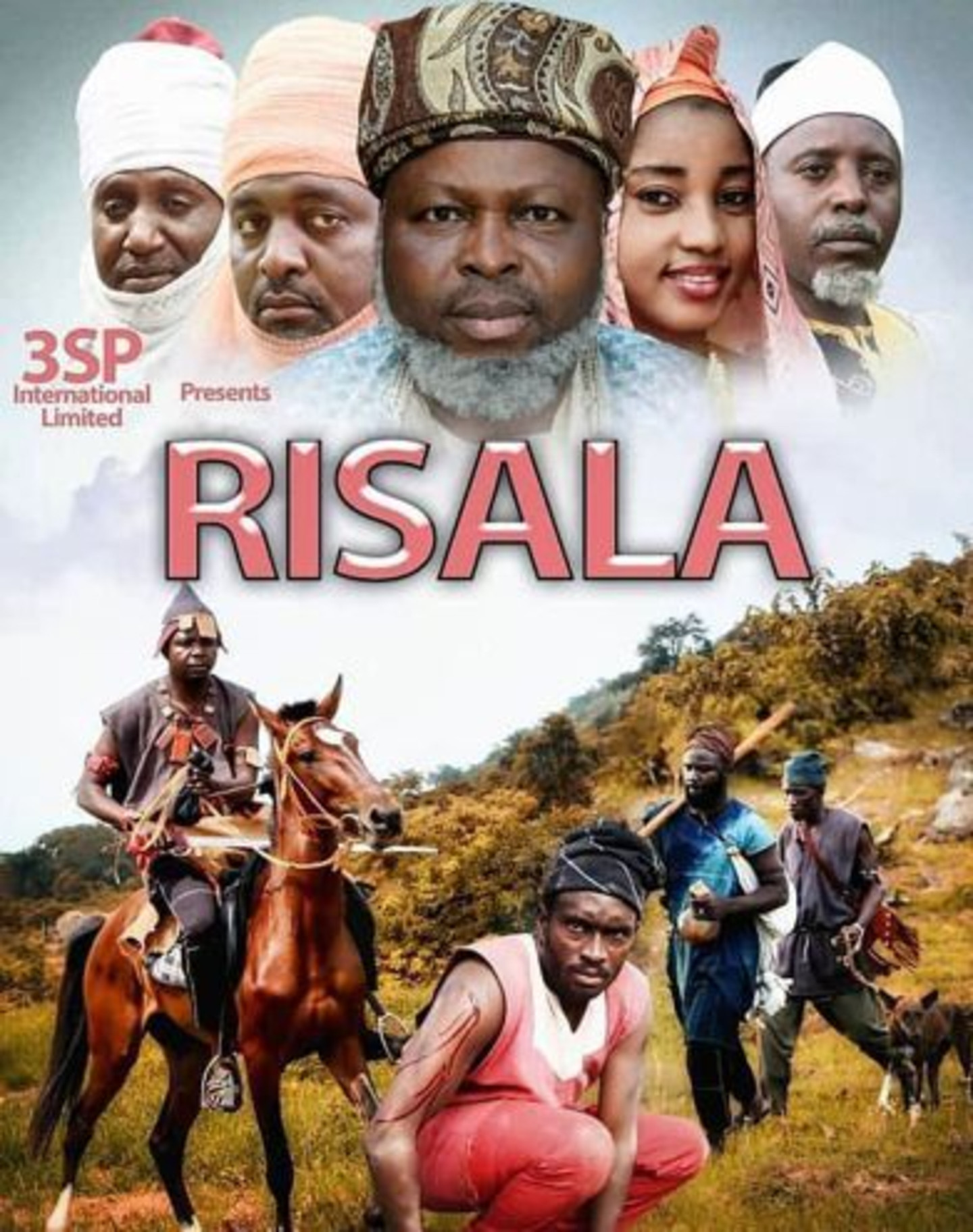
Film Review: Risala

By India Biró

How far would you go in order to be forgiven? Would you send a text message? A letter? Flowers, or a gift? Would you track down the person you hurt and beg them to forgive you, even if it required a two-month journey?

For Zakariyya, the hero of Abubakar Shehu’s Hausa-language film Risala, his desire to be forgiven for eating fruit from a stranger’s farm sends him on a week-long journey on foot to the village of Baihan to ask the farm’s owner to absolve him of his sin. Throughout this journey, he encounters unsavoury characters, is repeatedly beaten up, almost dies of thirst, finds a fortune and loses it, and ultimately meets the love of his life.

Zakariyya is the perfect hero: modest, handsome, determined, faithful, never straying from his morals. Even when he is accused of being a robber, beaten, and insulted by the village’s men, he remains calm and only defends himself by explaining the misunderstanding. When they realize their mistake, he simply forgives them and moves on without holding a grudge. His character seems so genuinely good; it makes you wonder if you would admire him or be annoyed by his constant perfection if you knew him in real life. Surely there must be something that makes him angry or tempts him to sin? However, his strength of character throughout the movie is reminiscent of noble mythical or legendary characters known to Western audiences, such as Robin Hood. This is further reinforced by the pre-colonial setting when modern amenities were not yet present in Nigeria.

When Zakariyya finally encounters the farm’s owner, he appears unwilling to forgive him at first. Yet, because Zakariyya is such a noble person, he senses the opportunity to marry off his daughter to a worthy man. So he proposes to Zakariyya that he marry his ugly, deformed daughter Ummulkhair (sometimes also referred to as Ummu Salma). Zakariya, being the modest man he is, immediately accepts Ummulkhair and promises to treat her well. However, when we see her, she turns out to be exceptionally beautiful.

We learn that the farm’s owner in Baihan has been looking for a suitable husband for his lovely daughter for quite some time, yet every man he has encountered was too enamoured with her beauty, which he considers superficial. Thus, to test Zakariyya’s good faith, he tells him his potential wife is horrendously ugly. The fact that Zakariyya still vows to marry her proves he is not a superficial man and that he is truly worthy of marrying her. In the end, he is rewarded for all his troubles with a beautiful wife. Zakariyya questioning his wife’s integrity by asking her about her relationship with her parents proves he is still not superficial and really is interested in marrying a righteous woman, not just an attractive one.

The fact that Ummulkhair’s beauty is treated as a detriment to her father, resulting in her spending most of her life indoors, as well as her treatment as a prize or commodity for a man (especially her virginity), is unsettling to feminist viewers, yet reminiscent of Western fairy-tales such as Sleeping Beauty, Rapunzel, Snow White, etc., as well as being very fitting for a story set several centuries ago. While Zakariyya’s “test” of his wife before accepting her reeks of sexism, it is probably a very realistic portrayal of the treatment women faced (and continue to face) in many societies.

Another theory about Ummulkhair with regards to the many fairy-tale and magic-like elements in Risala is that she is, in fact, not conventionally attractive and that it is Zakariyya’s reward for being a good man that she appears beautiful to him. This theory can be discounted because, after revealing herself to him, Ummulkhair tells Zakariyya she was barred from leaving the house because of her beauty, so apparently, she really is beautiful and not ugly. However, disregarding this, one could come up with a hypothesis:

Before unveiling her to see her for the first time, Zakariyya says, “everything created by God is beautiful. Only people make distinctions between the good and the ugly.” Perhaps, Ummulkhair is somehow cursed with an ugly outer appearance, and Zakariyya’s words acted as a spell that lifted the curse and made her appear beautiful to only him. So, because his heart is pure and he has good intentions, he sees a beautiful face instead of an “odd-looking” one and instead of a hunchback, he sees a striking woman. Because he is deserving, he sees the beauty in her while others do not. Had he approached the situation differently, perhaps thinking, “poor me, to be stuck with an unattractive bride”, she would have appeared ugly to him.

Ultimately, regardless of the specifics of Zakariyya’s marriage, the message is clear: Those who are good-hearted and seek forgiveness for their sins will be rewarded for it. As such, Risala is a very wholesome film worth watching for its retro charm reminiscent of fairy tale films or Bible stories and its interesting storyline. In addition, the acting and editing manage to steadily capture the viewer’s attention, something unfortunately not always a given in Kannywood cinema as it is still a developing industry and production quality is often low.

While I consider Risala to be one of the better Hausa films I have seen, do not expect a lot of character development since Zakariyya is a perfect hero right from the start and other, more sinister characters like the robber Gambo die before they get a proper chance at reform. There is also some slightly unnecessary bloodshed coupled with overly dramatic and unrealistic special effects reminiscent of low-budget Japanese anime. On the other hand, the music may not be to everyone’s taste (especially Western audiences), but I found it rather pleasant and meshed well with the action rather than distracting the viewer. Subtitles for the final song would have been helpful for non-Hausa speakers, but the song was still fascinating and enjoyable, especially the dancing and colourful Hausa clothing. Overall, while the film could have easily been condensed into one part instead of two, the storyline is gripping, and the acting is done well. I would recommend this film to anyone new to Kannywood cinema.

India Biró is a student at the Institute of African Studies and Egyptology, University of Cologne. She can be reached via ibiro@smail.uni-koeln.de.