Hausa Culture

Tips for women on balancing kitchen duties and worship during Ramadan

By Aisha Musa Auyo

I know this is coming in late, but better late than never, huh? Ramadan is a sacred month that is supposed to be dedicated to fasting, Quranic recitation, prayers, sadaqah, etc. But part of that ibadah comes with a lot of cooking and eating.

Ramadan is synonymous with a delicious variety of dishes—a paradox, right? That’s why many media stations and content creators dedicate time, energy, and resources to Ramadan dishes and treats.

Women are more often on the receiving end of this cooking duty during Ramadan. This has been the tradition since time immemorial, so we cannot change it, but we can create ways that will help us adapt, manage, and not be overwhelmed by it. We can make it beneficial and more rewarding.

First and foremost, cook with the intention of getting rewarded, not to impress your man, the family, or his friends. That gender may not even say thank you, sannu da aiki, abincin yayi dadi, or even Allah Ya miki albarka. But if your intention is to get rewarded by Allah, you are sure to have that reward. Innamal a’amaalu binniyati.

Know that whoever feeds a fasting person receives an immense reward. The Prophet (PBUH) said, “He who feeds a fasting person will have a reward like that of the fasting person, without any reduction in his reward.” (Tirmidhi) This applies to the one who buys the food as well as the one who cooks the food.

When it comes to tafsir, Ramadan lectures, and the like, technology has made things easier for us. You can listen to live or recorded programs on your phone, wherever you are in the world, while you’re cooking or cleaning. You can listen to Quranic recitation too; you can do lots of dhikr and istighfar while doing most chores. Try not to miss out on this.

If you have the means, give out sadaqah in cash and in kind, especially food and water. That will fetch you an immense reward. In the end, it’s the reward we are aiming for, so the end justifies the means.

If you are fortunate enough to have electricity, you can devote your weekends to making pepper soups, stews, and juices. Then, freeze them, which will make cooking easier for the rest of the week. Also, make use of food processors and other appliances that will simplify your work.

Make use of processed foods as much as you can afford. For example, if you want to make tiger nut drink, buy tiger nut powder from Auyo’s Cuisines. This will make your work faster and easier, and you will have the energy for Tarawih. Other processed foods that are much needed for Ramadan are ground peppers, ground kuli, masa premix, and garin kunu, all of which are available and affordable at Auyo’s Cuisines.

Making a weekly food timetable ahead of time helps a lot. Thinking about what to cook is very draining; knowing what to cook is like finishing half the work.

Seek help; don’t try to do everything yourself. Engage the kids and hire someone to help you, even if it’s just for the month. Going to the market will drain you and waste your time; find someone to help you with that from time to time.

You see that Zirkr our Prophet gave his daughter when she asked for servants, Subhanallah, walhamdulillah, and wallWallahar, don’t joke with it before you sleep, you need it now, more than ever.

Try to hydrate a lot during the non-fasting hours. Don’t be too exhausted to eat; you need health and energy more than anyone.

As much as you can, avoid social media, movies, useless chit-chats, and worldly distractions. You will have ample time for that after Ramadan. This month is sacred and only comes once a year. The Prophet said, “Verily, Gabriel came to me and he said: Whoever reaches the month of Ramadan and he is not forgiven, then he will enter Hellfire and Allah will cast him far away,”.

The Prophet peace be upon him also said, that a loser is the one who witnessed Ramadan and didn’t earn Allah’s pardon. A loser is one who’s despaired of Allah’s mercy. A loser lets time pass by procrastinating good deeds. A loser is the one who loses the reward of his fasting to mere hunger and thirst.

My fellow women, try to be on your best behavior this month. Try not to be a loser. As a woman, know that you will sleep less than anyone else in the house, but it’s okay; that’s your part of the sacrifice. Men go out to work too; some men work under the scorching sun. Some men’s work involves hard labor, harder than what you do at home. Some men, even though they work under AC, have pressures and issues they need to solve, which is also very difficult and draining.

Over to you, my brother. If you can afford it, please get some domestic help for your wife. She needs it, especially this month. If not someone who will help in the kitchen, find someone who will help with the shopping and outdoor activities.

If you want to bring people for iftar, do so in moderation. She is only human with two hands.

If you want to feed many people, employ ‘Mai kosai da kunu’ for that project. Many people need the job and the extra money that comes with it. Allow your wife to handle the family’s iftar. Allah Ya biya ka da aljanna.

Bro, I know you’re working hard to provide, but a kind word, a prayer, a gift (in cash or in kind) will make your woman feel appreciated and loved. It won’t kill you.

My fellow women, know that all this work you are doing might not be possible if your man were not providing the food and resources. Appreciate him, encourage him, and respect him. You are not the only one working hard.

But if you are the woman of the house and also the one providing for the household, know that only Allah SWT can help and reward you. I cannot explain or tell you how to manage your time, but I know you are incredible, and in sha Allah, you will enjoy the fruits of your labor, here and in the hereafter.

If you are a son or daughter still living with your parents, know that you also have roles to play. These roles can range from helping with meal preparation and cleaning to running errands and greeting your parents when they return home from work. Praying for your parents is also an important act of worship.

If you are earning money, buy fruits, vegetables, or gifts for your parents and siblings.

Guy, before you shamelessly take a Ramadan basket or kayan sallah to your girlfriend, who may not even marry you, do so for your parents first. It will be more rewarding for you.

Girl, before you shamelessly invite that stingy boyfriend of yours for iftar with your parents’ cefane, make sure you are always helping out with the cooking and cleaning; it will be more rewarding for you. Don’t be a lazy girl and then an active one when your guy is coming for iftar.

Dear couples, as much as I know you are tired, don’t ignore za oza room ibada during this month. It is very rewarding, it enhances mood and offers benefits for physical and psychological health including lowering stress, improving sleep, and boosting immune function.

Experts say the hour before suhoor is the best during Ramadan. By then, couples are well-rested, and they will be waking up for suhoor anyway.

Let me stop here. May Allah accept our ibadah. May He give us the health and wealth to perform this ibadah to the best of our abilities. May Allah make us among the servants who will be freed at the end of this month. May He forgive our shortcomings, and may all our prayers and wishes be granted. May we witness many more Ramadans in good health and wealth.

Aisha Musa Auyo is a Doctoral researcher in Educational Psychology, a wife, and a mother of three. She is a homemaker, caterer, and parenting/relationship coach.

Impact of communication skills on our daily interactions

By Abubakar Aminu Ibrahim

Communication is vital to human interaction, influencing relationships, emotions, and outcomes. In all languages, the impact of communication skills is profound, especially in expressions of greetings, well-wishing, congratulations, condolences, and the like. While these expressions are often used to convey positive intentions and goodwill, how they are communicated can significantly affect the recipient’s feelings and perceptions.

In Hausa culture, for example, greetings are essential to daily interactions, reflecting respect, courtesy, and social harmony. Appropriations of greetings demonstrate politeness and establish a positive tone for communication. However, the impact of greetings goes beyond mere words; it encompasses the tone of voice, body language, and facial expressions. A warm and sincere greeting can make the recipient feel valued and respected, while a cold or indifferent greeting may convey disinterest or disrespect, leading to negative feelings.

Well-wishing is another crucial aspect of communication in our daily encounters, especially in the context of prayers for someone’s well-being or success. This is something that seems cordial yet can be volatile. Whether it is praying for someone to have a child, to get rid of poverty, or to find a job, how these wishes are expressed matters significantly. The spot where such utterances are made can make or mar the situation.

For example, when offering prayers for someone to have a child, it is quite unnecessary to say it to their face. It is often like reminding them and telling those around them how childless they are! Then, is it really necessary? Prayers can be both general or precise, thanks to the fact that Allah is always aware of our inner intentions. Thus, such prayers can be positively concealed in a more general term. “May Allah offer your wishes”, “May Allah reward you with Jannah/bless your family”, etc., cannot harm, I guess.

A similar reproach is often experienced when offering consolations. The manner, tone and words used can reflect civility and ensure privacy yet remain empathetic, hopeful, and positive. A well-expressed prayer can uplift the recipient’s spirits and strengthen their resolve. In contrast, a poorly articulated wish may appear insincere or lacking in empathy, potentially causing emotional distress. Consider a situation where an ill person (who needs support and encouragement) is constantly being told how he is wasting weight! Is that consoling or condemning? Instead of extending the tender support required, we often extend emotional pain and wash away the little drops of hope in the patient.

Similarly, congratulations are often extended to celebrate achievements or milestones in a person’s life. Whether congratulating someone on a promotion, a wedding, or any other accomplishment, the manner of expression can enhance or diminish the recipient’s joy. A heartfelt congratulatory message conveys genuine happiness and support, whereas a superficial or casual expression may undermine the significance of the achievement, leading to feelings of disappointment or devaluation.

In conclusion, the impact of communication skills is profound, especially in expressions of greetings, well-wishing, congratulations, condolences, and their likes. How these expressions are communicated can significantly affect the recipient’s feelings and perceptions, shaping the quality of interpersonal relationships. Without diplomacy and sensitivity in communication, even well-intentioned expressions can have unintended negative consequences. Therefore, it is essential to cultivate effective communication skills to convey goodwill and ensure that our words and actions do not inadvertently cause harm. Without diplomacy, we may do more harm than good despite our noble intentions.

Abubakar Aminu Ibrahim wrote from Katsina via matazu247@gmail.com.

Lost Heritage Series: Furakenstein Monster and the Rufaidahization of Tradition

By Prof. Abdalla Uba Adamu

Birnin Kudu. The 1960s. An incredibly wonderful town. Still a wonderful town! Even more, wonderful, friendly people. So far away from Kano that a whole limerick was composed to warn of its distance ‘Birnin Kudu da nisa take / ɗa ya ɓata bare jika /.

For me, the town evokes memories of wonderful summer months spent there in my auntie’s house in ‘Gangare’ quarters, literally, a sloppy part of the town located in a depression. Years later, they filled the depression on the main road, making it easier for motorists to travel through the town easily. The mountain range has a wonderful greenback during the rainy season. The range stretches as far as the eyes can see, providing a wonderful wallpaper for the students in the secondary school (BKSS) at the foot of the mountain.

Memories of her earthen water storage pot (randa) with jema-scented grass floating in to give the water a cool, pleasant scented taste. The mere presence of the jema grass also scented the room. Then there is the river, about two kilometres away from her house. More like a brook than a river, the clear water flowing over the underlying rock bed was a wonderful sight for a city boy. I used to spend hours just watching the water bubbling gently under the bridge towards an unknown destination and trying to read my African Film (Lance Spearman) pictorial novels

And the rocks that littered the town – dark, broody, holding centuries of secrets. Massive rocks – you can see them from the atrium of her house. It became a pleasure to sleep in the open atrium, the night sky framed with those slabs. The rock paintings enhanced the appeal of the town discovered a decade earlier, in the 1950s. Conferring on the town an ancient status – and they had evidence of a 2,000-year human artistic activity.

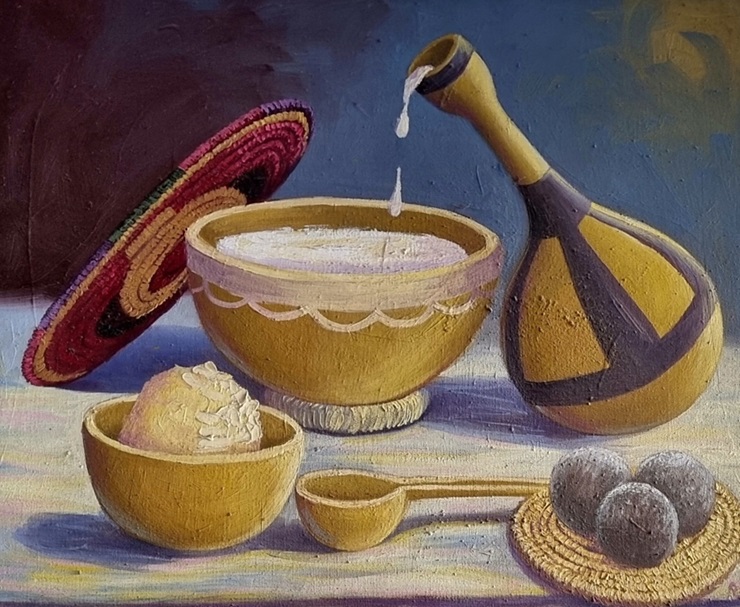
However, the best memory was the kindirmo (yoghourt) market, right by the roadside near the entrance to the market. Sold by the stereotypical Fulani milkmaids. Kindirmo is so thick that it breaks up like ice floes on a frozen river when you hit the skin film on top of the large calabash holding it. Kindirmo is so sweet that it harks back at an ancestral memory of existence. Pure. Natural.

My old aunt was an artist and adept at churning up the thick kindirmo with equally massive balls of fura. Using a ludayi (ladle) carved from a gourd plant, she was adept at blending the fura right into the kindirmo floes in a calabash. The end product was a supremely nourishing, rich, tasty meal of classic fura – containing all the ingredients needed to nourish the body. Absolutely no sugar is needed or even desired. As you slurp it, you are often lucky to come across an unblended fura – gaya. Taken in a calabash container with ludayi. The ecstasy can only be imagined.

Sold with the kindirmo was fresh butter. Aunt used to fry the butter into a ghee. Pour a spoonful into any meal – ecstasy reloaded! Evoked Hassan Wayam’s verse:

Ga fura ta mai nono /

Tuwo na mai nama /

Years passed by, and my childhood memories of Birnin Kudu were kept in storage in my mind. Whenever I passed by the town – my aunt had left the place in mid-1980s when her husband passed on – and crossed the bridge, the memories came flashing by. Of the only friend I made, a Yusha’u, whom I cannot trace.

The daily grind made it difficult to re-create the culinary pleasures of my aunt’s fura. Further, I was too occupied with other things. One day, the urge came back after my return from studies. The question was, where would one get a fura meal? I was told it has now become a franchised business, and right opposite the block of flats I was staying in, Zoo Road, was what I called ‘Fura Café’ run in a kiosk. I dashed up there for a treat.

I was shocked. First, the fura balls were tiny. Like a baby’s fist. And white – not enough millet, obviously. Then, horror of horrors, he dropped three of them into a BLENDER! Would you believe it? A BLENDER! That’s the machine I saw my wife using to grind those ingredients used in making a soup! The worst was yet to come.

Next, he poured WATER into the blender. I could not stand it any longer, and I stopped him, asking for the kindirmo. ‘That was it. I just poured it into the blender,’ he saucily replied. Nothing like kindirmo – more like ‘tsala’ – watered down milk. He pressed buttons. Everything churned and chugged in the blender cup. He stopped, removed the cup, and then poured the lot into a PLASTIC cup – more like moɗa! I was speechless throughout this charade. I decided to see it through.

I asked for the ludayi. He gave me a look that clearly indicated he had never heard the word and passed on a PLASTIC spoon – y’know, the kind that comes with a cheap rice takeaway. I paid, took the cup, and had a sip. It was horrible. Sour. No pleasant flavour (garɗi) of a true kindirmo. Seeing the expression on my face, he offered cubes of sugar. I passed. I handed the entire sludge to him and left. That was the end of my first attempt at rekindling a memory.

Years later, after a five-year absence from Kano, I came back to see modernised Fura Cafes all over – Habib, Yusrah and the new kid on the block – Rufaidah. I was told some, e.g., Habib, had been around for a long time. Knowing I might regret it, decided to relive Birnin Kudu again. So, I popped into Rufaidah for a treat. Better than the horrid kiosk I had been to before. I was attracted by the post-modernist décor. Like the airport in Dubai.

Ahaf! The same Furakenstein monster was there. A blender, watery milk, lots of sugar, tiny chunks of unblended greyish fura, and a ‘dambu’ – moistly powdered fura as a spare. All are neatly packaged in a pretty container. It’s not as bad as what I had before, but it’s still a Furakenstein monster. Seems the Rufaidah Fura Café is the ultimate in the fura business. I am happy for them and impressed by their franchise. But for old codgers like me, even at our Fresh Young Dattijo (FYD) phase? Thanks, but no thanks. I can’t stand the monster – Furakenstein – that is the modern blender-churned fura, no matter how ‘ultra-modern’ their café is. Young people who throng the place, happily taking selfies, have no idea what they have missed in the generational journey.

Fura, as a meal, should be churned in massive chunks of kindirmo floes, the likes of which I am pretty sure can only be found in Birnin Kudu, Bulkachuwa and Danbatta. With huge dark grey fura balls providing high millet content. Spicy fura. Thick floes of yoghurt. No sugar. Not because you are on a health kick, but because it is almost a sacrilege to put sugar in such yoghourt.

So, to celebrate this culinary purity, I am sharing the third painting in my office of classic Fura da Nono and fresh butter lost heritage scene painted on a medium canvas by the brilliant Bashir Abbas of Kano Polytechnic. It reminds me of the idyllic, peaceful and wonderful Birnin Kudu, with its rolling hills, tema grass (still available?), and the now drying river.

Transition of Tashe

By Sumayya I. Ja’eh

Chorus/children: ‘Ka yi rawa kai mallam ka yi rawa.’

You’ve danced, oh! Mallam, you’ve danced

Mallam: ‘Ban yi ba’,

I didn’t

Chorus: ‘tsoho mai gemun banza.’

Old man with a useless beard

The call-and-response dialogue, accompanied by the beating of a drum, propped open my six-year-old eyes in my grandfather’s compound in a village in Katsina. It was one of those fuzzy moments when you wake up and don’t know where you are for a minute. I had slept off in the car, only to find myself in a dim room lit by a kerosene lamp. There was no electricity, and the young moon illuminated the compound. The young boys that woke me were beating a locally made drum from tins, nylon, and sticks. They looked like characters from the famous tale by moonlight series produced and aired by the national television station NTA, which I was obsessed with then. The main character, Mallam, had a costume: a babban riga, an old cap placed haphazardly, a white beard, attained by putting white cotton on a boy’s face, and his mimicry of an old Mallam thrilled me. It made me and their audience laugh. That was my first conscious experience of Tashe and one of the reasons I look forward to spending my fasting period with my grandparents in Katsina or Kaduna.

Tashe is an old-age traditional mimetic performance performed by children between 6 to 14. It is an annual cultural performance that takes place in the 9th month of the Islamic calendar and is performed in the early hours of the morning or the evening before the pre-dawn meal or after the break of the fast. Tashe is a short play that challenges a social issue, accompanied by songs, dance, and mimicry.

Tashe can be traced as far back as the contact of the Hausawa with Islam. The word is derived from ‘tashi’, a Hausa word for wake up. Muslims are expected during the month of Ramadan (9th) of the Islamic calendar to fast, and they are highly recommended to take the pre-dawn meal. So, some people feel the need to wake others up for Sahur, to replenish their empty stomachs and energy to see them through the rigours of the day’s work without much difficulty. So, a few community members took it upon themselves to wake people, to prepare and eat just before dawn. To lighten the frustration of struggling to keep awake with no alarms, these volunteers enact the games named wasannin Tashe. While the adults prepare the meals, children with nothing to do occupy themselves with games to help while away time. Another factor is the essence of Tashe, which is aimed at luring people away from un-Islamic leisure pastimes since the beginning of Ramadan.

Tashe is performed mainly by young children, who imitate adults. It is often satirical and full of humour but laden with moral lessons and socio-religious ethics of the Hausa community. Tashe is usually passed down orally from generation to generation. The characters fill the roles with costumes, makeup, and dialogues in call-and-response songs. It is social criticism and a mirror/lens to view the socio-religious ways of life in most Hausa communities.

The Almajirai also are volunteers that perform Tashe. The Almajiri’s source for their food, move from house to house, seeking food or alms. During Ramadan, the Almajiri sing a dirge in the late night hours, songs calling out to anyone with an extra plate to give them. Some musicians and drummers, along with young children, also began to imitate the activities engaged in by the adults. In time, these plays shifted to the early hours of the night. They sing, dance, dialogue, improvise and wear costumes. It is a comedy, but like all comedy, it is the presentation of serious matters in unserious ways.

One striking characteristic of Tashe is its didacticism; it doesn’t only entertain but emphasizes the Hausa cultural belief and tradition—Tashe projects social ethics. Therefore, many performances aim to ridicule those who deviate from correct social norms merrily.

One well-known Tashe passed down from generation to generation is that of naci na kasa tashi, meaning‘I’m so full, I can’t stand.” One of the young boys dressed as an older man puts cotton on his chin that looks like a beard and puts on some clothes to show his protruding stomach. When they are ready, they go from house to house. The lead character sings, and the other children chorus/reply.

Baba: na ci na kasa tashi!

Children: Baba zare gareka!

Baba: Tuwon da dadi yake!

Children: Baba zare gare ka!

Baba: kuma har da nama!

The above can be roughly translated as ‘I’m so full, I can’t stand’, and the children reply with ‘Baba, you’re greedy,’ while the Baba tries to justify his gluttony by saying the tuwo is sweet and there is meat.

For instance, Ga Mariama Ga Daudu, another Tashe, gives us a socio-historic glimpse of the Hausa laden with humour. It is a mimetic performance of the communal responsibilities/expectation of husband and wife, the type of staple food eaten by Hausas. Although a comic, the play is social criticism of the institute of marriage, which several people from both genders are desecrating. Girls stage the play. One of the girls puts on a costume, a long kaftan and a beard and tries to deepen her voice to sound like a man. It is a telltale that enlightens young women about what society expects from a married woman.

Due to the Hausa tradition that does not allow the two genders to mix freely, the girls and boys don’t mix to perform Tashe. Instead, each gender play switches roles with its unique performance type.

A very well-known Tashe is of Gwauro. It is a mime that consists of 5/6 boys. One of them is dressed in nothing but bante (a short nicker) Hausa traditional pants, a rope tied to his waist, a bundle of clothes with kitchen utensils like used tins, old, discarded radio, an old dirty kettle can be found in the bundle carried by the main character. The others hold on to the rope while the lead character tries to run and is being pulled by the rope, while they sing ‘gwauro gwaurogwauro nuna mana yadda kake tsanawa’? Gwauro can be translated to as Divorcee or an old bachelor. ‘Show us how you cook?’ He goes on to put a tin can, wedged it between two stones, and mimics blowing air into the woods.

This is aimed at ridiculing the bachelor, and lessons deducted from this drama border on the irresponsible nature of the bachelor for trying to play the role of a woman, who in most Hausa communities is the one who cooks. Tying the rope around the waist of the lead actor is symbolic. The rope restraining the bachelor also portrays the image of someone in bondage. This shows that in Hausa society, marriage is given such importance that the bachelor/divorcee is considered a lesser being than the other community members.

One Tashe that has gone viral and is available on YouTube is the 2021 Ramadan Tashe ridiculing the state governor of Kano, who asked for 15 billion naira to tackle the issue of Covid 19, as well as a scandal video of him collecting kickback. The short clip shows a boy lying on the floor with a babban riga (an overflowing gown), a red cap, and a white beard. His friends, the crew call out, ‘Ganduje tashi,’ ‘Ganduje stand up,’ to which he replies, ‘sai an ba ni dollar Corona’ ‘not until I am giving dollars to fight Corona.’ The clip is a short comedy skit that not only cracks people up but also has an undertone that challenges corruption by government officials.

Though Tashe is basically performed to provide merriment, the reverse may occur. Sometimes, Tashe meant to ridicule certain personalities, which may not be acceptable to the person concerned. Here the object of ridicule will not find the performance funny, and it is pretty common to see the performers running helter-skelter, being chased by the target of the performance. At other times, the performance itself may be acceptable, but the attitude of the performers may be irritating to the target audience. To cap it up, these performers would taunt any house owner who refused to donate anything. Upon exiting, the actor would often sing, “mun taka tutu, maigidan nan ya yi shi.” “We have stepped on a heap of shit; the owner of this house must have excreted it”.  

Tashe emphasizes communal performance. My grandparents or parents always give out some loose change to the performers. This is the norm that the adults expected to give alms to the performers. These donations can be money or food items, primarily grains like millet and sorghum, the staple foods in any Hausa community. There is no fixed amount for alms, but donation largely depends on the social and financial status of the audience, as well as the extent of enjoyment of a performance.

The audience, primarily adults, also participates by correcting any misrepresentation in the texts, disguise, or dramatization. With globalization and urbanization happening worldwide, Tashe, as I used to know it, is fast becoming a relic of the past. The face of Tashe has evolved in urban cities. Few children or Almajirai go from house to house, entertaining people while seeking alms.

This long-old tradition of performance entertains and highlights the life of the Hausa folks and brings the fore societal expectation of a man/woman in Hausa society. Although it is a series of plays that comes only once a year as entertainment, it is full of dramatic content that reflects contemporary events. This mimetic performance encompasses most characteristics of a drama; costume, dialogue, improvisation, storyline, and purpose. These earliest Tashe performances are the precursor of modern Hausa drama.

Tashe tries to divert the community’s attention from the economic and political predicament. Tashe, like Macukule, which explores the Hausa stereotype of the Gwari man, is still dominant in contemporary Hausa movies. A renowned character Dan Gwari is not new to anyone familiar with Hausa movies.

Today, if you google Tashe on YouTube, a few children and young adults pop up on your white screen. The TV channel, Arewa24, created a short series of Tashe that they stream. While this is another means of preserving this long tradition, the thrill and euphoria experienced by the audience are reduced by the limited screen. Unfortunately, my children would most likely never experience this long communal tradition of Tashe as I did.

Sumayya I. Ja’eh wrote from Abuja via sumyjaeh@gmail.com.

Let’s promote our culture

By Usama Abdullahi

It’s challenging that we are found wanting in our own culture. We don’t promote it simply because we don’t want to be looked down upon or mocked about it. Western culture has now substituted ours. We assimilate and worship anything western. Ironically, the West doesn’t force their culture on us; we rather westernise ourselves. 

Sometime in 2013, my uncle bought us pizzas. I used to see pizza as the best dish ever, but I was nauseous when I took my first bit. Being in the company of my cousins, I had to conceal my bitter feelings and fake some smiles to fit in. I was pretty low that day. 

For me, pizza is supremely overrated and not as delicious as I thought; it’s aromatic, though. Mind you, I’m not condemning the Italian dish in its entirety. But why do I bring this to light? I felt like sharing my experience, and I want my people to understand that not everything foreign is delectable.

As people with beautiful cultures, we have crazy good dishes that can excite and quench so many aliens’ appetites. Yet, we don’t promote that. We fault it instead. I have watched several western TV shows where the westerners expressed their liking for African culture, particularly their foods.

Arguably, most Nigerians tend to shun and dislike their culture because, to them, it’s worthless. The preference for western dishes leads to the decay of our cultural dishes. Sadly enough, most of the dishes are given western names, which has become difficult to catch on to. Those names don’t correspond and are mostly corrupt versions of the western ones.

Some of us, the so-called civilised ones, erroneously claim that most of our foods are detrimental to one’s health. Though I’m not medical personnel, the little I know tells me that foods like Tuwo provide the body with energy. Awara/Kosai, the most-avoided dishes by the corps d’elite, help build and repair tissues because they are “proteinaceous”. My claims are open to criticism because they are perhaps not well-grounded.

There are others too, which I guess could be harmless and good for consumption if thoroughly examined. It’s time we stopped self-hating or ridiculing ourselves merely because we want to look or sound different, say like the western. Until we promote our culture, our culture will go extinct someday.

Usama Abdullahi wrote from Abuja, Nigeria. Can be reached at usamagayyi@gmail.com.

Cultural heterogeneity: Where it comes from, how to confront it?

By Safwan Suhaib Ibrahim

Culture, just like science, is never static. As we read more, travel more and impinge more and more on one another through trade, schools, international and religious organizations, our culture and behaviour patterns become heterogeneous – more cosmopolitanised. As people who are committed to the acquirement of wealth and knowledge for the power and insight they give, we must accept the challenges (?) they come with, which is, “Cultural Dynamism”.

Culture, to put it in a mild way, does not only centre on customs and attitudes inherited from our predecessors or the circulation of folktales by word of mouth. It’s also a formal way of training the young in a body of knowledge or creed, borrowing techniques and fashions of others, adopting and selling new ideas or products. Thus, cultural homogeneity is our – everybody’s – way of life.


It’s often not realised, least of all by a layman, that culture is a step further from people’s traditional food, dress, language, music and ceremonies; rather, it’s the people themselves and the society they live in. The human being is an evolutionary animal who is always assimilating new changes brought about by the socioeconomic wind. As we live, we design our culture and we also get designed by it. The everyday flirtation of native dress, songs, dances and language, skin colour or faith are never what exactly our culture is; they only represent a wee portion of it. Our ideas, our ties, our standards and the logic we reflect on a specific problem that confronts us speak more about our culture. 


We – Hausa – have perpetually claimed to be a unique breed of people who despise, or claim to despise, copying others, especially the Western world, though our current moral attitudes and ceremonies are in no way different from theirs. We’re now men of two worlds. So, It’s, of course, a sheer delusion for some of us to pretend to reject everything they’ve acquired from foreign culture simply because it’s “foreign”, but it’s not foolish to rescue one’s culture from total extinction. There’s a need for the revival of awareness of Hausa culture with its great philosophy and epos of music and poetry, dress and language and its ancient literature, but not a total rejection of foreign or alien culture; for that’s as illusive as self-defeating. 


Lest I be misunderstood, I’m not denying that foreign culture or ideas cannot have a destabilising influence on us (of course they do), but I believe there are some that impart a new impulse that prods us to create a new method of organisation and new hope for development. Thus, before we start thinking of driving those alien cultures and ideologies away, we need to study our culture and our people well. We need to start from the basics. That’s, I think, there’s a wider conception of our culture which we give little or no particular emphasis that needs to be tapped now.

Our respect for elders, hospitality to strangers, our feeling of brotherhood and community, our mutual aid for the provision of support and development of services like health protection and education, our freedom of expression, our readiness to provide an economic surplus to neighbours which was so deep-rooted in us that none was allowed to starve, wander in the street or suffer when there’s anything could be done to help him out, and our democratic statecrafts are all but an adventure to us and our progeny. Don’t you think the fight should be on our abstract, not physical culture? 


Safwan Suhaib Ibrahim sent this article via bagwaisafwan@gmail.com.