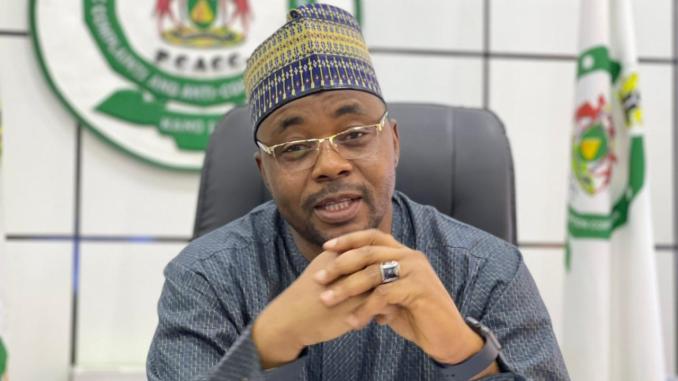
How Kano officials locked up SAN who represented Shekarau faction
By Salisu Uba Kofar-Wambai
By Hussaina Sufyan Ahmed
By Salisu Uba Kofar-Wambai
By Hussaina Sufyan Ahmad
The Government of Kano State ordered the closure of no fewer than 1,581 premises used as hospitals, clinics, pharmacies, and patent medicine shops in 20 Local Government Areas of the state.
The government embarked on these measures following the growing menace of quack doctors, inexperienced pharmacists, and other health officials that use unlicensed premises for rendering health services across the state.
In this regard, the government’s action was said to have been prompted by reports that many unsuspecting residents had continued to fall victim to the nefarious activities of quack doctors and illegal clinic operators in the state.
The state, working in collaboration with the Pharmacists Council of Nigeria (PCN), has since swung into action, shutting the fake centres and moving ahead with more measures to sanitize the state and save the lives of the citizens.
The Registrar of the PCN, Pharmacist Elijah Mohammed, represented by his Director of Enforcement, Stephen Esumobi, told the media that efforts to sanitize the state would continue until the place is safe and secure from unqualified persons to practice and render services.
Mohammed said: “A total of 1,581 premises comprising 657 pharmacies and 924 patent medicine shops were visited across 20 local government areas of the state. A total of 537 premises made up of 138 pharmacies, and 399 patent medicine shops were sealed for offences which include: operating without registration with the PCN, selling ethical medicines without the supervision of a pharmacist, poor documentation, poor storage conditions, unauthorized sale of substances of abuse, amongst others.
While 25 were issued with compliance directives. Many patent medicine shops and medicine dealers in Kano still operate without adequate storage facilities, while others have illegal warehouses scattered around the state, some of these warehouses have a large stock of ethical products and substances of abuse which could find their ways into the camps of criminal elements in the society thus contributing to the adverse security situation.”
Similarly, the Private Health Institutions Management Agency, PHIMA, has also closed down many illegal clinics actively rendering services as hospitals to unsuspecting persons in the state. The Agency’s Executive Secretary, Usman Tijjani Aliyu, said the agency shut a chemist operated by a low-level secondary school exciter as a ‘hospital,’ describing it as a case of ‘quackery’.
The Chairman of the Kano State Chapter of Nigeria Medical Association (NMA), Dr Usman Ali, said that efforts were in been taken to checkmate activities of quack doctors in the state; “We are fighting this quackery, and it is because of this that a committee, Medical and Dental Council of Nigeria, (MDCN) monitoring team was set up in the 36 states including Federal Capital Territory.
“The committee comprises director of medical services of the Ministries of Health as chairman and the NMA chairman of each state as the secretary. About two years back, with the collaboration of the Kano Police Command, we have arrested two to three quack doctors in the state. Similarly, for all doctors in the state, we must make sure a doctor is qualified and certified to practice in Nigeria. That is why the same monitoring team is going round to help check these in hospitals.”
By Uzair Adam Imam
Who could have thought that the lingering issue of street begging would still be persistent despite the imposition of an outright ban on begging by the state government? Likewise, who would believe that the state government will continue to be the captive of the past, allowing Almajiri parents to drop around their children for Qur’anic education without shelter, food or clothing?
This and many more have called into question the government’s effort to end street begging in the state.
Recalling the statement issued by the Chief Press Secretary to the Governor of Kano State, Abba Anwar, the Kano State Government announced the ban of street begging in the state. It said that the effort was to fully consolidate the free and compulsory primary and secondary schools education.
“The decision was meant to integrate the Almajiri system into the policy and address the lingering problem of street begging,” Governor Abdullahi Ganduje said in the statement. He further warned that Almajiri teachers must accept the newly introduced approach by the government and that “If Almijiri teacher thinks he cannot accept the new policy he has to leave the state.
“When Almajiri are caught begging, it is not only that beggar is caught but also his parents or guardians. Such parents or guardians would be taken to court to face the wrath of the law,” the governor added.
The statement disclosed that the newly introduced system was meant to allow the beggars to continue their studies to secondary school and beyond.
But despite the declaration, promises and threats against beggars and their teachers, beggars are still on the state’s streets. They beg from car to car, tricycle to tricycle and from person to person freely and in the presence of security personnel.
Meanwhile, Almajiris in Kano were neither being thwarted from begging nor introduced to western education, as the governor promised.
One of the Almajiri teachers in the state who spoke with The Daily Reality said, “I had no idea of the new policy the state government introduced and no official of the government contacted him ok the policy.”
An educationalist, who prefers not to be named, opined that; “I believe this will definitely be a joyous and celebratory idea if the government could be able to implement the new system.
“But sometimes government plays politics, and I am afraid this might be one, considering the length of time since the assertion was made.” He observed.
Some beggars who were brought to the city from Minjibir explained to our reporter that they face no challenge from anyone. According to them, they move around freely in every nook and cranny, including Nassarawa GRA, where the Kano State Government House is situated.
“We are brought here for Qur’anic education from Minjibir Local Government. Our Tsangaya is situated at Rimin Kebe, Ungogo LGA, and we are not even aware of the ban on begging in the state.”
The lingering problem of street begging is known to anyone living in Kano and the North, or even the country as a whole. But it is worse than expected in the North.
Kano State Government’s idea of banning street begging is an idea many residents applauded when launched. The ban was introduced to enable the Almajiri to acquire western education while undergoing their Qur’anic education. The ultimate goal was to empower them in society.
By Muhammad Abdurrahman
Professor Umar Farouk of the Department of Mass Communication, Bayero University, Kano and a former Kano State Commissioner of Information during the second tenure of Dr Rabi’u Musa Kwankwaso spoke with The Daily Reality on the possibility of Malam Ibrahim Shekarau’s return to the Peoples’ Democratic Party (PDP) and the possible emergence of the Third Force before 2023 elections.
Prof. Farouk said that “Mal. Ibrahim Shekarau’s decamping to APC didn’t help him. They don’t respect him. Someone as eloquent as Shekarau is now missing in the headline tells you there is a problem in APC. His silence tells you he is not happy with the manner he is treated. He is just waiting for an opportunity to break his silence.”
“When he was at PDP, Dr Rabi’u Musa Kwankwaso visited him, sought for his support and made him many promises when they form a government. But Shekarau thought differently and decamped to APC. Even though people see him as our arch-rival, look at how Kwankwasiyya supporters received him at the airport without any hard feelings. Look at how they escorted him to his car, and also those at Nassarawa Local Government look at their pictures with him. This is the discipline instilled in them by our “Jagora” [Kwankwaso].”
A similar incident brought Senator Kwankwaso and the Minister of Communication, Dr Isa Aliyu Pantami, at the same Malam Aminu Kano Airport in 2019. At that time, some Kwankwasiyya supporters shouted at the latter, a few others attempted to wrestle him. Recalling this regrettable incident, Prof. Farouk responded, “Dr Isa Pantami was only unlucky because of the political climate at that time. And that brawl was mainly premeditated by a lot of issues.”
Since 2003, supporters of Kwankwaso and Shekarau dominated political programmes on Kano radio stations with talks and counter talks on the two political giants. But it seems that is no longer the case.
Prof. Farouk argued, “To the best of my knowledge, it is infrequent now, that is if even it happens to see a bona fide Kwankwasiya supporter criticising Shekarau on both social media and conventional media. Considering how the leadership of APC in Kano and at the national level treats him, we sympathise with him. A Kano State governor for eight years; a former minister and presently a senator of Kano Central, but his party, APC, doesn’t see his worthiness. He is not contacted about the party’s activities in most cases as he was not considered in the previous local government elections.”
“There is a possibility that both Shekarau and Kwankwaso will forget their differences and form a formidable alliance to bring the change people have been aspiring for because we all tested the bitterness of APC’s administration. Shekarau was from PDP, and certainly, he will return. We, the Kwankwasiyya bloc, have an existing structure that is waiting for him. It is not a shame if he comes back to his home, PDP. His return will certainly boost the strength of PDP,” said Prof. Farouk.
The Third Force is not a new phenomenon in Nigeria’s politics, especially when there are crises in the ruling party and things are not faring well. Both politicians and the governed look for an alternative. Prof. Farouk added, “Though it is a bit late, Third Force is inevitable considering the political unrests in the country. Both APC and PDP have internal crises with many cases in the court about the leadership structure and other issues.”
“There would be a lot of movements to and from both parties depending on where the wind blows. Therefore, governors, senators, and state and federal representatives need to be the third force to cause any change. Without these people, it is a futile exercise to talk about the third force. This is the reason why, often, some people stay in the ruling party because it has the resources to win elections, legitimately or otherwise.”
“But naturally, there must be an opposition. Those members who stay and nurse their ambition to fruition will win. This is what President Muhammadu Buhari did for many years, and in the end, APC won. So you must be patient,” Prof. concluded.
By Ibrahiym A. El-Caleel
Northern Nigeria, Arewa launched her Shari’a project on the eve of the third millennium, precisely in 1999. The project was cheered by Muslims, who are the larger share of the Arewa population. But, on the other hand, the project became a thorn in the flesh of liberal Muslims as well as Islamophobes. Therefore, this generated heated discussions within the Arewa intelligentsia, from the mosques’ pulpits to traditional media pages.
Immediately Shari’a was launched, additives were added to strengthen its influence over the years. The Shari’a courts appeared visibly effective and powerful in their jurisdictions. On the other hand, they were feared due to their initial charisma. Shari’a hudud (penalties) were unapologetically executed in states that subscribed to the project. In 2003, Kano State impressively established the Kano State Hisbah Corps to deepen Shari’a application further. All these were efforts that every conscious Muslim found impressive. Nigerian Muslims were able to leverage democracy to re-establish their lost treasure of Islamic Law. It was a sort of blessing in the eyes of conscious Muslims. Today, however, things are beginning to fall apart.
In recent years, we see rather poor management of the Shari’a project. Convicts in Shari’a courts now find a way to evade justice, leveraging the weak points in the project. More problematic is the visible selective application of Shari’a among Arewa Muslims. Concerning the Shari’a application, Arewa currently operates a caste system. Masses are prosecuted under Shari’a for the slightest offences, but the elites commit big offences and get away with impunity. The Shari’a practised by the earliest Muslim generations was egalitarianism, where everyone was equal before the Islamic Law. But in Arewa today, Shari’a is an elitism that only applies to the nobodies in the society, while the elites break the code and fingers are not raised at them.
Kano Hisbah is famous for coming into the spotlight with all sorts of amazing arrests and “Shari’a law enforcements”. There are pictures of them randomly stopping youths and cutting their hair because they have kept bushy and unkempt hair. To me, this should be a minor thing that should bother Kano Hisbah, when every week, men and scantily dressed women converge at costly-rented event centres, dancing and freely mixing in the name of celebrating weddings. Kano Hisbah never shows up in such Shari’a noncompliant events because they might be meeting the last son of a commissioner, the wife of a minister or even the nation’s First Lady herself. Apologists of this caste system might say perhaps Kano Hisbah never comes across these numerous events that happen frequently and simultaneously. But the answer is, after concluding the events, these “untouchables” audaciously flaunt the immoral pictures and videos on social media to the public glare. And nothing still happens.
Shari’a in Arewa will continue to be feeble because Arewa leaders are not genuinely committed to executing it. Only Allah knows the hearts of men, but the body language we are seeing is that these leaders use Shari’a in the spirit of populism; to woo political fandom. If we have Shari’a, then everyone must come equal before it. In a sane society, everyone comes equal before the law. This is called “the rule of law”.
It was narrated that during the reign of Caliph Umar bnul Khattab, Amr bnul Aas was the governor of Egypt. This governor had a son who entered a horserace with an Egyptian man, and the Egyptian man won the race. This defeat angered the governor’s son, so he decided to flog the Egyptian man. The man left Egypt and travelled to Madinah to complain to Caliph Umar. Umar summoned Governor Amr bnul Aas and the son to appear before him. When they showed up, Umar asked the Egyptian man to flog the Governor’s son as he had flogged him. Then he said to the governor, “when did you start to enslave people when they were born free?”. This incident indicates that Caliph Umar, as one of the most influential leaders in history, never allowed impunity and elitism to prosper in the land.
Secondly, when a lady from Bani Makhzum committed theft, the people of Quraysh requested Usama bn Zayd to intercede for her with Prophet Muhammad (Peace be Upon Him). When Usama spoke about it to the Prophet (Peace be Upon Him), the Prophet said, “Do you try to intercede for somebody in a case connected with Allah’s Prescribed Punishments?” Then he got up and delivered a sermon saying, “What destroyed the nations preceding you, was that if a noble amongst them stole, they would forgive him, and if a poor person amongst them stole, they would inflict Allah’s Legal punishment on him. By Allah, if Fatimah, the daughter of Muhammad stole, I would cut off her hand.”
Prophet Muhammad (Peace be Upon Him) is the grand patron of all leaders executing the Shari’a. This is him (Peace be Upon Him) saying if his own most beloved daughter were found guilty, he would apply the laws on her with no regard to her exalted status. May Allah’s salutations be upon him. He indeed is our ultimate role model worthy of emulation.
Until Arewa leaders take the Prophet (Peace be Upon Him) as a role model in the Shari’a project, we will continue to be a laughingstock. It is quite shameful that daughters of Arewa governors and emirs dress immodestly at their weddings. We have seen the daughter of former Kano Emir Mallam Muhammadu Sanusi II taking a handshake from the Vice President, an ajnabi (strange man), in front of her father. The daughter of Kano State Governor Khadimul Islam, Dr Abdullahi Ganduje, dressed immodestly on her wedding day. She wore a sleeveless wide-necked gown that almost revealed her chest. As if that was not enough of breaking the Shari’a code, she danced in this outfit to the visuality of strange men. The daughter of former EFCC Czar Mallam Nuhu Ribadu also made a similar appearance some months back.
This week, the trending topic on Arewa Facebook centres around another Kano princess, Zahra Nasir Ado Bayero, who is getting married to the President’s son, Yusuf Muhammadu Buhari. In her bridal shower event in Abuja, the princess appeared in a tight wedding gown, exposing the upper part of her torso. Of course, her hair was styled and opened to the public like her fellow sisters in the Shari’a code-breaking. People are wondering how Kano Hisbah is not seeing all this and issuing a press release.
The amoralism is getting institutionalised by the children of Arewa leaders. It speaks volumes to why Shari’a is still a baby in Arewa despite spending more than 20 years in the system. People who could give us a formidable Sharia are issuing licenses to their children to abuse the code and go scot-free. This is why even convicted blasphemers these days do not end up suffering the penalties. Anyone with some copper coins in their pockets and a little political network can find a way out. Only the poor and the unconnected can be convicted and be eventually punished. This is the caste system we have awaken to in Arewa today. Unfortunately, leaders are not ready to walk the talk. We need a leveller to be able to have an effective Shari’a system. What is good for the goose has to be good for the gander. Else, we are all joking around.
Ibrahiym A. El-Caleel is a Civil Engineer by training with an interest in public and social commentary. He writes from Zaria and can be reached via caleel2009@gmail.com.
The Kano State House of Assembly has recommended the dismissal, arrest and prosecution of the suspended chairman of the state’s public complaints and anti-corruption commission, Muhuyi Magaji. In addition, the Assembly has set up a 6-member committee to investigate his conduct as the anti-corruption czar from 2015 to 2021.
Details will follow.