FCT Abuja

A visit to EFCC Headquarters: A corps member’s experience

By Haroon Aremu

It was one evening when my boss simply told me, “I have an invitation from the EFCC. You and Zekeri should join me tomorrow!”

Since I was posted to this PR firm as a member of the National Youth Service Corps (NYSC), my tasks included writing news and opinion articles and monitoring media coverage related to our clients and stakeholders. Despite being busy with my mobile phone, I never entertained or engaged in suspicious activities that could lead to fraudulent corrupt intents, whether online or offline.

“The invitation indicates 10 am, but we should leave the office at 9 am to arrive there on time. Have a nice day!” the boss interjected my thoughts before I could even respond.

I immediately picked up my phone and Googled terms like “EFCC,” “invitation,” “guest,” and “youth.” The search results left me apprehensive—students, top politicians, and public figures had all been guests (meaning detained) after an invitation (meaning investigation) by the EFCC operatives, primarily related to online fraud and other corrupt practices.

Despite the EFCC’s efforts to combat corruption across all sectors, questions persist about the perceived preferential treatment given to political officials and government figures compared to ordinary citizens or young internet fraudsters. Citizens argue that the principle of equality before the law must be upheld, urging for a more equitable approach to justice by law enforcement agencies.

Some contend that the EFCC tarnishes people’s image and reputation. I often wonder whether suspects in EFCC custody are truly innocent of the accusations or allegations, given the damning reports and stories—such as the ongoing case involving former Governor Yahaya Bello of Kogi State.

However, accountability must be a two-way street. While the EFCC bears the responsibility of upholding the law, the accused must also uphold transparency and sincerity to avoid tarnishing their image.

The mandates of the EFCC can be incredibly demanding, considering the fate of past chairmen who faced challenges and controversies both during and after their tenure. The unsteady nature of leading the agency underscores the gravity of the task at hand and the constant threat of backlash from political intrigue.

Recently, the arrest and prosecution of cross-dresser Okuneye Idris Olanrewaju, alias Bobrisky, and celebrity barman Pascal Okechukwu, popularly known as Cubana Chief Priest, on allegations of misusing the national currency caught public attention. Both were accused of abusing Naira notes by spraying and tampering with them during social events, contravening the Central Bank Act of 2007.

While the cases of these two influencers may impact nightlife enthusiasts, musicians, and public gatherings, they also serve as a deterrent against extravagant spending and flaunting wealth irresponsibly. Such measures, while initially restrictive, contribute to a more responsible and accountable society.

I have been closely following an ongoing investigation into a financial scandal involving the Ministry of Humanitarian Affairs, Disaster Management, and Social Development. The investigation became even more interesting when the EFCC confirmed the recovery of $445,000 and N3 billion, in addition to the earlier retrieval of N30 billion. The probe, initiated after the suspension of Minister Dr. Beta Edu, has now extended to her predecessor, Sadiya Umar-Farouq, and Halima Shehu, the Coordinator of the National Social Insurance Programmes Agency.

There were also probes into fraudulent activities related to COVID-19 funds, World Bank loans, and the Abacha loot, among others.

However, beyond its role in tackling financial crimes, the EFCC also engages in advocacy campaigns against the scourge of corrupt practices.

Many questions consumed my thoughts on the EFCC until I fell asleep in the Corper’s Lodge close to the office. I woke up even earlier than usual, anxiously pacing around my room, hoping my boss wouldn’t ask me to accompany him again.

However, my hopes were dashed when my phone rang, and my colleague informed me that our boss was already outside waiting for me in the car.

Fearfully, as I emerged from my room, I noticed that our boss’s driver was not available to drive us. It was very unusual. My senior colleague, Mr Zekeri, instructed me to sit in the back seat while he sat in the passenger seat as the boss drove us.

As we zoomed off, I couldn’t shake the feeling that this was a very strange affair, especially since it was rare for my boss to drive himself.

We arrived at the EFCC gate precisely at 9:40 A.M. The security personnel were on high alert, wearing stern expressions. My boss introduced himself, explaining that we had an appointment at 10 A.M. The security guard insisted we wait until the exact time before entering, so we bided our time nearby. Minutes after 10 A.M., we were granted entry.

As we proceeded to the office, I noticed other staff members, including cleaners and gardeners, wearing friendly smiles and offering warm greetings. In fact, when I almost slipped, one senior officer quickly helped me regain my balance. This experience led me to realize that the EFCC has a diverse staff, with some appearing stern but others displaying kindness and politeness.

Once inside, our phones were immediately confiscated, and we were escorted to a secure area with heavily armed security personnel. We proceeded to the registration room to provide our details, then we were led upstairs to an office where we underwent thorough security checks before being seated. I positioned myself beside my boss, hoping his presence would offer some relief.

A female EFCC staff inquired if we needed anything, but we politely declined. She was even jovial with us. Eventually, we were informed that it was time to proceed.

We were then escorted to a larger room, more like a conference hall, where we encountered a sizable crowd.

As we entered the room, my boss was warmly received by senior officials from the anti-corruption agency’s Public Affairs Department. 

It then dawned on me that the ‘invitation’ extended to my boss was not for a suspect but as a Guest Speaker to discuss “Effective Public Relations Strategies for Law Enforcement Agencies” at the quarterly lecture organized by the Public Affairs Department of the Agency.

The lecture aligns with the dreams of Ola Olukoyede, the Executive Chairman of the Economic and Financial Crimes Commission, who aims to constantly hone the public relations skills of staff.

This visit corrected the erroneous impression that visitors to the EFCC office were all financial crime suspects. It also dispels the notion that the Agency is merely a den of lions waiting to pounce on unsuspecting visitors.

Haroon Aremu is a corps member with PRNigeria Centre, Abuja, and wrote in via exponentumera@gmail.com.
Protests erupt in Abuja as LP supporters rally behind National Chairman

By Uzair Adam Imam

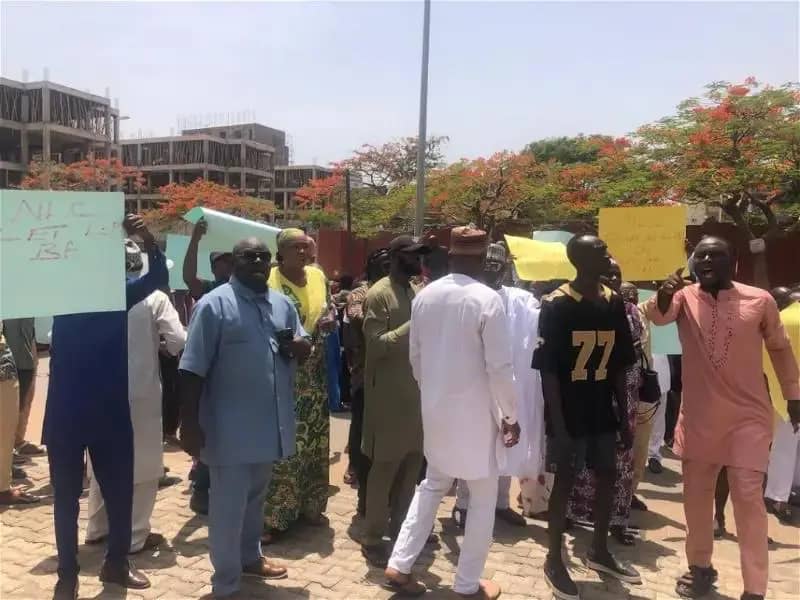
Supporters of Comrade Julious Abure, the National Chairman of the Labour Party (LP), took to the streets of Gudu, Abuja, today to voice their grievances against what they perceive as unwarranted interference by the Nigeria Labour Congress (NLC) in the affairs of their party.

Dozens of protesters, brandishing placards emblazoned with messages such as “On Abure’s mandate we stand,” “NLC leave Abure alone,” and “Nnawi’ National Convention is valid,” commenced their march from the new Abuja chapter secretariat.

The demonstration follows a recent escalation in tensions between the Nigerian Labour Congress and the leadership of the Labour Party, with the NLC accusing Abure of operating as a sole administrator within the LP. This accusation culminated in the NLC passing a vote of no confidence in Abure’s leadership and demanding his resignation.

The conflict between the two organizations has captured widespread attention and sparked debates regarding the NLC’s authority to intervene in LP’s affairs, as well as the underlying reasons behind their dispute.

Investigations by Vanguard have revealed that the ongoing power struggle between the Julius Abure-led National Working Committee of the Labour Party and the Comrade Joe Ajaero-led Nigeria Labour Congress is jeopardizing the future of the Labour Party itself.

Central to the conflict is the battle for control over the party’s structure, with major stakeholders accusing Abure of treating the LP as his personal fiefdom, an allegation vehemently denied by Abure.

Trouble began brewing for Abure shortly after the 2023 general elections, when some party members, led by Alhaji Lamidi Apapa and Abayomi Arabambi, accused him of financial mismanagement. Subsequent court battles resulted in Abure’s leadership being upheld by the Court of Appeal.

However, fresh turmoil erupted when the party’s former National Treasurer, Ms. Oluchi Oparah, publicly alleged that Abure must be held accountable for over N3.5 billion, purportedly received by the party from the sale of forms and donations during the 2023 elections. Oparah’s outspokenness led to her suspension for six months on grounds of bringing the party’s reputation into disrepute.

Currently, the Abure-led NWC of the LP finds itself at odds not only with the NLC but also with the House of Representatives caucus of the party. This discord stems from Abure’s unilateral decision to proceed with plans for a national convention without soliciting input from party stakeholders.

As tensions continue to mount, the future trajectory of the Labour Party remains uncertain, with the specter of internal strife casting a shadow over its viability as a political entity.

Police arrest suspects in Abuja Bolt driver’s murder

By Muhammadu Sabiu 

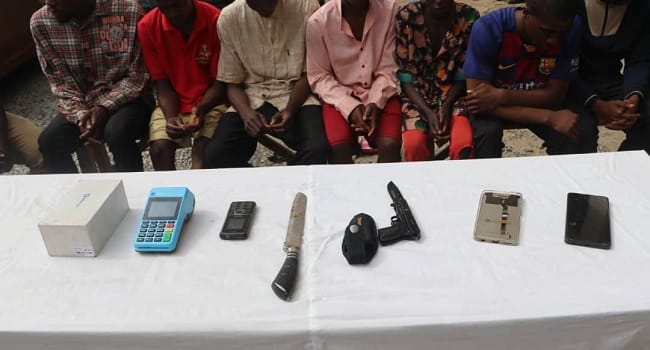
Police in the Federal Capital Territory have Apprehended three suspects over the murder of a bolt driver, Obasi Okeke, in Abuja. 

According to the FCT Commissioner of Police, Haruna Garba, who was parading the suspects in Abuja, the victim was found on June 5 at Ngugu, near Area 11 Garki, Abuja, lying in a pool of blood with a cut throat. 

Obasieyene Inemesit Inem, Aaron Anthony, and Alasan Ayomide Olusegun, all Bingham University students who have been suspended from the university, were arrested after a rigorous investigation to identify the perpetrators of the crime. 

The Commissioner said it was found during the inquiry that the deceased was a bolt driver who had been hired by one of the suspects to drive them to the Guzape Area of Abuja, where they had gone to purchase Indian hemp. 

He said, “Back from Guzape, to their takeoff point, they discovered they had no money to pay for their trip. They decided to play a fast one by showing the deceased a fake debit alert on their phone, but the deceased insisted that he has not received any alert. 

“In the ensuing argument one of the suspect brought out a knife slit the deceased throat and fled from the scene. The three (3) suspects have since confessed to the crime and will be charge to court soon.”

Police investigate shooting of two brothers by vigilante group in Abuja

By Uzair Adam Imam

The Federal Capital Territory Police Command has confirmed the commencement of investigations into the shooting of two brothers by some local vigilante group in Bobota/Dabi Kwali Area Council of the FCT on Sunday.

The two brothers were identified as Abdulmalik Abubakar, 27, and Ibrahim Abdullahi, 22.

It was gathered that Abdullahi sustained gunshot wounds to the lap and buttocks while Abubakar was hit in the leg.

The Daily Reality reports that the victims were rushed to the hospital, where surgery was performed on one of them.

Speaking with the journalists, their sister, Jemilah, said two of the victim’s toes were amputated following the injury sustained from the gunshot.

Josephine Adeh, the Police Public Relations Officer, FCT Command, confirmed in a statement that the investigation into the matter had commenced.

According to the statement, one of the suspects arrested on the day of the shooting was still in police custody despite moves by the local vigilantes to release him.

FCT Abuja: Please, appoint a native as minister

By Abdullahi Adamu

As the Nigerians await a ministerial list from the executive, we urge president-elect Asiwaju Ahmad Tinubu to balance Nigeria’s political diversity by appointing a minister among natives of the Federal Capital Territory, Abuja.

“We  are appealing to Mr President to appoint somebody from FCT as a Minister in the federal cabinet because we believe that doing so will give Abuja natives a sense of belonging within the Nigerian federation.”

FCT natives have contributed immensely to the nation’s socioeconomic and political development. Accordingly, their exclusion is a gross injustice and a negation of constitutional provisions, including the federal character principle.

The contributions of FCT indigenes in maintaining the country’s unity, none of its kinsmen was occupying leadership positions within the nation’s political, judiciary or military circles.

The exclusion of Abuja natives in the last administrations and appointing any credible person within the FCT indigenous population as Minister would right the perceived wrongs and injustices.

“We are appealing to President-elect Asiwaju Ahmad Tinubu to use his exclusive powers to appoint an FCT man as a Minister in the Federal Executive Council.

In making appointments in any portfolio, please consider FCT natives. As stated in the Constitution of the Federal Republic of Nigeria, every citizen shall be treated equally. Likewise, where the nation’s capital is located, the FCT natives should be included in the executive council of the presidential cabinet. To balance Nigeria’s political diversity, everyone should be carried along.

Since the inception of Democratic governance in 1999, it has been crystal clear that FCT natives shall be appointed as the territory minister.

Your excellency, sir, it might interest you to know that with the huge amount of populated FCT natives in Nigeria, they only have one senator and two members of the House of Representatives only at the national assembly. It is an injustice.

We need a state status to increase our franchise beyond local government elections to enable us to have an executive governance structure and independent governing body and to expand our representation at the National Assembly.

Abdullahi Adamu wrote via nasabooyoyo@gmail.com.

Just-in: FCT PDP chairman dies in an accident

By Ahmad Deedat Zakari

The Federal Capital Territory Chairman of the People’s Democratic Party (PDP), Sunday Zaka, has passed on.

Mr Zaka, who was popularly known as HIV, was involved in a car accident that claimed his life on Saturday morning.

Bawa Benjamin, a close aide of the deceased confirmed his demise to newsmen.

According to Bawa, Mr Zaka lost control of his car and crashed into a tree on his way home from the party’s meeting.

He also disclosed that the deceased was rushed to the University of Abuja Teaching Hospital Gwagwalada, where he was confirmed dead by doctors.

Reports have it that Mr Zaka’s personal security also died alongside his boss in the car crash.

A chieftain of the party, Michael Kpatuba mourn the death via a post on his Facebook page on Saturday morning.

“Dying Election day is really heartbroken to the FCT, PDP family.

“Rest in peace, Hon Zaka Sunday, FCT PDP Chairman”, the post read.

Pastor faces backlash for bringing AK-47 to church

By Ahmad Deedat Zakari

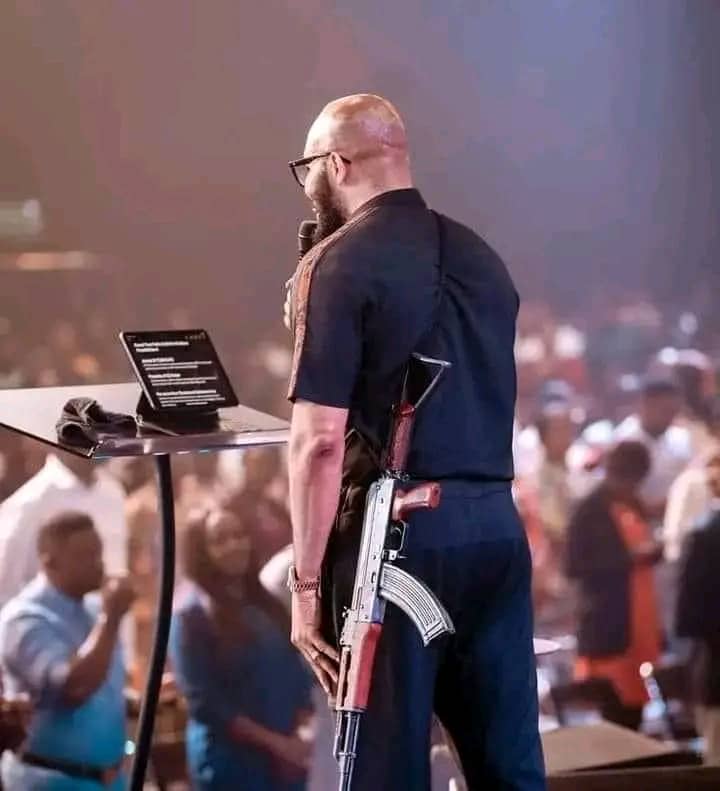
The presiding pastor of an Abuja church, Pastor Uche Ugbe, has brought himself to great disrepute and backlash after he took gun to the church on Sunday.

Pastor Ugbe, while on the altar addressing christian faithfuls, had an AK-47 dangling from his shoulder.

He was reported to have said he came to church prepared because some people are looking for his trouble

However, his action do not sit well with many Nigerians and they have taken to different social media platforms to lambast him.

Abdullahi O. Haruna, a journalist and public affairs analyst, described his action as insensitive.

Haruna said, “Yes, he is not a security guy,
He is a pastor wielding unabashedly this weapon of death, to a congregation that had children, exuberant youths, not minding the sensitivity. He reigns with such impunity. Don’t worry, this is Nigeria. Anything goes…”

Another Facebook user, Nasir Muhammad Salis, said, “I can’t fathom the high level of panic or tension some people will ignite in the country if this was Sheikh Gumi or Sheikh Pantami. But now, they are ignoring it. I don’t see, in my view, any justification for this childish dramatic action!”

Other persons have described him as silly, childish and attention-seeking.

As at the time of writing this report, the Christian Association of Nigeria (CAN), is yet to comment on the illegal possession of firearm by the pastor.

Interestingly, the Nigerian Police Force has also been conspicuously silent on the issue.

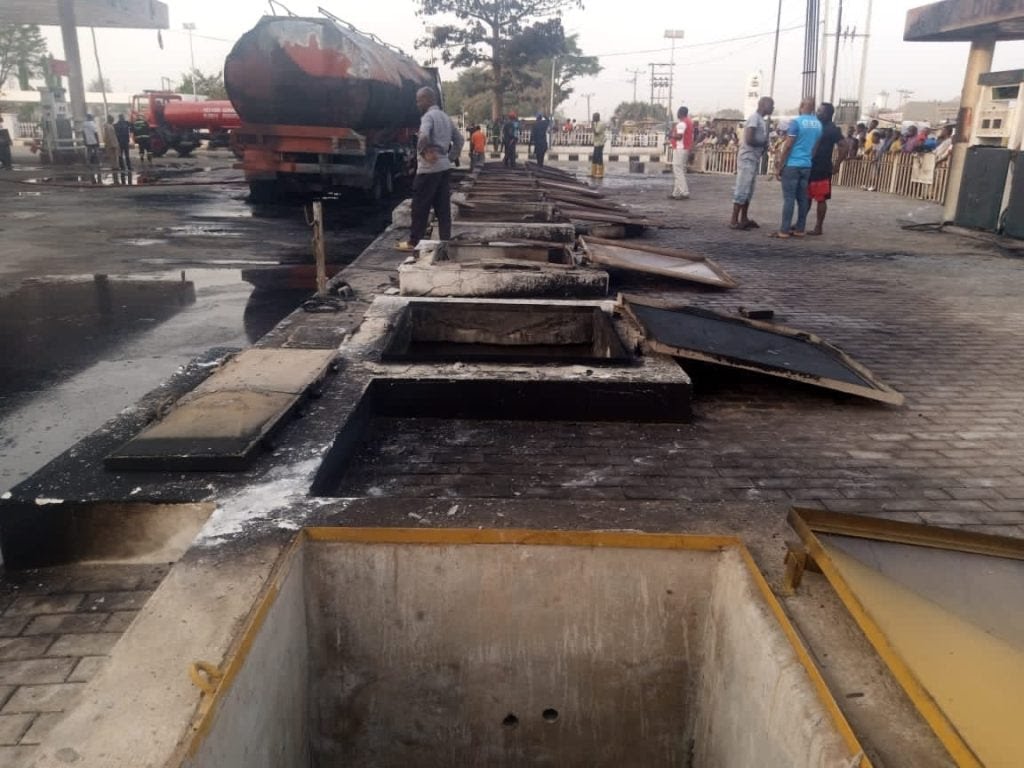
Fire razes AA Rano filling station in Abuja


 By Muhammadu Sabiu 
 
AA Ranos petrol station, on the Abuja-Lokoja Expressway, caught fire on Sunday.
 
The Federal Capital Territory police command’s spokesperson confirmed the incident Sunday.
 
She states that the fire broke out when a gasoline tanker was unloading petroleum products at the station.
 
She added that firefighters, police officers, and other emergency personnel are on the scene putting out the fire and making sure that no one or any property is harmed.
 
There is still no information on the havoc wreaked by the inferno.

Abuja-Kaduna train: A call for caution

By Tajuddeen Ahmad Tijjani

The Abuja-Kaduna train resumed operations after eight months of suspension due to the sad event of March 28, 2022, where terrorists attacked the train and kidnapped 168 passengers, killing eight others. Thus, the situation is now under control. Captives were freed and reunited with their families. We hope not to have a repeat of these ugly scenarios in the future. 

Behold, the Nigerian citizens can’t hide their excitement as the train is back on track after the unfortunate incident. We all call for a proper investigation into the circumstances and, at the same time, call on the authority to remain vigilant. 

However, citizens have the habit of crossing the railway track without proper guidance and caution, resulting in accidents and damage to the public infrastructure, which is public property that shouldn’t be dabbled with. 

There is a sad report of a Toyota Camry with a female occupant that was allegedly crushed by the train as it carelessly came to pass the track. Often those with prior knowledge of the train, especially as you leave Kubwa train station in the suburb of the city centre, Bwary Area Council, the community residents of that axis have a habit of trespassing anyhow without being cautious of the danger therein. This has, of course, inflicted untold hardship on the victims and, at the same time, damage to the slippers of the track. Perhaps people are not aware of the dangers or have deliberately neglected them. 

However, as I went to the axis some time ago, I observed a provision for a pedestrian channel to pass. Sadly, people develop the habit of going through the danger zone. It’s a patriotic call on the ministry of transport to take a leaf from the city centre and provide barricades in such a way that communities have to follow the normal route, which will indeed be a win-win situation, as neither the track will be damaged nor no accident will occur within that axis as long as proper precautions are taken. 

I also laud the measures of the management for the proper check and balance of passengers, where thorough screening is put up so that those with suspicious motives are apprehended. I call on the general public to give maximum support to security agencies and report any sceptical movement for the benefit of all Nigerians.

Tajuddeen Ahmad Tijjani writes from Galadima Mahmoud Street, Kasuwar Kaji Azare, Bauchi State.

The roadside discussions

By Abdussamad Ahmad Yusuf

It was Wednesday evening, and the clock was ticking to 6:00 pm. Alongside two friends, we were joined by another friend’s friend reminiscing my 44 days stay in Abuja, the Federal Capital — the longest I have stayed off Kano.

It’s a roadside discussion, and all topics have the freedom to cross our minds. So we present, discuss, argue and analyze. We sometimes even pass verdicts and judgments.

In Kano, it is Majalisar Bakin Titi, the roadside parley. It is a local gathering of men. In the local roadside parleys, unless in some exceptional circumstances, there is segregation of age, group, social and even economic status. While there is Majalisar Attajirai, the wealthy’s parley, there is that of the humbles, nobles to that of ‘Yan caca, the gamblers’. Men branched in the majalisa after work or after market hours in the evening. For the youth, joblessness and idle-mindedness have made their conversation almost an all-day affair.

It’s easy when you talk of youth or a range of bachelors, rest assured, women and girls have to find a way to dominate the discussions.

Habu would begin showing the girl in blue that her Atampa cost six thousand, the bag two, her veil eight hundred; putting everything she wore averagely kept at Fifteen thousand. She was of humble background and not suitable to be “settled with”, he concluded. Marrying her means you have to struggle all your life to satisfy your needs and hers’ and expect nothing from her side or her parents. Is it crass materialism or the new normal? Anyway, it’s a roadside parley, not an academic or intellectual forum.

Until the beginning of the 1990s, marriage is contracted on the mutual friendship between two families of the intending couples, for settling disputes, generally to stiff bonds or forge new ones. Therefore, the material benefit does not count as much, even at the community, not a familial level, where crowd-achievement due to communal lifestyle is more prevalent than the individualist materialism in prevalence today. 

This permeation of a materialistic viewpoint of life has degraded the standard of familial life seen manifest in roadside discussions, more unfortunately, stemming from the Manyan Gobe, leaders of tomorrow who are nurturing an ignorant standpoint for the nucleus of society: the family.

The Habu thesis painted above shows the complexity of young man’s  ‘misthinking’ wealth, status and rank for fancy and expensive dress and accoutrements. Sadly, it has reduced young girls of marriageable ages to racing for material possessions; an iPhone – the latest in the market, expensive ‘Vatik’ Atampa, posh shoes for kece raini, ‘being above equals’.

These are the ‘yan mata Roadside Discussions extolled to the high heaven, and about-to-marry young men internalize as the best description of a woman to seek her marriage. It is no longer about the Ladabi (obedience, and I am not being apologetic to the ‘alpha’ men), kunya (modesty and good manner), hankali (sobriety), mutumci (humanity toward others) and  Karamci (generosity), in addition to what zamani, current dynamic brings; industriousness, economic dexterity, education (in the western sense or the karatun boko) and may be tech-friendliness.

The Roadside parleys are a hub to discuss which girl has the curviest hip, who has a bosom chest and who walks beguiling, and identifying who has Girman kai, ego in the community. The one egoistic, closely when interrogated, one would discover she is the one who is not trading her teeth for beautiful smiles at any of these near-jobless men, what they will turn out to brand Rashin kamun kai, not modest. The best of the times, if any,  is one that discusses, often prejudicial perspectives, who is mutuniyar kirki, a good girl and who is not.

Many girls dodge passing by roadsides parley to skip their topic brought up unsolicited and to evade the roadside social appraisals and analyses of their lives.

What I will not close, however, without telling you; beautiful marriages have been tied from Roadside Discussions, even though, one may argue equally, many have been dissolved thanks to Roadside Discussions. But, the paradox notwithstanding should not deter young men and women from being the best they can be so that the best comes their way.

Abdussamad wrote in from Kano and can be reached at Abdussamadahmad69@gmail.com