Extortion

Police crack down on officers over extortion incident along Benin bypass

By Muhammad Abubakar

The Nigeria Police Force has taken swift action against six officers caught in a viral video engaging in extortion along the Benin bypass.

The officers, including a Chief Superintendent of Police who supervised the team, were brought before the Inspector-General of Police, Kayode Adeolu Egbetokun, at the Force Headquarters. The IGP described their conduct as “shameful, distasteful, and utterly unacceptable ” and ordered immediate disciplinary action.

According to a police statement, the officers have been queried, and orderly room trials for the Inspectors involved are underway.

The Force said this move underscores its commitment to professionalism, integrity, and accountability. The public was assured that such misconduct would not be tolerated and that appropriate sanctions would follow.

When police become predators in uniform

By Abdulhakeem Yetu Zakari

Police officers are sworn to protect, yet too often they become the very predators that citizens fear. The recent case of police extortion at Murtala Muhammed International Airport, highlighted by an editorial in the Nigerian Tribune on Friday, March 14, 2025, is just one of many disturbing examples.

A traveler, on his way out of the country, found himself at the mercy of uniformed officers who accused him of internet fraud merely because they discovered a love letter on his phone. What should have been a routine encounter quickly escalated into an ordeal—one that concluded with him being extorted of ₦260,000 through a POS transaction. 

The money was sent to an account linked to a suspect, a method that has become all too common in these shakedown operations. This brazen misconduct is more than just a stain on the reputation of the Nigerian police; it is a cancer eating deep into the fabric of society. 

When those responsible for law enforcement become the enforcers of lawlessness, to whom do citizens turn? Police extortion in Nigeria has evolved from sporadic bribes into a well-organized criminal enterprise embedded within the force. Officers who should be defending the rights of the people now act like rogue agents, preying on innocent citizens. 

The danger of this menace extends beyond financial loss—it breeds fear and resentment and erodes trust in the justice system. For many Nigerians, the fear of encountering police officers has surpassed the fear of encountering criminals. When citizens approach a police checkpoint, they are not concerned about security but about how much money they might have to part with to evade harassment, intimidation, or even arbitrary detention. 

Those who resist are often brutalised, falsely accused of crimes, or threatened with trumped-up charges. Some do not make it out alive. Every incident of extortion further damages the already fragile relationship between the police and the public. Citizens who are supposed to rely on law enforcement for protection now view officers with suspicion and fear. 

This loss of trust has far-reaching consequences—not just for individuals but for national security. When the public distrusts the police, cooperation in fighting actual crime diminishes. People become reluctant to report crimes, knowing that the very officers they turn to may exploit or even implicate them falsely. 

This weakens overall law enforcement efforts and emboldens actual criminals. On the international stage, these acts of extortion paint Nigeria as a nation where corruption is deeply entrenched. Foreign travellers and investors hear stories of police preying on citizens, and it raises concerns about safety, governance, and the rule of law. 

Who would want to visit or invest in a country where law enforcement officers act like criminals? I do not speak as an outsider to this reality—I, too, have been a victim. In December 2024, in Ajaokuta, Kogi State, my friend and I stepped out to buy something from a nearby store. Suddenly, police officers appeared and singled out my friend, accusing him of an unspecified crime. 

They found nothing incriminating, yet they threatened him and demanded a “bail” fee—right there on the roadside. No station, no paperwork, just a blatant extortion scheme. Having heard too many similar stories, I knew better than to linger. I ran. Because in Nigeria, when the police grab you, guilt or innocence does not matter. What matters is how much money they can extract before letting you go.

This is the harsh reality that many Nigerians face daily. Whether traveling abroad or simply walking down the street, citizens are easy targets for extortion. The very people meant to ensure safety have transformed into predators, shaking down those they vowed to protect. This must stop. 

I urge the relevant authorities to impose strict penalties on officers who misuse their power. There should be an independent complaints system where victims of police extortion can safely report cases without fear of retaliation. Surveillance and monitoring systems must be implemented, especially at known extortion hotspots such as airports and major highways.

If decisive action is not taken, police extortion will continue to thrive, deepening the distrust between the people and law enforcement. The Nigerian police force still has an opportunity to redeem itself, but it must act swiftly and decisively to purge corrupt elements from its ranks. If the police are no longer our protectors, then who will save us from them?

Abdulhakeem Yetu Zakari is interning at PRNigeria and can be reached at: abdulhakeemzakari7@gmail.com.

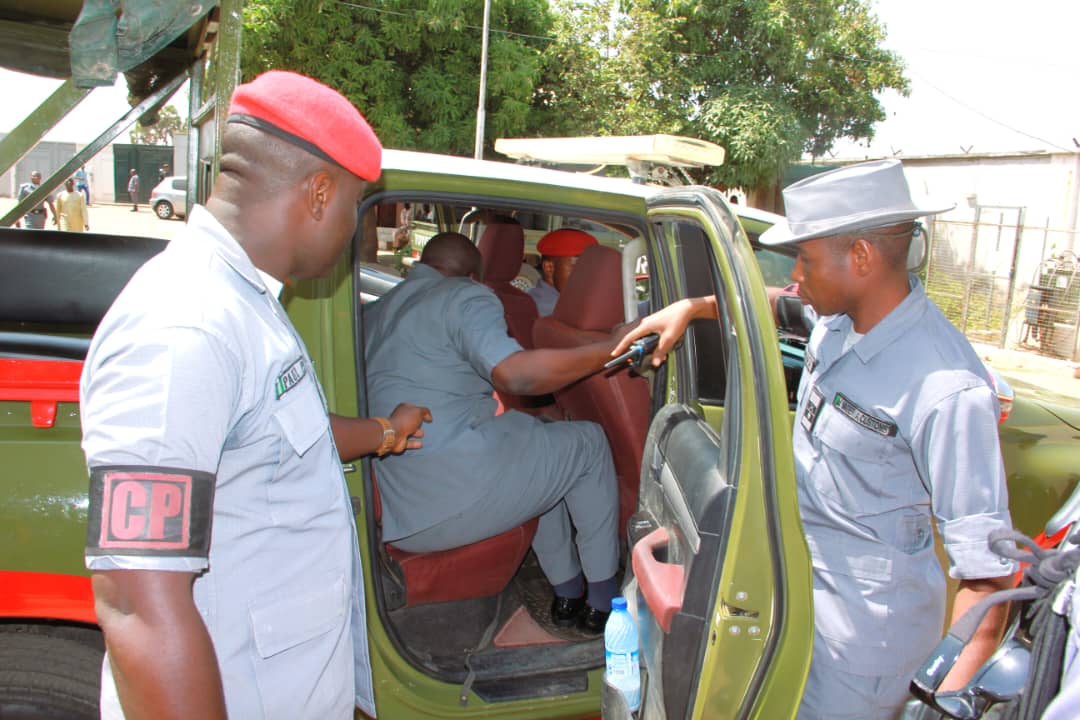
Allegation of extortion by officer of Nigeria Customs Service under investigation

By Sabiu Abdullahi 

The Comptroller of the Federal Operations Unit Zone ‘B’ Kaduna, Comptroller Dalha Wada Chedi, has taken swift action in response to allegations of extortion by an officer of the Nigeria Customs Service.

The incident allegedly occurred along the Mokwa-Jebba Road in Niger State. 

According to reports, the officer in question is accused of extorting the sum of Five Hundred Thousand Naira (N500,000.00) from a car buyer named Muhammad Dahiru Ahmad.

The complainant reported the incident, prompting an immediate investigation by authorities. 

Addressing the media at the unit’s headquarters in Kaduna, Comptroller Dalha Wada Chedi confirmed that the suspected officer is a member of the unit deployed to the Mokwa Patrol Team in Niger State. 

He stated the gravity of the allegations and the commitment of the Nigeria Customs Service to uphold integrity and discipline within its ranks. 

“The Comptroller General of Customs, Bashir Adewale Adeniyi MFR, and his Management team frown upon such unruly behavior,” stated Comptroller Dalha Wada Chedi. “The disciplinary committee will conduct a diligent and firm investigation into this matter.” 

The suspected officer has been handed over to the Assistant Provost Marshal (APM) Customs Police Unit in Kaduna for a discreet investigation.

Comptroller Dalha Wada Chedi assured the public that the findings of the investigation would be transmitted to the Nigeria Customs Service Board for further action. 

“We are deeply concerned and assure the general public that this matter will be treated with the deserved vigor, decisiveness, and transparency,” he added. 

The Comptroller pledged to provide updates on the investigation’s progress, urging the public to continue rendering support and cooperation. 

The Nigeria Customs Service remains committed to maintaining the highest standards of professionalism and accountability, and any misconduct within its ranks will be thoroughly investigated and addressed accordingly.

Extortion and exploitation: the double banes of quality education

By Salim Yunusa

Salim Yunusa As the summer break draws to an end and schools are set to resume in the coming weeks, parents are already grumbling over the increased school fees across many private primary and secondary schools across the nation, despite their salaries not increasing even by an inch. Due to the not-so-great condition of the public schools, parents have no other options than to send their wards to these private schools.

Although private schooling is a money spinning venture for many school owners, the least these schools should provide is excellent service delivery in teaching and imparting discipline on students. Unfortunately, this is not the case in many instances.

The learning facilities are substandard, to say the least and the teachers are below par in quality. Their sights are set on the profit the schools will return, not the excellence they’ll deliver and the students they will be proud of at the end of the day. Most of the buildings rented by these low budget schools are originally residential houses or uncompleted buildings that are converted to classrooms with little or or no ventilation; with tiny classrooms containing high number of students in each space.

Many of these schools are not fit for learning, with some of these classes demarcated with cardboards or plywood to create more space. There is absolutely no regard for safety standards and building regulations of any sort. I know of a “school” facility that serves as a school during the day and a football viewing centre at night.

Another school that upsets me anytime I pass it by is a school for young kindergartens and primary students that is directly beside a huge fueling station and inches away from a major highway.

I wonder what the development control authority was thinking; approving such a chaotic land use violation. Yet, it is these schools that charge parents outrageous amount of money every time. It is high time the government wades into these fraudulent waters; making sure that every private school that operates is duly registered, has a license and has ticked off every box of standards and regulations. It also has a responsibility of regulating the uncontrolled and unreasonable school fees and levies set by these schools themselves.

One would think that as these schools are extorting parents in broad daylight, their staff would be well paid. That is far from the reality. Teachers employed in private schools suffer the worst form of dehumanisation and extortion by their employers, unfortunately. They’re overworked and underpaid, with some teachers in some schools taking home less than N10,000 in a month…in 2023!

Their employers take advantage of the saturated labour market that is filled to the brim with young, unemployed teachers – qualified or not – and are desperate for employment. Some of these teachers are unqualified and burdened with many subjects in order to cut the cost of hiring more teachers. They learn on the job for long hours and meagre pay, with threats and deductions for the smallest of mistakes. They’re constantly in fear of speaking up or speaking out against their employers because they can be sacked without any reason whatsoever.

It is the height of wickedness to make parents pay through their nose for their children’s’ education without actually getting the value for their money in a tight, cramped up environment that is not conducive for learning while at the same time underpaying and overworking their staff.

Schools should not only be an avenue to generate more money for their rich owners. They should uphold a standard of excellence and quality delivery of education that’ll produce educationally sound students who can compete nationally and globally.

The government, as a matter of urgency, should continue to upgrade its schools so that they become more attractive to parents than private schools. That way, it will be a healthy competition; judged based on excellence and quality education but before then, they have the responsibility of registering, regulating and standardising private schools for the development of education in the nation.

Salim Yunusa writes from Zaria and can be reached at syunusa@gmail.com