entrepreneurship

A Generational Discontent: A tribute to Mallam Ali Garba

By Adamu Tilde, PhD

This tribute should have come earlier. I have tried to write something about Mallam Ali Garba several times, but it always ended in a stalemate. Not that I can capture the essence of Mallam in a few paragraphs, but I, nevertheless, will share what Mallam meant to me.

It is trite to discuss the mutual distrust between the few Western-educated elites and the remaining populace of the Muslim North. The condescending looks the former harbour for the latter has inadvertently led to animosity, disdain, estrangement, and suspicion. This mutual distrust has stalemated the needed cultural and social changes and transformation for growth and development. 

For long, the ordinary populace cannot find reasons to associate with the educated elites; the elites, on the other hand, cannot understand why the public views them with utter cynicism. In my view, the effortless meandering of this contradiction tells the essence of Mallam.

Mallam was educated in Kent up to PhD level, published books and articles in reputable journals, worked in some elite organizations and finally settled in Bayero University Kano (BUK), Department of Business Administration, until his demise. This impressive resumé only made Mallam more courteous, down-to-earth, and humble. So, how did he surmount what appears to be an insurmountable challenge? I will come back to that later.

I first met Mallam in 2014 at Kano Central Hotel. I was selected for a workshop on entrepreneurship by Hajiya Amina Ado Kurawa. Mallam was one of the resource persons. Given how Hajiya Amina praised Mallam Ali, we waited with bated breath for this all-important resource person. We were not disappointed. Mallam delivered a flawless presentation. I could not wait to engage him after the presentation, only for Mallam to excuse himself for another engagement. I later searched for his name on Facebook. 

Mallam interspersed his discussions, teachings and writings with ‘barkwanci’ (humour). This invited a lot of traffic to his wall; it also made his students and followers feel at ease in his presence which thus facilitated two-way communication. You would feel confident asking Mallam anything.

Another charming trait that won Mallam many hearts was the extent to which he would reach to correct you without belittling you or making you look/sound foolish. This all the more made him endearing and welcoming. 

Mallam knew he had a lot to share, and we were not making better use of his knowledge and experience. He looked at us (Tijjani, Marzuq, and I) in one instance and said: “Use me.” In another instance, during our first visit to his house, he invited us upstairs, introduced us to his wives, and finally said to us: “This is your house. Come whenever you want.” We were not alone. He did this to many. This unassuming and welcoming personality made Mallam a darling to many and led to the birth and polishing of innovative business ideas. Maryam Gatawa’s Gatmeals is one example. 

Muslim North has no shortage of brilliant minds bristling with excellent ideas that can transform its economic prospects into reality. However, I suspect that the knowledge of how to harness and translate these innovative, transformative ideas into reality is in short supply.

One way of achieving this is to bridge the gap of access between the two aforementioned mutually distrusting classes. This is the essence of Mallam Ali Garba. And this was what Dr Waziri Junaidu cautioned us against in 1971: “Let not your degrees, research and publications be an excuse to feel haughty amongst your own people. Knowledge is at best when it is universally useful, and the best scholars are those whom the ordinary man fears neither to encounter nor to address.”

Adieu, Professor Ali Muhammad Garba.

Dear children of the masses, wake up

By Hassan Ahmad Usman

What else do we need to see before we believe that we don’t have anyone to cry out to, fight with, or even be our hope? 

Two things happened over the weekend that explained clear how dualism exists in Nigeria. First, the gap between the so-called “elites” and the masses is so wide that you can’t imagine these two people living and sharing a country.  It is a clear call for us, the less privileged children, to have sense and redirect where we burn our energies and pursue a realistic future.

First, when airline operators announced their resolution to stop operations on May 9 due to the ever-increasing prices of aviation fuel, we thought it was time for them too (elites) to feel how discomfort Nigeria can be and how a malfunctioning Nigeria is not suitable for anyone. But our curiosity got punctured when we woke to the news that the operators had suspended the planned stoppage of operations.  Why? How? We only have one answer – it is something that has to do with them (“elites ” or “big men” if you like). They don’t deserve humiliation. On the contrary, they deserve a swift response to what affects them (even behind closed doors). They are the true Nigerians.

 How do you expect an Atiku, Tinubu, Moghalu, Wike, Amaechi and the rest to campaign without air transport? Osinbajo will undoubtedly use the presidential fleets. So he’s a bigger boy. 

On the hand, ASUU announced the end of their warning strike of three months with another three months of strike ( it doesn’t even sound logical). How can you go on strike while on strike? So it is another painful morning for the children of the poor and their parents. 

It is high time we understood that to survive in Nigeria with these same elites; we must go beyond being their praise singers or political foot soldiers for actualizing their political dreams.  We must understand that our unborn children deserve much more than we have.  

Our schools have been closed for a quarter of this year, and we’ve braced up for another quarter to go unaccounted for.  Unfortunately, given the political atmosphere looming for the next general election, the ground is set for them to cultivate many young, hungry people for political thuggery with the help of our lecturers who never see sense in keeping us in school to shape us for the future.  

My dear children of the masses, our lives and future are not and never tied to any politician.  Therefore, despite our condition, we can dream and aspire just like their children. What we need is to focus and keep building in ourselves.

Let’s equip ourselves with relevant skills. The certificates ASUU and the Federal Government of Nigeria are denying us are becoming irrelevant on the global stage. Yes,  education is good, but there is no specified timeframe for it. We can build ourselves before going back to classes. So, let’s endeavour to show that we’ve not only come of age, our senses, too, have come of age.  

Hassan Ahmad Usman writes from Lafia, Nasarawa State, Nigeria. He can be reached via basree177@gmail.com.

What next after NYSC?

By Fatima Usman

During their compulsory National Youths Service Corps (NYSC) scheme, many people don’t usually ask themselves, “What next after the service year”? Many people know what they want and what to do, but they don’t have any concrete idea of what they want or even what they want to do.

But now, the service year is over. For many, the reality will face them right in the face, NO MORE ALLAWEE (33,000 stipends). As small as this money is, it will become gold to many who could not find a job after some months of completing service.

The scheme’s purpose is primarily to inculcate in Nigerian youths the spirit of selfless service to the community and emphasize the spirit of oneness and brotherhood of all Nigerians, irrespective of cultural or social background. This is because the history of our country since independence has indicated the need for unity amongst all our people and demonstrated the fact that no cultural or geographical entity can exist in isolation.

The Joy of every student is to see that they graduate and serve their father’s land without minding the stress they passed through while in the school, but then what next after the one year of NYSC? This is the question many people ask themselves while still on camp, but when you know the answer to it, you are good to go, and vice versa.

After the service year, you are faced with the next phase of life. Some very lucky ones will get a well-paying job or will further their education, while others may have to start all over again after the 33k allowance must have stopped coming.

Back in the day, when a person graduated from tertiary institutions, there was a high tendency that such a person would get a well-paying job without any stress of going to look for a job, but now the case is different. Many students are scared of even leaving the NYSC because they know that there’s no job.

Millions of graduates with outstanding results out there are looking for white-collar jobs, but the country doesn’t have jobs to give everybody. Thus, you should try as much as possible to acquire one or two skills that can be of help after your service year. Don’t wait to finish NYSC before you start thinking of what to do next. Before you even go into NYSC, ask yourself these questions:

What is life after NYSC?

What am I going to do after NYSC?

How am I going to start with life?

When you know the answers to these questions, you are 50% on the track. Today’s world requires us to do more than going to school or graduate with good grades.

Don’t be carried away by the title “graduate”; get yourself something doing. If you have a skill already, develop it; start from small. Yes, it’s pretty stressful, but you will reach that goal with determination and hard work.

Many people who are now successful today passed through a lot, but today they are doing fine. So if those people can do it, there’s no excuse for you.

Fatima Usman is a 300 level student of mass communication at IBB University, Lapai. She can be reached via usmanfatima499@gmail.com.

On schooling and becoming rich

By Alkasim Harisu Alkasim

Often, the people that idolise going to school are arguably the ones who, in the long run, turn out to be stinking poor. This is to paraphrase a friend that ardently considers schooling a total waste of time. This assertion is controversial. But, is my friend spot-on or not? It is, to some extent. Still, I have my buts. 

This argument has often generated a heated debate amongst us. Whenever it comes to my mind, it reminds me of Kiyosaki’s book Rich Dad, Poor Dad. The writer dissects factors that hinder the learned from earning big bucks. Kiyosaki argues that going to school is the biggest hurdle that denies one the chance to make a bank. He opines that a person spends twenty to thirty years worshipping books, yet, over that period, he scarcely becomes a big gun. Unfortunately, in Nigeria, one ends up jobless after this long journey. 

Debunking formal education, Kiyosaki argues that a person is not taught a single subject on how to make money from primary school to university education. The conventional subjects such as chemistry, physics, literature, etc., are what one seriously enrols in. In his opinion, students should be taught topics such as financial education. Education indeed discourages one from accepting jobs that are not money-spinning. For instance, somebody with a Master’s degree or PhD will feel ashamed to sew for a living, not to talk of driving the commercial tricycle (aka A Daidaita Sahu). 

Are the graduates the only ones to blame? This is a question we should all ponder. The government is blameworthy too. Like it or not, the government cannot give everybody a job. True. But it can establish a conducive environment to doing other jobs. I have never hunted for gainful employment, thanks to my passion for academia. I know this job in Nigeria does not make you a money bag. Yet, I have for long picked interest in it.

In the developed and even some developing economies, the private sector employs a great score of people. The government creates an environment that will aid it to carry out its businesses for the sector. Private sectors pay handsomely in such countries, especially in the western world. I wondered if you know that employment is scarce even in the UK. Even the rampant lack of jobs causes deviance and other criminal acts there. (See Haralambos and Holborn’s book on Sociology).

Of course, we walk tall. We don’t want to do what society looks down on. However, some of us make an exception here. I know of a person with a First Class honours degree in engineering who humbled himself and took up a job many of us can’t do. He ekes out his livelihood from selling coals, taking pride in it. He sees the world of the little he earns from what he sells. Life goes on. Nothing reduces his charm.

I was once in India for a higher degree. There, I saw a lot of wonders. We had a cook in our university who is a master in political science. It is said that people with first degrees in India outnumber the whole population of France. Remember, India is the second-most populous country in the world. Imagine somebody in Nigeria cooking for a living. I don’t say we can’t find one. But rarely can you find more than two in your quarters. Of course, people with degrees, or even diplomas in Nigeria, feel too big to do lowly jobs. I, nevertheless, think our arrogance is reducing because you can now see graduates doing menial jobs. Why not? There is a score of jobless First Class students roaming the streets.

I submit that people with higher educational qualifications always end up jobless or not raking it. People with lower qualifications or no qualifications are the ones that are the business moguls. Jeff Bezos, Bill Gates, Elon Musk, Mark Zuckerberg and Aliko Dangote are textbook examples. Zuckerberg dropped out of Harvard, and he is now stinking rich. 

Indeed, formal education discourages and slows down creativity. It also dampens one’s enthusiasm. Honestly, the way an avid reader confines himself in his study speeds his entrepreneurial death. This is nothing but creative imprisonment. Whenever in his study, the reader seems to imprison his creative faculty in books. He brims with wishful thinking,  ideals and all what-have-yous owing to his fervent reading of all sorts of books. 

Having read a lot, he begins to idealise the world. He pictures and pores over how the world should be. But this is just his wildest dream. In his attempt to make the ancient Greece an ideal state, Socrates lost his life. He was sentenced to death for being a corrupt influence. In his book The Republic, Plato also romanticised how Greece should be,  how rulers should lead, the type of people to obtain in a state, and those exiled. After all, he died not having his dreams fulfilled.

Not very long ago, Karl Marx and Friedrich Engels conceptualised and advocated a classless society in their works. For instance, they co-authored a book titled Communist Manifesto. In the book, they discussed how the masses could emancipate themselves from the domination of the bourgeoisie. In his three-volume book Das Kapital, Marx critically studied the architecture of the economies of European societies. Unfortunately, most of the ideations and philosophies of these great thinkers flopped. For instance, Marx’s classless society idealised where all and sundry would live equally has yet to happen. Marx, who died an atheist, lacked the knowledge that such a classless state is a paradise. So said Dr. Saidu Ahmad Dukawa.

May Allah awaken and help us embrace the realities of today’s world. May we not feel too big to do the most menial jobs we can find around. The journey is long. You can start unimportant and end up important, and vice versa. Remember that Margaret Thatcher was from a lower-class family. She went through rigours to make it to the upper class. 

Wonderfully, Thatcher became the first female UK Prime Minister. She was even taught how to speak, walk, and act in an upper-class-like way when voted into office. Like the UK and other democratically capitalistic countries, Nigeria also allows social mobility. Thus, try to move up the economic ladder. Just give it your best shot. You can. I, rest assured, know you can.

Alkasim Harisu Alkasim wrote from Kano via alkasabba10@gmail.com.

How I started my own business with zero naira

By Zainab Ahmad Dantsoho

Most people believe that one cannot start a business without huge capital, but that is absolutely wrong. So let me first define what capital means according to economics.

Capital is anything that increases one’s ability to generate value. It can be used to increase value across a wide range of categories, such as financial, social, physical, intellectual, etc. In business and economics, the two most common types of capital are financial and human.

But I will like to give my definition because the most neglected is the Human Intellectual faculty.

In the 21st century, capital is the ability of an individual to think using the intellectual capacity to make money in the absence of little or no resources.

I want to stick to my definition because based on analysis, our economic index can be weighed by the standard of living and income expenditures, but I come from the North where according to the average statistics of people living in poverty as of 2020 holds 87% of Nigeria’s poverty rate – World Bank

So, are there resources in the North? Of course, YES! But the problem is intellectual capital.

In a community where people can’t even feed properly and begging seems to be a way out, how do we end poverty in families and our communities? I have asked this question to myself a lot of times.

Our northern community would be great if only our brains can think about starting a business with zero naira or little or no capital. And this makes me think that in the absence of money and basic resources, the only value any society could have is thinking skill because that’s the best way to beat poverty!

Let me take you through my journey of 1 kobo.

At a point in my life, I just decided to start my own business, make money in a halal way, take care of myself, and help the people close to me and my community at large. So I asked myself, “Zainabu, what about the capital? Where will you get the required amount to start the business?” Of course, this immediately came to mind, but then I remembered capital doesn’t necessarily have to be money.

Thus, I started going to some perfume shops, taking pictures and samples of the perfumes, showing friends, advertising on my social media platforms. Then, when someone asks for it, I’ll quickly go back to the shop and get what they wanted while adding a little profit for myself. This continued for months, and I was able to save some money!

So, I realised that the only capital I have in the absence of resources is my intellect, the ability to think and make money. So, these are a few basic things I had my eyes out for when starting my one kobo business.

  • Location – Where can I sell this product?
  • Demands – Is the product highly consumables, highly used in my environment?
  • Standard of living – this is where I have to think critically. Can they afford it? If they can, at what cost, and what’s my profit because nobody wants to start a business losing. It’s a win-win goal.

Then when it comes to branding – since I have no resources and capital of my own, whenever I want to make more profits, I usually meet the producers and negotiate with them. They make it, but then it carries my business name and agrees on percentage without losing anything but gaining. Most traders into cosmetic products typically agree with this since it offers mutual benefits.

Now, let’s talk about mind poverty, also known as mentality poverty. Mentality poverty is not the absence of cash and resources. It’s simply our way of thinking and behavioural pattern.

And I also think our average mentality is poor, and that’s why poverty in African societies seems to be inherited. We have resources, yet we are poor. It’s time to shift from the cash flow method of capital and currency to its intellectual flow because, that way, our community will grow.

If we were to cut down the amount we spend on our phones, clothing, accessories, cosmetics, etc., we would be surprised at how much we will save.

One may wish to know the advantages of this type of business. Don’t stress yourself. I will help you with some basic information.

1.  It empowers you

2. It eradicates poverty

3. It`s easy to access

4. You earn without deposit

5. You can advertise from your home using your social media handles.

If you aren’t on social media, you can do Door to Door, attend events or places where you can meet many people, and take advantage of friends to friends marketing strategies.  Especially for those that don’t go out.

But here are some of the challenges you will face with this type of business:

1. People may want to take credit from you, and you can’t give it out since the items don’t particularly belong to you; for me, it’s even risky giving and selling items on credit.

2. You may need more time and patience to get customers.

3. Sometimes such items may be out of stock, so that means you need to know or keep contact with the store, to what’s available and what’s not available

4. You may need one or more stores to patronise, if you want quick profits and if it’s worth the energy!

My advice to our young entrepreneurs is that we should always avoid perishable goods, except if the areas we live in have a high demand for those particular items.

Lastly, with the way our economic system is currently running, it is still possible to start a business with zero or little income. So don’t wait for significant capital. You can save and think, spend wisely, and Allah will certainly help you.

I hope you will find this article very helpful and join our one kobo community to start your business and get substantial information from us.

Why not make a move and be your boss with zero naira today?

Zainab Ahmad Dantsoho is a graduate of the Federal University, Gusau and an entrepreneur. She writes from Kaura-Namoda Town of Zamfara State. She can be reached at zainabahmaddantsoho@gmail.com.

Drop that certificate, go after your passion

By Aminu Mohammed

I must confess that I wrote this article due to a post made by a Facebook friend who just completed the NYSC scheme in Jigawa state. In the post made last week, he mentioned his readiness to fall back on his skill as an iron bender to fend for himself, pending when something better comes up.

I was impressed by his sense of reasoning and his zeal to drop his certificate and embrace a vocation to escape idleness and poverty. This has become apt given the current realities in Nigeria, where jobs are pretty limited and difficult to come by.

I know many people, especially recent graduates, will sneer at me for commending this young man for the courage to take responsibility for his own life. They may even wonder why I praised him for choosing to do a “menial job” below his status as a graduate.

But the reality today, coupled with the dwindling economy and limited opportunities for the teeming youths in the country, warranted me to write this article. The era of youths waiting for white-collar jobs is over. Many graduates are roaming the streets looking for elusive jobs. Typically, the few jobs available will be taken by the best candidates and those with a connection at the high places. Thus, most applicants are left with the option of either staying idle at home or embracing any vocation or skill to earn a living.

Let me clarify that I am not a motivational speaker, and neither do I claim to have a magic wand to turn silver to gold. But I believe in pragmatism, and the ability one has to achieve his goal if he has passion and works towards it. Passion is the only thing that can keep a man steadfast in his pursuit of success irrespective of the difficulties on his path. Your certificate will amount to nothing if you cannot shun pride and seek a means to earn a living.

I still recall my NYSC days nostalgically in the Numan, Adamawa state, 19 years ago. I did my primary assignment at Government Secondary School Pare, Numan, which gave me ample opportunity to engage in external activities. I kept myself busy outside school hours by selling clothes and shoes to augment the N7500 NYSC monthly allowance. I didn’t spend much out of my monthly stipend throughout the service year because my side business could cover my living expenses. I completed my NYSC in 2003 and engaged in various activities to earn a living for three years before I got my first job in August 2006.

During the service year in Adamawa state, I observed a stark difference in the mindset between some southern corps members that I interacted with and their northern counterparts. While some southern corps members engaged in all sorts of activities to earn income, some of their northern colleagues see those activities as demeaning to their status as graduates. Some of the southern corps members then decided to stay in Adamawa after the service year to continue their hustle, and many have prospered.

I still remember a friend we served in the same local government area, Mr Ifeanyi, a pharmacist from Anambra state. He did his primary assignment at the General Hospital, Numan and subsequently moved to Yola to set up a pharmacy after the service year. He was able to prosper a few years after the NYSC scheme due to his doggedness and zeal.

I decided to narrate this story to encourage our youth to shun pride and find a means or trade to improve their wellbeing. Acquiring education is just a means to enable you to unlock your potential. That you have a degree should not make you despise other vocations. Instead, find a work you are interested in and try to acquire the requisite skills to support yourself. Life after NYSC is tough, and the labour market is almost saturated due to many unemployed people seeking jobs.

I am not saying that our youth should focus only on entrepreneurship alone and abandon their certificate by not seeking jobs. Of course, not everybody has an inclination towards business and entrepreneurship. But for those that have no interest in entrepreneurship could learn other skills via the internet. Skills such as digital marketing, affiliate marketing, and web development are there for people interested in learning to earn an income.

In Germany, young people acquire skills in various fields through the vocational system popularly called “Ausbildung”. I admire the German Ausbildung system because a student attends school and works simultaneously. The student acquires theoretical and practical knowledge during the duration of the apprenticeship, which usually lasts three years. The training focuses on practical skills for actual work and includes several skills such as plumbing, software development, landscaping, mason, baking, painting, salesperson, nursing, care for the elderly, and electrician.

Those who completed the training earn very well just like their counterparts who obtained a degree in Germany. Ausbildung is highly valued in Germany, and the need for craftsmen is always on the rise here. German society has been structured so that virtually all jobs are accorded due respect. Nobody looks down on a painter, electrician, carpenter or mason in Germany, unlike what we do in Nigeria. Most of our youths, especially graduates from the North, shy away from doing those jobs as they see them as not befitting their status. Some prefer to remain idle at home while hoping to get a job. There is dignity in labour, and it is quite normal to see a female painter, mason or female plumber in cities across Germany.

Therefore, the onus is on the youth to follow their passion and strive to achieve their personal goals. Efforts should be placed on personal development through reading and skills acquisition. For instance, if you have an interest in baking, do not hesitate to go and learn it to support yourself, likewise any other skill. Life favours the meek and those who shun societal pressures and go after their passion and dream.

I will also urge our young men, especially new graduates, to leave their comfort zone. If you think that opportunities are very limited in your locality, there is no harm in moving to another city to take advantage of better opportunities there.

Do not hesitate to read good books, as it opens your mind to great possibilities. Scholarships are also available for those who are interested in studying abroad. You can use Google to search for scholarships in various universities across Europe, Asia, Canada and the United States. There are multiple scholarships worldwide for you to apply for, and there is no harm in trying. You could be lucky to get one if you meet the requirements and expectations even though it is highly competitive. Do not be discouraged if your application is rejected but continue to persevere and reapply to other scholarships. I also faced many rejections while seeking admission in Germany.

Take a look within your locality and find something to do. You can volunteer your time and energy to learn something new or even work on a farm. Don’t bother about what people will say; so far, you have a target and a dream of where you want to go. Try to get busy with something no matter how small it is, pending when you get the desired job. Remember that many big organisations and establishments that you see today started small several years ago. May Allah bless our hustle and efforts as we strive to achieve our goals this year.

Aminu Mohammed is at the school of Sustainability, Christian- Albrechts- Universität zu Kiel, Schleswig Holstein, Germany. He can be reached via gravity23n@gmail.com.

How tailoring saves my father

By Lawan Bukar Maigana 

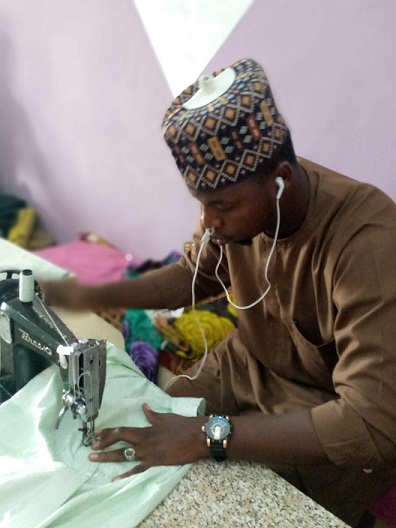
I learned tailoring before I finished secondary school. I can still remember when my patient father asked my mother to stop me from going to the tailoring shop. I begged her to beg him to allow me to continue going. Thus, she politely explained the importance of allowing me to be an entrepreneur. Luckily, she okayed everything she said and allowed me to continue learning.

I took myself to my boss Babakura Lawan. I was passing by and saw my friends working in his blessed shop. I stopped by, met him, and told him that, “You are my older brother’s friend. Thus, please, teach me how to tailor.”

I knew the way I talked to him wasn’t friendly at all. I was battling childhood at that time. He kindly responded, telling me that he agreed and would teach me if I genuinely wanted to learn it.

It was an unforgettable experience. Guess what! I started sewing in two weeks because of my commitment to learning it. It worked out for me. Tailoring has helped me a lot in both Polytechnic and the University. I would have disturbed my father with many monetary requests if I had been unskilled.

I can’t describe how much grateful I am to my boss. He helped me a lot. I can still remember the times I reported him to my father because he bombarded me with many works. He told me that he gives me more work than others in the shop because he trusts my work.

Graduates who are still unemployed and seeking jobs shouldn’t feel they are late to learn paying entrepreneurial skills such as tailoring and carpentry.

My brotherly advice to graduates is: do not allow arrogance to consume them. Whoever is arrogant may fail in life, especially if they are poor. It is not too late. Stop spending much time on social media. Learn some skills, hard or soft, online or offline.

Look for any learnable skills and learn. We all know that there are no available jobs for poor Nigerians. Only a few will have the opportunity to be employed. So kill the arrogance in you!

Babakura Lawan is a graduate of accountancy from the University of Maiduguri. He has trained more than 25 people in Bolori I, Maiduguri. I called on the federal and Borno State governments to please engage people like him to teach as many graduates as possible. We need many of his likes in Nigeria. 

Lawan Bukar Maigana wrote from Maiduguri and can be reached via lawanbukarmaigana@gmail.com.

My life, my choice: Why I rejected university job for catering (II)

By Aisha Musa Auyo 

Coursework lasted for four months. I enjoyed it as it’s Psychology, and got excellent results. But I couldn’t go back as planned, as I had already enrolled my kids in school. I complained to my parents about my lack of a job and how relatively boring it was to stay without my husband. They promised to do something about that. I ventured into the catering business full-time while my husband and I were still making plans to reunite. Fortunately, another transfer was by the corner, so the goal is to wait and see the posting. Living alone was getting harder for him and affecting his work productivity. No man wants to go home to an empty house. No man wants to be eating out every day; the inconveniences are just too numerous.

On my side, I felt empty and taking care of the home and raising the kids alone was taking a toll on me. He could only come once a month and spend two to three days. His kids saw him as a stranger. Although we were constantly on video calls, it’s not the same as being present.

An opportunity for a university job came, but I rejected the offer, explaining that we were leaving as soon as the transfer came out. The one and half years we did apart as couples have taught us never to try that again; I’ve changed my decision on work. I called my husband, told him about the offer, and made it clear I was not accepting it. He advised I should not do anything hasty, but I remained unshaken. Any job that would tie me to one place and make me apart from my husband is not worth it. At that time, the transfer came out, and the location was not travel-friendly. His workload too would not allow unnecessary travel, so the job is a big No for me. 

However, People judge from afar and couldn’t hide their disappointment of me not working in a cooperative world. A neighbour looked into my face and told me, ‘if you reject the job because of your husband, I swear you will regret this decision’.

 I was not saying I would not work outside my kitchen, but whatever my work is, it shouldn’t be the one that would split my family apart. One should not be surprised if they see me working outside home tomorrow if the work was within the place I stay and can offer transfer whenever we are made to leave the state. So, yes, my future work should revolve around my husband’s work state.

But for now, I choose catering, and I decide to do what works for me. Who knows it, feels it. Those who mattered have accepted and made peace with my decision. The challenge now is balancing the catering business with my PhD thesis.

Let me explain why my parents want us to pursue these degrees. They are university professors, have few kids, with guaranteed pension and gratuity. So, they don’t need any financial help from us. But they want us to be independent and financially stable. In addition, they want us to be highly educated and respected. As parents of girls, in this era of divorce, irresponsibility, and many life uncertainties, they know the best they could give us is this education.

Our parents often tell us that they’re not rich; they won’t leave us with mansions and millions when they die. This education is the only legacy they have, and I understand them. The University environment does that to its inhabitants. This is a general problem ‘we quarters’ children’ face.

A neighbour of mine whom we came from the same quarters made a similar decision not to work or further her education. She told me how her dad used to compare her to coursemates, that they’re all PhD holders now and doing great things in the university. Thus, he always begged her to at least further her education. To our parents, a bachelor’s degree is never enough.

To say I’m grateful to my parents is an understatement. Wallahi, I often cry, knowing I can never pay them for all they did to me. They’ve given and are still giving me the best of everything; we are over-pampered. We are the envy of our peers, and we have achieved so much at young ages due to their persistence and guidance. It’s not only Boko (Western education) they gave us; they also ensured all of us have memorised the Quran at young ages and have attended multiple Islamic schools and conferences.

Moreover, they have our best interests at heart; they are even overprotective. So I’m not only grateful, but I always feel indebted. All I do is pray for them to have the best of here and hereafter. Now, this story is history as I’ve eaten my cake and still have it. I’m doing my PhD while my family have been reunited. A postgraduate program is temporary and flexible. I’m glad I followed my parents’ advice, thanks to them, I’ll be a young Dr soon inshaAllah.

The lessons here are:

1. Allow, guide and encourage children to follow their dreams and passion. The result is a win-win, as parents won’t have to push the kids to work or study hard. Passion naturally breeds excellence.

2. Don’t make or set life goals too early. Be open-minded. The definition of success is very dynamic. Our dreams can change as we advance in age and transition from stage to stage in life.

3. Accept people’s decisions even if you have power over them. Just pray, and let them face the consequences. If it turns out good, that’s great. If it turns out bad, that’s a lesson, not a failure. All decisions are born from real-life experiences and or reading that change one’s line of thinking or learning an idea somewhere that sparks one’s interest in something.

4. When your passion is what you do for a living, your life will be happier thus healthier. The fulfilment and peace are on another level.

5. Diversify your knowledge and skill. Don’t just dwell on a single niche and plan your life around that. Don’t pigeonhole your thinking into believing that “I am a civil servant” or “I am a business person” and nothing else. It’s too dangerous. Life is dynamic; even if you chase degrees, learn a skill or trade. Government jobs are not guaranteed. Priorities also change, especially for women. For instance, my catering business has never been affected, even though I’ve been moving around. Cooperate jobs will not have been this flexible. 

6. Read, read, and read. Learn, unlearn, and relearn. Reading is an art that teaches one about life beyond their daily reality. Reading could help you avoid many problems, crises, and misunderstandings. Reading changes one’s outlook towards life makes one understand himself, those around him and the world better.

7. People should learn to mind their business and respect other people’s choices. Every individual is entitled to their decision. Making derogatory comments, asking personal questions, or judging based on half-baked information hurts. Many people think my husband, as an Ustaz, dictates my decision to be a housewife for now. On the contrary, he supports, pushes, and encourages me to work hard on my school projects. When I told him about the university job offer, he was willing to sacrifice. I single-handedly decided to reject it. He promotes my thesis and business on their tv channels. He pays for my air tickets whenever I need to see my supervisor and lots more.

8. Sometimes, one needs to stand firm on his decision, especially about his own life. Sometimes, one needs to put himself first; it’s not selfishness.

9. A married woman can actualise her dreams, career, and aspirations with a husband’s support.

10. To achieve greatness, one needs to make sacrifices. Success has never been achieved without struggle.

Finally, and most importantly, pray hard for God’s guidance on whatever decision or journey you want to embark upon. With a clean heart and good intentions, trust Allah to be always there for you.

Aisha Musa Auyo is the CEO of Auyo’s Cuisine and wrote from Abuja. She can be contacted via aishamuauyo@gmail.com.
Why are graduates unemployed?

By Uzair Adam Imam

Every year Nigerian institutions produce thousands of graduates who come out to compete for the few available job opportunities in the country.

There is no doubt that Nigeria labour market has continued to see a steep increase in unemployment.

Professionals have argued that there is a need for urgent action to save the country from an impending danger posed by the exponential increase in unemployment.

According to the National Bureau of Statistics (NBS), the unemployment rate increased to 33.30 per cent in the fourth quarter of 2020 from 27.10 per cent in the second quarter of 2020.

Today, Nigeria battles a high rate of crimes: insurgency in the Northeast, banditry in the North West, and IPOB attacks in the Southeast, aside from the cybercrime, which is inviting to the youths.

 These security threats are believed to have been caused by some circumstances, especially unemployment.

The root cause
A lecturer at the Department of Business Administration and Entrepreneurship, Bayero University, Kano, Dr Mu’az Hassan Mu’az, attempted to trace the root cause of unemployment among graduates in the country.

He said that the issue of unemployment would persist if graduates continue to look up to the government for jobs.

He added that graduates need to be self-employed to eradicate poverty and unemployment in the society.

However, according to him, one major factor contributing to the rising unemployment in society among graduates is wishful thinking of great life after graduation.

He said most students do not want to venture into small scale businesses as they think they would be employed in big offices when they graduate. This, he said, increases the number of unemployed youths in the country.

He stated, “If students will be innovative, the effect on the economy will be fruitful.

“Many will be self-employed, poverty will reduce, social vices will drop and above all, the government will generate revenue from these entrepreneurial ventures.

“Graduates will have to look inward, explore some of their capabilities so as to start something, no matter how small that could make them financially liquid.

“There are needs in the society that no one is offering to satisfy for a premium; try to do that, then one is in business.”

Unemployment breeds crimes
On his part, Malam Hassan Sule Adamu, an entrepreneurship lecturer with the Kano State Polytechnic, stated that unemployment might unfold to all sorts of crimes.

 Muhd said, “It leads to societal ill-being, human trafficking, prostitution, insecurities like banditry, armed robbery, burglary, social and political crises, and any other crime.”

Students air their grievances
Several students expressed their grievances over the lingering issue of unemployment.

They urged the government to come to their aid by creating more jobs opportunities.

A university graduate, who preferred not to be named, said that he bagged his Bachelor’s degree eight years ago from Bayero University.

He added, “Since then, I have been applying for different sorts of recruitment. But, up to now, I am not employed.

“But I thank God because I am running a small scale business from which I earn my living and even help my relatives.”

Bad governance complicates the situation
Another university graduate, Abdulmalik Ibrahim, said bad governance complicates the situation.

Abdulmalik added, “Bad governance, mainly corruption and inhumanity of political leaders, contribute to the present situation in Nigeria.

Suleiman Ishaq believed that the only way to arrest the situation was for the authorities concerned to create more business and job opportunities.