Education

Don’t forget your date of birth 

By Nasiru Tijjani

The role of guidance, counselling, and mentoring in our interaction remains strategic and fundamental for achieving one’s goals and objectives. Doubtless, none of us is perfect enough not to be mentored, guided, counselled or nurtured at one point or another. Therefore, mentors, parents, counsellors, teachers and the likes are vested with the power of educating the teeming youth on the implication of age in one’s life.

Honestly, age is one of the problematic issues that need to be treated with extreme caution. But unfortunately, the problem appears to be common even among the students of tertiary institutions, civil servants, corp members and business people. Initially, the issue cannot be divorced entirely from ignorance, carelessness, poor mentorship, parental attitude toward learning, policy review and implementation, selfishness and what have you. Therefore, age is needed in every situation to meet a particular requirement for admission, job or anything.

In Nigeria, as we grow older, our services are no longer needed in some institutions. Accordingly, National Identity Management Commission (NIMC) has classified ‘date of birth’ as one of the fields in the data of a person to be non-updatable and non-modified unless an approved fee of ₦15,000 is paid. Meanwhile, the country’s birth certificate is issued to the citizens by the Nigeria National Population Commission. However, until recently, ‘date of birth’ has not received proper attention from the youth, parents, teachers, mentors, etc. UNICEF (2016) has reported that only 30 per cent of  Nigerian children under the age of five (5) have their births registered. Meanwhile, the country had one of the highest average birth rates in the world between 2010 and 2015.

In the academic arena, date of birth has denied many people access to secure admission into higher learning institutions at national and international levels. For instance, a friend of mine was recently denied admission to an undergraduate programme in Sudan. The university management told him that was due to his age.

In addition, the National Examination Council (NECO) has reviewed its policy in 2020 and mandated that ‘date of birth’ be written on the candidates’ results. Furthermore, the National Youth Service Corps has introduced a new policy in the year 2020, which states that the date of birth must be written on the national certificate to guard against age falsification. Before this, the NYSC  policy had mandated that graduates should not be or exceed 30 years of age to be enrolled on the scheme. Therefore, with this mandate, many graduates end up collecting exemption letters.

Returning to civil service, ‘date of birth’ has sent many civil servants to early retirement. I discussed with someone who lamented that he had unceremoniously and unduly retired from service due to the age written on his documents. In contrast, his colleagues are still in the system, for they have no problem with age. I trust you have a lot to say on this case. In Nigeria, for example, the retirement age of civil servants is 60 years by birth and 35 years in service. However, on January 20, 2021, the Federal Executive Council (FEC) approved a bill to increase teachers’ retirement age and service years. With the bill in effect, teachers are now to retire at 65 years by birth and 40 by service.

Furthermore, no one can deny that banks attach value to the topic of discussion, and due to this, many people, including the writer of this piece, have suffered the pain of having dual dates of birth. Without hesitation, I can attest that many accounts have been restricted and closed due to irregularities in age. Equally, many transactions have been denied, cancelled or withheld by the banks’ managements. I trust you can give an example of the victim of the problem.

In sum, the issue of ‘date of birth’ should not be treated slightly…Therefore, one will be at an advantage if one pays attention to the date of birth. Because of this, the following recommendations will be helpful:

  • One should ensure they have a unique and standard date of birth.
  • Parents should be cautious by avoiding anything that will jeopardise their children’s future, such as negligence to NIN enrollment.
  • Parents should endeavour to register the birth certificates of their children in time or right at a tender age.
  • Birth certificates or date of birth should be committed to memory so that forgetfulness and what have you will not strike between what is and what ought to be.
  • No reason, or whatsoever, will warrant you to allow your friends to use your dates of birth.

Nasiru Tijjani writes from Gwaram Tsohuwa, Jigawa State. He can be contacted through tijjaninasiru@gmail.com.

Musa Abubakar Daura: The talented blind man who defies odds

By Salisu Yusuf

Musa Abubakar, 29, was born a full-sighted child in Daura, Katsina State. He came from a low-income family, though his mother teaches at a primary school. Her job helps her support a family that lost their breadwinner 18 years ago.

At 9, Musa started feeling some discomfort and strain in his eyes. When his mother took him to a hospital, he was diagnosed with “retinitis pigmentosa,” a rare inherited degenerative eye disease. Initially, he witnessed vision decrease and impairment, especially at night or in low light. While Musa went through this predicament, his father was bedridden with a terminal illness. So, he was loaded with the dice at a tender age.

At 11, he lost his father and, later, his sight. Life had taken its toll on him as he grappled with going to school, looking for a guide and contending with walking with a blind cane. Musa felt lonely, isolated and disillusioned; he needed a company that proved elusive. Sometimes he would want somebody beside him with a gentle nudge, but nobody was around to whom he could unburden and escape from his loneliness. So he started meditating on an escape route.

Later, Musa discovered that education was the only antidote against loneliness, boredom and disillusionment. So he went back to school. In the beginning, his classmates served as his guides. However, social stigma forced him to opt for a blind cane as his guides were insulted or maligned daily. Whenever he reached class, his classmates would take notes and dictate to him. His mother had attested to his precocious talent; he demonstrated extra guile and quick-wittedness during his childhood.

After his primary education, he also joined another conventional junior school, obtaining a junior school certificate with flying colours. His potential was realised when in 2015, he joined Katsina School for the Blind. He learned how to use his “embosser typewriter” to take braille (a form of written language for the blinds, in which the characters are represented by raised dots that are felt with the fingertips). He also learned to use his emboser printer to convert conventional texts into braille for easy manual reading. He artfully mastered the skill of manual reading. Whenever I visit him, I am bewitched by the power, beauty and manual dexterity of his tactile reading. 

Musa Abubakar completed his ABU diploma in English Education at the College of Arabic and Islamic Studies, Daura, with a merit pass in 2020. 

His academic activities were wonderfully exceptional; he didn’t only surpass many full-sighted coursemates, but he mastered a good command of English during class presentations.

While studying for his diploma, Musa proved exceptional and combined conventional and unique learning methods. He used the braille writer to take notes, a recorder to record the lecturer’s voice,  and would later use the braille printer to write his notes and unorthodoxly use the braille writer to convert longer texts into braille for easy manual decoding. 

Musa is currently a 200-level undergraduate of English at an NTI degree satellite centre in Daura. He weaves baskets and local chairs to earn his daily bread and support his education. He can teach and perfectly write on the board. He can also assess his students by converting their works into his embosser and grading them. He’s also computer literate. 

Katsina State Government should not leave this talented blind man to waste. Instead, he should be employed so that his intellectual treasures are explored. His likes shouldn’t be left to beg. They should, like his braille, be converted to help the human cause. 

Salisu Yusuf wrote from Katsina via salisuyusuf111@gmail.com.

How much is your salary?

By Hamza Sulayman, PhD

One of the most difficult questions to answer among Nigerians is “How much is your salary?”. It does not matter who asked the question; the answer is always tricky. It might be a father asking his son or daughter after spending a fortune paying for their education, or a wife asking her beloved husband. The reason behind this varies from one person to another.

I came across a US-based content creator (IG: americanincome) who moves around the cities of the US asking strangers about their annual salary. To my surprise, they always answer right away and specifically to the last dollar. He asked some follow-up questions, like what did you study? And from which university, how many years of experience do you have? And what advice will you give someone who wants to follow in your footsteps?

To me, that type of content creation is amazing because it provides the young generation with factual data on how they can achieve their goals, which is much better than what the guidance and counselling departments of schools and universities can offer. That is, if the department exists.

My recent interaction with some youth led me to believe that they are after the money or, as they say, “secure the bag”. So, for example, if you are willing to get $150,000 per year, you should work as a Data Analyst, Model, or Software Engineer. If you are humble, you can be a high school teacher and earn about $42,000 a year. If you have a higher taste, you can be a doctor or dentist and rake about $200,000 to $300,000. There are other non-formal sectors with high income, like a professional barber earning $300,000 (I was surprised too) and a sneaker dealer earning $150,000. Top on the list was a luxury watch seller that makes $1,200,000 yearly.

Enough with the numbers, can you answer the question? How much is your salary? Many people cannot answer the question because they don’t even know. After all, what they received is not what is on their offer/pay slip, or the amount is laughable. Some people don’t answer the question because of what people might expect from them. I remember one of my colleagues. He told me that when the salary scale of academic staff was circulating on social media, it became a blessing for him because his family and extended family saw his salary as a Professor and decided to reduce the responsibilities placed on him.

Although in Nigeria, what you study is not entirely relevant to where you work, having a guidance and counselling advisor or a mentor is still advisable. Find someone you want to be like in the future and ask him to mentor you. Learn from their strengths and weaknesses and be a better version of yourself. Lastly, choose a career path that will make you happy, whether it is about the monetary aspect or otherwise.

Hamza Sulayman is a postdoctoral research fellow at Zhejiang University, China. He can be reached via hamza.sulayman@gmail.com.

Were you mocked because of your English in school?

By Lawan Bukar Maigana

 I was spoofed when my father changed my school from a public school to a private school. I remember the first class I had. Our teacher, a lady, asked me a question, and I answered it. She asked me again where I got the answer, and I told her that I got it from my brain. She laughed at me, and everyone laughed at me because I spoke poorly. Our school fee was 16,650.

My friends were always laughing at my spoken English because I didn’t know how to speak good English. I still can’t speak good English, but I am working hard to perfect it. That same lady—my teacher—forced me to start reading a novel in class every day, and she mostly asked me to explain what I understood from the book. She corrected me as I explained it to the class, and that was how I started speaking gradually.

My proprietor had always told me that I would become a perfect English speaker one day and encouraged me to ignore my classmates and teachers who made jest of my English. With His mercy on me, I started speaking well with confidence until our graduation. Right now, I speak better English than some of my friends who laughed at me because of my English.

Today, she is proud of me anywhere she sees or hears about me. Had I worried about what my friends did to me then, I wouldn’t have become who I am today because they mocked me well. Some of them are on this platform. They will read this post and laugh at themselves because they know they have done many bad things to me.

Honestly, those days were difficult for me because there were days I didn’t talk from morning to the closing time in school. I didn’t know how to speak good English; English was our school’s only means of communication. So I chose to keep quiet because I didn’t want to be laughed at or mocked by my classmates.

Don’t taunt people with English and don’t laugh at people’s spoken and written English because everyone makes mistakes. No one has a monopoly on English knowledge, including native speakers. Don’t stop learning English because of what people think about you or what they do to you. Continue learning. You will perfect it one day; they can’t laugh or mock you anymore.

The world reads me today. I want to read your articles and watch you talking to a large audience one day. So, don’t stop speaking in public. Those who condemn you today can’t do so tomorrow. They won’t have the opportunity.

Lawan Bukar Maigana writes from Abuja and can be reached via lawanbukarmaigana@gmail.com.

Corps member empowers widows with sewing machines, donates books to school in Yobe

By Tijani Hassan

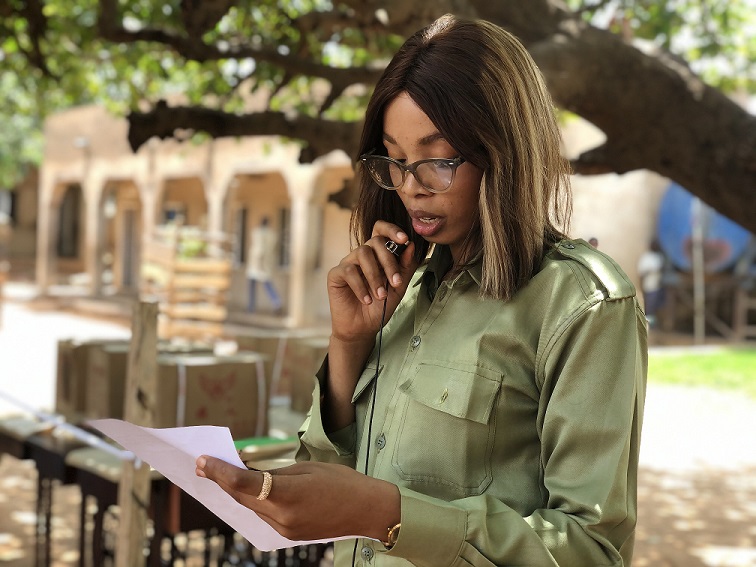
A corps member serving at Al-Furqan Learners’ Academy, Potiskum, Yobe State, has trained and empowered twenty widows on fashion design and tailoring skills in an effort to eliminate poverty and unemployment amongst women in the society.

The corps member, Chidimma Atuchukwu Obiageliaku, who hails from Anambra State, said the gesture was born out of her passion and desire to assist the vulnerable and less privileged in society.

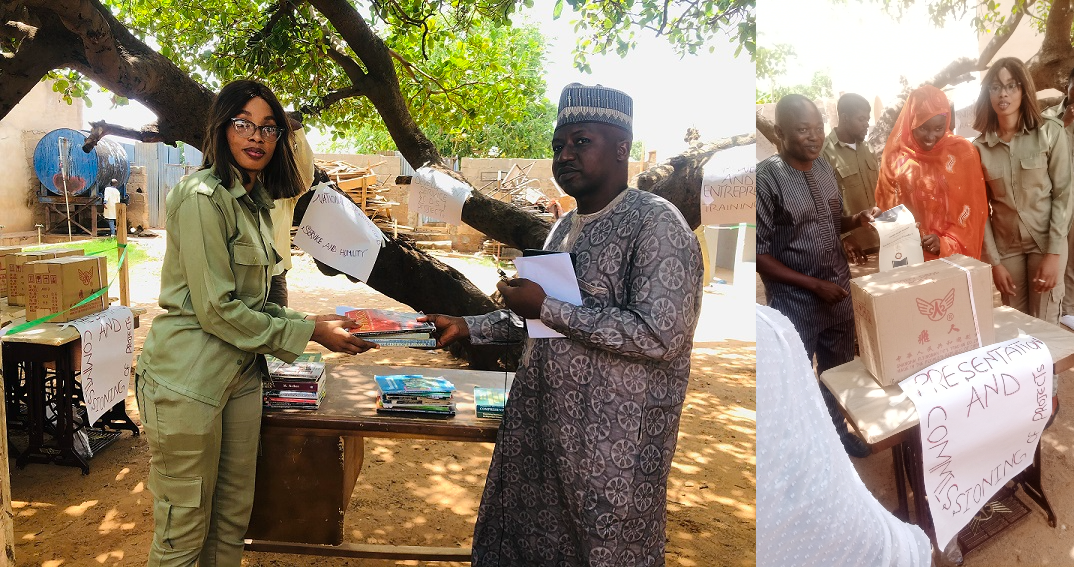
The Commissioning and Presentation Ceremony held on Thursday, 30 June 2022, at the school premises,  witnessed the presentation of certificates, wrappers, sewing materials and seven new sewing machines to the trainee widows. This came after 6 six weeks of intensive dress-making training and other entrepreneurial skills.

Other projects initiated by the Corps member included renovating and stocking a 40-seater school library to boost students’ learning capacity. She said, “whenever you read a book, it equips you with the knowledge and power to become whoever you aspire to be”, hence, donating the library to the school to equip the students to become great in the future.

In his welcome address, the School Director, Alhaji Ibrahim Mohammed, represented by Alhaji Suleiman Dauda, commended all the Corps members serving under his watch and specifically the project initiator Chidimma. He added that she was the first of her kind to execute a project of this considerable repute.

The state Coordinator of NYSC Yobe State, Hajiya Hafsat Yerima, represented by the Head of Community Development Service, CDS, Mr Abimbola Akin, expressed her satisfaction with the project carried out by the Corps member and hinted that the state would never forget her in a hurry while urging other Corp members to emulate her good gesture.

In his contribution, the Provost, Federal College of Education (Technical), Potiskum, represented by the Head of Digital and Visual Library of the College, Mallam Abubakar Hassan, explained that education is the bedrock of every meaningful society which deserves the contribution of all stakeholders.

Hassan, on behalf of FCE (T), Potiskum donated a reasonable number of textbooks to the school as part of their contribution to the project.

The benefiting widows, who were highly pleased, thanked the Corps member for the humanitarian support. The leader of the widows, Mrs Ladi, said the training is a lifetime investment that has transformed their lives beyond imagination. She prayed to Almighty God to grant their benefactor success in her future endeavours.

Other attendees included the Commissioner, Basic and Secondary Education, Yobe State, Dr Muhammad Sani Idris, representative of the Emir of Fika, His Royal Highness (Dr.) Muhammadu Idrissa Ibn Abbali, Humanitarian organisations, parents and students.

In his closing remarks, the School Director thanked the initiator of the projects and the sponsors and offered her automatic and pensionable employment with accommodation and other benefits after her National Service.

The Community Development Service is one of the key components of the NYSC, designed to have a beneficial influence on the lives of the host community.

Kano Gov’t settles NECO fees, includes PWDs, female students

By Muhammad Aminu

Kano State Government has said that all students who passed its qualifying examination would write the 2022 Senior School Certificate Examination organised by the National Examination Council (NECO).

Kano State Commissioner of Information, Malam Muhammad Garba, told journalists in Kano on Monday that the Kano State Government had settled part of its debt with the examination body.

Malam Garba further debunked what he called “erroneous reports” that the State owes NECO N15 billion naira.

He confirmed that 15, 313 students would sit for the examination as planned.

Mal Garba also hinted that the examination would not hold on Monday as it is only the Test Interpretation Practical for teachers to come up with modalities for the practical exams that would be held Monday.

He said the State Government also paid examination fees for over 1000 students with special needs in public schools to enable them to write this year’s examination.

He said: “We have settled for 15,313 Students with nine credits and the essay part of the exam is commencing on 4th July while the State still paid for 1,018,000 Disabled Students, which means that the story that Kano is holding N15 Billion Debts is untrue”.

According to the Commissioner, 7,500 female students’ registration fees had been also settled as part of a special intervention to promote girl-child education in Kano State.

He added that LGAs cumulatively also sponsored 5,400 students for the examination.

“15,313 students that had 9 credits from qualifying examination; 1,018 students living with disabilities, as well as 7,300 for Special Intervention which is basically for Girl Child Education; and local government councils paid for 5,400 students,” the Commissioner explained.

The Daily Reality reported earlier that Kano students may not write the examination due to debt settlement conflict between Kano State Government and the examination body.

The examination body demands settlement of N700m of the N1.5bn before the students will be allowed.

He said the state government had paid NECO N356m last week and would finalise their discussion any moment to resolve the impasses.

Anxiety as Kano students may miss 2022 SSCE over N1.5bn debt

By Muhammad Aminu & Uzair Adam Imam

Kano State students from public secondary schools may not write the 2022 Senior Secondary Certificate Examination (SSCE) due to the failure of the Kano State Government to settle outstanding debt of N1.5bn to the National Examination Council (NECO).

Sources familiar with the matter in the Kano Ministry of Education and NECO office confirmed to The Daily Reality.

The examination body has been in touch with the Kano State Government for the settlement of the debt, but the feedback remained negative.

At least 15000 students from Kano State public secondary schools are expected to sit for the examination, whose fees are paid by the Kano State Government.

Insiders in the NECO Office said that due to the indebtedness, which affects logistics and other obligations, it is less likely for the exam to commence tomorrow, June 27, as scheduled nationwide.

Earlier, Permanent Secretary Kano State Ministry of Education, Hajia Lauratu Ado, told Solacebase that the state government is already discussing with NECO.

Hajia Lauratu said the state government had paid NECO N356m last week. Still, the examination body insisted that N700m must be paid before the state students would be allowed to write the examination.

“We are surprised with the stand of NECO because apart from the payment of N356m, the state government also wrote a commitment letter to the body stating that N50m would be released to the examination body monthly.

“The examination body did not inform us that it did not accept our commitment and the payment of the N356m not until yesterday. Since then, we have been in discussion with NECO so as to address the issue,” quoting the Permanent Secretary.

Hajia Lauratu said the state government is committed to releasing another N300m to enable Kano students to participate in the examination, but the NECO’s portal was not available as at Sunday evening.

NECO’s Public Relations Officer, Azeez Sani, said he is unaware of the development between NECO and Kano State Government.

Meanwhile, parents and teachers lament the lackadaisical attitude with which Kano State Government is handling the education sector in the state.

“Look, I paid the fees for my children and I was told they may not be allowed to write the examination starting tomorrow due to the government owing NECO, how is that my problem?

“As I speak with you, my children are disturbed about the situation,” said a parent.

A secondary teacher who spoke in confidence to The Daily Reality said: “The development is very traumatic. The Kano State Government has failed both teachers and students, let alone parents.

“Government shouldn’t have allowed this to happen. The debt of about N1.5bn should be paid, so our students do not miss this year’s exams.”

It can be recalled that NECO withheld the 2021 results for Kano students due to the outstanding debt the state owed the Council.

Similarly, in 2022, Kano State Government drew public outcry for declining to pay NECO fees for students that failed the Qualifying Examination.

Mathematics Phobia: Face the fears and see wonders

By Ahmad Abdulhadi

Math phobia, as from the name, means fear of mathematics or a mixed feeling of tension and apprehension towards mathematics. When dealing with mathematics, many students feel like they are in the middle of a battle with little or no chance of surviving. Thus, such feeling interferes with the atmosphere of their emotional and intellectual status, hindering them from understanding the concept.

I will begin this article with a true story that happened to me when I was in secondary school. I told myself that mathematics is a gift, but I was left to believe that I lacked that gift. Hence I would not even practice what I was taught in mathematics class, even though I don’t know how to simplify simple fraction addition.

The real journey began when I secured admission to a university to study in the Faculty of Sciences. Among the prerequisite courses I had to take, mathematics was among, and in the university, the fear of carry-over will hunt someone to his sleep. So, naturally, the student will try every possible means to see that he is free from such prison; that was what I did.

When I absolutely realized that I had to pass those elementary mathematics and other elementary courses that require the application of mathematics, like Chemistry and Physics, I decided to face my fears. I firstly installed in my mind that mathematics was no gift. Then, I started practising every topic taught in mathematics class, solving numerous examples, and going to tutorials and group discussions. In less than three months, I realized mathematics was not a gift. All it needs is the morale to learn and the time to practice where you have missed.

After I paid the price of time sacrifice, I began to enjoy mathematics more than any course. Moreover, understanding mathematics helped me significantly pass other elementary courses like Physical Chemistry and Mechanics with A grades, including mathematics which was almost every 100-level student’s headache.

In short, I face my fears, and I surely did see wonders in less than three months, and so does everyone that thinks mathematics is a gift to certain people. If only you can face that fear hidden inside of you and pay the little price you have to pay, I’m more than sure that you, too, will see wonders    

Ahmad Abdulhadi wrote via bnabdulhadee@gmail.com.

English letters and sounds: How we get them wrong

By Salisu Yusuf

One of the problems encountered in learning English phonetics and phonology by the second language learners in Nigeria is the assumption that the English phonemic orthography is having the same trends as those of our first language. For example, the Hausa letter /c/ as in caca, ciki and abinci is always predictably realised as /c/. It can’t be realised as any other sound in any other environment. In contrast, English letters are unpredictable in their phonetic realisation. For instance, the sound /y/ can be realised in ‘lure’ as in ‘failure’ /’feilja/ or something like /felya/ not /felwa/ as we pronounce. The /y/ can also be realised in /year/, etc. 

 While the phonemic orthographies of Hausa, Igbo and Yoruba are uni dimensional, that each written symbol or letter has a predictable sound, the English phonemic orthography is complex and unpredictable. For example, the symbol /ch/ can be realised as /sh/ sound in ‘charade’ /ʃəˈrɑːd/ or /sharad/, the /teous/ in ‘righteous’ /’raetʃas/ or something like /raicas/ not the /raitiyos/ we say.

 What I am trying to say, is that the English spelling of words can’t be a reliable guide to pronunciation. For example, there are 26 English alphabets and 20 vowels but there are 44 conventional English sounds! Moreover, there are English sounds that aren’t found in African languages. For example, the /ʒ/ sound in ‘division’ or /ə/ in ‘police,’ etc.

 Some English letters are not pronounced at all in their phonetic realisation. For example, the /t/ in ‘ ballet’ /’baelei/ or /balei/, the /au/ in ‘restaurant’ /’resrɒnt/ or /restront/ not /restaurant/ as we say, the /w/ in ‘sword’ is deleted /sod/, the /b/ in ‘plumber’ /ˈplʌmə/ or /plama/, the /t/ is deleted in pronouncing ‘sachet’ /ˈsaʃeɪ/ or /sashe/ not /sacet/, the /o/ in ‘leopard’ /ˈlepəd/ /lepad/is silent, the /b/ in bomb /bom/ is also silent, so is /s/ in ‘debris’ /’debri:/ or /debrii/, etc.

Some letters are substituted with other sounds that are different from the actual letters. For example, ‘memoir’ /ˈmemwɑ/ is closer to /memwa/, the ‘chure’ in brochure /ˈbrəʊʃə/ is /sh/ sound pronounce closer to /brausha/, the /toise/ in tortoise /ˈtɔːtəs/is /ta/ sound, pronounce as /totas/ not /totuwas/ as we say. The word ‘poignant’ /ˈpɔɪnjənt/ is pronounce as /poyinyant/, vehicle /vi:ikl/ is more closer to /viyikl/ not /vehikl/ we say. Chasis /ˈʃasi/ is /shasi/ not the /chasis/ we say. 

 Some vowels are changed during phonetic pronunciation differently from the written ones. Example, honey /ˈhʌni/ is /hani/ not /honi/, onion /ˈʌnjən/ or /anyan/ rather than the /oniyon/ we pronounce. Matrix /ˈmeɪtrɪks/ is /meitriks/ , village /’vilidz/ or /vilij/ not /vilej/. Stipend /ˈstaɪpend/, quay is pronounced as /ki/, chaos /ˈkeɪɒs/ or /keyos/, fuel /fjuː(ə)l/ is pronounced as closely as /fyuuwal/, verbatim /vəːˈbeɪtɪm/ or /vabeitim/ not /vaba../ we say. Albeit /ɔːlˈbiːɪt/ is pronounced as /olbiit/, receipt is /’risit/ not /resipt/, and liason /li’eizan/ or /liyezn/.

 We pronounce certain combinations through generalisation of certain features of similar combinations from other environments. For example, the following words are pronounced from similar sounds say in example the word ‘ tuition’. So unlike in ‘ tuition’ almost all those English words with /ui/ combination are pronounced with a long /u:/: juice /dzu:s/ or /juus/, suitable /’su:tabl/, or /suutabl/, suicide /’su:said/ or /suusaid/, suit /su:t/( but ‘ suite’ is /swi:t/ or /swiit/) or /suut/, fruit /fru:t/ is /fruut/, etc.

 In words with similar syllables, a preceding sound is used to randomly pronounce wrongly the immediate syllable. For example, gigantic /dzae’gaentik/ or /jaigantik/ is usually pronounced wrongly as /dzaidzantik/, etc.

These are some of the features that influence Nigerian phonetics. A companionship with an English dictionary, listening to stations like the BBC World Service, etc. can give us some hints on English phonetics and phonology.

Salisu Yusuf wrote from Katsina via salisuyusuf111@gmail.com.

Why do students hate or fail mathematics?

By ImamMalik Abdullahi Kaga

Many students across Nigerian schools hate the king of subjects – mathematics. Mathematics is a subject that has application in most things, if not everything, in our life. Yet it is loved by few. Why?

The application of mathematics is there in every aspect of our life. Mathematics is crucial for industries, artisans, doctors, engineers, and many others. Yet, despite the vast and promising applications of the subject in our day-to-day activities, many students find it uninteresting. However, as a 200-level student, it is among the most straightforward and exciting subjects I enjoy. The reasons for the aversion towards mathematics include the teachers’ teaching methodology, students’ attitude towards the subject, poor reading culture, and lure of peer mates.                                                                                                                                                  

Some teachers (trained ones) employed to teach this almighty subject do not teach from the background. On the other hand, some are not trained and qualified to teach the subject. We cannot deny the fact that not all that are practising the noble profession of teaching are teachers. The majority have found themselves in the cause accidentally. This results in their inability to carry out the job correctly. It is becoming rare seeing a well-trained mathematics graduate teaching the students because the untrained ones are displacing them. And this applies not only to mathematics but to other subjects too. It is worrisome to notice that most of our schools produce students with a minimal or poor background in mathematics. The truth is that our schools are invaded by non-professionals parading themselves as teachers.                     

Students’ lack of seriousness and keenness on the subject cannot be over-emphasized. In this world of technology, students face many distractions which cause hindrances to their studies. Students nowadays are addicted to phones. They prefer surfing the internet and social media, playing games, watching the so-called series films, listening to music to devoting time to practising the subject. With this attitude, no student will perform excellently in this subject because mathematics requires constant practice.                                                                        

These days, students are not keen on their studies, so they barely read their books. In the past, students worked hard; some even read harder than their teachers. This helped them understand mathematics and other subjects, and then a holistic knowledge and solid background. Ours is entirely different. We hardly ever find students that have devoted keen interest in reading the subject in the six-year academic program at the secondary level. Still, they expect to score a credit pass in the subject.                                                

In some instances, fellow students discourage others in their crew from being focused on the study of mathematics in our schools. Some of the students in question, either out of sheer laziness or fear, would not devote their time and energy to the subject, which is one of the reasons for the mass failure in the subject in recent times. It is a fact that once a student hates a topic, he will equally hate the teacher, resulting in a large group of students who develop an aversion toward learning the subject. Another disturbing aspect is the influence of peer groups that lure others who might have an interest in this subject to go to games, parties and others. This has ignited lugubrious discouragement to others.                                                                    

Another disturbing aspect is the kind of textbooks used in schools. Unemployed folks searching for jobs plagiarize the works of hardworking researchers and sell them to schools. You will believe me that the books in circulation in various schools are full of silly pictures instead of extensive clarifications about the topics contained.

ImamMalik Abdullahi Kaga wrote from Borno State University via abdullahiimammalik@gmail.com.