Education Ministry

WAEC CBT Exams: A laudable initiative, but wait…

By Lawal Dahiru Mamman,

While the nation, parents, and income earners are still debating the legitimacy of the Tax Laws rolled out by the Federal Government due to “alterations” in some sections and their broader implications, final-year senior secondary school students have other things to worry about. A case of different strokes for different folks.

A student called and, after exchanging pleasantries, he said, “Is it true we’re going to write WAEC exams with computers? We have a computer lab at our school, but it can accommodate only about 30 students at a time, and not everyone offers computer studies. Some people I know don’t even have any in their schools.” He is familiar with how computers work, but was looking out for others, and his concerns are legitimate.

The Senior Secondary School Certificate exam, conducted by the West African Examinations Council (WAEC), is held in Ghana, Sierra Leone, Liberia, The Gambia, and Nigeria. WAEC announced plans to shift from traditional paper-and-pencil tests to Computer-Based Testing (CBT) for Nigeria’s 2026 West African Senior School Certificate Examination (WASSCE), affecting about 2 million students across 23,554 schools.

The rollout begins with this year’s edition, tentatively scheduled from 24 April to 20 June 2026, with the aim of improving integrity, reducing malpractice and ensuring results are released 45 days after the exam, with digital certificates available within 90 days. 

WAEC’s Head in Nigeria, Amos Dangut, revealed that 1,973,253 students (979,228 males and 994,025 females) will participate, covering 74 subjects and 196 papers. According to him, the digital exams will feature unique question papers for each of the 1,973,253 students as part of efforts to uphold academic integrity.

To support students, the examination body says it has introduced digital learning tools, such as the WAEC E-Study Portal, the E-Learning Portal, and WAEC Konnect. These platforms offer past questions, marking schemes, and performance analysis. 

Despite these promising statements, the young student’s apprehension is not an isolated case. It is the silent and loud cry of thousands of students across Nigeria. While the shift toward digitalisation is a progressive move intended to curb examination malpractice and speed up the release of results, the infrastructure on the ground tells a different story. 

In many suburban and rural schools, the “digital revolution” feels like an ancient myth. It was only last year that Nigeria crossed the 50% broadband penetration mark, according to data from the Nigerian Communications Commission (NCC) under the National Broadband Plan (NBP) 2020–2025.

We can also recall that, in May 2025, some students in Asaba, Delta State, took some of their exams using torchlights. The Minister of Education promised to “investigate” the situation, and Nigerians are still waiting for the outcome. But the substance of the matter is, can schools that lack the ability to purchase electric bulbs to light classrooms build rooms and stock them with computers before this year’s test commences?

Students in urban centres may not be affected; both at home and in school, they’re exposed to computers and the Internet. But introducing a computer-based exam to a student who has never used a mouse or sat in front of a steady power source creates an unfair playing field.

The House of Representatives learned of this development in early November and asked WAEC to halt it, citing concerns that it could lead to widespread failure and disadvantage students in rural areas with limited access to computers and the internet. Lawmakers suggest deferring it for at least three years to allow sufficient time for proper infrastructure and capacity building.

Interestingly, WAEC, through the Nigeria National Office Head, confirmed in the last week of the same month that “its plan to introduce a fully Computer-Based Test (CBT) system for the 2026 WASSCE for school candidates is firmly on track”, assuring the public that a key concern regarding travel has been addressed: “No candidate will have to travel more than 2km from their location to take the exam. This assurance is based on a new school mapping strategy.”

The transition to digital examinations cannot succeed through pronouncements alone. If the examination body insists, there must be clear communication to students through their schools and other stakeholders on a step-by-step strategy for this rollout, because students have registered and the examinations are underway.

Issues such as the delivery model must be addressed. Will the exam be fully digital across all subjects, or will it follow a hybrid model, with practical and essay-based subjects remaining on paper for now? Is it going to be JAMB-style? If essays are not retained, this well-intentioned effort could end up being a disaster for all parties involved.

What is the plan to equip public schools at 2km intervals with functional computer laboratories and consistent power solutions, such as solar energy? This must be considered carefully, as our reality shows that students across Nigeria study on bare floors and in other dilapidated conditions.

There must be a nationwide programme for “Mock CBT” exams to familiarise students in underserved areas with the software interface before the actual harvest of grades begins. In this case, even teachers in such areas must be trained to ensure adequate supervision.

In today’s world of artificial intelligence, big data, and other emerging technologies, digitalisation is inevitable, but it must be inclusive. If the goal is to improve the integrity of education, no student should be penalised for their geographical location or economic status.

Without adequate information, one may not be able to speak for The Gambia, Liberia, Sierra Leone, and Ghana, but here in Nigeria, WAEC and the Federal Government must speak clearly on how they want this to happen, because if the questions raised above cannot be answered with clarity, we should as well heed the advice of the lawmakers in the green chamber.

Lawal Dahiru Mamman writes from Abuja and can be reached at dahirulawal90@gmail.com.

FG unveils committee to boost education infrastructure via PPP

By Hadiza Abdulkadir

In a significant move to overhaul Nigeria’s educational infrastructure, the Federal Government has inaugurated a high-level committee to develop comprehensive Public-Private Partnership (PPP) guidelines aimed at attracting private sector investment into the sector.

The initiative, led by the Honourable Minister of Education, Dr. Maruf Olatunji Alausa CON, seeks to address persistent infrastructural and capacity deficits, particularly in secondary and tertiary institutions.

Speaking at the committee’s inauguration, Dr. Alausa emphasized the need for innovation and collaboration in education financing. “Government cannot do it alone… We must leverage private funding to modernize and sustain our educational system,” he said, noting that while current funding efforts—such as the 2025 education budget and TETFund interventions—are commendable, they remain inadequate.

The newly inaugurated committee, chaired by the Honourable Minister of State for Education (represented by the Director of Special Duties), includes key directors from the ministry, and representatives from the Infrastructure Concession Regulatory Commission (ICRC), Ministry of Housing, and other stakeholders.

Its mandate includes formulating PPP benchmarks, reviewing legal frameworks, clarifying stakeholder roles, establishing performance indicators, designing oversight mechanisms, and recommending penalties for non-compliance. The committee has been given three months to submit its report.

“If we do this right, this document can be a model for other ministries,” Dr. Alausa noted.

Other speakers at the event, including ministry officials and stakeholders, expressed strong support for the initiative and its potential to transform Nigeria’s education landscape.

FG releases ₦50bn to university unions, reaffirms commitment to education

By Muhammad Abubakar

The Federal Government has released ₦50 billion to academic and non-academic staff unions of federal universities, fulfilling a promise made by President Bola Ahmed Tinubu as part of efforts to enhance the welfare of university personnel and strengthen Nigeria’s education sector.

Announcing the development, the Honourable Minister of Education, Dr. Maruf Olatunji Alausa, described the disbursement as a strategic move to reaffirm the President’s commitment to transitioning Nigeria into a knowledge-driven economy. He emphasised that the release goes beyond a financial transaction, calling it a bold investment in human capital and youth development.

“This intervention is a reaffirmation of our President’s belief in the capacity of Nigerian youth and the invaluable role played by academic and non-academic staff in nurturing them,” Alausa stated.

In a message conveyed through the ministry, President Tinubu reiterated that ensuring uninterrupted academic activity in Nigerian universities is a core priority of his administration. “Keeping our children in school is not negotiable,” he declared, expressing optimism that strikes in higher institutions would soon be permanently resolved.

The Education Minister also acknowledged the cooperation of university unions, noting that Nigeria is currently experiencing one of the longest periods of academic stability in recent years.

The release of the funds is seen as a significant milestone in the President’s Renewed Hope Agenda and a step toward positioning Nigeria’s education system as a benchmark for excellence on the continent.

Prodigal Daughter – Now, proudly my Boss: Dr Suwaiba Sa’idu Ahmad, Minister of State, Education

By Prof. Abdalla Uba Adamu

It is not often that one gets the rare opportunity to witness the birth of a star. I count myself to be privileged to have done so. 

In 1980, I started my employment as a Graduate Assistant in the Department of Education at Bayero University, Kano. As was the case at the time, I was allocated a housing apartment on Zoo Road. Two of my neighbors were Isma’ila Abubakar Tsiga and Sa’idu Ahmad Babura. I was a bachelor, and both had families who treated me with the utmost respect despite the age gap. Both were older than me, and both became my lifelong friends. So much so that they opened up the doors of their homes and minds to me and got me deeply involved in literature (they were both in the Department of English BUK). If you are looking for the precise moment the seeds of my literary tree were watered, it was on Zoo Road. 

In 1981, Sa’idu’s wife gave birth to a stunningly beautiful baby girl and was named Suwaiba. I remember holding her in my hands and saying the prayers I could for her long life and prosperity. We later went to the naming ceremony in Baɓura —it was the first time I was in the town, and the serenity of the place struck me.

That child soon bloomed into an undergraduate B.Sc. Ed Chemistry student. Incredibly brilliant and emerging at the top of her class. There were no surprises there – she and her other siblings were simply at the top of their class wherever they found themselves due to the incredibly liberal but supportive family atmosphere that pervades the house. Although there was firmness, for instance, she wanted to study medicine after high school, but her dad insisted on her studying education. She came to me crying to intervene. I tried, but he was adamant it has to be education. After going back and forth, we decided she should obey her father and study education. She agreed but vowed to return to school to study Medicine after she had finished her Education. 

I can easily sympathise in reverse. My father wanted me to study medicine, but I didn’t! So, I ended up in Science Education—just like Suwaiba. Look where she is—following parental counsel, she was blessed to be at the top of the game. Oh, she decided not to come back for Medicine after all—education was just too good. 

Employing her in 2005 after she graduated from the Department of Education under the able leadership of (now) Prof. Abdulrashid Garba, the current Vice-Chancellor of Khalifa Isyaku Rabi’u University (KHAIRUN), was a boon to the Department. She was quickly the hardest-working staff member, always eager to be part of a team and often taking leadership control if the ship seemed rudderless. 

In 2007, the University created the Science and Technical Education Department. I, together with Suwaiba, (now) Prof. Sagir Adamu Abbas (current Vice-Chancellor, Bayero University Kano), and a few others, were deployed to the new Department. She started her Master’s degree under my supervision. I could barely keep up with her ballistic enthusiasm, a trait she inherited from her father, Prof. Sa’id Ahmad Babura. 

As my “daughter” (her reference to me has always been “Baba Abdalla”, endearing me further to the family), she became my protégé. I became her Head of Department from 2010 to 2013, and we got heavily involved in NGO activities in teacher training, for she is highly dedicated to teacher education. She spent 15 years in international NGO activities in improving teacher education programs. 

She finished her Master’s degree in record time and almost immediately rolled over to a PhD, but this time at Ahmadu Bello University Zaria, finishing in 2014. She was the first female from Jigawa State to obtain a PhD in the rare field of Science Education. Her Google Scholar profile profiles her impressive research in Chemistry Education, Science Education, and Gender Studies. Her ResearchGate profile highlights one of the first experimental uses of AI ChatGPT in Organic Chemistry Classrooms, demonstrating her future-oriented focus on embracing AI in high school education. 

In every workshop setting, I would just sit down and watch her proudly as she explained the various teaching techniques to Kano and Jigawa States teachers. She developed a series of teacher training modules for international NGOs used in teacher training refresher programs. When she finished her doctoral studies in 2014, I had already migrated to the Department of Mass Communication in October 2012. She was visibly unhappy about my moving away because we taught a course on the Philosophy of Science together, which she really enjoyed. I assured her I would always be around the corner. 

Administratively, she also earned her laurels. From 2018 to 2020, she became the first female to become the Head of Science Education, then Sub-Dean Academics in the Faculty of Education, and eventually Associate Professor of Chemistry Education. Due to her brilliant performances, she was appointed Director of the Center for Gender Studies from 2020 to 2024, a position she impressively held, forming a womanist rather than feminist focus on gender issues, especially education, in a traditional society. She was mentored by Prof. Ruqayyah Ahmed Rufa’i, the former Honorable Minister of Education (2010-2013), also from Jigawa State. Bayero University remains proud of its women Education Ministers –all from the same State!

From there, she became the Provost of Jigawa State College of Islamic and Legal Studies, Ringim, in March 2024. In October 2024, she was nominated as the Minister of State for Education. 

At 43, she is young. That’s for sure. That is also her biggest advantage. She promises a fresh breath of future learning with her demonstrable competencies in field-tested qualitative research, Artificial Intelligence, and a focus on scientific learning among young people, particularly young girls. 

I am proud of Suwaiba as a daughter. Proud of her as a colleague. Proud of her as a protégé. As the recently appointed Minister of State, Education, I am proud of her as my boss. Allah Ya ƙara basira da albarka, amin.

FG reverses decision, sets 16 as minimum age for tertiary institution admission

By Uzair Adam Imam

The Federal Government has reversed its earlier decision, announcing that 16-year-olds can now be admitted into tertiary institutions.

Education Minister Prof. Tahir Mamman had initially directed the Joint Admissions and Matriculation Board (JAMB) to only admit candidates who are 18 years or older.

However, stakeholders at a policy meeting organized by JAMB in Abuja objected to this decision, arguing that it is illogical to deny admission to 16-year-old students who have passed the West African Examinations Council (WAEC) and JAMB exams.

Following this feedback, the minister accepted the stakeholders’ suggestions and announced that candidates aged 16 and above would be eligible for admission this year, while the new policy would take effect from next year.

Yusuf Sununu exemplifies dedication to transforming education sector

By Abbas Datti

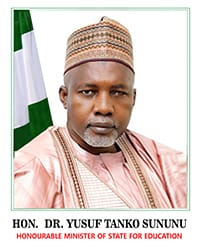
The state minister of education, Yusuf Tanko Sununu, has been making giant strides in improving the nation’s education sector and ensuring that all children have access to quality education. His dedication and hard work shouldn’t go unnoticed, and he deserves to be commended for his efforts.

One of the key initiatives implemented in his intertwined collaboration with the minister of education, Tahir Mamman, is expanding access to educational programmes in underserved communities. By building new schools and upgrading existing ones, the minister has ensured that more children have the opportunity to receive a quality education. This has helped to bridge the gap between urban and rural education and ensure that all children have equal access to educational opportunities.

Furthermore, the state minister has been actively working to improve the quality of education in schools. He has introduced new teacher development programmes, like the Teacher Internship Scheme (TIS), provided support for teachers, and introduced innovative programs for teachers to adapt to a new digital age and assist in the development of smart education in Nigeria. This has not only improved academic performance but has also instilled a love for learning in students, helping them to reach their full potential.

The Teacher Internship Scheme which was introduced by the Universal Basic Education Commission (UBEC), to address the dearth of teachers in the field of smart education being championed by the commission in Nigeria, with the establishment of 37 smart schools across the country.

The Korea International Cooperation Agency (KOICA) is providing technical support for the execution of the smart education programme in Nigeria and has committed about $10.4 million to the project.

Additionally, the state minister has been a champion for inclusivity in education by creating a transnational educational policy that will promote diversity and massive enrollment in tertiary education institutions. The minister has also created a welcoming and inclusive environment for all students, regardless of their background or abilities. This has helped to create a safe and supportive learning environment where all students can thrive.

Moreover, Yusuf Sununu has shown a deep commitment to improving the education sector and ensuring that all children have access to better and quality education

Abbas Datti writes from Kano via abbasdatti448@gmail.com.