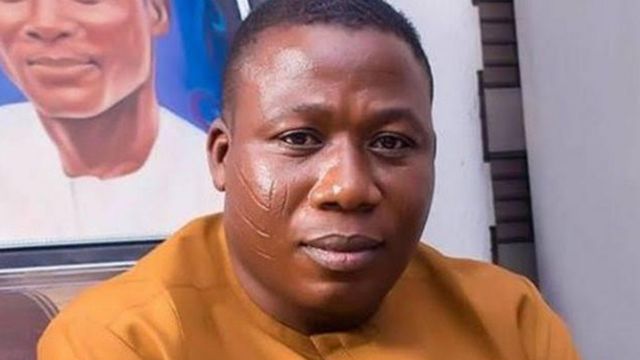
DSS invites Kaduna activist, Buhari over protest against killings in the North
By Rabiu Muhammad Gama
For a start, protest is something that you do to show publicly that you think something is wrong and unfair. Protest is an expression of disapproval; it’s done in different forms and on any day; it can be verbal or physical or via social media. In a democratic society like Nigeria, protest is an effective and legitimate tool, usually the only tool, that citizens can use to express their displeasure concerning some government measures or policies publicly. For example, when the government fails to discharge its duties, the citizens can hit the streets to register their grievances against the government. The nagging question, which this article sets out to answer, is: must people get a permit from a state governor or the Police Commissioner before convening a protest?
The Constitution of the Federal Republic of Nigeria, 1999 (as amended), is the fundamental law of the land. It is the law on top of which there is no other law. It is over and above any law, body or authority. It has been aptly submitted that the Constitution of any country, and don’t forget Nigeria is still a country, is the embodiment of what the people desire to be their guiding light in governance – their supreme law – the “grundnorm” of all their laws.
By virtue of Section 1(3) of the 1999 Constitution, any law, and that ‘any’ does mean ANY, that is inconsistent, or in conflict with a provision of the Constitution, that law is invalid and utterly useless due to its inconsistency with the Constitution. Please, permit me to draw an analogy; whenever there is a boxing match in a ring (read: court of law) between the Constitution and any other law, the referees (judges) always rule, and will undoubtedly continue to rule, in favour of the Constitution. No law can knock out the Constitution, no matter how strong and powerful its muscles are. The Constitution always prevails.
The Constitution provides for Fundamental Human Rights, precisely from Section 33 to Section 44, and these sections are in Chapter Four of the Constitution. These Fundamental Human Rights are simply those Rights that every human is entitled to simply because he is human. Therefore, these Rights cannot be taken away or restricted except in full compliance with Section 45 of the Constitution and some other relevant provisions therein.
Section 39 and Section 40 of the 1999 Constitution provide for the Right to Freedom of Expression and the Right to Freedom of Association and Peaceful Assembly, respectively: merging these two Sections gives us the Right to Protest. In the light of the foregoing, it is safe to submit that Right to Protest is a Fundamental Human Right that is clearly guaranteed and enshrined by the 1999 Constitution. Hence it cannot be restricted by anybody, including the DSS or the Police, or rather particularly the DSS or the Police. It is only the Constitution that can restrict that Right.
Before 2005, there was one undemocratic federal law (Act) that was dripping with dictatorship and some leftovers of colonialism mentality, the Public Order Act. The Law (Act) was initially promulgated as the Public Order Decree 5 Of 1979, and it later became an Act of the National Assembly under Section 274 of the 1979 Constitution. Sections 1 (2) (3) (4) (5) (6), 2, 3 and 4 of the Act required intending protesters to get a permit from the Governor (he can delegate the powers to the Commissioner of Police) of the state where the protest is to be held before they can protest. When the Governor, or the Commissioner of Police as the case may be, thinks that the protest is likely to disrupt public order, he can refuse to issue the permit.
However, in the celebrated case of IGP v. ANPP (2008) 12 NWLR 65 when Malam General Muhammadu Buhari (as he then was) and his then political party, the ANPP, lost the presidential election in 2003 to Olusegun Obasanjo, requested the Inspector General of Police (IGP) by a letter dated 21st May 2004, to issue police permits to their members to hold unity rally throughout the country to protest the alleged rigging of the 2003 election. The request was refused.
General Buhari and the rest of them organised the rally without the permits. As a result, there was a violent disruption of the rally organised in Kano on 22nd September 2003, on the ground that no police permit was obtained as required by the Public Order Act. The Federal High Court invalidated the provisions of the Act that required a Police permit before a protest is staged on the ground of their being inconsistent with the provisions of the Constitution, particularly Section 39 and 40, and Article 11 of the African Charter on Human and People’s Rights ( Reification and Enforcement) Act, Cap. 10, Laws of the Federal Republic of Nigeria, 1990.
On appeal, the Court of Appeal also affirmed the decision of the Federal High Court. Right from the Federal High Court, the learned trial judge relied on the decision of the Supreme Court of Ghana in the case of New Patriotic Party v. Inspector General of Police (1992 – 93) GBR 585 – (2000) 2 HRLRA 1 where it was aptly submitted that:
“Police permit has outlived its usefulness, statutes requiring such permits for peaceful demonstrations, processions and rallies are things of the past. Police permits is the brainchild of [the] colonial era and ought not to remain in our statute books.”
That was how the Court sent those unconstitutional provisions of the Public Order Act to their eternal grave. By the way, it may interest you to know that by virtue of Section 83 (4) of the Police Establishment Act, 2020, where a person or an organisation CHOOSES to notify the police of his or its intention to hold a public meeting, rally or a procession on a public highway, the police officer responsible for the area where the rally will take place shall mobilise personnel to provide security for the rally! The police or the DSS have no powers whatsoever to stop or restrict the Fundamental Right of Nigerians to freedom of expression and assembly once those rights are exercised within the ambit of the law.
As the law stands today, no police permit is required before staging a protest in Nigeria. The right to protest is a Fundamental Human Right given by the Constitution, which cannot be taken away or restricted except in accordance with the provisions of the Constitution.
Rabiu Muhammad Gama is a Law student from Bayero University, Kano (BUK). He can be reached on 09061912994 or via rabiuminuwa327@gmail.com.
By Muhammad Abdurrahman
On July 23, 2021, Dr Abdallah Uthman Gadon-Kaya delivered a Friday sermon in one of the mosques he leads prayers in Kano State. That sermon did not go down well with Prof. Ibrahim Maqari. Thus, he appeared in a video threatening Dr Abdallah to withdraw parts of the statement, or they would meet in court. On July 26, Dr Abdallah received a letter from Prof. Maqari’s lawyers, giving him a 7-day ultimatum to withdraw those “remarks” or face legal action.
Many media organisations, including online newspapers, reported the recent development. But no media reported Dr Abdallah’s side of the story. So the Daily Reality (TDR) spoke with one of his lawyers, Ibrahim Umar Abere.
Barrister Abere told TDR that “We initially received a letter from Prof. Maqari stating that his lawyers were charging Dr Abdallah for defamation. And he was given seven days to withdraw his utterances against Prof. Maqari. If not, he must appear before the court to stand a trial.
“In the letter he sent, his lawyer said that he knew Dr Abdallah had not mentioned Prof. Maqari’s name, but it was clear to them that the things said were directly referring to Prof. Maqari. [This means they were the ones who said that to their client]. We wanted to reply to them instantly. All of a sudden, the Department of State Service (DSS) from Abuja intervened, asking the two parties to sheath their sword and that both parties should report to the DSS office in Kano for reconciliation.”
“We went to the DSS office. I was there; Dr Abdallah was there, and Prof. Maqari, represented by his lawyer, was there. They said that Dr Abdallah must go and withdraw his utterances publicly on his pulpit. We said this is impossible because what happened was that Prof. Maqari spoke, and Dr Abdallah also spoke in their sermons about the things happening. Though some clerics already asked Dr Abdallah to withdraw those remarks that some people felt were harsh. He did so and apologised to all and sundry.
“The DSS stated that they were aware Dr Abdallah had apologised to anybody who misunderstood his sermon or felt any pain. We were satisfied with that. For this, there’s no reason for Abdallah to go and apologise for the second time.
By Allah, this was what happened. The DSS personnel also reminded us that both Abdallah and Maqari have followers; therefore, unless handled cautiously, the issue might become a grave conflict. That was why we did not respond to their letter. Because we take what authority said seriously, that was how our sitting ended,” said Abere.
On August 24, a copy of a summons showing that Prof. Maqari sued Dr Abdallah in an Upper Sharia Court at Rijiyar Lemo, Kano State, trended on social media.
In reaction to that, Abere told TDR that “We have seen that. It means they disagreed with the reconciliation made by the DSS a few weeks ago. That was why they went to court. On hearing that, we had to call the DSS and told them that these people took the case to court despite the fact the dispute had been resolved. For this reason, we had replied to their letter for them to know our stand. We told them that we were also charging Maqari with defamation and other things.
“In our reply on July 30 to Prof. Maqari’s lawyers, Dr Abdallah unreservedly denied all the allegations forwarded by Prof. Maqari. We also gave the lawyers a 7-day ultimatum to withdraw some defamatory remarks in their demand letter. They call Dr Abdallah derogatory names such as liar, lawless, mischievous, reckless, heartless, penchant for hate speech, high-handed and threat to public peace. Otherwise, he [Prof. Maqari] too will face a legal battle,” he lamented.
Surprisingly, Prof. Maqari appeared in yet another video on Saturday, August 28 2021, telling the public that some prominent personalities in the country had intervened on the matter. Therefore he left the case in their hands. This means there would be no court case against Dr Abdallah.
“We have thoroughly prepared to appear before the court on September 6, 2021. All our defences and counter-charges or claims are ready. Then we suddenly saw Prof. Maqari again on social media in another video saying that some people talked to him and now the case is with them.
Does that mean he had withdrawn his charges against Dr Abdallah? If that is the case, that is now how it is done. For Prof. Maqari to withdraw his charges against Dr Abdallah, it should be in a written form. Until now, we have not received any official letter. We just heard about it on social media. People should not seriously regard what has been said on social media or in a video,” concluded barrister Abere.
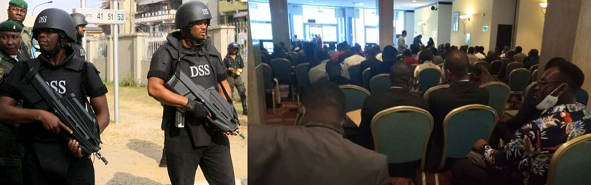
Men of the Department of State Services Thursday stormed Sheraton Hotels in Abuja, where the Saudi Ministry of Health was interviewing doctors for recruitment.
The DSS operatives arrived at the interview venue, dispersed the medical doctors and arrested Marcus Fatunde, a journalist that works with the International Centre for Investigative Reporting.
However, the journalist was later released, and the interview exercise has been suspended.
Most of the doctors at the interview venue were either unemployed or poorly paid.
Doctors in Nigeria have on several occasions embarked upon industrial action due to bad working conditions and underpayment.
Department of State Services has declared Yoruba activist Sunday Adeyemo alias Sunday Igboho wanted. The declaration followed rumours that men in uniform carried out a midnight raid on his residence in Ibadan, Oyo State, which led to the death of two people.
The DSS Public Relations Officer, Peter Afunnaya, disclosed this Thursday night during a press briefing and parading of suspect arrested during the raid at the national headquarters of the secret police. He further advised Igboho to turn himself in to the nearest security.
“Those cheering and eulogizing him may appeal to or advise him to do the needful,” Afunnaya said. “He should surrender himself to the appropriate authorities. He or anyone can never be above the law.”
Afunnaya added that the raid on Igboho’s residence was a response to an intelligence report that he had stockpiled arms in the place, some of which were now recovered.
“On approach to the residence, the team came under heavy gun attack by nine men, suspected to be Igboho’s guards. Six of them were armed with AK-47 guns and three others, with pump-action rifles,” the DSS spokesman added.
After a gun duel that lasted for an hour, during which Igboho escaped, “The [DSS] team procedurally searched the house and subsequently recovered the following seven 7 AK-47 assault rifles, three pump action guns, 30 fully charged AK-47 magazines, 5,000 rounds of 7.62mm ammunition, five cutlasses, one jack knife and one penknife”, among other items.
In June, Igboho declared that Yoruba would break away from Nigeria latest by December 2021 to form the Oduduwa Republic. He was also alleged to have led attacks on Fulani herders and Hausa traders in the southwestern states of the country.
The Nigerian government have stepped up action against separatist recently. Igboho’s attempted arrest came a few days after the leader of proscribed Indigenous People of Biafra (IPOB), Nnamdi Kanu, was arrested and extradited to Nigeria. He has been charged for treasonable felony, evading arrest and inciting violence at the Abuja Federal High Court.