By Ibrahim El-mu’azzam
Four years ago, we witnessed the removal of Mallam Muhammadu Sunusi II as the Emir of Kano and the splitting of the Kano emirate a few months earlier. As they say, what goes around comes around.
Since then, many people have prayed, predicted, and foreseen that the action would be reversed. Thanks to time and destiny, we are now witnessing the return of the Emirates to one and the reinstatement of Muhammadu Sunusi II to Gidan Rumfa and the throne of Dabo. People forget too soon; if not for that, this wouldn’t have made these trends and surprises.
Muhammadu Sanusi II was legally appointed as the 14th Emir of Kano by Gov. Rabi’u Kwankwaso in 2014, following the passing of Alhaji Ado Bayero, the 13th Emir of Kano. Although he initially faced the usual opposition from some people, his appointment was eventually accepted by all, including the family of his predecessor, the Emirate council, the people of Kano, and the global community.
After about six years, a personal-political misunderstanding arose between him and the then-government of Dr Abdullahi Ganduje. This personal-political interest had no adverse effect on the Emirate or the good people of Kano state. However, despite calls from respected individuals and institutions worldwide, as well as a court order, Ganduje, in a display of power, divided the ancient Kano kingdom into five different kingdoms and proceeded to dethrone Sunusi on groundless grounds.
Ganduje didn’t stop there. He took the former CBN governor, the 14th Emir of Kano, an Imam, and the chartered Economist to Loko and later to Awe villages in Nasarawa state, where there was reportedly no stable electricity and water supply. His actions were only halted by the intervention of Malam Nasiru El-Rufa’i, the then-governor of Kaduna state.
You see, I’m not a big fan of SLS. I disagree with some of his takes, but this is an apparent disrespect and damage not only to him but also to the Kano Emirate, the people of Kano, and the entire Kingdoms of Shehu Usmanu Ɗanfodiyo. It pained me more to divide the Kingdom into pieces than to even dethrone the King.
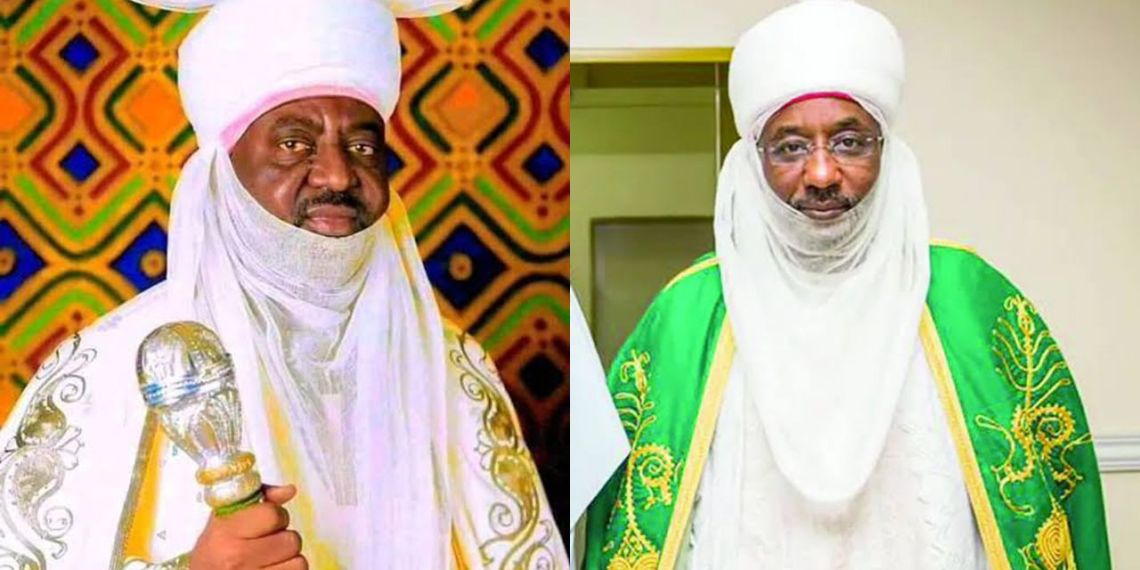
Alhaji Aminu Ado succeeded the central Kano Emirate and performed admirably. I admire his personal qualities, demeanour, lifestyle, and effective handling of the throne. I often tell people that Sarki Aminu Ado embodies more of the traditional King’s character than Sarki Sunusi II. But sad, Aminu Ado was alive and well when his father, Bayero, the 13th Emir, passed away, and Sunusi was appointed. Despite Aminu’s charisma, love of the people, and competence, Sarki Sunusi was chosen by the Almighty to ascend to the Kano throne.
Ever since the campaign of the current governor of Kano state, Engr. Abba Kabir Yusuf, there have been suggestions to reinstate Sunusi and restore the Kingdom to its previous state. I supported this idea, but I didn’t fully agree with the decision to remove the Kano Emir again. I wanted the Kingdoms to be returned, with Aminu continuing as the King. I hoped Sunusi would oversee and move forward, especially with the furtherance that occurred and continue to befall him, like the Khilafa of Tijjaniya and more. I strongly oppose the idea of our honourable Kings to be played like toys by democratically elected governments. I even think of how unaware people were when the law of dethroning a King was made like this.
Although I have some doubts, I wanted everything to be very amicable, especially since all the parties are descendants of Malam Ibrahim Dabo—the same family, living in the same house and sharing the same bloodline. However, Sunusi’s return and acceptance of the reinstatement should not be blamed.
Firstly, for Emir Sanusi, it’s a repetition of history. The same thing happened to the King whose name he bears, Muhammadu Sunusi I. So, to cleanse their lineage of misfortune and bad luck, he can take this as a starting point.
Secondly, he was the last occupant of the undivided Kano throne. It is suggested that the five created kingdoms should be dissolved. Sarki Aminu has not been sworn in for the undivided Kano kingdom. If he is the one to continue, there must be an elevation that extends the continuity of the process. With this, reinstating Sunusi is more legal and straightforward.
Furthermore, if Aminu is to continue, it will likely be forever prohibited for Sarki Sunusi to visit his origin, the Gidan Dabo. This is a hardly bearable consequence with the opportunity at Sarki Sunusi’s disposal. More importantly, everything is believed to be done on baseless grounds.
We should be reminded that the ultimate desire of every heir to a throne is to be crowned. In addition, Sarki Sunusi’s got the government at hand, the similar power that dethroned him before. Therefore, I don’t view this action as wrongful but rather corrective. The criticisms of Sarki Aminu’s supporters are expected and accepted.
Dr. Ganduje, the prior architect of the dilemma, is currently in a position where he has to watch everything unfold. He is even facing challenges in his current role. Whether he initiated this with a positive or negative mind, it’s up to him to reap. The important lesson to remember is that power is transient. If you have it now, use it wisely; it may turn against you in the future.
In conclusion, it is very significant to call on the Sultan, the high-ranking Emirs, and other stakeholders to address the law that allows Governors to singlehandedly dethrone their Emirs. It doesn’t make sense at all. These Emirs were the foundation. They founded these communities and controlled them for centuries. Then why on earth should a borrowed phenomenon dominate the founding one? Why should an Emir be selected or dethroned without the consent, not even the approval, of the Sultan or his Emirate council? This is the major issue that needs to be addressed.
For Gidan Dabo. Sarki Sunusi, Sarki Aminu, and Sarki Nasiru, you all come from that house. It’s your base and heritage. Why would you allow the government or any external party to distort your peace and relationships?
Sarki Sunusi and Sarki Nasiru lived in the same room for over a decade. Sarki Sunusi’s first wife, Sadiya Ado Bayero, is a biological sister to Sarki Aminu and Sarki Nasiru. Sarki Ado Bayero was on good terms with Sarki Sunusi I. It’s your family. Why would you let an outsider tear you apart? Assume the government dethroned Sarki Sunusi II in the first place, and you all disagree with it; none of you accepted it. Can Ganduje give it to an outsider? “Sai bango ya tsage ƙadangare ke shiga” – “It’s when the wall cracks that a lizard gets a passage,” as Malam Bahaushe says. Please give this a concerned look.
I believe it’s high time for the Emirs and Kings of our respective Kingdoms in Nigeria to stand firm in upholding their dignity and that of their kingdoms. It’s hard to believe that an Emir needs the consent of his local government chairman for his outings and some of his activities. I understand the importance of the position of a local government chairman, but when compared to that of an Emir or a King, there’s a clear distinction. Let’s face reality, set aside selfishness and personal interests, and work together for the betterment of our lands.
A person’s power is his greatest enemy. He either uses it well, or it uses him well.
Sarki Muhammadu Sunusi II (the 14th and 16th Emir of Kano), may Allah protect and guide you. Sarki Aminu Ado, Sarki Nasiru Ado, and the others, may the Almighty accept the right you have done and overlook the wrong. May the blessings of the Almighty be upon all of you for eternity.
Ibrahim El-mu’azzam wrote via elmuazzammail@gmail.com.