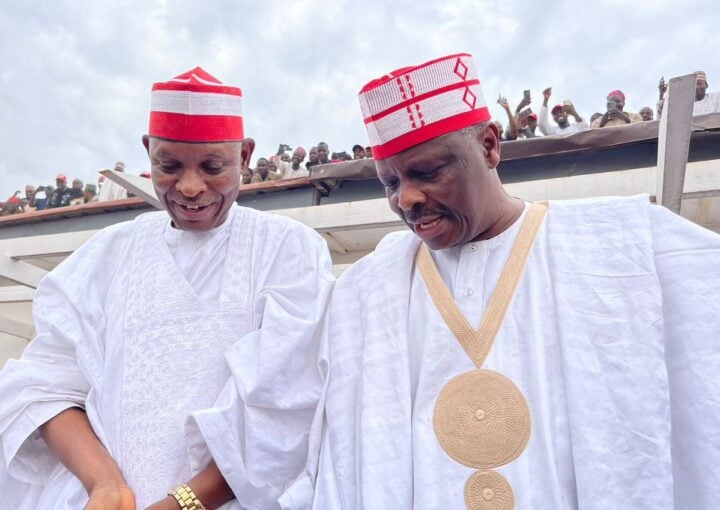
Dr Abdullahi Umar Ganduje

I inherited N8.9bn debt as APC chairman — Ganduje

By Anwar Usman

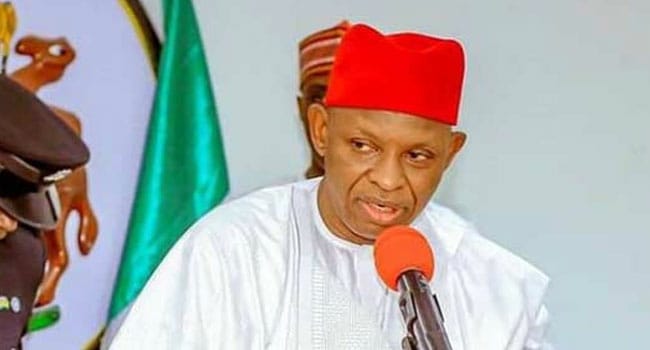
The National Chairman of the All Progressives Congress, Dr Abdullahi Umar Ganduje, said on Wednesday that when he assumed office, he found an N8.9 billion debt from the previous leadership.

The former Kano State governor made this known in Abuja, where he was speaking at the ongoing National Executive Committee meeting of the APC.

He stated that the expenses were incurred during pre-election legal battles, election cases, and appeals for legislative, governorship, and presidential elections.

He explained, “The current NWC inherited debts and legal liabilities amounting to N8,987,874,663, arising from various legal engagements.”

The former Governor explained that Professor Abdul Kareem Kana (SAN), the National Legal Adviser, has been working to alleviate the debt burden.

He pleaded, “We still passionately appeal to the National Executive Committee to intervene accordingly”.

In attendance were President Bola Tinubu, Vice President Kashim Shettima, Senate President Godswill Akpabio, Speaker of the House of Representatives Tajudeen Abbas, state governors, NWC members, and other party chieftains.

Barau distributes 61 cars, 1,137 motorcycles to Kano APC leaders, promises more support 

By Uzair Adam  

On Sunday, the Deputy President of the Senate, Senator Barau I. Jibrin, distributed 61 cars and 1,137 motorcycles to leaders of the All Progressives Congress (APC) in Kano State.  

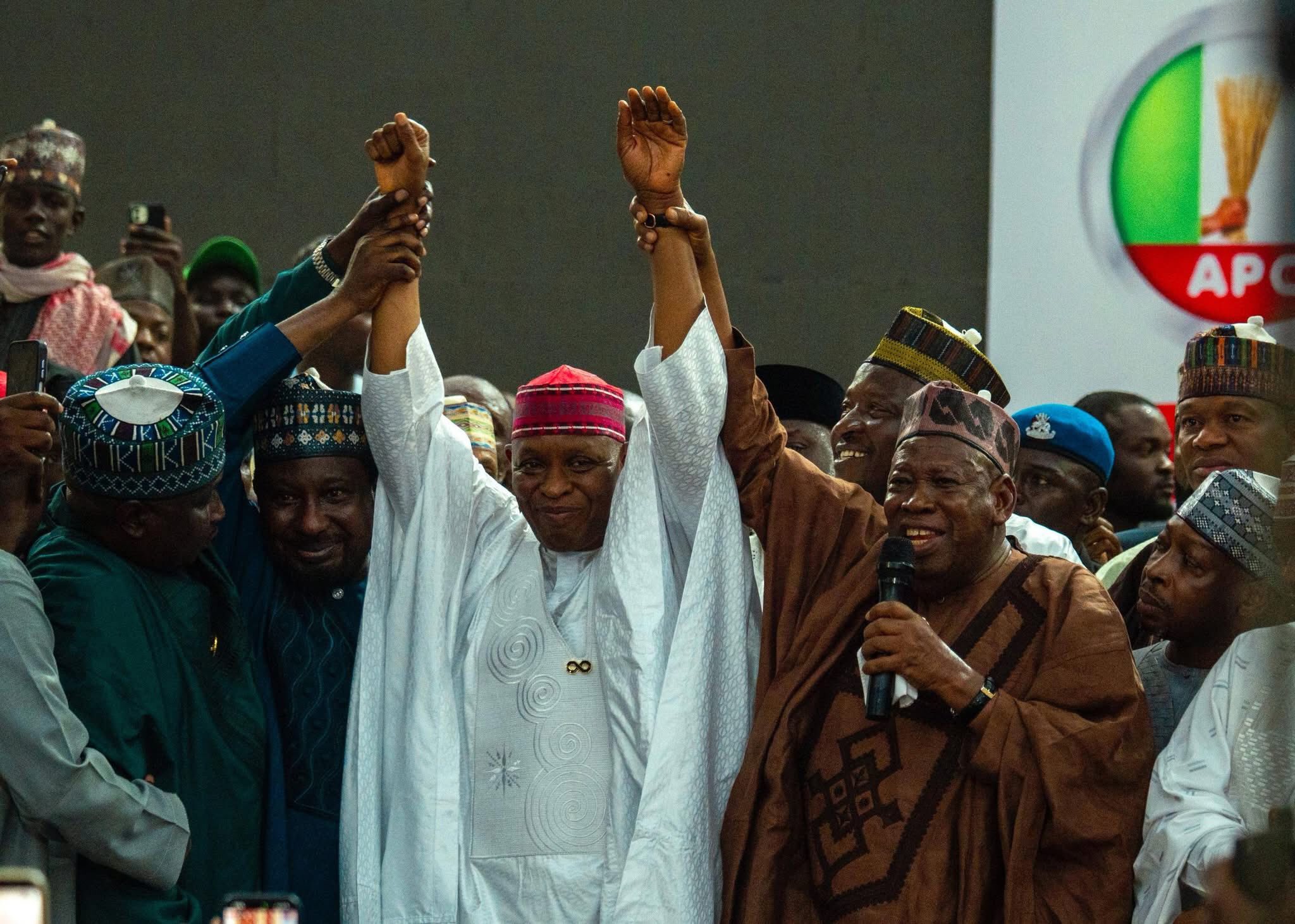
The distribution, held at Meena Event Centre on Lugard Road near the Kano State Government House, was attended by key party stakeholders, including the APC National Chairman, Dr Abdullahi Umar Ganduje.  

The vehicles and motorcycles were allocated to party chairmen in the 44 local government areas and 484 wards of the state as part of efforts to strengthen the APC’s grassroots structure.  

Speaking at the event, the Kano State APC Chairman, Abdullahi Abbas, lauded Barau for consistently supporting the party since the New Nigeria People’s Party (NNPP) took over the state in 2023. 

He emphasized that ahead of the 2027 elections, aspirants would be assessed based on their contributions to the party’s development.  

Similarly, the Chairman of the House of Representatives Committee on Petroleum Resources (Upstream), Rep. Alhassan Ado Doguwa, expressed confidence in the APC’s resurgence, predicting that the NNPP would be defeated before 1 p.m. on election day in 2027.  

In his remarks, APC National Chairman Dr Ganduje commended Barau for the initiative, describing it as a step towards consolidating the party and improving the livelihoods of its members. 

He also highlighted the increasing defections from the NNPP to the APC, suggesting that the opposition party’s influence in Kano was waning.  

Senator Barau, while addressing the gathering, described the empowerment initiative as just the beginning of a broader program targeting various sectors, including youths, students, farmers, women, traders, and clerics. 

He reaffirmed his commitment to expanding the initiative and urged continued support for President Bola Ahmed Tinubu’s administration.  

He noted that Tinubu’s policies were beginning to yield positive results, citing the gradual reduction in fuel prices, stabilization of the Naira, and improvements in food prices.  

“This is just the tip of the iceberg. We will empower all spheres of society. Let’s continue to support Mr. President for the success of his programs,” Barau said.

Kannywood actor Nabraska dumps NNPP for APC

By Hadiza Abdulkadir

Popular Kannywood actor Mustapha Badamasi Nabraska has defected from the New Nigeria People’s Party (NNPP) and the Kwankwasiyya Movement to the All Progressives Congress (APC).

Senator Barau Jibril, representing Kano North, announced the defection on social media, revealing that Nabraska visited his residence in Abuja, where he symbolically discarded his red cap—an emblem of the Kwankwasiyya Movement. Senator Ibrahim Lamido (Sokoto East) and Political Adviser Hon. Yusuf Tumfafi were also present to receive him.

Nabraska, known for his shifting political allegiances, previously worked under the APC-led government of former Kano governor Dr. Abdullahi Umar Ganduje. However, after the NNPP’s victory in the 2023 Kano governorship election, he switched sides, only to return to APC now.

The actor’s latest move has drawn mixed reactions. Many social media users mock his frequent party changes, suggesting they are motivated by personal gain rather than ideology.

Gov. Yusuf vows to expose, fix Ganduje’s fraudulent land deals

By Abdullahi Mukhtar Algasgaini

Kano state Governor, Abba Yusuf, has accused his predecessor, Dr. Abdullahi Umar Ganduje, of promoting corruption and nepotism in the management of urban planning and land allocations during his tenure.

Governor Yusuf vowed to expose and correct the mistakes made by Ganduje, who is currently the National Chairman of the All Progressive Congress (APC).

In a statement signed by his spokesperson, Comrade Sanusi Bature Dawakin Tofa, Governor Yusuf criticized Ganduje’s administration for alleged corruption, mismanagement, and urban planning failures.

He vowed to restore order through reforms, emphasizing accountability, innovation, and sustainable development.

Governor Yusuf also launched the recertification of Certificate-of-Occupancy (C-of-O) for efficient and transparent land management system in the sate.

Governor Yusuf described the development as a milestone for creating an efficient and transparent land management system.

He flagged off a comprehensive recertification of Certificates of Occupancy (C-of-O) to ensure accurate, secure land records, protect investments, and resolve disputes, urging landowners to comply promptly.

According to the Statement, central to the reforms is a state-of-the-art Geographic Information System (GIS) to modernize land management, improve urban planning, enhance taxation, and eliminate revenue leakages.

Measures also include banning inappropriate land allocations and setting up a State Task Force on Development Control to address urban development challenges and protect Kano’s cultural heritage.

Governor Yusuf highlighted the complete renovation of KANGIS and the Ministry’s facilities, now equipped with modern ICT infrastructure to enhance service delivery, reflecting the administration’s commitment to professionalism, transparency, and development.

Kano State Government: Please revitalise the abandoned technical schools in 44 LGAs

By Bilal Muhammad Bello (BMB)

It is widely recognised across Kano State that the 44 LGA Day Technical Schools have been abandoned and remain under incomplete construction. These schools were established in 2012 during the second tenure of former Governor Senator Rabi’u Musa Kwankwaso. 

The initial progress on these schools was swift under Kwankwaso’s administration. However, the subsequent government, led by former Governor Dr. Abdullahi Umar Ganduje, halted the continuation of the project.

The abandonment of these schools has not only led to their physical decay but also created opportunities for theft and vandalism, with some individuals stealing materials from the school premises. The neglected sites have also become hubs for illicit activities, posing a threat to the safety and well-being of the surrounding communities.

It is crucial to bring this matter to the attention of His Excellency, Engineer Abba Kabir Yusuf, the current Governor of Kano State. Your commitment to advancing education in both urban and rural areas, particularly through the construction of classroom blocks, the reduction of registration fees for higher education institutions, and the provision of postgraduate scholarships, is commendable and has garnered praise from Kano residents and visitors alike.

During your 2019 and 2023 gubernatorial campaigns, you pledged to resume work on the 44 LGA Day Technical Schools. I respectfully appeal to your administration to take swift action to complete these schools. By doing so, you will transform these temporary sites into permanent institutions, ensuring they fulfil their original purpose and preventing further loss of valuable materials.

Bilal Muhammad Bello (BMB) wrote from Mass Communication, Bayero University Kano.

Kano Emirship Crisis: It always helps to live in the real world

By Dr Raji Bello

Following encouragement from some friends, let me say what I’ve been a bit reluctant to say. It is based on my conviction as a dispassionate and non-partisan observer and of course, as a non-indigene of Kano State.

The root cause of the emirship imbroglio in Kano, in my view, was the inability of Muhammadu Sanusi II to subordinate himself and his office to the Ganduje administration as required by the terms of his appointment. This is essentially what triggered every other thing that has happened and which has led us to where we are today. To correct any problem permanently, we need to examine its root cause.

I am not saying that Sanusi is not an emir of high intellect who is enormously popular among the people. This assessment of mine is based on only one criterion — his willingness or ability to comply with the terms of his appointment — and it is made without prejudice to his qualities, endowments and accomplishments as an individual, technocrat and emir. Like other human beings, the emir is not perfect. He might have excelled in 9 out of 10 criteria but his failure in the 10th is the cause of the emirship crisis because it happened to be a very important criterion.

All post-colonial emirs and traditional rulers have been obligated to demonstrate loyalty and due courtesy to government be it colonial, democratic or military. History is replete with examples of the huge price that was exacted each time an emir fell short on loyalty towards government.

As an intellectual of high standing, the emir must have been aware of that history. When he set out to be emir, he should have been conscious of the terms of appointment and should have fully reflected on whether it was the appropriate platform for someone of his disposition or not. The emir seems to want the Kano emirship in its pristine 19th century form when it didn’t answer to a non-traditional authority. This betrays a lack of situational awareness and good judgement because the reality is that the 19th century is long gone and can never be brought back. So if anyone is interested in becoming emir in the 21st century, it has to be under 21st century terms.

The Ganduje administration had accused the emir of multiple infractions from political partisanship, insurbordination and failure to demonstrate courtesy towards it. Some of these infractions had played out in public for all to see and hear which means that they were not false accusations. I do not fully endorse the former government’s actions (which bore traces of the usual Nigerian impunity) but it is clear that it was provoked into taking actions against the emir. I believe that all state governments are inclined by default to respect the traditional institutions within their states and hostilities only break out when there is a breach of the terms of appointment (usually, but not always) on the part of the traditional rulers.

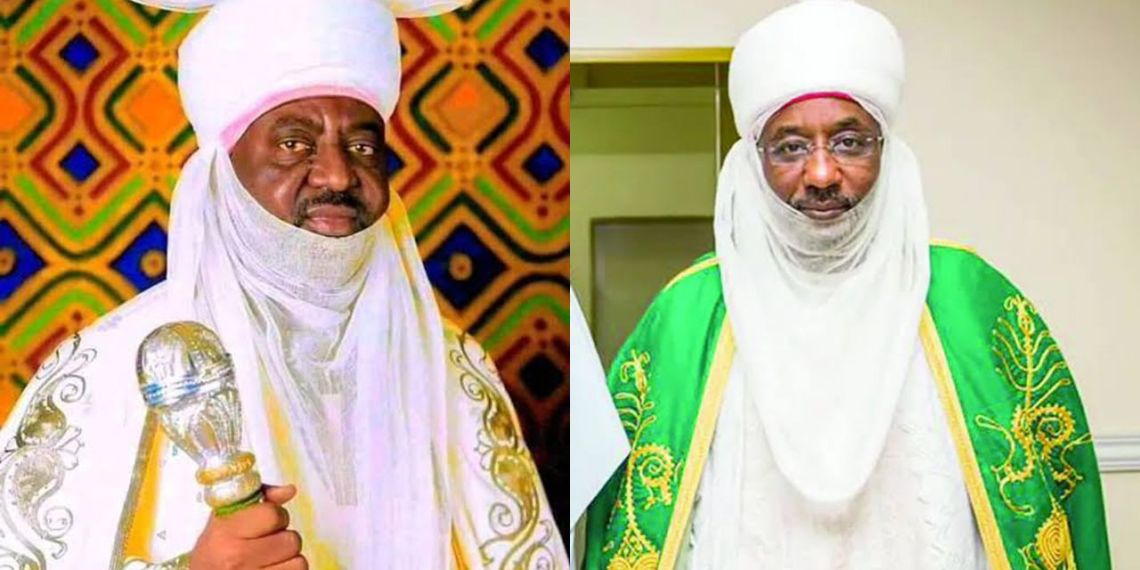
There is no individual who is so important or popular that they would enjoy exemptions from complying with the terms of their appointment. This is an incontrovertible fact. A friend told me that the emirship style of Aminu Ado Bayero is a bit bland compared to that of Muhammadu Sanusi II. I replied that this is true but the Aminu style is actually the correct one.

Post-colonial emirship is not a radical or revolutionary platform and, after the 1976 Local Government Reforms, the traditional institutions in northern Nigeria lost all the vestiges of authority that were previously delegated to them under the Native Authority system. The post of traditional ruler is now just a custodianship of heritage whose essential features are loyalty, co-operation and circumspection.

Yes, Sanusi is wildly popular, has a deeper intellect, a gifted oratory and displays a higher sartorial elegance but it was Aminu Bayero who was doing the emirship correctly under its current terms. Those who cheered Sanusi as he breached the terms of his appointment were not helping him or the Kano emirship institution.

Return of Sunusi: The dilemma ahead

Mohammad Qaddam Sidq Isa (Daddy)                     

The return of Muhammadu Sunusi ll as Sarkin Kano is yet another manifestation of the influence of politics on the traditional Masarauta establishment, which, after all, has always been used and abused by politicians.

Since the British conquest of the Usman Dan Fodio Islamic sultanate in what subsequently became part of today’s northern Nigeria, the enthronement and dethronement of emirs (Sarakuna) have always been motivated by underlying political interests. 

Throughout the colonial era, the British would only enthrone aspiring princes deemed the most loyal to the British colonial establishment as leaders of their respective emirates. This practice enabled them to maintain their colonial grip through those proxy-Sarakuna. And since then, successive generations of military and civilian administrators have followed suit, enthroning and dethroning Sarakuna literally at will. 

The only shift in this regard is that, in the past, the influence of political leaders would mostly come to play only when a throne became vacant mainly due to the death of the Sarki, when the incumbent governor would influence the emergence of his successor, as it happened in 2014 in Kano that led to the enthronement of Sunusi. However, now that the trend is becoming systematic, it will indeed, if left unchecked, render the reins of Sarauta effectively tenured, subject to the tenure of the governor behind it. 

After all, just like his enthronement in 2014 by then-Governor Rabiu Musa Kwankwaso and his subsequent dethronement in 2020 by then-Governor Abdullahi Umar Ganduje, Sarki Sunusi’s return to the Kano throne remains politically motivated within the context of the power struggle in Kano politics between Kwankwaso and Ganduje, two provincial vindictive enemies hell-bent on finishing off each other.  

By the way, as a subservient Kwankwaso ‘boy’, Governor Abba Kabir Yusuf himself is a mere fighting tool in the hands of his godfather in the struggle. 

Interestingly, Kwankwaso has tactically put his vengeful mission against Sunusi on hold for now, pending finishing off Ganduje and his legacy. 

Sunusi incurred then-Governor Kwankwaso’s wrath as a then-Lagos-based bank executive when he kept dishing out disparaging criticisms against Kwankwaso and his government. For instance, in an article he titled “The Kwankwaso Phenomenon”, Sunusi described then Governor Kwankwaso as a “rural aristocrat” who “surrounds himself with provincials and places key posts in the hands of rural elite”. He also compared Kwankwaso’s government to “the classic comedy of the Village Headmaster in a village council”. 

Kwankwaso got mad at Sunusi and demanded his sacking by his then-employer, United Bank for Africa (UBA). He threatened to stop his government’s dealings with the bank in case of non-compliance. 

Anyway, now that Sunusi is back, it remains to be seen how it plays out between him and Governor Abba, considering Sunusi’s penchant for publicity stunts involving controversial utterances against government policies and wrongdoings. 

As much as Sunusi is excited about his return to the Kano throne, the development represents a tricky dilemma for him that also tests his supposed commitment to outspokenness against government wrongdoings. 

On the one hand, Governor Abba won’t tolerate his stunts in the name of outspokenness; no governor will, either. And unless he (Sunusi) has, this time around, decided to desist from his stunts to keep his throne, Governor Abba, under Kwankwaso’s influence, won’t hesitate to go to any extent, including dethronement, to deal with him. 

On the other hand, his distance from his stunts would undoubtedly mean the end of the reputation he has somehow earned as an outspoken critic of government wrongdoings.  

Mohammad wrote from Dubai and can be reached via mohammadsidq@gmail.com.

The return of Sanusi

By Aliyu Nuhu

I have read the amended Kano Emirates law, which was brief, concise and straight to the point, to achieve certain ends. It is a promise fulfilled by the new NNPP government. Engr. Rabiu Musa Kwankwaso had said time without number that if elected, the government would repeal the Dr Abdullahi Umar Ganduje-led Emirates laws.

If Governor Abba Kabir Yusuf signs the amendment into law (which is a certainty), it will remove the present emirs from their offices and return all the Ganduje creation of first-class emirs back to district heads (hakimai). The affected emirs are those of Gaya, Rano, Karaye and Bichi.

The new law gives the governor the power to either re-appoint them hakimai or remove them and search for new ones.

Until the coming of this new law, I thought that Muhammadu Sanusi II’s return was impossible, as it had no precedence in the history of the Kano emirate. But after talking to officials and people who know the workings of the government, it appears certain that Sanusi will return to his throne, in fact, soon enough to preside over the coming Eid-Kabir prayer. 

Nothing is certain yet, but nothing is impossible, thanks to political intrigues and the need for the new government to reverse Ganduje’s legacies. There is no love lost between Kwankwaso, Abba, and Ganduje.

For my own views, I support the amendment of the Emirates laws and the return of a strong Kano emirate, but I don’t support Sanusi’s return as emir of Kano. The current Emir of Kano, Aminu Ado Bayero, is doing well and is loved by the people. 

I don’t support Sanusi’s return. I know he has not learned a lesson and will still come back and meddle with Kano politics, attack Abba and his government, and continue shooting his mouth as if he is an ordinary person. People who sit on the Kano throne don’t talk too much. He must also not try, like his grandfather did to Sardauna, to outshine the Kano state governor.

In history, there was an incident where the then-Emir Muhammadu Sanusi shamed Sardauna in the Kano race course parade ground by attracting a standing ovation with the Sardauna seated. The premier of Northern Nigeria considered it an affront to himself as the Emir stole the spotlight by arriving in full splendour and pageantry, and the whole assemblage had to stand up for the Emir in traditional homage and honour. It was a percussion to the dethronement of Emir Sanusi of Kano.

The grandson Sanusi Lamido Sanusi has inherited those tendencies from his grandfather, and I daresay when it comes to attacking and criticizing the government, Kwankwaso/Abba don’t have the patience, and if you like to call it table manners of Ganduje. They will throw out Sanusi in a blink of an eye.

They said a leopard never changes its colours. But time will tell.

Until then.

Group lambasts Governor Yusuf for alleged cover-up amidst governance failures

By Uzair Adam Imam

A political movement based in Kano, Arewa Renaissance Front (ARF), has criticized Governor Abba Yusuf for levying what they term as unfounded accusations against Dr. Abdullahi Umar Ganduje, the National Chairman of the All Progressives Congress (APC).

ARF accused Yusuf of using unsubstantiated claims against the former governor as a shield to conceal his own failure in meeting the expectations of the people.

In a statement released by Aminu Gawama, the Secretary-General of ARF, the group alleged that Yusuf, along with his political mentor, former governor Rabiu Musa Kwankwaso, are engaged in a vendetta against Ganduje.

According to the statement, these allegations were merely propaganda orchestrated by state-owned entities to divert attention away from the glaring inefficiencies and lack of direction in Yusuf’s administration.

The statement further highlights the public’s growing frustration with Yusuf’s tenure, questioning his accomplishments despite the ample fiscal resources available to the state. ARF denounced the judicial commissions of inquiry initiated by Yusuf to probe Ganduje’s tenure, labeling them as biased and aimed solely at depleting state resources.

ARF also condemned Yusuf’s selective targeting of Ganduje’s administration while absolving Kwankwaso’s tenure from scrutiny, characterizing it as a futile attempt to mislead the populace.

Nepotism in Nigerian politics: A tale of two governors

By Umar Sani

In the intricate tapestry of Nigerian politics, nepotism is often woven deep into the fabric of governance. Recent events surrounding Engr. Abba Kabir Yusuf, popularly known as “Abba Gida Gida,” and Dr Abdullahi Umar Ganduje illuminate a troubling pattern of favouritism and cronyism that continues to plague the nation’s political landscape.

In a move reminiscent of his predecessor, Abba Kabir Yusuf has nominated Mustapha Kwankwaso, the son of his godfather Engr. Rabiu Kwankwaso, for a commissioner position. This decision raises eyebrows, echoing past criticisms of Ganduje’s administration, where appointments seemed to prioritise personal connections over merit.

Such actions underscore a disturbing reality: the entrenched culture of nepotism in Nigerian politics, where loyalty to political dynasties often outweighs competence and merit. While the faces may change, the playbook remains eerily similar, perpetuating a cycle of patronage that undermines the principles of accountability and good governance.

The parallels between Abba Kabir Yusuf and Abdullahi Umar Ganduje serve as a sobering reminder of the challenges facing Nigeria’s democracy. Despite differing affiliations, both governors have succumbed to the temptation of nepotism, prioritising the interests of elites and families over the welfare of the broader populace.

This nepotistic trend erodes public trust in the political system and exacerbates social and economic inequalities. When positions of power are monopolised by a select few, talented individuals from marginalised communities are denied opportunities for advancement, further entrenching the status quo of privilege and exclusion.

As the nation navigates its democratic journey, it is imperative to confront and address the scourge of nepotism head-on. Transparent and merit-based governance systems must be championed, where appointments are made based on qualifications rather than personal relationships.

Moreover, robust mechanisms for accountability and oversight are essential to ensure public officials are held accountable for their actions. Civil society organisations, independent media, and vigilant citizens play a crucial role in exposing and challenging instances of nepotism and corruption, fostering a culture of transparency and accountability in governance.

Ultimately, the fate of Nigerian politics rests in the hands of its citizens. By demanding accountability, transparency, and a commitment to the common good, Nigerians can pave the way for a brighter and more equitable future, free from the shackles of nepotism that have privileged few.

Umar Sani Adamu (Kawun Baba) wrote via umarhashidu1994@gmail.com.