Corruption

Nigeria, NNPC and the oil windfall

By Kabir Fagge Ali
 
Presently, it is obvious that the time is ripe for the oil producing countries to smile due to the unprecedented increase in the oil price which eventually signalled an opportunity for a windfall. However, the situation is not the same for Nigeria as the country has plunged into deep fuel crises that has remained persistent for over a month. These crises border mostly on adulteration of the Premium Motor Spirits, PMS, also known as petrol, as well as its corresponding scarcity across the nation.

It can be recalled that, in the last three weeks, Russia has authorized a special military operation by invading the neighbouring Ukraine which caused the usually volatile crude oil prices to skyrocket beyond bookmakers. As a result, many countries are counting their fortunes in the windfall but unfortunately, Nigeria is counting its losses due to mismanagement of resources by the Nigerian National Petroleum Corporation (NNPC).

From the opening crude oil price of $76.03 per barrel at the beginning of 2022, prices have jumped to about $130 per barrel which is the highest price of the commodity for the last decade.

Just as noted in the Daily Trust Editorial of March 14, 2022, the gloom for Nigeria in the era of increased commodity prices was first forecasted by the world bank country director for Nigerian, Shubham Chaudhuri who said in January that Nigeria is at a point where rising oil prices might not be a good thing because although oil production might go up and crude oil revenue may increase, which in some point is a good thing.

The fiscal cost of petrol subsidy will also rise and while other countries may rejoice from the windfall, Nigeria will on the other hand be at the receiving end by reaping what it sows, courtesy of mismanagement of the oil sector over the past years by the NNPC. 

Truth be told, the consequences of the mismanagement of Nigeria’s four refineries is that the 440,000 barrels of crude oil supplied to NNPC daily for local refining is exported and never transparently accounted for. 

Meanwhile, the Group Managing Director, GMD, NNPC Mele Kyari claimed that N100 billion was sunk into the maintenance of the four refineries in Nigeria which is quite different from the N26bn already spent on supposed Turn Around Maintenance (TAM) on the maintenance of the refineries over the years which is an amount that will be sufficiently enough to build three new refineries as argued by many experts.

In addition, it is disheartening to learn that apart from being fleeced by NNPC and its collaborators in the name of oil subsidy or the strange term ‘under-recovery,’ Nigeria has failed to meet its oil production quota allocated by the Organisation of Petroleum Exporting Countries (OPEC). From an average of 2.1 million crude oil production quota per day, when the Buhari administration was voted into power in 2015, Nigeria is at present allocated 1.7 million per day, out of which it produces between 1.3 million and 1.4 million per day. This shortfall is a result of the lack of investment, as International Oil Companies (IOCs) have continued to exit Nigeria’s oil sector.

Despite the above scenario, the Ministry of Petroleum Resources, NNPC and its subsidiaries cannot convince Nigerians that there will be no gains from the current oil windfall. Such gains must not be frittered away under any guise.

The real question that is still begging for an answer is, can the NNPC convince Nigerians on how the country’s economy is not going to gain from this kind of oil windfall or how are Nigerian leaders being able to resolve this issue and what is NNPC’s decision on the lack of accountability to the people? 

Therefore, it is in the good interest of Nigerians that the National Assembly should investigate this issue thoroughly and ensures that money meant for the country indeed comes into the nation’s treasury unfailingly. The managers of Nigeria’s oil and gas sector must account for the gains that accrue to Nigeria from the current windfall.

Moreover, the NNPC in collaboration with the federal government and other stakeholders in the oil sector must as a matter of urgency expedite their efforts in fixing the moribund refineries in order to be functional enough to refine our petroleum products so as to meet the nation’s daily average consumption capacity of 62.5million litres of petrol. The time is long overdue to save the country’s ailing oil sector!

Fagge, is a student of Mass Communication Department, Skyline University Nigeria. He writes from Abuja, Nigerian and can be reached via faggekabir29@gmail.com

On buying and selling job offers: A true, harrowing story

By Ibrahim Aminu Iliyasu

A job is a valuable thing that many graduates aspire to gain after graduating school, especially those who consider certificates as tickets for a better life. Years back, our parents told us to go to school and read well so that we could get better jobs and live in affluence.

Today, the trend has changed. Many graduates have now become financially unsuccessful since day one. Of course, it is good to be educated because education is a privilege even among one’s peers. Yes, it is. But that does not assure one a luxurious life. Also, being a graduate does not allow you to be selective in the business or job you can do. I am saying this from pure experiences. 

It has not started today. Buying job offer is as old as the Nigerian post-colonial bureaucratic system. To join the military, one has to pay the sum of 100K or 150K or even above to get himself a permanent ticket for life in the Sambisa forest.

Doubtlessly, all our public institutions have been compromised. They are after money, not merit. Sadly, schools and health institutions where professionalism is supposed to be prioritised are also indulged in this. These days, if you do not have money, no matter your qualifications, you would be unemployed. Even those who can link you to those who give job offers have to pay for you or bribe the human resources team or MDs for a job offer.

I have received different but few job vacancies for sale. Sometimes I ignore them or deliberately reject them. For example, there was a time when I was a security guard at one institution that I coincidently met a father’s friend – a banker, an influential one. He is currently a bank manager in Kano. I opened the gate for him, welcomed him and greeted him. He was surprised that I was a security guard because my father knows the big guns. 

While having a conversation, he told me one word that still makes me happy and proud. “Ai matsalar Alhaji dan due process ne, shi ba zai iya ba da kudi ba a samo ma ka aiki ba” (the problem of Alhaji is that he is a man of principles. Therefore, he cannot give money for his son to be employed”. At last, he promised to talk to Alhaji. While parting, he gave me some money I desperately needed, but notwithstanding, I summoned some courage and rejected the money. I thanked him and moved on.

Secondly, I was once sent to an interview. After I answered all their questions, the interviewer asked me what I had for him while leaving. I said nothing. He nodded his head and told me they would call me. Till now, they have never called me.

Thirdly, I had another interview with an organisation. The guy who sent me to the organisation pretended to care about my condition and wanted to find a better place for me. Fortunately, I have all the requirements. While I thought I would be automatically employed, the man invited me to his office and confessed that he was “gay”. Angrily, I insulted his forefathers, himself and the satan that sings for him. I still regret knowing him. Thus, I forgot about his job.

Frankly, I cannot do things to get a job and/or find a place in the labour market. I cannot do voluntary services in any organisation anywhere on earth because my family and I sponsored me to study. I did not attend a community school either, and I had never enjoyed any government scholarship. Therefore, I cannot share my knowledge or time free of charge. 

I cannot use my money to buy a job offer because any institution that requests me to pay something before it gives me a job is certainly not looking for my credibility or proficiency. Thus, it doesn’t deserve my energy and time, for I would rather die as a hawker than do such evil. 

I will not betray my Creator to please the created. For instance, I will not sodomise to get a job. God forbid. Amin. 

Ibrahim Aminu Iliyasu is a graduate of Political Science and writes from the ancient city of Kano. He can be reached via ibrahimailyasu@gmail.com.

Employability and connection, not money, ‘purchase’ you job offers

By Musa Idris Panshekara

The commercialisation of job offers is one of Nigeria’s most familiar new faces of corruption. But, on the other hand, there is a constant increase in the numbers of graduates each year produced from different universities and colleges around the country.

Let me begin by citing the Hadith of the Beloved Prophet S.A.W, where he said: “Whoever’s main concern becomes the Hereafter, Allah will make things well for him, and will make richness to dwell in his heart. And the world will come to him despite its unwillingness. And whoever’s main concern becomes this world, Allah will scatter his affairs and will place poverty between his eyes; also, the world will not come to him, except what was written for him.”

You cannot run and surpass your shadow, and you are constantly walking with your preordainment. Let me narrate a brief story of my previous jobs. When I finished my diploma, I worked with two companies. The first one was immediately after the completion of my diploma.

I met with someone and told him that I had finished my diploma. Therefore, if there was any job opportunity, I was available. He answered that he would contact me whenever he got a vacancy. Meanwhile,  I continued with my menial job (tailoring). After some months, I got a call from my friend that, that man asked him to ask me if I have experience of a particular job “he mentioned one working experience, whether I can or not?” I quickly responded, indeed! In sum, I successfully conducted an interview and got the job.

Moreover, a few months later, I got a call from my teacher. He informed me that his friend asked him to find someone who has a certificate in Agricultural science. I replied that I have diplomas in Animal production technology, a certificate in Laboratory science technology, and basic computer skills. He asked me to submit my credentials like that. Some months went by again. Then, I got a call that I should come for an interview. I finally secured the job. I left the present one and switched to the new one. Eventually, I quit the job and went back to school for my HND.

Similarly, after I finished my HND before going for NYSC, a friend of mine (whom we did SIWES together in primary health care) called me that his business partner was looking for an experienced laboratory technician at his newly established laboratory. I got this one, too, after an interview and so on.

Money helps make someone happy but does not mean that money will provide one with all kinds of happiness. Unfortunately, misunderstanding how life is makes many people think that money solves all problems. That is why people desperately toil to earn money to feed themselves and their families legitimately or illegitimately, forgetting the transient of worldly possessions.

Consider my story above; two main things helped me secure the jobs. First is my employability. In other words, my experience before coming across the opportunities. Second, my relationship or connection. Therefore, I am saying that acquiring skills makes a person employable.

Buying or selling job offers will not solve your problem forever. So let us free ourselves from corruption and prepare a better life for our posterity.

Musa Idris Panshekara wrote from Kano via pmusaidris@gmail.com.

Job for sale: Jobseekers recount travails in Nigeria

By Uzair Adam Imam

Jobseekers in Nigeria have narrated harrowing tales of how job offer sale decimates their chances of securing jobs in a country where the national economy has remained increasingly stagnant.

According to a recent report by Bloomberg, unemployment in Nigeria has surged to the second-highest on the global list, jumping to 33.3%.

Graduates, who took to social media to condemn the menace, decried how bribery, corruption and politics militate against the growth of institutions in the country.

They argued that buying and selling of job offers are affecting almost all the institutions in the country, as it will be at the expanse of merit and skills

Fraud in employment is believed to be the reason the standard of education in the country continues to witness a fatal decline, and unemployment rises at child’s Christmas wishes.

Graduates narrate harrowing experiences

Every year Nigerian institutions produce thousands of graduates who come out to compete for the few available job opportunities.

A graduate, Usman Bello Balarabe, said that he was once asked to pay N1.2 million for a lecturing job offer.

Immediately he returned to Nigeria from India after bagging his Master’s degree. He was greeted with an outrageous N1.2 million job offer to teach at a Federal University in northern Nigeria.

Balarabe, who was initially over-excited, said his hope was dashed upon learning that it was a give-and-take offer, as he had to break the bank if he indeed wanted to land the job. 


He said, “I was all smiling when I was told, until when I heard him saying that I have to pay N1.2 million to get that offer. The amount shocked me to the marrow”.

Auwal Mukhtar Usman, a university lecturer, said recently someone shopped her job offer for N3.5 million.

He said, “A lady recently confided in me that she bought her offer for about N3.5 million to teach in one federal government agency. It’s equally disheartening how these politicians connive with the university administrators by allocating slots for them. In the end, it is the University that suffers.”

A.S Mohammed also shared his experience, saying that a lecturing offer was advertised to him for N1.5 million in June last year.

He added, “I was asked to bring a potential buyer for a lecturing job offer at the Federal University, Dutsen-Ma, for N1.5 million; no discount whatsoever.

“And it didn’t matter what course the buyer studied or what class of degree he graduated with. That incident stroke me dumb with surprises and left me paralyzed. It took me almost a month to recover from that shock.”

Pay, get promoted

From job offer sale things are worsening to ‘promotion’ for sale, as workers at various institutions in the country pay to get promoted. 

Sa’idu Mustapha Buhari argued that it is not only job offer that is sold, but also promotions are purchased.

He said, “It is not only job offers that are sold.  Promotion, advancement, transfer, release for training, among others, have their prices in some sectors.

“Though fixing Nigeria must be a collective effort, people as individuals must change.

“The bitter part of the story is that: everyone works for himself, not for the people. The sense of nationalism is totally absent among us. That’s why I support the mantra: CHANGE BEGINS WITH ME…If any Nigerian applies this, Nigeria will be fixed,” he added.

Also commenting, a media consultant, Yahya Abdurrahman, stated that the fraud is not only rocking not only the education sector.

He said, “The deeper you dig, the more worrisome information you would come across. Unfortunately, the rot is also prevalent in the Nigerian Police, Customs Service and other Security affiliated Agencies.”

EFCC partners with NYSC to fight corruption

By Ahmed Deedat Zakaria

The Economic and Financial Crimes Commission (EFCC) signed a Memorandum of Understanding with the National Youth Service Corps (NYSC). The MoU aims at a partnership that combats financial crimes. 

The EFCC Chairman, Abdulrashid Bawa, received the Director-General of NYSC, Major-General Shuaibu Ibrahim, at the EFCC headquarters in Abuja on Monday, February 21, where the MoU was signed. 

Addressing the audience at the event, Mr Bawa said the document is important as it will guide the two agencies on what is expected of them.

“We are delighted to have you. NYSC has been part of us from the beginning, as we have always had the opportunity of welcoming corps members to help us in one area or another where we have gaps in our staff, even though the sensitivity of what we do requires trained officers, but they are actually helping us a lot,” he said.

Bawa also commended the role of corps members in the fight against corruption.

“Corps members are agents of enlightenment. I want to assure you that our collaboration will address fraudulent acts, and I assure you that we will continue to sensitize members of the public on the dangers of corruption,” he said.

On the other hand, Ibrahim asked for the support of EFCC in arresting online scammers attempting to defraud unsuspecting Corps Members and the public. 

“All of us have to fight corruption for the sake of our country, and I can assure you that the NYSC will play its part as enshrined in the MoU,” he said.

Subsidy Removal: Is Nigeria on the verge of collapse like Lebanon?

By Sa’adatu Aliyu

In August 2020, the Port of Beirut came under explosive attacks, which shook the country’s very foundation. After many reports came in after that, it was said that another attack to have shaken the country with such intensity was that which killed the then Prime Minister Rafik Hariri in 2005.

Before the explosion, however, Beirut had been struggling with its economy, thanks to its widespread corruption. That already had it standing at the doorstep of the World Bank begging for financial relief. It also saw many of its populace unemployed, uncertain of the future.

Therefore, for a country already grappling to pay its citizens their salaries, with families finding it increasingly hard to feed their children or send them to school, the explosion added fuel to the fire. After much investigation, it was gathered that the port officials had been indirectly responsible for the incident, which killed and injured many. This is because the large amount of chemicals initially bound for Uganda was instead stashed up in the Beirut port, left without any safety preservative precautions taken to prevent an imminent attack.

After that, Beirut was indeed to see itself knocking at the gates of the World Bank, yet again-if once silently and with patience – then now it was with desperation for help. It would, in fact, at this point turn its hands to accept any offer coming in from any country but most importantly, the Saudi government with which it maintains a close political tie.

What makes me liken the Nigerian state to the status quo in Beirut is its corruption and the most recent proposition by the government on the possible removal of fuel subsidy. For a country whose system is heavily built on corruption and even more so we can say still thrives because of it, I am afraid to say that I hope we, too, do not one day wake up to the smokes of our country in flames with everyone running helter-skelter in search for safety.

Beirut’s reality stares Nigeria in the face. The trudging of its imminent collapse is ever so closer. Abject poverty remains the order of the day with the larger part of the population living below one dollar; price for education forcing worry heaves and sighs out of its largely lower-middle-class population, price of food items costing twice more than before. To make matters worse, the state of our country’s security has never been so fragile and then to have life becoming more difficult by the removal of fuel subsidy by a government on which many have placed the hope of a better living condition is to assert to the population that the government lacks any sense of good direction.

I don’t want to sound pessimistic. However, with the country’s challenges rising every day and a government that focuses more on enriching themselves and their families, I cannot see a brighter future for us either.

With the drama in display and the Nigerian state calmly maintaining its dance on the tracks of lagging-behind countries, and as we face yet another upcoming election next year, I pray we do not wake up to the scorching burns of increased crime rate, escalating terrorism, among other ills.

One thing that doesn’t require divine telling is that Nigerians have never felt more apathetic towards the system. We are all bracing for what lies ahead.

Sa’adatu Aliyu comes from Kogi state. She is a graduate of English Language from Ahmadu Bello University, Zaria and a Masters student in Literature at the same institution. Her email is saadatualiyu36@gmail.com.

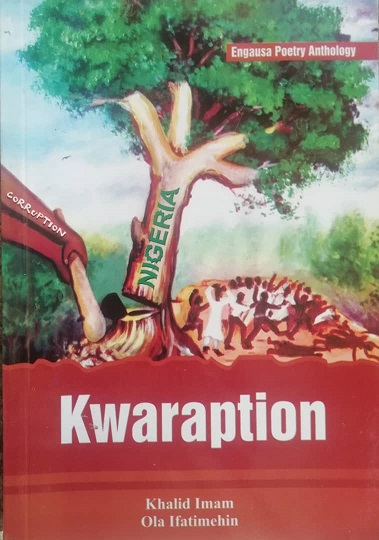
Book Review: “Kwaraption”

Book Title: Kwaraption

Editors: Khalid Imam and Ola Ifatimehin                                                                                   

Type: Anthology of poetry written in Engausa

Publisher: Whetstone Art and Information Service

Pages: 72

Year of publication: 2021

Introduction:

Although not simple to define, corruption is a major impediment and barrier to Nigeria’s progress. For many years the country suffers a lack of infrastructure and poor condition of living because of corruption, which not only stagnates the nation but also derails it from the path of progress. Although more endemic now than ever before, the story of corruption in Nigeria is at least very old.

A missionary teacher in Kano, Madam Ethel Daniel Miller (who came to Kano in 1917) in her book The change here in Kano complained of a prince from the emirate that gifted her a set of clothes for the simple reason that she is a sister to Dr Walter Miller, thinking that she could influence his choice as a successor to the throne.

Other examples can be found in fictional works such as Magana Jari Ce (1937), where Dan’iya bribed a police officer to deceive his friend, Daudu, in a story titled “An ƙi cin biri an ci dila.” The case of Obi Okonkwo in Achebe’s No longer at ease (1960) and that of The Incorruptible Judge (1962) by Olu Olagoke were just a few out of many similar cases. These are clear indications of how writers used their pen to expose and sometimes fight corruption since the beginning of Nigeria formation.

This anthology of poetry edited by indefatigable Khalid Imam and awesome Ola Ifatimehin contains 51 poems contributed by 45 poets. Nearly half of the contributors are female writers, which is a clear indication that females have come of age in terms of literature in northern Nigeria.

The title of the book “Kwaraption” is a Hausa and English attempt at pronouncing corruption. While the first, “kwara” part is just the Hausa sound of the first four letters, “corru” (in a word corruption), the second part was derived from the last for letters (ption) of the original word. In other words, kwaraption is a corrupt way of saying corruption. Instead of the editors using Hausa translation of the word corruption which is loosely translated as Cin-hanci or Rashawa, or just writing Hausa variant of corruption as kwarafshin, they decided to retain part of the original English words. This is to portray the uniqueness of the work as an anthology of poems written using Engausa which involves coding switch or mixing of languages (English and Hausa) with a view to achieving artistical beauty and increasing richness of literature.

An Appreciation of Some of the Poems in the Collection

Looking at the anthology, one can understand that the poems covered a wide range of issues of interest as far as corruption in Nigeria is concerned. Some of the issues covered are:

  1. Recognizing Nigeria as a rich country which is very blessed with both human and material resources, but whose citizens are poor because of corruption and other social vices.

ƙasa mai albarka da albarkatu,

mai attajirai, masu ilmi da yan siyasa Hafsa Ja’afar in a poem titled Rashawa (p. 30). 

  • The state of the country as far as corruption is concern. For example, Ameer Nasir in Cutar Zamani described the country as one having expertise in corruption to the extent that it is difficult to separate us from corruption “tamkar jini da hanta” (p.17). Basheer Adam Gobir assumes that ‘almost everyone’ in the country is corrupt (p.23). Similarly, Farida Mohammed Shehuin Abin Takaice (p.24)and Khalid Imam (p.37) see corruption as a hazard whose impact is everywhere; mosque, church and in all places, and Khalid particularly described corruption as ‘flood’ that destroys (Corruption Everywhere, p.39). Khadija Hanga in her poem titled Despicable Diseases sees corruption as marriageable girl, however dubious whose main goal is to deceive “a fool”. In fact, as captured by Ola in his allegory, “Kukan Kurciya”, corruption is now “new education”. Because we are so accustomed to corruption that we are given it good names and the corrupt person were assumed to be philanthropist as captured in a poem Philanthropist na gangan (p.26) “barazanar ɗan ta’adda ba ta mayar da shi gwarzo”. Also, YZ Ya’u corroborates this in his “Sai Mai Taimako”. Umma Aliyu educates us on different forms of corruption that we don’t see as such due to level of societal decay.
  • Looking at corruption as a cause to many problems this country witnesses.  For example, in a poem “Tick” byAbubakar Isah Baba, corruption is responsible for poverty and insecurity;

It causes abubuwa masu yawa,

Poverty mai kashe gwiwa,

Insecurity mai karkatse rayuwa,

Ga misalan scandals nan da yawa.

In “Lamentations for a Country,” Adesina Ajala blamed corruption for dividing the country along many social layers “Corruption is the common denominator that divides this land without fractions.” The division is along religious, ethnic, regional and even occupational strata. In “Gobarar Daji” Yahaya Abubakar sees corruption as “alpha and Omega”, hence, the chance of getting out of the current quagmire is very slim,

“ta yaya za mu yi rayuwa sustainable,

tattalin arziƙinmu disabled.”

Bashir Umar blames corruption for bankrolling the country such that it cannot meet its basic needs, he sees it as embarrassing that the country now relies on foreign aid for its development “wai yau ni ke neman aid from foreign organization”. The writers believed that Nigeria has taken a poisonous venom, whose effect transmitted to the children, making them engaged in killing one another “mun ɗauki kansakali, maimakon magani.” Ajuji in his “Bragging da Kayan Sata” captures an attribute of a corrupt person.

“there stand akimbo…

carrying pot belly,

like expected mother.”

  • Trying to understand the dynamism and causes of corruption is one other focus of the poets in the anthology. Amatullah Saulawa in her “We shall not be afraid” boldly says:

“yes, it is our faults,

if dictators shift gears,

we bring them back” (p.15).

This is a similar submission of Maryam Baffer in the poem “Har da ni”. However, the politicians are most blamed in the collection because they stand for it

“ko da tsiya ko da tsiya tsiya

sun kasa

sun tsare,

sun raka,

sun rabe”

as stated by Hafsa Ja’afar in Rashawa (p. 30). Lynda Mustapha in her two poems “Write it down” and “Buhu-buhun Iskanc”i blamed politicians for perpetrating corruption in the country. Moses Odozie writes on corrupt civil servants whom he nicknamed “Ɓarawo mai Biro”. Murtala Uba Mohammed, in his poem “Corrupt Nation”, believed that corruption is not limited to politicians, there is also the police, court and parents (p.51).  

  • The writers are tense of corruption and eagerly want it to end. Adesina Ajala said;

“Yaushe zamu warke daga wannan ciwon ne?

Wa zai haska fitilar gaskiya cikin wannan duhun baƙi?.

Corruption is here seen as a wound that needs to be cured and darkness of a night that should be put in the light. In “The Oak Tree”, Aliyu voices out; “yet we hope for betterment”

  • The authors not only lamented over the problem, they also recommended some solutions to the problem. Madinah Abdussalam in his “Yours and Mine” sees the solution as public, that every person should do it himself.  He says “who will end corruption in ba mu ba”.

In “Soyyayar Corruption” by Elizabeth Zephaniah, the public is seen as a solution, she metaphorically states “yaushe za mu ga eagle na fighting corruption”. Musa Adam was also having a similar view in his “My father’s 61st Rebirth”. Some of the poets expressed unity as an important factor in the fight against corruption, “dole we have to be united” as stated by Haneefa Musa Isah in her poem “Mu haɗa kai” (p 31). Also, Sani Abdullahi Salisu in his Kwarapshin (p.61).      

Engausa

It was not surprising when I saw this anthology. This is because of my prior knowledge of the debate that started on the page of APNETi when Dr Ola began to release his poems in a fashion of code switch, mixing English with the Hausa language which Khalid and some other members called ENGAUSA and opined that it is new and welcomed development. Some members of the group, most especially Professor Yusuf Adamu objected to that saying that language blend and code switch is not new in poetry particularly among Hausa poets citing a popular line of late Nai’ibi Sulaiman Wali in his poem Damina

“… su yi kasuwa su yi kantuna,

kowa busy sai su damina.

Yaran gari ko sai bal suke,

kowa ka duba very happy…”.

Khalid and his likes were not convinced arguing that the example given is INGAUSA, different from ENGAUSA. They said INGAUSA is a Hausa poem where words and phrases are used to complement the writer’s inability to come up with the right words based on context or meaning as opposed to ENGAUSA which is a poem written specifically with two languages blending and it is purely artistical. In the introduction of this book, the editors maintained this view indicating that they had not shifted their position, more so, in an interview conducted by Ola stated that this Engausa is almost his own daughter.

While this anthology may certainly be the first collection on the ENGAUSA poem, the view that the ‘new ENGAUSA’ is different from the ‘conventional INGAUSA’ is very weak. This is because language swap in Hausa poetry is not just triggered by weakness or inability to come up with the right phrase or word in a context, it is equally deliberate. Also, when we look at recent popular Hausa songs we can see Engausa. In particular hip-hop singers such as Billy’o in his song “Rainy Season” wherein he said:

Mosoyiya, farkon ganinki na yo confusing,

sai da zuciyata tai ta squeezing,

sai da temperature ta tai rising,

jiri nake sai ka ce na sha poising,

ni ko so nake a san ina da reason”

is a good example of Engausa. In recent, northern Nigeria’s film series such as “Son of the Caliphate” and “Gidan Danja” are also full of Engausa. In addition, Aliyu Idris aka Abdurabbihi is another example, whose poems are in a mix of Hausa, English and Arabic languages even before seeing Ola’s “Sarauniyata” which appeared first in APNETi platform. Agreed, Ola and to some extent. Khalid can take the accolades of popularizing the Engausa and APNETi for holding the first workshop to teach it. It is another issue as to whether the new Engausa has a rule or not. But it is important to state that Engausa is an attempt to mimic how we (particularly the educated elite among us) talk at home and other places.

Finally, I wish to congratulate the editors for the first Engausa anthology and the All Poet Network International (APNETi) and Centre for Information Technology and Development (CITAD) for sponsoring the publication of important literary work that can help in Nigeria’s corruption crusade. The text is truly a noble of a kind. While wishing to see more literary work of this format, I wish the editors will do more in editing the Hausa language in the subsequent publications. I noticed many orthographic errors with respect to the Hausa language, which our indefatigable Imam will share the larger blame for his expertise in the area. I also conclude with the following lines:

Mai biɗar gane corruption,

To ya ɗau wannan collection,

Hausa tare da Englishin,

Sandwich kuma conjugation,

An zubo concatenation,

Kar ku ce contamination,

An yi ne don education,

Tun da Ola ya yi motion,

Ka ga Khalid zai yi action,

An yi  don inganta nation,

Yau kwaraption mun rejection.

The reviewer, Dr Murtala Uba Mohammed, is with Geography Department, Bayero University Kano, and can be reached via murtalamuhammadu@gmail.com.
Yuletide: Corruption has overtaken Nigeria’s free train tickets

By Aliyu Nuhu

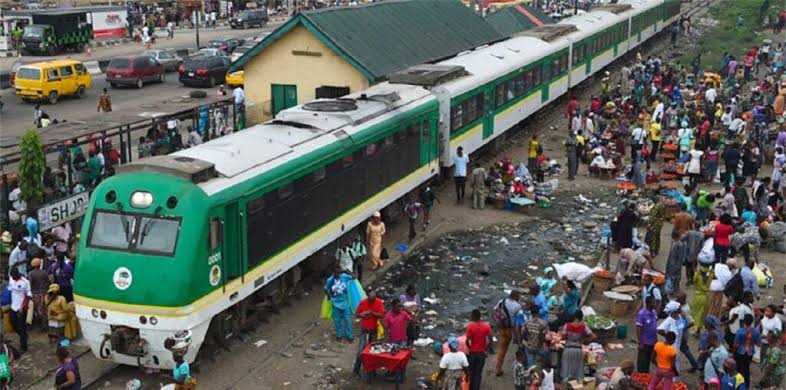
The federal government of Nigeria announced free rail tickets for Nigerians during the holidays, for ten good days. But the following day, all tickets went into an ambush of corruption, and people had to buy them at very exorbitant prices. As a matter of fact, people would have fared better if FG had not made the free offer. What went wrong?

As usual, with the shambolic government approach to issues, the process was left for corruption to dictate who gets and who doesn’t get the tickets. In addition, railway workers racketeered the process, leaving harpless Nigerians at their mercy. Government has its own problem, but we are our own worst enemies. We are wicked even to ourselves.

Even though not free, the airlines’ tickets are all being bought in advance by racketeers. You can’t book online. All flights have been booked, and you have to go to the airport and buy on the spot from touts and corrupt airline officials. A plane ticket from Abuja to Kano goes for 95,000 instead of 30,000. The worst is that the tickets are not bearing people’s names. So in the event of an accident, the families of victims will have serious problems with airlines and insurance companies. It also compromises internal security.

The federal government wanted to give rice millers N10m loans each as a loan. But right from the onset, the Central Bank of Nigeria (CBN) itself sabotaged the process through corruption. NIRSAL was the disbursing agency. CBN appointed a vendor to receive the money and give the millers equipment worth ten million naira. But the vendor supplies goods that are only worth six million in the market. He makes cool four million doing nothing while the millers are saddled with ten million debt. This is Nigeria. Corruption finds official approval, and the rest of Nigerians keyed in.

This country is beyond redemption. No one can save Nigeria. We are too wicked, too lawless, too selfish and just too corrupt to allow our country to work. We corrupt everything!

Aliyu writes from Abuja, Nigeria.

Private jet ownership, death of Nigeria Airways and the country’s “flying” corruption

By Aliyu Nuhu

The Boeing Business Jet, currently the one used by president Buhari, cost $80M, while the other jets favoured by other private individuals like Dangote and Adenuga are the Gulfstream (400-500 series) which cost $45M.

Other planes used by our elites are Hawker Siddley, Bombadier Challenger 600 series, Global Express, Embraer Legacy and Falcons; all depending on the deep pockets of the buyer. The least price of this category is $35million.

Forbes magazine claimed that Nigerians spent $6.5Billion on planes in the past five years. You will probably need a scientific calculator to get the Naira equivalent of that amount.

As the Nigerian leaders successfully abandoned, destroyed and completely killed our – National Carrier – Nigerian Airways, they become obsessed with private jets. Between 2007 and 2012 demands for private jets by the Nigerian class of the rich rose by 650 per cent. In the year 2000 Nigeria had 20 private jets shared among the presidency, NNPC, Shell and a few individuals. That time President Obasanjo and EFCC would sniff the accounts of any politician and businessman that ventured to buy a plane.

This number has increased exponentially in many folds as corruption and easy money gained ground during President Yar’adua administration and the President Jonathan government that showed no interest in fighting corruption. The result was an avalanche of expensive jets parked in the sun as status symbols of Nigeria’s greedy and boisterous elite.

In early 2015, the Guardian reported a total number of private jets at 200 and still counting with new orders placed in US and Canada. The figure is ten times the combined number of commercial aeroplanes in the country. There are presently only 20 operational commercial air crafts servicing the entire 200 million Nigerian public!

According to reports released by Bombardier Corporation of Canada, Nigeria is only behind the US, China and the UK in the placement of orders for private jets. We can excuse US and China at least they are the world’s biggest economies and China has 300 billionaires and over 15000 millionaires, the highest concentration in the world. All of them made their money through real-time investments and hard work. Corruption in China attracts the death penalty while the US punishes corruption with long jail terms. Both countries’ laws respect no status. However, Nigeria, since Obasanjo’s time, has stopped punishing people with corrupt cases. Poverty and unemployment are at epidemic and unacceptable levels now in Nigeria.

While the Federal Bureau of Statistics put the graduate unemployment figure level at 50%, the Federal Ministry of Labour put it at 45%. We don’t know who to believe, but it is well known that Nigeria is notorious for inaccurate statistics.

The World Bank however put the national unemployment figure at 56%, meaning that a population of 167million Nigerians will translate to 60 million jobless on count, the equivalent of the combined population of the entire countries in the sub-continent, lumping Benin, Togo, Ghana and Ivory coast together. I think World Bank is being modest, as the actual unemployment could well be 80 per cent.

Nonetheless, they are grim statistics and a real threat to growth and national security. Because our rich elites have no regard for cost-saving, they care less about the monumental waste of maintaining a plane. A private jet is a huge liability, costing money even when parked on the idle ground.

It cost 20 times 1st class commercial jet ticket to travel to London compared to a single trip on a private jet. Private planes are not like cars that you can just enter and drive off to your destination. To fly a plane you need all sorts of permits, ironically you cannot even taxi out of the hanger without permits which usually cost money. Servicing a plane is something that needs an entire life saving to carry, usually done out of this country which takes weeks to complete and is highly regulated.

To service a plane you need checking, removal and replacement of components, usually plugs, oils and hydraulics, replacement of tires, plates, cylinders, compressors that must all conform to stringent regulation and a certificate must be issued to back it up. Also, there are the routine A check, B check, C check and D check depending on the aircraft cycle.

In the case of D check which happens every 5 years, the entire plane is taken apart and is comprehensively subjected to rigorous overhaul that involved checking the entire fuselage metal skin and possible replacement of engines. This takes 40,000 man-hours calculated at a huge cost. No cost of aircraft maintenance is calculated in Naira here!

So why all the trouble?

The answer is pure ego trip and the Nigerian mentality of personal competition and the usual inferiority complex. The trajectory here is both wicked and ungodly to own a private jet in a land where frustration is written (in CAPITAL LETTERS) on virtually everyone’s face.

Warren Buffet who owns the largest plane manufacturing company in the US flies economy class in commercial airlines and has been known to drive a 2014 Cadillac XTS.

Bill Gates does not own a plane and drives a 1991 Porsche 911 Carrera, Porsche 930 and a 1988 Porsche 959 Coupe. When he came to Nigeria with his wife Belinda he flew a commercial economy ticket. So what is wrong with the Nigerian rich?

I don’t expect this kind of modesty and humility from the crop of leaders we have and the elite in Nigeria. They are undoubtedly easy money bags and hyenas that call themselves rich. Most of them were unemployed and in rags 15 years ago. They killed all our ways to Nigerian Airways. They now shamelessly fly in corruption.

Aliyu Nuhu is a social commentator and an expert in socio-economic and political commentary. He lives in Abuja, Nigeria.

I can’t live without corruption: A mock confession of an African civil servant

By A. F. Sesay

When I was young I had a pure heart, bright eyes and a sparkling smile. All I wanted then was to grow up quickly and set things right. I wanted to be a shoulder for the poor, a shield for the oppressed and a think-tank for my nation. I grew a bit older …. And then there was a minus one to my dreams.

Then I entered youth with exuberance and disillusion I knew the people who have ruined the nation more than I knew myself. I wished I had the power to remove all of them from power.  I knew I was a good young man but I never gave much thought to the realities of life, not more the realities of power. I grew a bit older and I got my first job (as well as my first shock). And then there was a minus one to my dreams…

Here I am today with so much money but very little direction. With a special room in every seven-star hotel, I lay my “ears” on. Yet I have very little peace in my mind. I thought money was all I needed to change the world. If I could stop being poor and deprived, I had thought, then I would be happy and resourceful. Little did I know that money had little to do with wellbeing.

True, sometimes money brings the tools of happiness, but it takes a grateful and content mind to put them to good use. What use will the money be, when all people around me wallow in mud and dirt poverty? I wonder. But people like and respect me even though I am a  corrupt rich man. Corruption persists when all around you insist that your La Vida Loca life is an inspiration for them, without asking for your source of income. Actually, they don’t want to do bad belle for you.

I spray money at their functions to feed my empty ego. I donate a lot of money (well that’s a very tiny per cent of the loot) to charity organisations in return for publicity and praise. But deep within my soul, the truth keeps me debased. The wound of conscience brings more pain than a thousand dagger cuts. I spend here and I spend there. But at night, I secretly spend much more to feed the dirty flesh. Then I grew older …. And then there was a minus one to my life.

Sometimes, I make more money in a day than some unfortunate PhD holder may make in his/her whole lifetime. Don’t mind these Doctors of Philosophy! They talk a lot about the evil things we do. But when they cook up “research” to carry out,  they bring the proposals and we give them part of that evil money and they are all smiles. Now that’s the power of corruption trumping the power of “knowledge”. You get the point now.

I grew a bit older and I started losing the taste for money. All efforts to seek reliable sources of pleasure proved abortive. No amount of beautiful women, or exotic cars or houses or even new places ever sang the you-have-finally-arrived song I heart longs for. The more I got, the less fulfilled I became. Then I made a resolution to give up bribery and corruption, but my soul resisted. In fact, the organ that transports blood to my heart almost became rotten in protest. I was rushed to my doctor and he vehemently advised that I should not give up corruption so that I can pay all my medical bills on time. And some more during medical tourism. As you know, the nation can’t afford that so I have to foot my heavy bills.

My children told me they are tired of studying overseas where they are daily exposed to insults over race and nationality. So I had to look for them the best private school in the country. Their school fee per annum is my exact salary for a whole year! But never mind, I have a way of fetching it in a twinkle of an eye.

In this final quarter of the year, I discussed my resolution to give up corruption with my children’s school principal, a tiny white man, who reminds me of my grandfather’s master before the 1960s. He is a practical man. also told me, “Be fair to yourself,” He emphatically told me. In sum: if I knew I was sincere about giving up corruption, he had posed, why did I bring my children to their school when salary was not paid in pounds sterling.  I grew a bit older …. Then there was depression looming in the air. Ready to take me to my grave, even before I have eaten a tenth of what I have ‘worked’ for.

I look around again and it seems everything around me encourages me to remain corrupt. After all, everybody is doing it (or so I thought). One day in my solitary reflections, two stubborn questions popped up in my head. What if  I suddenly die without repenting, will God punish me for all my sins? Will I be deprived of all that I have done in life? I tried to fight them by asserting that the Hereafter is an ancient tale told by religious men who wanted to exercise their will to power. But it is difficult to convince myself. Deep within me, I harbour doubts since there had been no standard (or even a substandard) experiment to nullify the belief in life beyond the grave so as to prove these religious folks wrong. And the complex process of life from inception to death also betrays a complete denial to resurrection. There has to be an Intelligent and Just Lord waiting in ambush! What will I say to Him, if Hell turns out to be true?  Will I enter it alongside my beloved wife and children who are nourished by the fats and protein public wealth?

Truly, I am afraid, but I am also afraid of poverty. If I give up corruption and become poor, my enemies will think it is their curse that overtook me. But if I die with the wealth of the nation in my private account, will my enemies assist me against the Angel of Punishment?  I am somewhat torn between the devil and the deep blue sea.

My dear friend! Imagine if what you just read was a false confession from a young man who is reflecting on what he will make out of his life were he to be a public officer, will his false confessions make any true impact on your life? What if it is actually a true confession of an old civil servant or politician who has approached old age (and subsequently death) will you learn any lessons from his “wasted” years! It is important for us to know, fellow citizens, that people’s wealth can never be ours. Both conscience and religion deny us that.

Let’s be honest and work hard and sincerely for whatever we want in life. Just because we are living in hard times, does not mean we have got a licence to take bribes. Many became billionaires without reliance on the public treasury and many more will.  So, O young man, why are you afraid of relying on God and unleashing your potential to the fullest! Be wise now that you still have some time.