Corruption

Nigeria’s border checkpoints plagued by extortion, not security — Witness

By Muhammad Sulaiman

Security experts have long warned that Nigeria’s porous borders are a major threat to national stability. This concern was echoed again when Dr Bulama Bukarti, a security researcher, lamented how almost anything can be smuggled into the country due to ineffective border control.

In reaction to Bukarti’s remarks, Dr Aliyu Yakubu Yusuf of Bayero University, Kano, shared a firsthand account that underscores the depth of the problem.

Dr Yusuf narrated that on a trip from Damagaran in the Niger Republic to Kano earlier this week, he sat in the front seat of a commercial bus and witnessed what he described as “a chain of extortion masquerading as security.”

According to him, as the bus approached the Babban Mutum border on the way to Ɓaɓura, he observed “so many annoying checkpoints,” sometimes only a few meters apart. Police officers, soldiers, immigration officials, road safety personnel, and customs operatives were all stationed along the route. Yet, none conducted any meaningful inspection.

“Each time we reached a checkpoint, the driver would simply pull out a one-thousand-naira note and hand it to an officer, then we would move on,” he said. Some officers even addressed the driver by name, apparently familiar with him as a regular traveller.

Dr Yusuf said the driver disclosed that there are 35 checkpoints between Damagaran and Kano, and at each one, he must part with between ₦500 and ₦2000, depending on the officials present. He estimated that drivers spend at least ₦30,000 during a single trip.

“Throughout the four-hour journey, not a single officer asked the driver to open his boot,” he added, expressing disbelief that such laxity exists despite Nigeria’s ongoing fight against insecurity.

His account reinforces concerns that many checkpoints serve as avenues for bribe collection rather than effective security screening—leaving the country vulnerable while motorists bear the financial burden.

“We are jokers, wallahi,” Dr. Yusuf concluded.

Kano DG Protocol sues Jaafar Jaafar over “Thieving Aide” tag

By Muhammad Abubakar

The Chief Magistrate Court No. 15 in Kano has ordered police to investigate Daily Nigerian publisher, Jafar Jafar, and a staff of the newspaper, Audu Umar, over allegations of criminal defamation against the Director General of Protocol, Government House, Hon. Abdullahi Ibrahim Rogo.

Rogo filed the case, accusing the duo of maliciously describing him as a “thieving aide” to Governor Abba Kabir Yusuf in two reports published on August 22 and 25, 2025. He argued that the stories, carried by Daily Nigerian, were deliberately crafted to tarnish his reputation and portray him as corrupt.

One of the reports, titled “Gov. Yusuf Defends Thieving Aide, Says Protocol Directorate Under Ganduje Spent N20 Billion in 3 Months”, and another alleging that anti-graft agencies traced ₦6.5 billion to his office, were cited as damaging to his image.

The complaint, filed under Sections 106 and 107 of the Administration of Criminal Justice Law 2019, and Sections 114 and 393 of the Penal Code, seeks prosecution for defamation and breach of public peace.

Chief Magistrate Abdul’aziz M. Habib subsequently directed the Assistant Inspector General of Police, Zone One, to launch a full-scale investigation.

Meanwhile, Rogo has also filed a civil suit at the Kano State High Court demanding damages for defamation.

Bawa unveils explosive book on Nigeria’s fuel subsidy scandal

By Muhammad Sulaiman

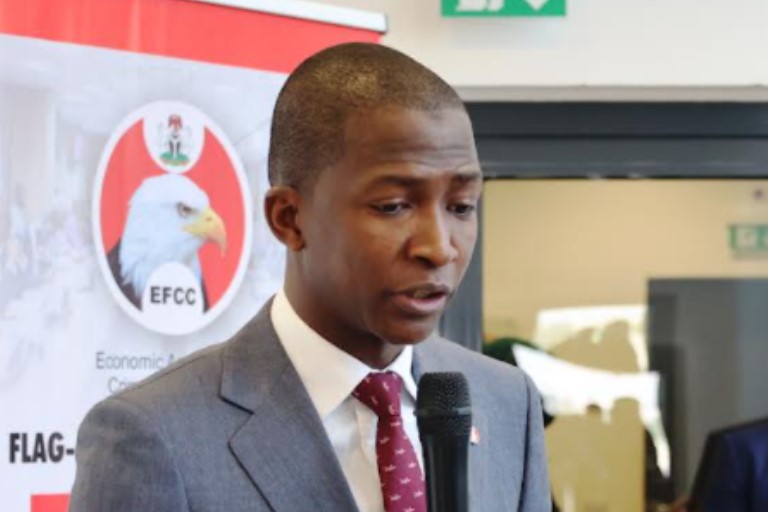
Abdulrasheed Bawa, former chairman of the Economic and Financial Crimes Commission (EFCC), has released a revealing new book that exposes the depth of corruption in Nigeria’s petroleum subsidy regime.

Titled The Shadow of Loot & Losses: Uncovering Nigeria’s Petroleum Subsidy Fraud, the book offers a detailed, insider account of one of the country’s most expensive financial scandals. Drawing from his experience as a lead investigator in the 2012 probe into fuel subsidy fraud, Bawa unveils how trillions of naira were siphoned through fraudulent schemes.

According to the book, corrupt practices ranged from ghost importing and over-invoicing to manipulating shipping documents and round-tripping—all of which were aimed at exploiting the subsidy payment system. 

Bawa also highlights the roles played by both complicit officials and private sector actors, citing systemic weaknesses and widespread collusion.

“This is not just a chronicle of fraud,” Bawa said. “It is a call to action — a demand for transparency, accountability, and reform in Nigeria’s public finance management, especially in the oil sector.”

Published by CableBooks, an imprint of Cable Media & Publishing Ltd, the book is now available nationwide through RovingHeights Bookstore. It is already being hailed as essential reading for policymakers, journalists, and anyone concerned with governance and accountability in Nigeria.

Police crack down on officers over extortion incident along Benin bypass

By Muhammad Abubakar

The Nigeria Police Force has taken swift action against six officers caught in a viral video engaging in extortion along the Benin bypass.

The officers, including a Chief Superintendent of Police who supervised the team, were brought before the Inspector-General of Police, Kayode Adeolu Egbetokun, at the Force Headquarters. The IGP described their conduct as “shameful, distasteful, and utterly unacceptable ” and ordered immediate disciplinary action.

According to a police statement, the officers have been queried, and orderly room trials for the Inspectors involved are underway.

The Force said this move underscores its commitment to professionalism, integrity, and accountability. The public was assured that such misconduct would not be tolerated and that appropriate sanctions would follow.

Governor Abba K. Yusuf’s admin under scrutiny: Mismanagement and controversies rock Kano

By Umar Sani

Governor Abba Kabir Yusuf’s tenure in Kano State has been marked by a series of controversies and challenges, with the most recent scandal surrounding the Ramadan feeding program shedding light on broader issues of governance, priorities, and accountability. As we delve into the intricacies of these matters, it becomes evident that there are systemic failures that need to be addressed urgently to restore public trust and ensure effective governance in Kano.

The Ramadan feeding program scandal serves as a microcosm of the larger issues plaguing Governor Yusuf’s administration. This program, which is meant to provide essential support to the less privileged during the holy month of Ramadan, has instead been tainted by allegations of corruption, mismanagement, and inhumane practices. Reports indicate that resources allocated for the program have been misappropriated, with food meant for the needy ending up in the hands of those who are already well-off. Furthermore, there have been disturbing revelations of substandard food being distributed, posing health risks to the recipients.

Such egregious mismanagement not only squanders public funds but also undermines the intended purpose of welfare programs, which is to alleviate poverty and provide a safety net for society’s most vulnerable members. It reflects a blatant disregard for the welfare of the people and a failure to uphold the principles of transparency and accountability in governance.

However, the issues plaguing Governor Yusuf’s administration extend beyond the mismanagement of specific programs. There are deeper underlying problems related to governance, priorities, and political dynamics that must be addressed comprehensively.

One key issue is the misplacement of priorities. Despite the pressing need for investment in critical sectors such as healthcare, education, and infrastructure, resources have been diverted towards superficial endeavours associated with Governor Yusuf’s political agenda. The phenomenon of Abba Gida Gida, characterized by flashy projects and grandiose gestures, has overshadowed genuine efforts to address the socio-economic challenges facing Kano State.

The emphasis on political symbolism over substantive governance reflects a fundamental disconnect between the government and the governed. Instead of focusing on initiatives that have a meaningful impact on people’s lives, Governor Yusuf has prioritized activities that serve his political interests and consolidate his power base. This shortsighted approach not only undermines the credibility of the government but also exacerbates the suffering of the ordinary citizens who bear the brunt of poor governance.

Moreover, Governor Yusuf’s close association with the Kwankwasiyya political movement has further complicated governance in Kano State. While political alliances are a common feature of Nigerian politics, the tight grip of Kwankwasiyya on the state’s affairs has stifled dissent and marginalized opposing voices. This monopolization of power has created a culture of impunity where accountability is sacrificed at the altar of political expediency.

The entrenchment of Kwankwasiyya in Kano’s political landscape has also fueled factionalism and polarization, undermining efforts to foster unity and inclusivity. Instead of governing for the collective good, Governor Yusuf has been preoccupied with consolidating his grip on power and silencing dissenting voices within his own party and the opposition.

Furthermore, the lack of effective checks and balances has enabled corruption and malfeasance to thrive unchecked. The absence of independent oversight mechanisms has emboldened corrupt officials to exploit public resources for personal gain, exacerbating the state’s economic woes and widening the gap between the rich and the poor.

To address these challenges and chart a path towards genuine reform, Governor Yusuf must demonstrate a commitment to transparency, accountability, and inclusivity in governance. This requires a paradigm shift away from political patronage and towards evidence-based policymaking that prioritizes the needs of the people above partisan interests.

In addition, there is a need for robust institutions and mechanisms to curb corruption and hold public officials accountable for their actions. This includes strengthening anti-corruption agencies, empowering civil society organizations, and promoting a culture of transparency and accountability across all levels of government.

Moreover, Governor Yusuf must prioritize investments in critical sectors such as healthcare, education, and infrastructure to improve the quality of life for all citizens. This requires prudent resource management and strategic planning to ensure that public funds are utilized efficiently and effectively to address the most pressing needs of the population.

Furthermore, Governor Yusuf should endeavour to build bridges across political divides and foster a spirit of inclusivity and cooperation in governance. This means reaching out to opposition parties, civil society groups, and other stakeholders to solicit their input and support in addressing the state’s challenges.

Ultimately, the road to meaningful reform in Kano State will require courage, vision, and a genuine commitment to the principles of democracy, good governance, and social justice. Governor Yusuf has a historic opportunity to leave a positive legacy by addressing the root causes of the state’s problems and charting a new course towards prosperity and progress for all its citizens. However, this will require bold leadership and a willingness to challenge the status quo in pursuit of a brighter future for Kano State.

Umar Sani wrote via umarhashidu1994@gmail.com.

Rebirth of “humble thought” and a peep into Betta Edu gates

By Sani Bello Hamza

The popular Hausa adage “kyaun Ɗa ya gaji ubansa” is what prompt me to start this column. Humble Thought’s Foundation was laid by my father more than two decades ago on the now defunct Pointer Express; a weekly Newspaper wherein he dissect public issues ranging from politics, education, skills/entrepreneurship and other contemporary issues. I decided to pick the baton and continue with the pace to contribute my own quota to the development of our community and country at large. I believe with my consistency spiced up with your unwavering support and prayers, we will have an easy ride and convey my message with ease and touch the lives of many–as he did. You can always reach out to me through my email or phone number set out hereunder. I’m looking forward to hear from you and read your constructive Criticisms. Enjoy and be safe!

CORRUPTION: BETTA EDU AND THE REST OF US

In mid 2019, Boko Haram insurgency, banditry and kidnapping were on the rise. Families were displaced, schools were closed and businesses were shutdown. As a result, President Buhari through an executive order announced the creation of a new ministry and mandated it to develop humanitarian policies and provide effective coordination of national and international humanitarian interventions; ensure strategic disaster mitigation; preparedness and response; and manage the formulation and implementation of fair focused social inclusion and protection programs in Nigeria. The former president appointed Sadiya Umar Farouq as the first minister of the newly born ministry.

The ministry got a warm welcome from Nigerians as they were “assured” by the former president that the ministry will work tirelessly to mitigate disaster and provide succur to Nigerians affected by Natural or man-made disaster. The first minister Sadiya Umar Farouq also swore to discharge her duties in line with the extant rules and provisions of the Constitution–without prejudice.

Few months after the creation of the new ministry COVID-19 Pandemic surge in and became the major problem of Nigeria and the world. Donations began to pour in from governmental and non governmental organizations to aid in mitigating the spread of the virus as well as cater for the affected victims. However, there were series of allegations and mummurring regarding the financial management of the ministry. There were also unrealistic calculations and assertion by for the minister. For example;

The minister said she mandated the disbursement of COVID 19 palliatives across all the states of the federation. Few months later, the palliatives were found stacked in various states warehouses–untouched and undisbursed. This led to a serious chaos; youths all over the country were seen breaking the warehouses to take their shares from the palliative to cater for themselves and their families.

Again, the former minister also claimed to have spent more than 500 million naira to feed the “non-existent children” in their homes in Abuja and Lagos when schools were locked down in 2020.

The NPOWER scheme also loosed its significance under the minister as beneficiaries were owed for several months without payment.

In spite of the above and other allegations, Former president Buhari form a deaf ear and shun all the allegations without launching an investigative panel to look into the matter.

Ironically, Mrs. Farouq spent four years in office and vacated after President Buhari’s tenure, and today, she’s under intense investigation for alleged laundering of more than 37 billion Naira when she was in office. The former minister is under EFCC’s watch and mandated to report daily to the office.

Are we done with the Humanitarian ministry? No!

As expected, President Bola Ahmed Tinubu appointed Mrs. Betta Edu to steer and rescue the already sinking humanitarian ministry. Betta was expected to perform Better than her predecessor and deliver the missions and visions of the Renewed hope agenda. Betta Edu is among the closest allies to the president; a dedicated party member and a hardworking women leader of the party. She supported the president, campaigned for him and mobilised support him. Yet, the president suspended her to give room for investigation and serve as a deterance to other political appointees who think they are immune and untouchable.

President Tinubu’s no-nonsense and zero tolerance approach is where his administration differs from his predecessor–Buhari.

Among the allegations that led to her suspension was a purpoted memo mandating the Accountant general of the federation to transfer 585 million naira to one account Bridget Onyelu.The memo was full of unrealistic calculations including flight tickets to Kogi State–which is not known to have an airport.

Few days to Edu’s suspension, Mrs. Halima Shehu–the DG NSIPA was sacked for alleged transfer 40billion to a personal account. Mrs. Shehu claimed she mistakingly transferred the money to the personal. In another report, she claimed she transferred the money to stop Mrs. Edu from accessing the funds.

The combined efforts of Sadiya, Halima and Betta are really disheartening and disappointing. It is pathetic seeing “women”– who are suppose to be role models and family builders engaging in such disgusting and inhumane acts. I am certain the president will (as he has always ) make sure whoever is found guilty face the wrath of the law.

We can’t continue like this!

Sani Bello Hamza is a Law student at Ahmadu Bello University Zaria, he writes from Zaria and can be reached through his email; sanibellohamza@gmail.com or 09013506168

Muhyi Magaji leads the fight against corruption

By Abbas Datti

Let us take a deep sigh to reflect on the remarkable achievements Barrister Muhyi Magaji Rimingado made as the Chairman of the Kano State Public Complaints and Anti-Corruption Commission. Under Muhyi’s leadership, the fight against corruption and the promotion of public accountability has witnessed tremendous progress.

It is essential to highlight the proactive approaches, Barr. Muhyi Magaji adopted in addressing public complaints. Through establishing accessible and efficient complaint channels in various ministries, departments and agencies, Muhyi has provided a platform for Kano citizens to voice their concerns and grievances directly. This has increased public trust and facilitated prompt resolutions and the commission’s improved service delivery.

The chairman’s unwavering commitment to preventing corruption is genuinely commendable. In his steadfast commitment to fighting corruption, Muhyi has successfully implemented robust measures to ensure transparency, accountability, and integrity in government institutions. From implementing anti-corruption policies to strengthening internal control systems, his tireless efforts have significantly impacted reducing corrupt practices and enhancing good governance.

Furthermore, Mr. Rimingado has been instrumental in promoting awareness and educating the public about the detrimental effects of corruption. Through advocacy campaigns, workshops, and partnerships with civil society organisations and law enforcement agencies like immigration, Nigerian Security and Civil Defence Corps, Muhyi Magaji has fostered a zero-tolerance culture towards corruption. Such initiatives have been pivotal in creating public awareness and mobilising support for the commission’s anti-corruption efforts.

Additionally, the chairman’s strategic collaborations with law enforcement agencies have yielded positive results in prosecuting corrupt individuals. He has sent a strong message that corruption will not be tolerated by facilitating swift investigations and ensuring due process. This has brought unscrupulous individuals to justice and acted as a deterrent for potential offenders.

Lastly, the chairman’s visionary leadership and ability to inspire a dedicated team have contributed to the success of combating corruption and addressing public complaints. By fostering a culture of professionalism, ethics, and integrity within the Ministries, departments and agencies, Muhyi Magaji has created an environment conducive to achieving the set goals.

In conclusion, these giant strides are a testament to Mr. Rimingado’s exceptional leadership, unwavering dedication, and relentless pursuit of transparency and accountability. Magaji Rimingado’s contributions have undoubtedly profoundly impacted the overall socio-economic development of Kano State, and we must applaud and support Muhyi’s continuing efforts in building a corruption-free society.

Abbas Datti wrote from Kano State via abbasdatti448@gmail.com

Nigeria: The search for good governance and prudent policy

By Umar Yahaya Dan-Inu

Governance, in simple terms, means ‘quality decision’ that affects the citizenry’s life. It encompasses accountability, openness and responsiveness in our institution. When Nigeria utilizes its resources, it can achieve progress and development in every aspect, especially when its men and women come together, respect their differences and views, and work together for the nation’s development.

Any society that lacks leaders who can stand up and look at the challenges and solve them is bound to fail. One of the finest Historians in the world, Francis Fukuyama, opined that Nigeria’s problem is a “lack of quality governance”. Since the beginning of the fourth republic, Nigerians have elected four successive presidents with an optimism that the country’s governance would be changed. Moreover, they hope that prudent accountability and transparency would be established in the polity; corruption would be minimal; the difference would be set from the military rule we experienced in the 80s and 90s; every sector of the economy would thrive.

We also expected that there would be equity, fairness and inclusion in governance and leadership where every region of the country and everyone would be carried along to change the nation’s narrative for good. But instead, the nation’s stories remained the same after 23 years of democracy.

Democracy is all about giving people the opportunity to participate in the leadership and decision-making of their country, to decide on their future, to have their voices on who should lead them and the type of policy choices government made, and how national resources should be channelled for the development of the country.

In our polity, the stories are not the same. The flaws in our democracy are very glaring. There is no prudent accountability. Even the civil society organizations (CSOs) and media houses who are to help in grilling government and demand accountability are part of the problem. Corruption has become deep in our system. We institutionalize it. Mathew Hassan Kukah’s opined that “it is part of the human system”.

Ahmed Idris, a former Accountant General of the Federation,  and his accomplices, fraudulently siphoned 109 billion naira. They took advantage of the system, betrayed the people’s trust and put the nation and its people in more miserable poverty.

There are thousands of his types and stories in this poverty. The measures put by the government to checkmate corrupt practices are not adequate. There is a need for more because corruption is in every sector and aspect of the country. Insecurity, banditry and kidnapping have taken menacing proportion. People are killed unjustifiably regularly, while the government doesn’t seem to care.

On the other hand, the academic staff union of universities (ASUU) has been on strike for several months. Students are doing nothing at home. As the government is showing a nonchalant and lackadaisical attitude toward the striking lecturers, there is no sign of ending it. This justifies the position that Nigeria needs prudent leadership and governance.

Good policy is key to achieving national development. Though public policy can be seen as an act of government carried out through the identification of societal needs and demands and acted upon by the executive and legitimized through the legislative process, it should be pro-people, participatory and devoid of elitism. When we look at the challenges posed by the lack of good policy design and implementation, one will realize Nigeria is in the wrong direction. Every past administration came into power with a vague plan that could not be achieved.

This has been the norm since Nigeria got Independence in the early 60s. The trends have always been to tell people what to do, even if it’s not feasible and realistic. When policymakers disregard the poor segment of their society, they are bound to fail. I genuinely believe that “change will not come to us easily”; it is the responsibility of scholars and experts in our country to stand up and demand change.

We need a change in the area of policy design. People should be carried along in the process of design and implementation. All their problems should be captured, and attention should be given to the solutions stated. The CSOs should track all the government expenditures to speak on the pros and cons of every policy initiated by the government and engage the government on development issues.

Nigeria needs strong leadership. It is a known fact that global leaders showed resilience and exhibited what leadership means during the worldwide pandemic. Covid-19 posed a bigger challenge to people around the world. It killed millions of people, destroyed families and hit the global economy like never before.

In Nigeria and around the world, schools were shut down. The leaders imposed a lockdown; there was no movement of people from state to state. It affects everyone. People are afraid to interact with their families and friends because they fear contaminating the virus.

We need leaders that can inspire hope in times of crisis, especially in the forthcoming 2023 election. Nigeria doesn’t deserve bad people and leaders. We need efficiency in our governance and focused leaders. A courageous and bold one. A leader who can galvanize support from the global community and command respect. A leader with capacity, empathy, foresight and deep knowledge that can translate policy goals into reality.

We must prioritize security, education, health, and employment opportunities. Our failure in effective identification, design and implementation has been the major setback of our public policy. We need expert intervention and input to get it right. We must establish good governance and uplift our people from the artificial poverty created by elite manipulation. Until and unless we stand and get it right, we will continue to suffer at the hand of bad leaders.

Umar Yahaya Dan-Inu wrote from Nguru, Yobe State via umarnguru2015@gmail.com.
EFCC urges media to stop promoting corrupt citizens 

By Uzair Adam Imam 

The Economic and Financial Crimes Commission (EFCC) has urged media houses in the country to stop promoting corrupt citizens. 

EFCC stated that the media sometimes portrayed the approach of the commission in fighting cybercrime as draconian.

Abdurasheed Bawa, the chairman of the anti-graft agency, disclosed this Wednesday in Abuja at the opening of a workshop on financial crime reporting organised for the journalists covering its activities.

Bawa stated that the reportage was perhaps borne out of a poor understanding of the anti-graft agency’s modus operandi.

He added, “I want to use this opportunity to further urge media practitioners to put the interest of our country at heart, particularly as it relates to a conscientious effort not to celebrate the corrupt in our midst.

“I urge you to expose them on the pages of your newspapers, screens of television or on your various online platforms.

“The war against corruption is a worthy fight for the soul of Nigeria and for the future generation; it should not be left to the EFCC alone,” he said.

The workshop was said to be one of the interventions by the commission to improve the capacity of the media to deliver on its constitutional mandate.

Drugs Deal: Court admits Kyari’s alleged $61,400 bribe as exhibit

By Uzair Adam Imam

The sum of $61,400, which the suspended Deputy Commissioner of Police Abba Kyari allegedly offered as bribe to the operatives of the National Drugs Law Enforcement Agency (NDLEA), has been admitted as exhibit by court.

The Federal High Court sitting in Abuja under Justice Emeka Nwite, has admitted the money as exhibit on Wednesday.

The Daily Reality recalls that Kyari was on February 22 arraigned alongside ACP Sunday Ubua, ASP Bawa James, Inspectors Simon Agirigba and John Nuhu, while one ASP John Umoru was said to be at large.

Reports, however, gathered that this was coming after the NDLEA tendered the money through the third prosecution witness, Peter Joshua.

Joshua, told the court at the resumed hearing that the currency was handed over to him on January 25 after he conducted preliminary tests on the exhibits.

The NDLEA claimed to have obtained a video footage of Kyari negotiating the $61,400 sum as a bribe with its investigators to prevent the testing of the 17.55 kilogrammes of the drugs.

The witness also tendered 24 packs of cocaine brought before the court in two travelling bags.

However, the bags contained nine packs wrapped in white cotton sacks, three additional packs of cocaine, and 12 pellets that were separately tied in nylon bags.