CBN

Pay customers over-the-counter, CBN directs banks 

By Sumayyah Auwal Ishaq

The Central Bank of Nigeria (CBN) has directed commercial banks across the country to start paying the new naira notes to customers over-the-counter to ease the plight of Nigerians. 

In a statement on Thursday signed by the bank’s Director of Corporate Communications, Osita Nwanisobi, CBN stated that “We have equally noticed the queues at Automated Teller Machines across the country and an upward trend in the cases of people stocking and aggregating the newly introduced banknotes they serially obtain from ATMs for reasons best known to them”. 

“Also worrisome are the reported cases of unregistered persons and non-bank officials swapping banknotes for members of the public, purportedly on behalf of the CBN”. 

The apex bank has assured Nigerians that the queues at ATMs will end soon. However, Nigerians have continued to express their dismay over the scarcity of the new naira notes.

Senate asks CBN to extend old naira notes exchange deadline  

By Muhammad Sabiu

The Nigerian Senate has urged the Central Bank of Nigeria, CBN, to extend the window for exchanging old Naira bills from January 31 to May 31, 2023.
 
Sen. Sadiq Umar of the APC from Kwara North originally moved for an extension until July 31 because he was concerned about the apex bank’s insistence that there would be no such extension.
 
Recall that the CBN declared in October of last year that the old naira notes will no longer be accepted as legal money as of January 31.
 
However in December, the Senate approved a resolution asking the CBN to extend the deadline to June 30.
 
Umar introduced the motion, saying that the Senate had asked that the CBN extend the use of the old notes from January 31 to June 30, 2022, but the central bank had insisted on the January deadline.
 
Lamenting the situation, the lawmakers noted that there aren’t enough fresh naira notes in circulation.
 
He was quoted as saying: “Experiences around the world have shown that such abrupt decision if not controlled usually created chaos.
 
“The Senate should extend the use of the old notes to July 31,” he said.
 
Also lamenting is Sen. Biodun Olujimi (PDP-Ekiti) who urged the apex bank to “look away from the elections” after noting that 90% of people in her local government area have not even set their eyes on the new naira notes.

Naira policy: Nigerian governors summon CBN boss, Emefiele

By Muhammadu Sabiu 

The Governor of the Central Bank of Nigeria, Godwin Emefiele, has been summoned by the 36 state governors in relation to the withdrawal policy and the repainted naira notes.

The Nigeria Governors’ Forum, which embodies the governors, said on Tuesday that the scheduled meeting would take place on Thursday through its spokesperson, Abdulrazaque Bello-Barkindo.

Recall that Nigerians were instructed to deposit their old notes in banks by January 31, 2023, under the CBN’s naira redesign programme, which was implemented in October 2022 of last year.

The spokesperson noted that the virtual meeting would concentrate on the most recent apex bank withdrawal policy and currency redesign.

“For the virtual meeting, the agenda is the Economic and Security implications of naira redesign and withdrawal policy.

“The discussion promises to foster involvement and dialogue among various stakeholders, including governments and civil society organisations, to devise a solution to the lingering issue,” he said.

Philips Curve and Nigeria’s economic reality: a macroeconomic analysis.

By Muhammad Sagir Bauchi

Stabilization of prices and achieving full employment are among the core goals of every economy in their macroeconomic policies. In this case, there are two main approaches to curtail inflation, recession, unemployment and other negative macro-economic phenomena. These approaches are monetary and fiscal policies. While monetary policy refers to the central bank activities which are directed towards influencing the quantity of capital (money) and credit in an economy, fiscal policy refers to the government’s decisions on taxation and spending. Both monetary and fiscal policies are used to regulate economic activities over time. They can be used to accelerate growth when an economy starts to slow or to moderate growth and activity when an economy starts to overheat. In addition, fiscal policy can be used to redistribute income and wealth.

The overall goal of these monetary and fiscal policies is channelled to the creation of a healthy economic environment that could sustain economic growth, facilitate positive employment and stable inflation rate.

In a plain language, the main aim of these two policies is to steer an economy in the sense that the economy does not experience economic boom that could be followed by high period of low or negative growth, high level of unemployment and unstable price. In this situation, people can feel safe in their consumption, savings and investment decision and government could concentrate on economic decision making. And this is where the idea of Monetarist, Classical and Keynesian Schools of Economics come to play, where they have different views in respect to the effectiveness of the two policies.

PHILIPS CURVE FROM A SHORT GLANCE:

The issue of inflation and unemployment is not a new concept in the realm of economics and it’s one of the concepts that reflect the science of economics as a true reflection of reality, since that, almost everyone is feeling the impact of either of the two.

The history of Philips Curve can be traced to the research findings of A.W Philip, an economist who analyzed the relationship between unemployment and the rate of change of money wages in the United Kingdom in the years 1861-1957. At the end of his findings, he suggested that there is an inverse or negative relationship between wages and unemployment. In simple term, he meant that whenever there’s growth in unemployment, there would be a low level of inflation. And the rationale behind the justification of his idea is that wherein there’s employment, people have more money, which leads to high demand for goods and services, and eventually pushing prices up. On the other hand, when there’s a rise in unemployment, INFLATION will go down since there will be low demand for goods and services as there’s less money in circulation.

Philips and Other Economic Perspectives: there are different opinions with regards to the application of the curve and the measures to contain the phenomena.

According to Monetarist School, the issue of unemployment is a supply side phenomena, therefore, demand side measures cannot be used in curtailing them, and even if it occurs, it can be for a temporary and will accelerate price instability at the end. While to the Keynesian school, they argue that there can only be “demand deficient unemployment” And in the time of recession, demand side measures can reduce unemployment for long-term with little of inflation.

Nigeria’s Economic Reality:

In Nigeria, since its independence, unemployment and inflation are among the major distractions in the growth and development of the nation’s economy. This is evident as we are all witnessing a scenario where too much money is chasing few goods and another case of high supply of labor with low demand of it. According to data from the National Bureau of Statistics NBS), Nigeria’s inflation rate has been consistently high, averaging around 11% in the past decade. The high inflation rate can be attributed to a number of factors such as the devaluation of the Naira, increase in the cost of imports, and a rise in fuel prices.

In an effort to curb inflation, the Central Bank of Nigeria (CBN) has introduced and implemented a number of monetary policies, such as the recent cashless driven economy module; through daily and weekly money withdrawal limit, increasing interest rates, tightening liquidity, devaluing the Naira, etc. However, all these policies have not been entirely successful in bringing inflation under control. Additionally, the Nigerian government has also implemented fiscal and monetary policies such as capping government MDAs cash withdrawals limit to minimal amount, increasing taxes and cutting government spending to curb inflation, however, the effectiveness of these policies remains uncertain and challenging. Same goes to the apex bank ongoing monetary policy, especially the weekly withdrawals limit policy, which is an unprecedented threat to urban and rural businesses due to poor mobile/internet banking mechanisms in the country. As such, the apex bank must address these concerns through shifting the effective implementation date until all the proper mechanisms required to operate a cashless economy are put in place. This can be done if the CBN reasons and constitutes a committee that includes technocrats, bankers and internet service providers, which will make sure that effective moblie/internet services are made available to cover the whole country before the policy kicks off and kicks up.

In conclusion, the relationship between inflation and unemployment as represented by the Philips curve is a complex one that is influenced by a variety of factors. The Nigerian economy is facing significant challenges in terms of cashless economy application, high inflation and unemployment rates, and finding effective solutions to these issues will require a rigorous political will and careful consideration of both monetary and fiscal policies. It is important for the government and the central bank to continue to monitor and analyze economic data and make adjustments to policies as needed, in order to create a stable economic environment that supports growth and employment.

Muhammad Sagir Bauchi, is a graduate of Economics from Sa’adu Zungur University, Gadau, Bauchi State. He can be reached via ibrahimsagir1227@gmail.com
Cashless policy is too early for corrupt nations

By Lawan Bukar Maigana

I keep telling people that it is too early for us in Nigeria as a whole to adopt a cashless policy. It is just obviously too early. Yesterday, I read a post by Prof. Abdelghaffar Amoka of the Ahmadu Bello University, Zaria, in Kaduna State, about his experience with a Point of Sale, PoS, agent.

He had gone to refill his gas cylinders at the cost of 19k+ and he used a PoS machine to pay for it. Though he was debited, the money wasn’t credited to the PoS agent’s account. Rather than waste his time there, he transferred another money to someone’s account to pay for refilling. He would have become helpless if he was moneyless.

Some weeks back, I experienced a similar thing in Abuja. I went to withdraw 5k using a PoS from a woman at the NYSC parade ground. I was debited but she didn’t receive the money. She then told me that she won’t give me the money until she receives an alert. Luckily, I had a paltry sum left in my account. I then withdrew the money using a different PoS. It took my bank nearly ten days to refund me.

Before then, and about three years ago, I had the same experience with UBA. I used my father’s card to withdraw N100,000. I tried six times, but all of the transactions didn’t dispense cash, and he was debited five times. My dad only knew it after a week. He complained to the bank but they denied it, without carefully checking whether the transactions were successful or not.

They had to call me to come from school. I quickly got to the bank because it involved my father. I had to help them understand that the transactions failed. Only then they rechecked and discovered that I was right. That was indeed an issue bordering on unprofessionalism.

If not because of my father I would have sued the bank, because they threatened me with a police arrest, saying it was a criminal case. My father asked me to accept their apology else I would have sought compensation for making me look like a criminal, while they were at fault.

Before going ahead with its cashless policy, another factual and excusable factor the Apex Bank should consider is the fact that most of our businesses are done in cash, especially those trading in rural communities and towns and other remote areas where there are no banks, no network, no internet, no electricity, no education, and these people form a large portion of the Nigerian populace.

The questions I keep asking myself regarding this policy are: Did the Central Bank of Nigeria build banks in those areas? Would the people be traveling from their various villages to cities to transfer, withdraw or deposit money? What did the government do in place of these challenges? Does CBN have enough manpower to do this job even if they have built banks? Did CBN mistake Abuja, Kano, Lagos, Port Harcourt, and a few cities for Nigeria?

These, among other reasons, are the factors I want the CBN Governor to consider. Before they present this policy, they need to put all these things in place and educate people about it so that people will evaluate its strengths and weaknesses, and decide to either oppose or support it. The CBN didn’t do that. It just woke up from its slumber and served it to the Nigerians a la carte. Time will however tell if Nigerians will embrace it, warts and all.

Lawan Bukar Maigana is a social analyst. He writes from Abuja and can be reached via email: lawanbukarmaigana@gmail.com

Agitations against cashless policy insincere – Sanusi

By Uzair Adam Imam

A former Central Bank (CBN) governor, Sanusi Lamido Sanusi ll, said the new cashless policy by the Central Bank of Nigeria will help mitigate the lingering issue of corruption by some politicians during elections.

Sunusi also urged the general public to ignore the rain of complaints against the policy, reiterating that the policy would discourage rigging.

He disclosed this Sunday in a short video that went viral, adding that the policy dates back to 2012 when he was the CBN governor.

He said: “The cashless policy started in 2012 when I was governor of the CBN with Lagos and later spread to five states.

“The explanation we gave that time is that the world is evolving and people shouldn’t be carrying cash around, as such the introduction of cashless policy to ease transactions.

“At first people protested against it but they later accepted the policy and started using the different payment channels at restaurants, shops and other places.

“I want to advise people to be careful with what politicians are saying about the cashless policy because it does not favour them.

“They spend four years without delivering on their mandates and later return with huge sums of money thinking they can bribe the security agencies and the electoral body.

“What the policy entails now is that a politician who wants to bribe the security agencies or the electoral body, he/she must pay it in the persons’ bank account where the transaction can be traced.

“Therefore I urge people to embrace the policy as part of efforts to entrench democracy and also make rigging difficult for politicians,” he added.

Buhari unveils new naira notes

By Ahmad Deedat Zakari

President Muhammadu Buhari has unveiled the redesigned naira notes in Abuja.

The President unveiled the new naira notes on Wednesday morning at the meeting of the Federal Executive Council (FEC ) at the state house, Abuja.

The Governor of the Central Bank of Nigeria (CBN), Godwin Emefiele was also in attendance during the unveiling ceremony.

While addressing the FEC members after the unveiling ceremony, the CBN governor debunked the rumours that the early unveiling of new notes is a means to target any Nigerian.

He therefore appealed to the public to refrain from perpetuating such rumours.

He added that the CBN will intensify the monitoring process and interrogate the process of withdrawals.

He stated that there will be strict restriction on the volume of cash that people can withdraw over the counter, as it works with the EFCC to monitor the purpose of any heavy transactions.

Naira Redesign: CBN, Minister of Finance trade words 

By Uzair Adam Imam

There have been up and downs concerning the re-design of the Naira note in Nigeria as the Central Bank of Nigeria (CBN) and Ministry of Finance, Budget and National Planning continue to trade words over the development. 

The minister of Finance, Budget, and National Planning, Zainab Ahmed argued that the CBN’s proposal to redesign the Naira might not yield any good result. Ahmed stated that the redesign would have serious negative effects on the country’s crippling economic growth. 

However, the Spokesman of the CBN, Osita Nwanisobi, challenged Ahmed, who said her ministry was not carried along.

Nwanisobi reiterated that CBN duly sought for the approval of President Muhammadu Buhari which he granted immediately. 

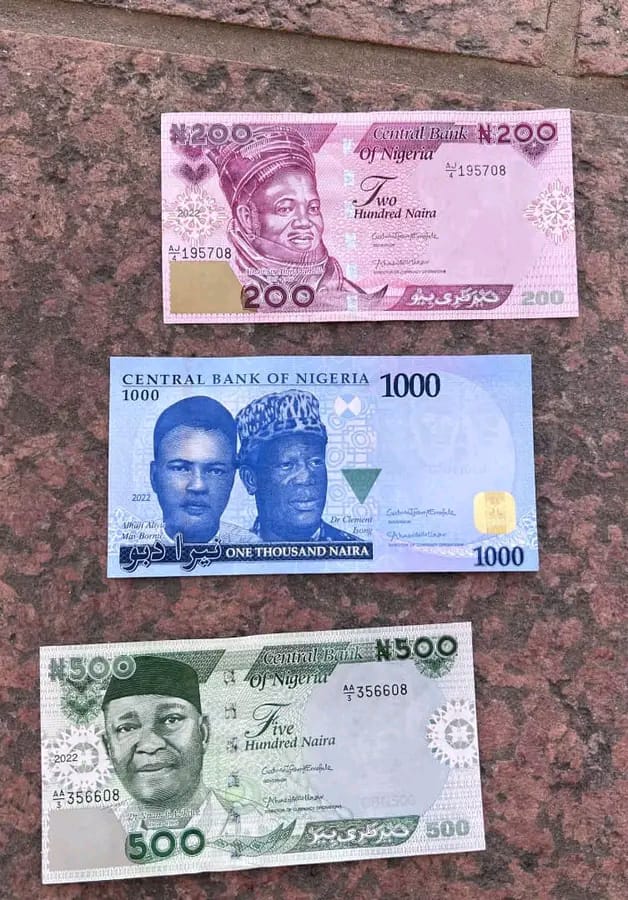
The Daily Reality recalls that the CBN Governor, Godwin Emefiele announced the intention of the CBN to redesign, produce, release and circulate new series of N200, N500, and N1,000 banknotes.

Re-designation of Naira portends serious consequences – Ahmed

“Distinguished senators, we were not consulted at the Ministry of Finance by CBN on the planned Naira redesigning and cannot comment on it as regards merits or otherwise.

“However as a Nigerian privileged to be at the top of Nigeria’s fiscal management, the policy as rolled out at this time portends serious consequences on [the] value of Naira to other foreign currencies.

“I will however appeal to this committee to invite the CBN governor for required explanations as regards merits of the planned policy and rightness or otherwise of its implementation now,” she stated. 

CBN was surprised by what Ahmed said 

However, the CBN spokesperson,  Nwanisobi expressed surprise at the minister’s claim, stressing that the CBN remains a very thorough institution.

He said the decision of the CBN management is in line with provisions of section 2(b), section 18(a), and section 19(a)(b) of the CBN Act 2007.

He also urged Nigerians to support the currency redesign project.

2023: Will Emefiele Declare?

By Zayyad I. Muhammad

Godwin Emefiele, 60-year-old Governor of the Central Bank of Nigeria, is one of the presidential hopefuls whose ‘aspiration’ has become a surprise to some people, and admiration to some other people.

Some people were surprised when Emefiele’s name popped up among the presidential hopefuls. This class of people thought that as an experienced economist heading Nigeria’s apex bank, Emefiele should concentrate on his job of formulating monetary policies, controlling inflation, and managing other economic fluctuations, while championing innovation to ensure the nation’s economic and financial stability.

On the other hand, the people who see Emefiele as a strong candidate believe that with the remarkable successes of the programs and schemes initiated or being implemented by Emefiele; if as president of Nigeria he will not only expand them but will also apply his wealth of experience as a development finance expert to stimulate the economy via other economic programs that will reflect on local needs in line with global trends. This group of people always cite schemes like the anchor borrower program- which has successfully created economic linkages between smallholder farmers and reputable companies involved in the production and processing of key agricultural commodities and the COVID-19 intervention that has cushioned the adverse effects of COVID-19 on households and MSMEs.

In the last five years, the CBN under Emefiele has disbursed over N114.09 billion to support the fertilizer industry- Nigeria had seven Fertilizer blending plants in 2016, and only four were operational. As of today, there were 62 functioning blending plants. These and many economic policies and progress are the ladders these people stand on to cheer Emefiele on, as a strong aspirant. There are reports that many farmers in the north, especially rice farmers have termed their successes as ‘Emefiele’.

Furthermore, political pundits are of the view that Emefiele’s candidature can be a very important political balancer for the APC ahead of the 2023 presidency game. Firstly, no camp in the Southwest will feel cheated with the Emefiele candidature since he directly doesn’t belong to any of them; but can be incorporated into any camp seamlessly.

Secondly, Emefiele from Ika South, Agbor region of Delta State, SouthSouth Nigeria, can also be linked to the cousins of the Igbos in the Southeast. This will to some extent calm the nerves of the advocates of the Igbo presidency and achieve geopolitical equity. For example. Goodluck Jonathan’s presidency was a stabilizing force in the southeast’s politics and social order.  Some political pundits believe that Emefiele, as president can also play that role, now that the Southeast is in agitation for the presidential seat. 

The time has come for Emefiele to officially declare whether he will contest or not. This is very important to clear the air- politics or CBN Governor.  If Emefiele will not contest- let him continue with his task as the driver of Nigeria’s monetary policies and other important roles of the CBN. However, if he decides to contest – this will be a big one in the field of the 2023 presidency game in the APC- already groups like the Emefiele Support Group and Arewa Alliance for the Presidency of Godwin Emefiele (AAPGE) have reached out to many quarters in the country campaigning for Emefiele.

So, what remains for Emefiele is political alliances, negotiation, and courting- this will be easy for him because of his privileged position. However, he also needs to understand that politics is not Development Finance. It is a game where a primary school dropout can teach or even ‘scold’ a Central Bank Governor!

Zayyad I. Muhammad writes from Abuja via zaymohd@yahoo.com.

CBN vows to punish banks over deposit of mutilated naira notes

By Ahmad Deedat Zakari

The Central Bank of Nigeria, CBN, has announced a plan to punish banks for depositing mutilated naira notes. 

This was made known to the public in Abuja through a circular signed by CBN’s Director of Currency Operations, Mr Ahmed Umar, over the weekend.

According to Mr Umar, the warning to the banks to stop depositing mutilated and composed banknotes will take effect from Friday, April 1, 2022.

“The management of the CBN observed with concern the increase in the number of composed banknotes deposited by DMBs and request for replacement of such banknotes by members of the public.

“The existence of composed banknotes in the economy falsifies the true value of currency in circulation, and can also be avenue for fraudulent activities.

Consequently, any composed banknote discovered in the deposit of DMBs shall attract penalty of 400 per cent of the value,” The circular reads.

Composed banknotes or mutilated Naira notes usually comprise several parts of different banknotes of the same denomination.