Borno State

GCC, government fight maternal mortality in Borno 

By Lawan Bukar Maigana 

According to a report by the World Health Organization, Nigeria, after India, has the highest number of maternal mortality in the world. The report shows 788 women and children deaths per hundred thousand’ in India, and 540 women and children ‘per thousand’ died in Nigeria.

Other countries with high maternal, neonatal, and stillbirth rates are Pakistan, the Democratic Republic of the Congo, Ethiopia, Bangladesh, China, Indonesia, Afghanistan, and the United Republic of Tanzania.

‘About 57,000 mothers died from pregnancy and complications during childbirth in 2023 alone,’ said Nigeria’s Minister of Health and Social Welfare, Muhammad Pate, at a public health function.

Unfortunately, the frequent loss of lives among pregnant women in Nigeria, particularly Northern Nigeria, remains an issue of concern. This gives Nigeria a poor global ranking.

Pate explained that the Federal Government was committed to drastically reducing maternal mortality through the new Safe Motherhood Strategy. He noted that the central government will take actionable steps and cascade the strategies to state and local governments, targeting at least seven million pregnant women.

“The aim is to ease six million new births by activating the Decentralised Facility Financing package, establishing robust collaboration with health NGOs, community leaders, and media to boost awareness campaigns.” 

Sequel to the Health Minister’s lamentation, the Girl Child Concerns (GCC), in collaboration with the Borno State Government through the Multi-Sectoral Crisis Recovery Project (MCRP), has trained 300 Community Health Extension Workers (CHEWs) on Basic Emergency Obstetric Care and Early Neonatal Care in Borno State.

The Chief Adviser and Coordinator for Sustainable Development, Partnerships, and Humanitarian Support to the Governor of Borno State, Dr. Mairo Mandara, stated that the training aimed to improve maternal and child health services across the state. The training was conducted in three zones of the state. Each zone underwent one week of theoretical training followed by one week of clinical training. 

The training for Borno Central was held on May 27, 2024, for Borno North on June 3rd, and for Borno South on July 1st, with each zone being exposed to theoretical and clinical aspects of the training.

Dr. Mandara emphasized the governor’s commitment to ensuring quality health services for the resilient people of Borno State, especially the locals, given the magnitude of the challenges they face due to the terrorist activities of Boko Haram insurgents in their communities.

Dr. Mina Endeley from the Namu Project in the UK and Oluwaseyi Akinlaja from Princes Alexandra Hospital Trust in the UK have also joined the training, leading a practical session on successful delivery and universal approaches to handling emergency cases.

Endeley at MCH Biu Local Government Area practically taught non-medical attendants the concepts of basic life support, including managing catastrophic bleeding in the community.

The participants practised approaching the scene safely, calling for help, managing catastrophic bleeding, and reviewing the patient’s airway, breathing, and circulation using a mnemonic we created.

Oluwaseyi Akinlaja from Princess Alexandra Hospital Trust, UK, explained the labour mechanism: how a baby is delivered as it passes through the pelvis into the birth canal and is born by expulsion. This was done to enable CHEWs to visualize the birth process so that they could make early referrals when necessary.

She exposed the participants to the seven steps/processes that a baby passes through before delivery, namely engagement, descent, flexion, internal rotation, extension, external rotation, and extension.

On his part, the Emir of Biu, Maidala Mustapha Umar Aliyu II, described the combined efforts of the organization—GCC—and Borno State Government as a “timely homily” and expressed readiness to support the effort in every way possible.

The lead facilitator of the training, Hadiza Yahaya, has expressed satisfaction with the performance of the participants during the training and expressed hope that the CHEWs will help greatly in the fight against maternal mortality. 

The training offered to Community Health Extension Workers (CHEWs) in Borno State is expected to result in each participant putting the knowledge into practice and witnessing a drastic reduction in maternal mortality in the state.

Lawan Bukar Maigana is the Communication Officer for Girl Child Concerns, GCC, and can be reached via email at lawanbukarmaigana@gmail.com.

Gwoza Blast: Jaiz Bank PLC donates ₦10 million to victims

By Abdullahi Khairallah

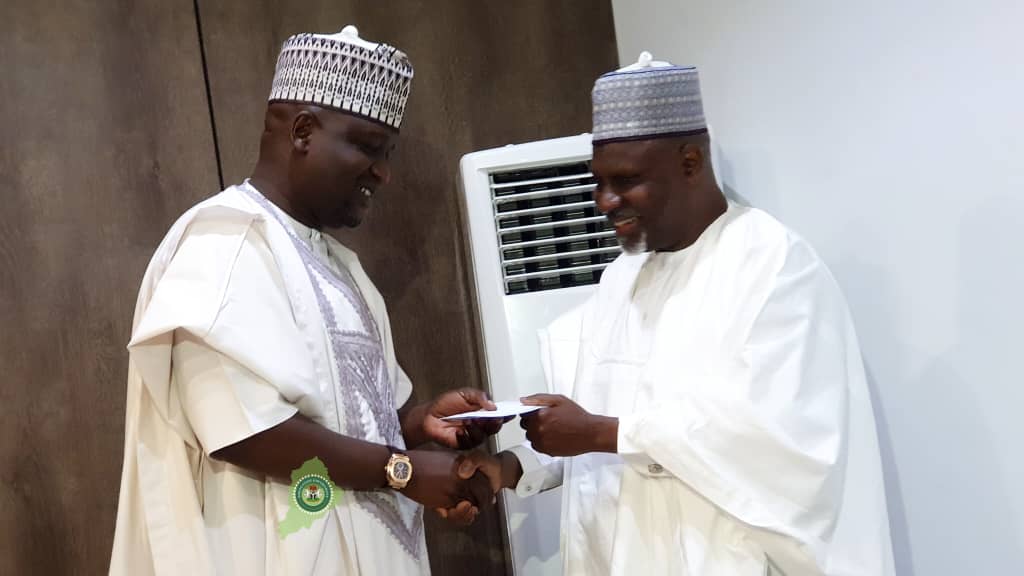
Jaiz Bank of Nigeria has donated 10 million Naira to provide medical support to the victims of the recent Gwoza bomb blast in Borno State. The bank presented the cheque as part of its corporate social responsibility to the community.

Receiving the delegation at the Council Chamber Government House Maiduguri, Dr. Umar Usman Kadafur, received the cheque for onward disbursement to the victims of the bomb blast. He assured that the medical support would be channelled appropriately to the victims while thanking the bank’s board and management for their gesture and support to the people and government of Borno State.

Earlier, while presenting the donation to the Acting Governor, Dr Kadafur, the chairman of the bank’s Board of Directors, Alhaji Muhammed Mustapha Bintube, said the bank’s board and management considered it necessary to contribute their quota and complement the efforts of the state government in supporting the victims in this trying time.

“This unfortunate and needless loss of lives is indeed a colossal loss not only to the Gwoza community but also to Borno state and the county at large.

“We sincerely empathise with the affected families and extend our hands of affinity to the Gwoza Community and the entire people of the state,” Bintube said.

He commended the state governor and his deputy for their good work for the people and assured them of the bank’s continuous support for the government and the people of Borno State.

Malam Mustapha Bintube prayed to Allah to forestall future mishaps and ensure a quick return to peace in the state.

Present at the gathering include Secretary to the State Government Alhaji Bukar Tijjani, Acting Head of Service Dr. Abubakar Sadiq, Commissioner for Transport and Energy Hon. Aliyu Lawan Buba, Commissioner for Local Government And Emirate Affairs, Alhaji Sugun Mai Mele, Permanent Secretary Administration and General Services Governor’s Office Dr. Muhammed Ghuluze, APC Party chairman Gwoza local government, Abdullahi Danjatau, Council Secretary Hajiya Fatima Musa, Special Advisers, among others.

Two female suspects arrested over Borno suicide attacks

By Uzair Adam Imam

According to authorities, two female suspects have been arrested in connection with the detonation of improvised explosive devices (IEDs) in Gwoza local government area of Borno State on Saturday.

A local government official confirmed that 30 female suicide bombers were sent to Gwoza to detonate IEDs at different locations within the area. However, only four suicide bombers had carried out the attack so far.

One of the female bombers, who came from the Pulka axis, detonated the IED at a checkpoint, killing herself, a soldier, and a civilian JTF member. The women were said to have entered Gwoza from different locations, including Pulka and the Mandara mountains.

Security operatives are currently on the lookout for the remaining would-be suicide bombers to prevent further disasters. The source explained that one of the female bombers that came from Pulka axis was responding to military interrogation at the checkpoint when she panicked and detonated the IED.

The Borno State government has condemned the attacks and vowed to continue the fight against insurgency. The governor of Borno State visited the victims of the bomb blast and reiterated the government’s commitment to ending the insurgency.

The investigation is ongoing, and security operatives are working to prevent further attacks in the region.

Six killed, many others injured in Borno bomb blast

By Abdullahi Khairalla

Borno State Police Command has confirmed that eight people were killed and fifteen others sustained various degrees of injuries following a bomb explosion in Gwoza Local Government Area of Borno State, which is about 100 kilometres away from Maiduguri.

Police Public Relations Officer ASP Nahum Kenneth Daso reported that the tragic incident occurred on June 29, 2024, at approximately 15:40 hours. 

The command further notes that ” a woman carrying a baby detonated an Improvised Explosive Device (IED) at a busy motor park in Mararaba T. Junction in Gwoza town. 

The explosion claimed the lives of the woman, her baby, and six others, with fifteen individuals who sustained injuries currently receiving treatment at General Hospital Gwoza”.

This is happening in the wake of the cropping season, which many observe is part of the sinister efforts of the insurgents to cause havoc and instil fear in the people, thereby preventing them from accessing their farmlands.

VP Shettima, Kadafur, Shehu lead Muslim faithful in eid prayer

By Abdullahi Khairallah

Vice President of Nigeria, Sen. Kashim Shettima; Borno State Acting Governor, Hon. Umar Usman Kadafur; and the Shehu of Borno, HRH Dr. Abubakar Ibn Umar Garbai Elkanemi, led thousands of Muslim faithful to observe Eid prayers in Maiduguri.

The two raka’at prayers were led by the Chief Imam of Borno, Imam Shettima Saleh, at Ramat Square, Borno’s central Eid ground.

Other dignitaries include Senator representing Borno North, Sen. MT Monguno; Speaker of the Borno State House of Assembly, Rt. Hon. Abdulkareem Lawan; Minister of Agriculture and Food Security, Sen. Abubakar Kyari; former Deputy Governor, Hon. Usman Mamman Durkwa; Members of the State House of Assembly; Hon. Commissioners and Members of the State Executive Council; Special Advisers; Senior Special Assistants; and Special Assistants.

Delivering his Eid sermon, Imam Shettima reiterated the importance of peaceful coexistence and prayed for a bountiful harvest as the cropping season begins.

Shortly after the prayer, the Acting Governor thanked Almighty Allah for making it possible to witness yet another Eidul Adha while congratulating the Muslim Ummah for the successful Eid prayer.

“Secondly, we want to wish all those who traveled to Saudi Arabia a successful and rewarding Hajj exercise. May Allah accept all their prayers,” Kadafur said.

He further urged Muslims to be law-abiding, peace-loving, and enjoined them to use this occasion for sober reflection and prayer for lasting peace in the state.

Prayers were offered for the restoration of total peace in Borno, the northeast, and the entire country.

MURIC condoles Zulum on death of Isa Gusau

By Muhammad Abdurrahman

Mallam Isa Gusau, the spokesperson of the governor of Borno State, died two days ago in faraway New Delhi, India, after a protracted illness. Meanwhile, the Muslim Rights Concern (MURIC) has commiserated with Governor Babagana Umara Zulum. 

In a statement issued on Saturday, 13th January 2024, by the group’s Executive Director, Professor Ishaq Akintola, MURIC urged the governor to take Gusau’s death in the spirit of the philosophy of death in Islam: ubiquitous, unavoidable and necessary end.

The human rights organisation also condoled the Shehu of Borno, Alhaji Abubakar Ibn Umar El-Kanemi, and the entire Borno Muslim Community. 

Akintola described Gusau’s death as painful and a heavy loss. He also described the deceased as a devoted Muslim, a professional to the core, a humanist, an idealist and a principled family man. 

He prayed for Allah’s forgiveness and al-Jannah Firdaus for Mallam Isa Gusau. He also prayed that members of the deceased’s family, friends and acquaintances would have the fortitude to bear the irreparable loss. 

BOOK REVIEW: A History of BORNO: Trans-Saharan African Empire to Failing Nigerian State

Author: Vincent Hiribarren

Date of Publication: 2017

Number of pages: 310

Publisher: Hurst & Company, London

If you knew very little about the territorial framework of the Borno empire before now, then reading this book might likely shatter some previously held notions about the region. Borno has, in recent years, notoriously gained renewed academic attention as a result of the Boko Haram insurgency. Spoiler alert: this book isn’t about the origin of Kanuri or other inhabitants.

Although the Borno empire found its roots in the 8th century, this book covered only the past 200 years of the kingdom’s existence. Therefore, the 8 chapters of the book started at the beginning of the 19th century down to around 2014 when the research for its publication was concluded. The author seemed very mindful of the political significance of the Borno empire following the Fulani jihad, even if the invasion had a different outcome, but that’s another topic entirely.

The earlier section of the book highlighted the spatial continuity of the territorial framework of Borno, which argued that fairly stable structural borders existed well before colonial times. This was a pivotal juncture, as discussed later in the book, for the ‘scramble for Borno’, where the 19th-century spatial frameworks were used to legitimise conquest by foreign invaders. It proved important even in the European colonial competition against each other.

Later on, the book explored how, essentially, the British and the Germans recycled the Borno region within their colonial spatial framework with an additional detailed perspective of the Indirect rule. It didn’t stop there, it goes on to analyse how, in reality, the colonial administration of Borno during the early colonial period played a decisive role in the preservation of its territorial continuity.

Navigating this book, you need to have an incredible tolerance for some nitty gritty details. The writing style is aggressively academic, and it is filled with flayed raw materials to inspire further reading. It is definitely not a very easy-to-read book but rather a slice of rock-hard brain playground! It’s very clear that the author is a cartography freak.

The book itself must have been inspired by the thesis undertaken by the author while pursuing a PhD at the University of Leeds in the UK with the title “From a Kingdom to a Nigerian State: the Territory and Boundaries of Borno 1810-2010”. The author teaches African History at King’s College London.

Dr Shamsuddeen Sani wrote from Kano, Nigeria.

Zulum reopens Monday Market

By Rukayya Abubakar Othman

Governor Babagana Umara Zulum yesterday commissioned the famous Maiduguri Monday market and relieved two years’ rent for about 8,000 traders:

Borno state governor commissioned Maiduguri Monday Market on Monday, which was rebuilt after a fire inferno that gutted the market in February this year. 

Governor Babagana Umara Zulum announced that over 8000 traders who hitherto rented shops and paid rent would no longer pay for the next two years because of the losses incurred by them as a result of the mishap.

This, of course, is the untiring commitment of the state governor to the cause of serving humanity.

Upon the February incident, the governor hurriedly set up a committee to reconstruct the market, which has been completely rehabilitated and remodelled, with over 8,000 traders to benefit from the reconstruction. 

The market is well structured, which involves a comprehensive design and more vacancies for other traders to thrive in their business activities.

 The governor in February donated about N2b to the committee constituted to immediately swing into action and release N1b to the disaster victims. 

During the commission, Governor Babagana Umara Zulum announced about 2,825 traders who could not allocate their previous shop after the fire disaster. 

“As a result of remodelling, over 2,000 traders who either operated at a temporary site or built shops illegally on waterways could not own shops in the market. Moreover, the government will support over 185 of them with N1m “. Zulum said. 

He also promised that the people doing business there would get shops at a newly constructed Monday Market in Maiduguri. 

Borno: Police investigate commissioner’s mysterious death 

By Abdullahi Khairalla

The Borno State police command has commenced an urgent investigation into the death of the state’s commissioner for Reconstruction, Rehabilitation and Resettlement (RRR), Engr Ibrahim Idriss Garba, Governor Babagana Umara Zulum’s spokesman, Malam Isa Gusau, has confirmed.  

The state commissioner of police was at the house where Engr Ibrahim died in Maiduguri on Saturday.

Governor Babagana Umara Zulum received the news with intense shock and profound grief. The Governor mourns alongside the late commissioner’s family, other loved ones, friends, associates, and state executive council members. 

Late Engr Ibrahim Idriss Garba was the Governor’s Special Adviser on Special Projects before he was elevated and appointed commissioner of RRR at the commencement of Zulum’s ongoing second term. 

It is rumoured in some quarters that the deceased was poisoned, which led to his untimely death.

Security management: The Adamawa model

By Zayyad I. Muhammad

At its 8th meeting held in Maiduguri, the Borno state capital, on September 9, 2023, the Northeast Governor’s Forum expressed its concern about the new dimension of growing banditry in Bauchi, Gombe, and Taraba states as a result of the concerted efforts of the military bandits from other parts of the country. The governors called on the federal government to intervene. With this new development, it’s evident that Adamawa State is doing well among the six states in the northeast sub-region in internal security. How did the Governor Fintiri-led government achieve that? Through planning and strategies or just sheer luck?

The Adamawa state government has employed three approaches. First, the Fintiri-led government looked at the areas affected by Boko Haram’s senseless insurgency. Then, the government developed excellent and feasible post-war programmes and projects with a comprehensive implementation strategy that fast-tracked the healing of the war’s scars. The government restored basic infrastructure and local economies, returning the affected communities to their peaceful and productive pre-war status.

A simple example is the burbling economic activity in townships like Mubi, Michika, and Madagali. Secondly, after the restoration of basic infrastructure and integration of the lives and livelihoods of thousands of people, the government employed a quick rehabilitation of agricultural land, places of worship, health centres, bridges, and schools, including the creation of productive employment for the teeming unemployed citizens, especially young people and women.

Over the years, most developmental efforts in many states emphasised urban development at the expense of rural development, which has led to a substantial rise in inequality among Nigerians—inequalities beget insecurity. What the Fintiri-led government did was balance urbanisation and rural areas’ needs. While Adamawa state’s capital, Yola, is gradually being transformed into a working city that accommodates all segments of society and provides basic and modern infrastructure, other local governments are getting what they should have in agriculture, basic electricity, healthcare, and human development. What the government did was equate each community’s basic infrastructure needs with youth employment needs to curtail crime.

For example, when the notorious Shila Boys re-emerged, the Fintiri government used a soft and hard approach: the government provided young people with cash grants, loans, and training on new skills through the Poverty Alleviation and Wealth Creation Agency (PAWECA) and the Adamawa State Social Support Programme (ADSSSP). While those who refused to change their ways were dealt with the hard way by law enforcement agents. Another approach that helped Governor Fintiri sustain the success recorded in its internal security management- the government reinforced its more knowledge-based approach, thus the coming onboard of Deputy Governor Professor Kaletapwa Farauta, Secretary to the State Government Awwal Turkur, and Chief of Staff Dr. Edgar Amos, etc. These people are well-read and have been through the mills in their respective fields.

According to the United Nations Development Programme (UNDP), community security seeks to operationalise human security, human development, and state-building paradigms at the local level. This is the concept the Fintiri government used to douse tension due to farmer-herder conflict in some communities. However, there is a theory that says no one can experience perfect security because individuals or states are not perfectly secure or completely insecure, but the Fintiri model of community engagement, local people’s parley, and provision of basic needs has helped Adamawa State curtail farmer-herder conflicts, peaceful co-existence, youth restlessness, assurance of safety, absence of fear, etc. within the state. The Fintiri model of internal security management is working; other states in the northeast sub-region can copy it.

Zayyad I. Muhammad writes from Abuja.