From Presidential Vision to Military Transformation: Waidi Shaibu Leads the Delivery of the Bola Ahmed Tinubu Barracks Phase II
By Kasim Isa Muhammad
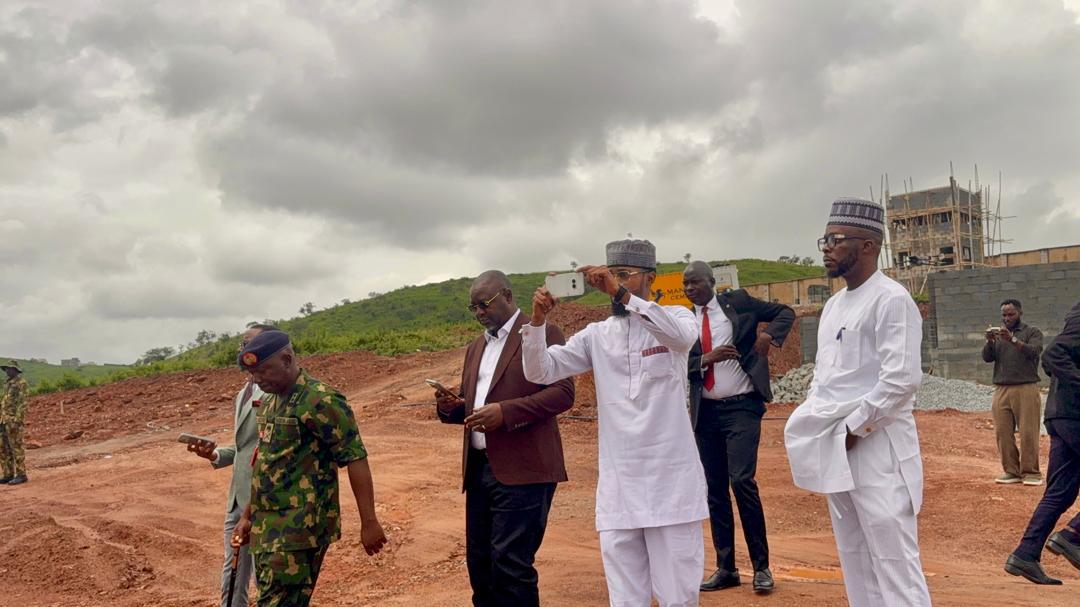
The Presidential Media Team on Tuesday inspected the ongoing construction of the Bola Ahmed Tinubu Barracks Phase II in Abuja, a major Nigerian Army accommodation project approved and funded by President Bola Ahmed Tinubu.
The inspection was led by the Special Adviser to the President on Media and Public Communications, Chief Sunday Dare, PhD, CON, and the Senior Special Assistant to the President on Digital and New Media, Mr. Otega Ogra.
The project is designed to provide accommodation for more than 1,000 soldiers and their families, with the completed facilities expected to serve a population of over 6,000 people.
The development includes 30 family quarters, six blocks of senior officers’ accommodation, an Army club, MAMI market, bridges, drainage systems and other supporting infrastructure.
Speaking during the inspection, Chief Sunday Dare said the project was one of the visible outcomes of the Federal Government’s decision to redirect resources towards infrastructure and development following the removal of fuel subsidy.
According to him, projects of this scale were difficult to undertake when substantial public resources were committed to subsidy payments.
Dare said the barracks project reflects the administration’s effort to improve the welfare of military personnel while also investing in infrastructure that supports national security.
He urged Nigerians to pay attention to the projects being implemented under the Renewed Hope Agenda, noting that some of the policies of the administration are beginning to produce visible physical projects.
Mr. Otega Ogra also described the project as part of the government’s broader investment in security infrastructure. He noted that the construction was providing employment and business opportunities for Nigerians involved directly and indirectly in the project.
The economic impact was also reflected in the experience of workers at the site.
One of the labourers, Usman, said his work on the project had enabled him to establish a family. He explained that before securing the job, he had not been able to get married. He is now married and has a child.
The Bola Ahmed Tinubu Barracks Phase II is part of wider infrastructure and welfare developments within the Nigerian Army.
Similar projects are nearing completion in Ekiti State, while expansion work is ongoing at the Nigerian Army Depot in Amasiri-Edda, Ebonyi State, as well as other military infrastructure projects, including the Osogbo project in Osun State.
The projects are being implemented alongside other measures aimed at strengthening the Nigerian Army, including improvements in personnel welfare, recruitment, training, equipment and operational capacity.
Four additional military divisions have been created, while the government has announced plans for additional recruitment. Military salaries have also been increased, alongside the procurement of combat-enabling equipment, including drones.
The military has also continued operations against terrorist groups, with the Federal Government reporting that more than 10,000 terrorists have been neutralised, over 8,000 apprehended and approximately 7,700 hostages rescued. Support has also been provided for more than 12,000 children of fallen military personnel.
The Chief of Army Staff, Lieutenant General Waidi Shaibu, is responsible for the military implementation and supervision of projects and initiatives within the Nigerian Army.
The progress of the Abuja barracks project is therefore one part of the broader effort to improve the Army’s infrastructure and welfare system.
For the soldiers and their families who will eventually occupy the facilities, the project represents more than a construction programme. The residential quarters and supporting infrastructure are expected to provide a more structured living environment for personnel serving in the nation’s capital.
The project also illustrates how government investment in infrastructure can generate economic activity during construction, while creating long-term public assets after completion.
The Presidential Media Team’s inspection provided an opportunity to assess the progress of the project and its wider relevance to military welfare and national security.
As construction continues, the focus will ultimately be on completing the facilities to the required standard and putting them into use for the soldiers and families they were designed to serve.