Bangladesh

Rare Albino Buffalo Nicknamed ‘Donald Trump’ Escapes Eid Sacrifice in Bangladesh

By Sabiu Abdullahi

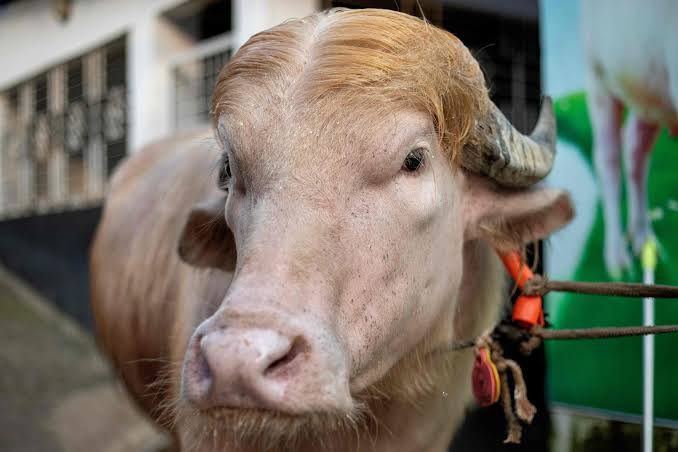
A rare albino buffalo in Bangladesh, popularly nicknamed “Donald Trump” because of its blond tuft, has escaped being slaughtered for Eid al-Adha after authorities intervened at the last minute.

The buffalo, which weighs nearly seven hundred kilograms, had already been sold for sacrifice before officials halted the process over security concerns linked to growing public attention.

A Home Ministry official confirmed on Wednesday that Home Minister Salahuddin Ahmed ordered that the animal should be spared. Authorities also directed that the buyer be refunded while the buffalo would be moved to the national zoo in Dhaka.

“At the ‌last moment, the decision was taken to spare the buffalo from sacrifice due to security ‌concerns and the unusual level of ‌public interest,” a ministry official said.

Interest in the animal spread rapidly after videos of it circulated online ahead of the Eid celebration scheduled for Thursday. Many people reportedly travelled to the farm to catch a glimpse of the unusual buffalo, which stood out because of its light-coloured hair and calm nature.

The owner of the farm, Ziauddin Mridha, said his younger brother gave the buffalo the nickname after noticing a resemblance to United States President Donald Trump.

Mridha explained that the animal is gentle and requires special care, including regular feeding and bathing.

Albino buffaloes are uncommon in Bangladesh, where dark-coloured cattle are more common during the Eid livestock season. Reports indicated that the animal’s unusual appearance and nickname contributed to the attention that eventually saved it from slaughter.

Meanwhile, Muslims in Mali are facing difficulties ahead of Eid al-Adha as the prices of sheep continue to rise following a blockade imposed by armed groups linked to al-Qaida.

The blockade has reportedly disrupted the transportation of goods into Bamako, the country’s capital. Analysts said the situation has affected supplies and pushed the cost of animals beyond the reach of many families preparing for the religious festival.

The armed group Jama’at Nusrat al-Islam wal-Muslimin reportedly announced the blockade earlier this month. The group has frequently targeted trucks and commercial vehicles transporting goods into the city.

Mali, which depends heavily on supplies transported from neighbouring coastal countries such as Senegal and Ivory Coast, has experienced increasing economic pressure as a result of the disruption.

Bangladesh’s Viral ‘Donald Trump’ Buffalo Becomes Eid Sensation

By Muhammad Abubakar

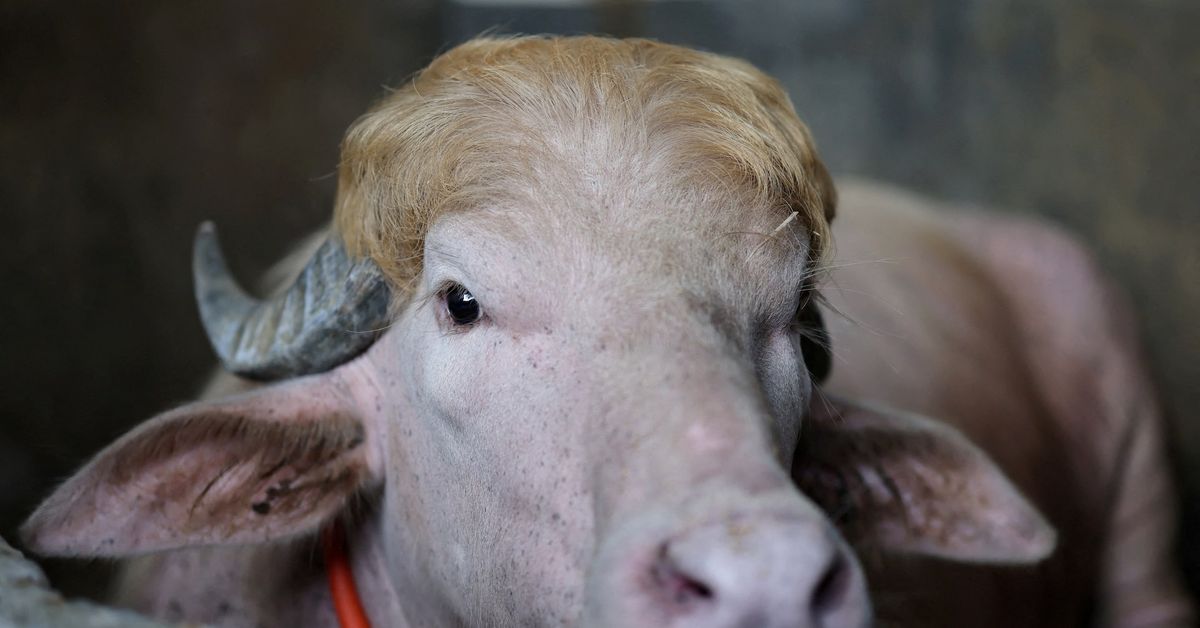
A rare albino water buffalo nicknamed “Donald Trump” has become an internet sensation and a massive crowd-puller in Bangladesh ahead of the upcoming Eid al-Adha festival.

The 700-kilogram (1,540 lb) animal went viral for a distinct tuft of golden-blonde hair on its forehead, prompting immediate comparisons to the former U.S. president. Raised at the Rabeya Agro Farm in Narayanganj, near the capital city of Dhaka, the buffalo features unique cream-coloured skin and pale eyes resulting from a rare genetic mutation.

The animal’s sudden fame drew thousands of visitors, with people travelling long distances by boat just to catch a glimpse or take a selfie. However, the overwhelming attention took a toll. The farm’s owner, Ziauddin Mridha, had to briefly restrict public viewing after the noise and crowds stressed the buffalo, causing it to lose its appetite.

To keep the celebrity livestock healthy, handlers pampered the animal with four baths and four high-nutrient meals a day.

Naming prized livestock after global celebrities and politicians has become a popular marketing trend among traders in Bangladesh to boost interest ahead of the Islamic “Feast of the Sacrifice”. The viral “Donald Trump” buffalo has already been sold to a buyer in Dhaka, where it will be sacrificed in accordance with Eid traditions.

Why Electricity Will Define Nigeria’s Future

By Muhammad Masud Yerima


From 2005 to 2025, the global electricity access story changed dramatically. Countries like India and Bangladesh moved from being among the countries with the highest populations without electricity access to largely exiting the list. Meanwhile, Nigeria moved in the opposite direction from third place in 2005 to leading the world in the number of people without access to electricity by 2025.

That should concern every policymaker, investor, planner, and citizen.

In 2005, India had over 360 million people without electricity access. Today, India is no longer on the list. Nigeria, on the other hand, increased from roughly 77 million people without access in 2005 to over 88 million in 2025. This is despite Nigeria being one of Africa’s largest economies and one of the world’s biggest oil and gas producers.

The question is simple:
What did India do right, and what is Nigeria still getting wrong?

India treated electricity not just as infrastructure, but as a national development priority. The country invested aggressively in grid expansion, rural electrification, generation capacity, transmission infrastructure, and policy reforms. Programs like village electrification schemes, renewable energy deployment, and public-private sector collaboration accelerated access across both urban and rural communities. More importantly, India planned long-term and executed at scale.

Nigeria’s challenge is more complex than simply “not enough power generation.” The issue is systemic.

First, population growth has outpaced infrastructure development. Nigeria’s population has expanded rapidly, but transmission networks, distribution systems, and generation capacity have not grown at the same pace. Even where generation exists, the grid often cannot evacuate or distribute the power efficiently.

Second, infrastructure investment has been inconsistent. Transmission bottlenecks, aging equipment, weak distribution networks, vandalism, and underinvestment continue to limit reliability and access. In many parts of the country, being connected to the grid does not even guarantee stable electricity.

Third, planning and execution remain fragmented. Energy policy changes frequently, projects are abandoned, and long-term continuity is weak. Electrification requires coordinated planning across generation, transmission, distribution, regulation, financing, and industrial development not isolated projects.

What makes this more worrying is the timing.

The world is entering a new economic era driven by artificial intelligence, cloud computing, automation, robotics, and digital infrastructure. Data centers are becoming the factories of the digital economy, and none of them can function without reliable electricity.

From the Agricultural Revolution to the Industrial Revolution, then the Information Age, and now the AI-driven digital economy, every major leap in civilization has been powered by energy.

Without reliable electricity:

* industries cannot scale,
* manufacturing becomes expensive,
* innovation slows,
* startups struggle,
* and Nigeria risks falling behind in the global digital economy.

The next global race will not only be about oil or population size. It will be about computational power, digital infrastructure, and energy resilience.

Beyond politics, this is a conversation Nigerian youths and every citizen must begin to take seriously. The future of Nigeria cannot depend only on election cycles and political debates. We need long-term systemic thinking about infrastructure, industrialization, energy security, education, and technology.

Nigeria is our country.

And if we truly want to compete globally in the modern economy, then stable and accessible electricity can no longer be treated as a secondary issue. It is the foundation upon which modern nations are built.

Muhammad Masud Yerima Mohayerima@gmail.com

Bangladesh: Army chief, Waker Uz-Zaman takes over after PM’s resignation

By Abdullahi Mukhtar Algasgaini

Bangladesh army chief Waker-Uz-Zaman spent nearly four decades rising to the top of the military and said on Monday he was “taking full responsibility” after Prime Minister Sheikh Hasina was ousted and fled.

Bedecked with medal ribbons on his green fatigues and wearing a four-star general’s cap, Waker said 76-year-old Hasina had quit and that the army would “form an interim government”.

“I give you my word that all the injustices will be addressed,” the career infantry officer said in a broadcast to the nation on state television, although it was not immediately clear if he would head the new government.

“The country has suffered a lot, the economy has been hit, many people have been killed — it is time to stop the violence.”

The mild-looking, bespectacled officer was appointed as chief of army staff, the military’s top job, only in June. Hasina had trusted him because he was a distant relative.

The experienced soldier has served as a UN peacekeeper as well as in Hasina’s office.

His father-in-law was army chief during the first of Hasina’s five terms as prime minister from 1996-2001.

The military declared an emergency in January 2007 after widespread political unrest and installed a caretaker government for two years.

Hasina then ruled Bangladesh from 2009 and won her fourth consecutive election in January after a vote without genuine opposition.

‘Forge a beautiful future’

As protesters stormed Hasina’s palace on Monday and she fled by helicopter, Waker said he would speak to the president to form a government.

He vowed that the new authorities would “prosecute all murders” following weeks of deadly protests.

The army was deployed on the streets to crush the protests last month but shifted on Sunday and in several instances allowed demonstrations to go on.

Waker said he had held talks with the main opposition parties and civil society members, although not with Hasina’s Awami League.

“All of us together will forge a beautiful future. If we work together, we can achieve a favourable outcome,” he said.

The Bangladesh Military Academy graduate, who served two tours as a UN peacekeeper in Angola and Liberia, called for the weeks of protests to stop.

At least 300 people were killed in the unrest.

“If the situation gets better, there is no need for emergency,” he said.

Waker appealed to the university students who first launched protests in early July to support the army. The protests were initially against government hiring rules but spiralled into demands for Hasina to leave office.

“Now the task of the students is to keep calm and help us,” he said.

Waker, who Bangladeshi media say is aged 57 or 58, also received officer training in Britain.

Married with two daughters, he holds master’s degrees in defence studies from Bangladesh’s National University and King’s College London.

He was commissioned in 1985, also serving as an instructor at the Army’s College for Infantry and Tactics and at Bangladesh’s Institute for Peace Support Operations.