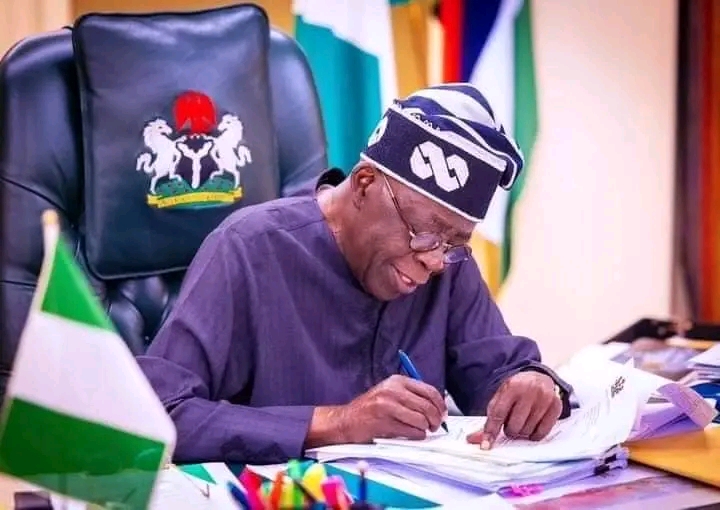
Asiwaju Bola Ahmed Tinubu

President Tinubu signs tax reform bills into law

By Anwar Usman

The President of Nigeria, Bola Ahmed Tinubu, has today signed the four tax reform bills into law.

The bills, which he said will transform Nigeria’s fiscal and revenue framework, were signed at the Presidential Villa in Abuja on Thursday afternoon.

The four bills include the Nigeria Tax Bill, the Nigeria Tax Administration Bill, the Nigeria Revenue Service (Establishment) Bill, and the Joint Revenue Board (Establishment) Bill, which were recently passed by the National Assembly.

Those present at the signing ceremony were Senate President Godswill Akpabio, Speaker of the House of Representatives, Tajudeen Abbas; Senate Majority Leader, House Majority Leader, chairman of the Senate Committee on Finance, and his House of Representatives counterpart.

On Wednesday, Bayo Onanuga, Special Adviser to the President on Information and Strategy, stated that the implementation of the new tax laws would significantly transform tax administration in the country, leading to increased revenue generation, an improved business environment, and a boost in domestic and foreign investments.

Letter to President Tinubu on Yelwata and Jos massacres

Dear Mr President, 

1. I hope you had a safe return after the visit to Yelwata, Benue State, to assess the killing spree that occurred there last week. While people like Mr Peter Obi and Dele Farotimi criticised your trip as one lacking compassion, I believe your presence there meant something. It is better than not going there. It means you have first-hand knowledge of how defenceless Nigerians are killed, not just in Benue, but across Nigeria, especially in the North. 

2. I write to draw the urgent attention of Your Excellency to a fresh tragedy. This afternoon, several national newspapers reported the killing of 12 Muslim passengers travelling from Zaria to Qua’anpan Local Government Area of Plateau State. They were ambushed in the Manjul community, Mangu Local Government Area, Plateau State. These innocent Muslim travellers were killed, and subsequently burned in the bus conveying them. Nineteen others are now nursing various degrees of injuries.

3. A survivor among the victims of this dastardly act was interviewed, and he remarked that they lost direction. Upon stopping and asking for directions, the locals at Manjul remarked that these are Hausa people and that they should be killed. In their words, as reported, “These are Hausa people, let’s kill them!”. This chilling statement underscores where we are as a country. Anyway, they successfully killed 12 and injured 19. It is in today’s newspapers – Daily Nigerian, Daily Trust, The Daily Reality, Punch Newspapers. 

4. Mr. President, no citizen should be targeted for their ethnicity or religion. Whether in Yelwata or Yorro, Mangu or Malete, Nigerians must be free to travel safely. Nigeria has tolerated this barbarism for too long. If terrorists in the forests remain elusive, those living in communities and attacking travellers should not be. What excuse does the state have when killers who can be easily traced and apprehended go unpunished? This silence by the system sends one loud message: you can kill and walk away. 

5. This is not the first time such horror has unfolded in Plateau State. In 2021, 20 members of the Tijjaniyya sect were killed in Rukuba, Jos, on their way home from a religious event in Bauchi. It is now 4 years. No justice has been served yet. In 2018, General Idris Alkali (rtd), a senior military officer and Chief of Army Administration, was ambushed and killed. His body was thrown into a pond in Dura Du. Suspects were arrested, but 7 years later, justice is being delayed. 

6. These cases remain open wounds. Mr. President, your influence should not stop at sympathy and condolence visits. Nigerians will feel more confident if you direct a full, public, and timely investigation into these recent attacks in Yelwata and Mangu. The perpetrators should be found, prosecuted, and punished—not just for justice but as a deterrent. Otherwise, each incident becomes an invitation for the next mob to strike.

7. Your Excellency, the time to act is now. Nigerians are watching. We can, for once, surprise the world and Nigerians themselves to know that Nigeria is not a jungle where anyone kills at will and goes about their everyday business. Where is the sanctity of life in this country? If the government cannot break this wanton bloodshed, then who will? You can decide to break this bad culture of letting killers get away. You can choose to be different from your predecessors. You can decide to let Nigerians know that this can be curtailed. Let this be the turning point. We have to give justice some opportunity to speak louder than violence. At this time, let us give the killers an opportunity to know that Nigeria is not a lawless country. 

8. Thank you. 

Ibrahiym A. El-Caleel wrote from Zaria, Kaduna State.

Amidst replacement push, Kashim Shettima stays focused on vice-presidential duties

By Lawan Bukar Maigana

Political drama recently unfolded in Gombe State as tensions escalated between the All Progressives Congress (APC) National Chairman, Dr. Abdullahi Ganduje, the APC National Vice Chairman (Northeast), Comrade Mustapha Salihu, Gombe State Governor Muhammadu Inuwa Yahaya, and Borno State Governor, Prof. Babagana Umara Zulum.  At the heart of the storm were whispers of a plot to replace Vice President Kashim Shettima. But in the eye of that storm stands Shettima himself; silent, composed, and unfazed.

There has been no speech, social media post, or press release. Shettima has not acknowledged the theatrics or addressed the speculations. There is no rebuttal, no outrage, just purposeful silence—a silence that suggests a man far more committed to duty than distractions.

While the speculations make the rounds in political circles, Vice President Shettima’s schedule remains unchanged. In January 2025, he represented Nigeria at the World Economic Forum in Davos, Switzerland. There, he engaged in high-level sessions on digital trade and investment and co-chaired discussions focused on humanitarian resilience, building international bridges while avoiding the noise of local politics.

He used the global platform to launch the Humanitarian and Resilience Investment Roadmap for Africa, advocating for deeper public-private partnerships across the continent. As always, his approach was less about rhetoric and more about results.

Back home in Maiduguri, Borno State, the Vice President continues to prioritise grassroots development. He commissioned the Expanded National MSME Clinic and Fashion Hub, a project expected to create over 48,000 jobs annually. He also distributed unconditional grants to entrepreneurs and pledged continued support through public-private partnerships to boost local businesses.

Shettima also inaugurated the National Asset Restoration Programme, reinforcing his long-standing commitment to post-insurgency reconstruction in the Northeast.

His record across sectors reflects structural impact. Over 300,000 businesses have been supported, and more than one million jobs have been generated under initiatives he directly oversees. These aren’t political promises; they’re measurable achievements.

At the national level, he chairs the National Council on MSMEs, advocating for innovation, job security, and stronger synergy between the public and private sectors, all under the framework of President Tinubu’s Renewed Hope Agenda.

As a champion of youth empowerment, Shettima spearheads human capital development efforts. He inaugurated the Nigeria Jubilee Programme Steering Committee, designed to train and equip thousands of graduates with marketable skills and workplace readiness.

He has also remained active in strengthening regional cooperation. At the 5th Lake Chad Basin Governors’ Forum in Maiduguri, he emphasised the importance of pairing military security with economic inclusion to secure lasting peace in the subregion.

In every assignment, Shettima has demonstrated sagacious loyalty, not only to his office and the President but also to the people he serves. Amid swirling conversations about his replacement, he has not lost focus. He has doubled down on leadership, service, and delivery.

His calculated silence is a strategy. He understands that emotional outbursts or political mudslinging could deepen divisions within the party. His restraint underscores a higher allegiance to duty, national stability, and unity.

The Vice President’s quiet determination sends a message: true leadership is about resolution, not reaction. In a political landscape often dominated by noise, Shettima has chosen the steady path of substance, letting results, not rumours, define his legacy.

Even as political storms gather, Shettima stays the course. His silence isn’t ignorance or weakness—it is discipline. And with his continued focus on economic development, job creation, and regional security, his work speaks louder than any rebuttal ever could.

Lawan Bukar Maigana is a journalist with PRNigeria and Economic Confidential, headquartered in Abuja. He can be reached via email: Lawanbukarmaigana@gmail.com.

The Proliferation of National ‘Honours’ 

By Amir Abdulazeez

If we can recall, on 7th October, 2015, a 19-year-old student, Hassan Mohammed Damagum, sacrificed himself to save others from a suicide bomber who attempted to attack a mosque during the Subh (Dawn) prayer at Buhari Housing Estate in Yobe State. Hassan had sensed that the individual standing next to him was a suicide bomber trying to kill people. The boy was said to have confronted the bomber, who blew both of them off. 

Again, on 25th January 2017, Yakubu Fannami, another student from Borno State who was just in SS1, died a hero while preventing a suicide bomber from entering the Darrusalam Science and Islamic Academy in Maiduguri. Fannami tackled the female suicide bomber, preventing her from reaching the mosque and detonating her explosives, thus saving the lives of many worshippers.  

To the best of my research, which may be inadequate, neither of the two boys was publicly given significant national recognition. Nigeria’s story is replete with the neglect of brave and heroic citizens who had sacrificed a lot and even laid down their lives to save others. 

Since 1999, Nigeria has always chosen to reward and honour many lazy elites who contributed virtually nothing but became huge beneficiaries of government patronage and corruption. Every President has made it a duty to bestow national honours on his chosen elites as one would do with his personal property.

In line with the routine tradition of his predecessors, President Bola Tinubu used the June 12, 2025, Democracy Day to confer over 100 national honours, some posthumously. As expected, many awardees are members of his administration and personalities very close to him. A section of the awardees list portrays a belated compensation package to a gang of Abacha victims, who actually need justice more than honour.

While people like Prof. Humphrey Nwosu (CON), Prof. Wole Soyinka (GCON), Alhaji Balarabe Musa (CFR), Bishop Matthew Hassan Kukah (CON) and Femi Falana, SAN (CON) truly deserve their awards, it would have been wiser and more balanced to include people like Late Bashir Tofa (Abiola’s NRC opponent), Late Abubakar Rimi and Magaji Abdullahi (two important SDP figures who miraculously delivered Kano, Tofa’s State, to Abiola) and, of course, M.D. Yusufu, the presidential candidate of MDJ, who was Abacha’s sole challenger in his bid to undemocratically transform into a civilian president, among others. Perhaps, they would be remembered by this or another President in the next set of awards, for at this rate, every political household name, dead or alive, may soon have a national honour in Nigeria by 2030.

What exactly is this national honour, and who deserves it? The honouring system was originally envisioned as a prestigious recognition of exceptional service to the nation. It was formally established by the National Honours Act No. 5 of 1964 to inspire patriotism, reward merit, and foster national unity. 

The structure of national honours, divided into two orders (Order of the Federal Republic and Order of the Niger) and eight ranks (GCFR, GCON, CFR, CON, OFR, OON, MFR, MON), was designed to reflect degrees of national impact. However, the system’s proliferation and indiscriminate distribution have undermined these distinctions, often placing true heroes, statesmen and national icons equal or below some presidential sycophants, political loyalists and officeholders, regardless of their performance or public standing. 

The early years of Nigeria’s national honours system reflected its original purpose. Recipients such as Dr. Nnamdi Azikiwe, Sir Ahmadu Bello, Chief Obafemi Awolowo and Mrs. Funmilayo Ransome-Kuti were honoured for verifiable and transformative contributions. However, over time, the politicisation and personalisation of the awards diminished their integrity, giving way to an annual ritual often characterised by hundreds of questionable awardees whose contributions to the nation are neither tangible nor verifiable. In the past 15 years, things have gotten worse as the selection system itself has been incompetently reduced to a mechanism marred by political patronage, duplication and credibility crises. 

Today, the integrity of this noble initiative is in serious jeopardy, with widespread scepticism about its selection process and relevance. Ideally, recipients should be individuals whose lives exemplify ethical integrity, measurable public impact and selfless service. However, the current trend favours tenure over achievement and proximity to power over merit. Politicians under corruption investigation, individuals with no tangible contributions and business moguls with opaque wealth have all made their way into the honours roll. Prominent Nigerians have rejected national honours in protest. Chinua Achebe, Gani Fawehinmi and Wole Soyinka famously turned down honours, citing corruption, misgovernance and the lack of transparency in the process. Their principled refusals sent powerful messages about the need to restore the system’s credibility. As Achebe aptly put it, ‘a government that fails its people cannot in good conscience bestow honours’.

Numerous scandals have exposed the flaws of the system. In 2022, the conferment of awards to serving ministers during a prolonged ASUU strike and the inclusion of people accused of corruption represented a new low. Even more embarrassing were administrative blunders such as conferring posthumous awards to please certain interests and duplicating awards to the same person under different titles. Meanwhile, countless unsung heroes remain ignored. Rural teachers shaping future generations, healthcare workers battling epidemics without protection and community leaders mediating conflicts receive no recognition. 

The establishment has reluctantly recognised a few non-elitist Nigerians in the past. The belated honour to Dr. Ameyo Stella Adadevoh (posthumous OON, 2022), whose sacrifice averted an Ebola catastrophe in August 2014, only came after sustained public pressure for about eight years. In August 2018, then President Muhammadu Buhari and the United States Embassy honoured the Bauchi State-born 83-year-old Malam Abubakar Abdullahi, a Muslim Imam in a village in Plateau State. He sheltered and fed 300 Christians for five days to prevent them from being killed in an uprising. The old man ran from one corner to the other, stopping youths who wanted to enter the mosque to get hold of his guests. Eventually, they gave up after realising that the only way to execute their evil plan was to kill the old man. That was how he saved their lives. I am not sure whether the man was given any national honour beyond that presidential acknowledgement.

If we are to continue like this, I will suggest the renaming of the awards to “Special Presidential Honours”.  The National Honours Act, last revised in 2004, offers the President near-total discretion, with little room for public input or institutional checks. With time, it has been turned into a presidential farewell affair as outgoing Presidents routinely populate honours lists upon leaving office to pay back loyalists. Recent attempts at reform, such as the proposed National Honours and Merit Award Commission, represent a step forward but are insufficient on their own. Far-reaching legislative and administrative reforms are needed to restore the honours’ integrity. This includes public nominations, independent vetting panels, open selection criteria and mandatory justification of award decisions. 

A critical reform must also introduce public objections and transparency mechanisms, such as publishing nominee shortlists and designing revocation protocols. Honours should be rescinded from individuals found guilty of crimes or misconduct post-conferment. The system should no longer shield disgraced figures or treat national honours as irrevocable symbols of status, regardless of later behaviour. Furthermore, awards should be capped annually to preserve their exclusivity. Honouring fewer, more deserving Nigerians will increase the prestige of the titles and prevent undeserving awards. Most importantly, the honours system must reconnect with the grassroots. By recognising farmers, nurses, teachers, inventors and humanitarian workers, Nigeria can turn the system into a true tool of national inspiration. 

All these are, by the way, because ordinary Nigerians no longer care about leaders honouring themselves and their cronies. No impoverished Nigerian has the luxury of waiting to be honoured by someone whose honour is questionable himself. All Nigerians are asking for is guaranteed security to farm, stable power supply to produce, quality and affordable education to learn, reliable healthcare to survive and a stable economy to thrive. When they can provide this, they can go on naming and renaming national monuments after their wives and continue with the vicious cycle of self-glorification in the name of national honours.

Twitter/X: @AmirAbdulazeez 

Nigeria condemns Israeli strike on Iran, urges immediate ceasefire

By Hadiza Abdulkadir

The Federal Government of Nigeria has strongly condemned Israel’s recent unprovoked strikes on Iran, which have triggered a fresh wave of hostilities between the two Middle Eastern powers. In a statement issued on Friday, the Nigerian government described the escalating conflict as a grave threat to regional and global peace.

The Ministry of Foreign Affairs, through its spokesperson, Kimiebi Imomotimi Ebienfa, expressed deep concern over the sustained missile and aerial exchanges between the Islamic Republic of Iran and the State of Israel, calling for an “immediate cessation of hostilities” and restraint from both parties.

“The continued cycle of retaliation not only endangers civilian lives but threatens to plunge the broader Middle East into further instability, with implications for international security and economic development,” the statement read.

Nigeria, which has long championed non-aggression and multilateral diplomacy principles, urged Iran and Israel to return to dialogue and constructive engagement. The government also called on the United Nations Security Council and the broader international community to intensify de-escalation efforts and provide diplomatic platforms for resolution.

Reaffirming its stance against military confrontation, the statement noted that “military action is not a substitute for negotiation” and that lasting peace must be built on diplomacy, mutual respect, and adherence to international law.

“Nigeria stands ready to support all genuine efforts aimed at de-escalating tensions and promoting peace in the region,” the Ministry added.

The statement comes amid growing international alarm over the potential fallout of the conflict, which many fear could destabilise the already volatile Middle East and disrupt global economic and political systems.

June 12 and the lopsided narrative: How Yoruba elites hijacked a national struggle

By Salisu Uba Kofarwambai

The annulment of the June 12, 1993, presidential election by General Ibrahim Babangida stands as one of the most consequential events in Nigeria’s political history. What began as a tragedy for democracy soon became a powerful weapon of political repositioning for the Yoruba elite, who skillfully leveraged national sympathy to strengthen their grip on Nigeria’s democratic evolution.

This singular incident opened the doors for the Yoruba to produce three heads of state—an achievement that might never have occurred under normal political circumstances. Ironically, this is the same political milestone that the late Chief Obafemi Awolowo, the revered father of Yoruba nationalism, spent his entire life trying to attain but could not.

Sadly, many who ultimately benefited from the June 12 crisis were not even supporters of Chief M.K.O. Abiola during the election. Instead, they emerged later as political opportunists—vultures who hijacked the struggle, turned it into a sectional movement, and weaponized it for political dominance.

It is important to recall that the North overwhelmingly voted for Abiola over its own son, Alhaji Bashir Tofa. But following the annulment, the Yoruba intelligentsia cleverly shifted the blame from the military, a national institution, to the North, creating a narrative that painted the region as the villain of democracy. This deflection became a foundation for the Yoruba to assert political superiority, while the North unknowingly fell for the narrative.

In the aftermath, Chief Ernest Shonekan—a Yoruba technocrat—was installed as head of the Interim National Government. Later, in 1999, the North once again conceded power to the South-West, with Chief Olusegun Obasanjo returning as a civilian president. However, Obasanjo’s tenure is remembered by many in the North for economic policies that led to the decline of the region’s industrial capacity. Many northerners believe these policies were deliberate, politically motivated, and economically harmful to the North.

Today, with President Bola Ahmed Tinubu at the helm, the North’s frustration appears to be deepening. Recently, a ₦16 trillion infrastructure project was allocated to the South, while liberal economic policies continue to disproportionately impact northern states, compounding existing inequalities.

This growing sentiment of marginalization was reinforced by President Tinubu’s Democracy Day national address. During the broadcast, a list of recipients of national awards was unveiled to honour those who fought for democracy. Yet, the list revealed a clear bias. While individuals like Professor Wole Soyinka—who went into exile during the military era—were honoured, many who stood their ground and bore the brunt of military repression were ignored.

Where are the names of Abubakar Rimi, Abdulkarim Dayyabu, Sule Lamido, Gani Fawehinmi, and M.D. Yusuf—figures who paid a heavy price for resisting military rule? Most of them were imprisoned under General Abacha and only released after his death. Yet, these sacrifices appear forgotten, excluded from a national recognition that should be inclusive.

Even the institutionalization of June 12 as Nigeria’s Democracy Day under the Buhari administration has continued to project the day as a Yoruba affair—further entrenching the idea that the Yoruba were the sole victims of the annulled election. This skewed narrative continues to sideline other critical voices and regions, especially the North, which was deeply invested in the democratic struggle of the 1990s.

As we mark June 12, the North must soberly reflect on how much has been lost—from the annulment of 1993 to the current political dispensation. The region must also begin to ask tough questions about its place in the national project and how to reclaim a fair share in Nigeria’s democratic future.

June 12 was a national tragedy and should be a national symbol of resilience—not a sectional emblem of victimhood. Until this is fully acknowledged, the spirit of June 12 remains only partially honoured.

Governor Uba Sani awarded CON national honour by president Tinubu

By Abdullahi Mukhtar Algasgaini

President Bola Ahmed Tinubu has honoured Kaduna State Governor, Senator Uba Sani, with the national title of Commander of the Order of the Niger (CON) in recognition of his contributions to democracy and national development.

Governor Sani, a prominent figure in Nigeria’s democratic struggle, faced multiple detentions during the fight for democratic governance. His long-standing commitment to justice and civil rights has earned him widespread respect.

Notably, he is the only serving governor named in this year’s national honors list, as announced by President Tinubu during a joint session of the National Assembly.

Congratulatory messages have poured in for Governor Uba Sani on the recognition.

APC cautions Ndume over prediction of Tinubu’s 2027 defeat

By Uzair Adam 

The All Progressives Congress (APC) has issued a strong warning to Senator Ali Ndume following his recent remarks suggesting that President Bola Tinubu could face the same electoral fate as former President Goodluck Jonathan in 2027 if urgent reforms are not implemented.

Senator Ndume, who represents Borno South Senatorial District, made the statement during his appearance on Channels Television’s Politics Today on Sunday.

Responding to his remarks, the APC Director of Publicity, Bala Ibrahim, on Tuesday acknowledged Ndume’s longstanding role within the party but stressed that discipline within the party is of utmost importance.

“Senator Ndume is a senior and respected member of the APC. This is not the first time he has aired his views publicly about how the country is being governed by his party, sometimes expressing dissent or contrary opinions,” Ibrahim said.

He continued, “However, the APC is a party of liberal-minded people. We do not reject diverse ideas, provided they do not violate the party’s constitution.”

Ibrahim reiterated that while the APC upholds internal democracy and freedom of expression, members are expected to operate within the party’s defined limits.

Inclusive leadership, not religious dominance, will save Nigeria

By Malam Aminu Wase

A presidential Muslim-Muslim ticket is not merely a political strategy. It is a catalyst for national instability. In a country like Nigeria, which is still grappling with deep-seated mutual distrust, such a move sends the wrong signal. 

For Nigeria to truly progress, its leadership must reflect the nation’s rich diversity. Only through inclusive governance can we assure every citizen, regardless of faith, ethnicity, or region, that they have a rightful place in the nation’s power structure.

Malam Nasir Ahmed El-Rufai played a pivotal role in promoting the idea of a Muslim-Muslim presidential ticket. While this strategy may have been politically calculated, it encouraged religious and ethnic groups to compete for power, rather than unite under a shared national vision that addresses the hardships facing all Nigerians.

Ironically, many of the architects of the Muslim-Muslim ticket are not reaping the benefits of their efforts. The lofty expectations they once championed of inclusion and representation have been dashed. Some have even defected to other political parties, disillusioned by the very system they helped establish.

Nigerians must open their eyes. The struggle among the political elite is not about improving the lives of the masses; it is a scramble for personal gain, to secure privileges for their children, families, and close associates. We must rise above the politics of religion and region and demand leadership representing all Nigerians.

I urge fellow citizens to reject the idea of a Muslim-Muslim ticket in the upcoming election. Let us vote for candidates committed to unifying Nigeria, easing economic hardship, and introducing policies that genuinely impact the lives of ordinary people.

Malam Aminu Wase, Write from Kaduna State. He can be reached via aminusaniusman3@gmail.com.

NIPSS, PRNigeria and the alarming breach of digital ethics

By Usman Muhammad Salihu

I never truly grasped the danger of exposing personal information in the digital space until Mr. Yushau Shuaib, my boss and mentor, handed me a book—Born Digital: Understanding the First Generation of Digital Natives by John Palfrey and Urs Gasser. 

It was an eye-opener, full of prescient warnings about the hidden costs of living in a world where our lives are increasingly mediated by technology. Ironically, neither of us imagined that the warnings in that book would soon play out so personally, and so dramatically.

Mr. Shuaib, a respected public relations expert and founder of PRNigeria, participated in Senior Executive Course 47 at the National Institute for Policy and Strategic Studies (NIPSS). On May 2, 2025, he was abruptly suspended from the course. 

His offence? Publishing articles highlighting and supporting President Bola Tinubu’s Digital and Blue Economy reforms. One article, “Understanding the ‘Blue’ in the Blue Economy,” praised the government’s innovative strides in marine resource development. 

Another, “NIPSS Goes Digital,” celebrated the institute’s transition to a paperless administrative system—part of Nigeria’s broader digital transformation agenda. While he did not write or edit the latter, it appeared on his media platform.

In response to his suspension, Mr. Shuaib petitioned the President, citing harassment, cyberbullying, and professional ostracism. He argued that the action was punitive and lacked due process. 

NIPSS, however, insisted he breached institutional policy by publishing materials related to the institute without clearance—a rule they claim he had previously been warned about.

But a chilling twist escalated the matter beyond internal disciplinary lines: PRNigeria’s editorial email account was allegedly compromised. Confidential communications between journalists and their sources, private story drafts, and editorial exchanges were reportedly accessed without consent. 

The intrusion, attributed to officials of the same institute that suspended Mr. Shuaib, raised serious ethical and legal concerns. This was no ordinary data breach. It directly violated professional boundaries, journalistic independence, and Nigeria’s own Cybercrime Act. 

It represented something more insidious than a lapse in judgment—it was, in many ways, a digital form of trespass. The incident sent ripples through the media and security circles. 

If an elite policy institute tasked with grooming Nigeria’s future strategic leaders could be implicated in such an act, what message does that send about our national commitment to digital ethics and the rule of law?

It is precisely the kind of scenario “Born Digital” warns about—a world where our private digital footprints are vulnerable not just to hackers or corporations but also to institutions that should be protecting those rights.

In one haunting passage, the authors write: “Young people who are living their lives mediated by digital technologies will pay a higher price, sometimes down the road, for the way privacy is handled in this converged, hybrid environment… 

“Most young people are extremely likely to leave something behind in cyberspace that will become a lot like a tattoo, something connected to them that they cannot get rid of later in life.”

That line has stayed with me because it is no longer just about young people; it is about all of us. Our identities, habits, preferences, locations, communications, and relationships are all being recorded, stored, and sometimes exploited through what are now known as digital dossiers.

These dossiers are detailed archives of our lives compiled by apps, platforms, websites, and even institutions. They are often created without our consent or awareness. While they promise convenience and personalised experiences, they also have profound risks.

Privacy has become a currency we are forced to spend for access. And increasingly, it is a luxury only a few can afford. The NIPSS breach is a wake-up call. It reveals the fragile boundaries between transparency and intrusion, policy enforcement and personal violation. 

It is a reminder that digital transformation must be matched by ethical responsibility and legal accountability. As a journalist, I have often lived under the illusion of digital safety. 

But as a parent, I now worry for my young daughter and the millions like her growing up in a world where data is your shadow—and sometimes, your shackle. We must do more. We must demand stronger data protection laws, foster a culture of privacy awareness, and hold institutions accountable, no matter how revered. 

Our digital world should not come at the cost of our humanity, dignity, or freedom. The threats are real, the consequences are near, and the time to act is now.