Aisha Buhari

Kperogi apologises to Aisha Buhari over controversial divorce claim

By Anas Abbas

Farooq Kperogi, a journalism professor at Kennesaw State University in the U.S. and a Nigerian commentator, has publicly apologised to former First Lady Aisha Buhari following backlash from a Facebook post in which he erroneously claimed she had divorced the late President Muhammadu Buhari.

In a statement issued days after the post ignited widespread public outcry, Kperogi acknowledged that his July 16 update, titled “Aisha Buhari, Divorce, and Forgiveness Claim,” represented a significant misjudgment on his part.

Kperogi expressed regret for not foreseeing the distressing impact his words would have on Mrs. Buhari and her family.

“I did not anticipate the profoundly painful consequences that my Facebook update would have on former First Lady Mrs. Aisha Buhari and those closest to her,” Kperogi stated.

He described the incident as one of the most regrettable lapses in judgment he has experienced, leading to “unfathomable personal anguish.”

In his original post, Kperogi claimed that Aisha Buhari had reverted to her maiden name, Halilu, and suggested she had refused to travel to London to care for her husband during his illness.

He asserted that the information was sourced from a reliable individual but acknowledged that making it public was a mistake.

“My source maintains the accuracy of the information but never intended for it to be disclosed publicly. It was wrong of me to share it,” he said.

He also mentioned that Alhaji Sani Zorro, former Senior Special Assistant on Public Affairs to the First Lady, reached out to contest the claims’ validity.

“I will not dispute the details with Alhaji Sani, who communicated Mrs. Buhari’s position that her marriage remains intact. As the late MKO Abiola famously said, no one can give you a haircut in your absence,” he stated.

Kperogi reiterated that only Mrs. Buhari has the authority to discuss her marital status and that her truth should be respected above all else.

He clarified that he did not intend any malice but recognised that the harm caused by his post far outweighed any potential value it might have held.

“The truth of this information is now far less significant than the hurt my disclosure has caused. I should not have shared it publicly. Period. This action violated every moral and ethical principle I uphold,” he admitted.

He concluded with a sincere apology: “To Mrs. Aisha Buhari, I offer my heartfelt and unreserved apology for the needless and deeply regrettable hurt I have caused. I am truly sorry.”

Kperogi’s post gained traction just three days after President Buhari’s passing, eliciting reactions across various political and social media platforms.

Late Buhari, Aisha were divorced before his passing—Farooq Kperogi

By Sabiu Abdullahi

Respected columnist and political analyst, Farooq Kperogi, has claimed that former Nigerian President Muhammadu Buhari and his wife, Aisha Buhari, were divorced before the former leader’s death.

In a piece titled “Aisha Buhari, Divorce, and Forgiveness Claim,” Kperogi wrote, “What I do know is that before Buhari’s death, he and Aisha were no longer married. They had divorced, and Aisha reverted to her maiden name, Aisha Halilu.”

According to Kperogi, signs of their separation had been evident since Buhari left office. He noted that Aisha did not accompany Buhari to Daura after his retirement and was absent when he later moved to Kaduna.

“If you paid close attention, you would notice that Aisha didn’t go to Daura when he retired to the town after leaving office. Buhari was also alone when he later relocated to Kaduna,” he stated.

He also revealed that when Buhari’s health declined in London, Aisha initially hesitated to travel to him.

“She reportedly hesitated because she was no longer his wife. She eventually went in the last few days before he died, but only after intense persuasion,” Kperogi claimed.

Commenting on the days following Buhari’s death, Kperogi noted that Aisha appears uncertain about her place in the ongoing mourning.

“Even now, during this period of mourning, she seems understandably conflicted about her role,” he said.

Neither Aisha Buhari nor the Presidency has responded to the claims, but the statement has stirred public interest in a part of Buhari’s life that remained largely shielded from public view during his presidency.

Aminu apologizes to Aisha Buhari, thanks supporters

By Ahmad Deedat Zakari

Aminu Muhammad Adamu, the detained critic of the First Lady, Aisha Buhari, has apologized to Aisha Buhari and thanked the people who stood for him on social media.

Following Aminu’s release from detention, he took to his Twitter handle on Saturday to apologize to the First Lady and thank his supporters for their supports.

Aminu, a student of the Federal University Dutse, Jigawa State, was arrested for trolling Aisha Buhari on Twitter. He was then secretly arraigned and remanded at a correctional facility in Suleja, Niger State.

Aminu in his tweet said, “I would like to use this medium to express my sincere apologies to those I’ve hurt especially our mother, Aisha Buhari it was never my intention to hurt your feelings and insha Allah I will change for the better. However, I’m also grateful for your forgiveness, thank u mama😊🤝.”

Aminu also thanked those who supported him in another tweet. He noted that his ordeals amount to a lessons for everyone

“I would also like to use this medium to express my heartfelt gratitude toward those that helped me go through the darkest hours of my life, man cannot escape his destiny but my incidence should serve as a lesson to all of us. Thank you all and one love❤️🌹.” He said

Aminu’s arbitrary abduction and consequent detention was condemned by international human rights organizations, media influencers and many people nationwide.

Aminu Adamu: NANS demands apology, compensation from Aisha Buhari

By Muhammadu Sabiu

The National Association of Nigerian Students (NANS) has demanded that the Wife of President Muhammadu Buhari, Aisha Buhari, apologize and give compensation for the arrest and detention of Aminu Adamu, a final-year student of the Federal University, Dutse, whose tweet berated the First Lady.

This was said in a statement released Saturday and signed by Comrade Kehinde Damilola Simeon, Chairman of the Joint Campus Committee (JCC) for Ogun State.

According to the students’ body, it was an abuse of power for Aisha Buhari to order Adamu’s arrest and incarceration for nearly two weeks.

The Daily Reality recalls how security personnel detained Adamu for reportedly tweeting an offensive remark about the first lady.

The statement reads, “We consider that the meeting of the President with Aminu after his release from detention is not enough.

“Madam Aisha Buhari should apologize publicly in at least four daily newspapers. Aminu and his family should be compensated for the inhumane condition the first family had thrown them into in the last few days.

“These principles are what we consider as the fundamental basis for demanding the release of the unjustly victimized Nigerian student, Aminu Adamu, who had only said nothing but the truth, which is visible to all”.

Leaders feed on the sweat of the poor: A case of Aisha Buhari and Aminu Adamu

By Lawan Bukar Maigana 

Truth be told, Aminu Adamu’s post is not libellous if we look at it from a legal perspective because it is true that all leaders (including their families) feed on the sweat of the masses. And that is not a crime because the nature of their offices gives them the privilege. 

A political officeholder must feed just like every other person. The only difference is that the poor don’t have a budget for food, unlike those leading us. So, it is proper for a poor man to say that he feeds his leader, although not directly. 

Recently, N7.20 billion was earmarked for the maintenance of Villa facilities out of its N21.137 billion total budgetary proposal for the 2023 fiscal year, and it planned to spend N1. 96 billion for the purchase of vehicles (all in the money paid in tax by the masses.) 

The details of the 2023 budget show that President Muhammadu Buhari and the Vice President, Prof. Yemi Osinbajo, planned to spend the sum of N3.57 billion on feeding and travelling expenses. N2. 6 billion of the vast amount was for the President’s office, while N77. Eight million was for the office of Osinbajo. Is it a lie that leaders feed on the money of the poor? 

I believe these and others are the figures Aminu saw, which provoked the tweet that landed him in trouble. But the seemingly intolerant Aisha Buhari saw it and deemed it hurtful. Many see her decision to order the arrest, torture, and arraignment of Adamu, a final-year student of the Federal University, Dutse, as unconscionable because it has caused incalculable damage to her reputation. Everyone has been insulting her due to what many see as her overreaction. 

Her decision has further angered thousands of young Nigerians who are already angry with her husband’s administration which consequently metamorphosed into insults that were way more grievous than Aminu’s post. 

Nigerian youths have enough reasons to be angry with Aisha’s husband. There is much hunger in the land. Security and the economy are not in good shape. To make matters worse, the Academic Staff Union of Universities (ASUU) and the federal government have, in the last year, conspired to frustrate the lives and future of undergraduates. 

Mrs Buhari got the context all wrong. Aminu may be right after all. 

After all, it is true that they feed on the country’s resources which can easily be translated into “masses money.” She took his post personally because she is a professional beautician, and it is embarrassing for her to gain weight because weight hides beauty (according to some ladies). 

Generally, women don’t like body shaming. They take offence when told they are getting fatter because they fear that they may become unattractive to their husbands or men in general. Perhaps, that was why she overreacted. Again, her size increase may not have been due to any enjoyment but to an undisclosed illness, which will naturally make the tweet pain her even more. But she should have ignored him as a mother and fighter for women’s rights and youth inclusion. 

I have never justified immorality on social media platforms. Still, the overbearing action taken against him by the Mother of the Nation is unjustifiable and condemnable, even though he hurt her feelings.

The Aisha Buhari-Aminu Adamu situation is a lesson for all and sundry. We can say many things that we believe have no legal implications but can still get us in trouble. Therefore, we need to caution ourselves. 

Lawan Bukar Maigana writes from Abuja and can be reached via lawanbukarmaigana@gmail.com.

Freedom of expression and the abuse of privileges

By Abubakar Suleiman

“There is freedom of speech, but I cannot guarantee freedom after speech.” – Idi Amin

The advent and tremendous upsurge of social media platforms have really enabled and deepened freedom of expression as guaranteed by the constitution of the Federal Republic of Nigeria. It has interestingly also destroyed barriers erected by politicians to insulate them from public criticism or scrutiny. However, this freedom has come with some blowbacks. The platforms aren’t the sources of the blowbacks, but the abuse of their usage is.

An issue on the front burner is the arrest and alleged torture or physical assault of one Aminu Adamu, a student of Federal University, Dutse, who was accused of posting a tweet suggesting the First Lady, Aisha Buhari, to be corrupt for squandering the poor man’s money and her body size is a sign of this alleged thievery. The arrest was allegedly carried out on the instruction or directive of the First Lady.

Surprisingly, as at the time of writing this piece, Mrs Buhari or her spokesperson is yet to give a public statement distancing her from this allegation which is a classic case of impunity or abuse of privileges or government institutions. Sketchy reports have it that it is the handiwork of an overzealous security detail attached to her. 

Warts and all, a Nigerian citizen has gone missing, and the Department of State Services (DSS), the Police and other security agencies have a duty to reunite him with his family or take him to a court of competent jurisdiction for whatever offence he must have committed. And, of course, whoever enabled this forced disappearance of Aminu Adamu should also be charged within the ambit of the law.

That said, it is worth noting that politicians or people in power are not alone in the abuse of privileges. What Aminu allegedly did was also a clear case of abusing the freedom of expression and the privilege conferred on him by the Nigerian constitution and social media, respectively. Some people are so engulfed by tendentiousness in partisanships sometimes that they miss the opportunity to network or create value for their business products or brands using social media platforms. 

One of the disadvantages of the freedom that comes with social media is the ability to break barriers unconditionally. It is devoid of a vetting process. Hence it sometimes makes ill-mannered people feel empowered to impugn the integrity or character of people they ordinarily would not dare or attempt doing that too. Plus, others will share this character assassination with glee and without verification.

Tellingly, that politicians or public officers should be subjected to scrutiny or held accountable as humanly possible does not mean they can be maligned, slandered or outrightly and falsely accused with no scintilla of evidence. Politicians or people in power have blood running in their bodies. They have emotions. And bad as they might seem, they also have some integrities to protect.

Bridges have been burnt in exchange for likes or savages on media platforms. Oftentimes effused hatred or unintelligent zingers have replaced verification and validation. In the comfort of basements, unscrupulous people have willingly or unknowingly plunged people into fierce physical or fight online, or even a country into chaos with uncouth written words borne out of unstable emotions. 

Some people just find it difficult to make a point without using insulting or derogatory words, while others will just classically defame or cast aspersions uncontrollably and even unintelligently. 

Interestingly, these people who enjoy and propagate this kind of bashing find it difficult to stomach the slightest of criticisms whenever they are subjected to one. I especially blame no politician or a person in power who approaches a court for this purpose. That they are politicians doesn’t mean their characters or integrities don’t matter.

Therefore, we really need to tread carefully with our engagements on social media platforms. If we derive pleasure in unfettered access to such platforms, then our usage of them should come with a high sense of responsibility.

Let me conclude with a few lines from Kalev Leetaru’s article published on Forbes with the title, “A Reminder That ‘Fake News’ Is An Information Literacy Problem – Not A Technology Problem,” he wrote, “schools no longer teach source triangulation, conflict arbitration, separating fact from opinion, citation chaining, conducting research or even the basic concept of verification and validation. In short, we’ve stopped teaching society how to think about information, leaving our citizenry adrift in the digital wilderness, increasingly saturated with falsehoods without so much as a compass or map to help them find their way to safety. The solution is to teach the world’s citizenry the basics of information literacy.”

Abubakar Suleiman writes from Kaduna and can be reached via abusuleiman06@yahoo.com.

NONIHIRA condems Aminu’s arrest, demands immediate release

By Ahmad Deedat Zakari

A civil liberty and human rights group, Northern Nigeria Human Rights Advocates (NONIHIRA), has in very strong terms condemned the “unlawful arrest and detention of Adamu Aminu Muhammad at the instance of Nigeria’s First Lady Aisha Buhari.”

In a statement signed by the group secretary, A.A Hakima Esq and made available to the Daily Reality on Monday, NONIHIRA described Aminu’s detention as arbitrary and unlawful.

“The Northern Nigeria Human Rights Advocates condemns in strong terms, the arrest and incarceration of Aminu Adamu Muhammad, the 23 year old student of Federal University Dutse over frivolous allegation of defaming the character of Nigeria’s first Lady Aisha Buhari,” part of the statement reads.

NONIHIRA further stated that defamation if proven is a simple offence for which punitive fine is awarded.

The group urged persons and authorities involved in Mr Aminu’s incarceration to release him immediately and issue him with an apology and compensation.

Buhari’s daughter-in-law graduates from foreign university

By Ahmad Deedat Zakari

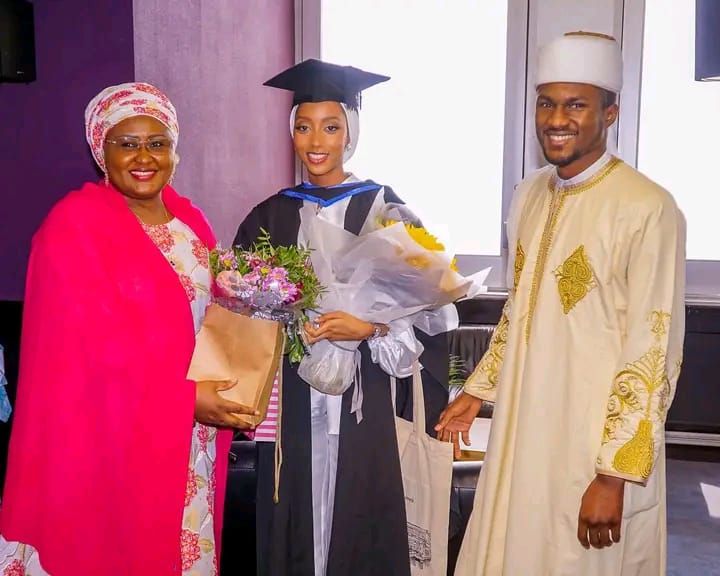
Zahrah Buhari, one of the daughters-in-law of Nigerian President, Muhammadu Buhari, has graduated from a foreign university.

Nigeria’s First Lady, Aisha Buhari, broke the news of the family’s milestone on Facebook on Tuesday.

The First Lady, who posted pictures from the graduation ceremony, congratulated her daughters-in-law on graduating with a first-class degree in architecture.

“Congratulations to Mrs. Zahra B Buhari on your graduation with First Class Honors in Architectural Science. Wishing you all the best!” She wrote.

This is coming amidst the Academic Staff Union of Universities, ASUU, months-old strike. Consequently, many Nigerians condemn the first family for being insensitive to the plight of Nigerian students.

Tawfiq al-Hakim’s satire and contemporary Nigeria

By Salisu Yusuf

Have you read Tewfiq Al-Hakim’s play Fate of a Cockroach? If yes, the Egyptian playwright has aptly satirized Nigeria’s current socio-political mood and reality. Though the play is deliberately written allegorically as the characters are cockroaches, they have fully depicted the inconsistency with obvious truth, the absurdity and folly of man in the 21st century when reasoning ought to replace emotion. From the King Cockroach, the Queen, Minister, Savant to the poor cockroaches, they have reflected and caricatured the careless attitudes of the leaders, the cronies, the upper class, and ordinary Nigerians.

The play opens with a problem bedevilling the majority of cockroach populations. If a cockroach slips on its back, an army of ants will round up the cockroach and take it to their house as food. And the cockroaches can’t have the gut to overcome the tiny ants. The ants are insignificant in the cockroaches’ world, yet, they prove to be integral in deciding the fate of the cockroaches. Hence, the title of the play: Fate of a Cockroach.

In Nigeria, the same scenario unfolds itself; a tiny group of bandits terrorizes the majority, kills and robs them of their possessions. The small armed group controls the fate of the majority.

From the beginning, King Cockroach blames the Queen for seeking to undervalue his authority and worth. While the King says that he tolerates the Queen because she’s of the weaker sex, the Queen argues that she’s more knowledgeable and reasonable than him. In addition, she complains that an existential threat posed by the ants is in the offing. However, the King can’t solve them because he’s weak and surrounds himself with wrong cronies.

In Nigeria, the same drama unfolds itself. The wife of Mr President, until recently, was at loggerheads with her husband. Can you remember when the president criticized his wife during a trip to Germany? The (in)famous “she belongs to the kitchen, my living room and the other room” is still fresh in the minds of Nigerians. The heated argument reached a boiling point when the wife said she might not back her husband at the then approaching elections. The president’s remark centres on his wife being the weaker sex (as declared by King Cockroach). Therefore, her role is limited to mothering, cooking and ‘the other room’ function.

Moreover, King Cockroach and the Queen quarrel over each other’s appearances. The King incessantly looks into a mirror and admires his long whiskers (the whiskers are the symbols of authority). He numerously says that his whiskers are longer than any other cockroach’s. This obsession with whiskers reflects the attitude of our president with power and the presidency (remember that he doesn’t go to funerals or ceremonies for fear of Corona that can wrench the presidency from him if he dies). In addition, he’s also obsessed with elegance and posing for pictures.

The Queen also looks at the mirror, admiring her beauty, and she tells the King that her whiskers are more beautiful than his. The Queen’s obsession is similar to that of our First Lady. Can you remember her long robe that was said to have cost some huge amount of money, which also generated social media arguments?

“Kitchen Cabinet” is also portrayed in Fate of a Cockroach. The trio of Minister, Savant and the Priest suitably reflect Nigerian cronyism. Minister Cockroach is suitable for his job because he proposes ‘disconcerting problems and producing unpleasant news.’ Can you also remember the allegation that some people shield Mr President from knowing the scorching Nigerian reality?

According to King Cockroach, the Priest is there as his priest because of the incomprehensible things he says. In Nigeria, some Northern Islamic clerics play the same role Mr Priest plays in Al-Hakim’s satire, of depending the morally undependable. They play the Public Relation role to the government.

The Savant in the play, on the other hand, is talented because he brings ‘strange information that have no existence.’ In Nigeria, he plays the same role as the president’s media team.

When the ants kill Minister’s son, he calls his death a ‘national catastrophe’, and King Cockroach declares a ‘public mourning.’ Since the infiltration of BH and banditry in Nigeria, many a death is greeted with silence. But when a relative of the upper class is affected, the power swiftly sends a federal delegate, or the president goes in person to mourn the bereaved. The King Cockroach is full of rhetoric, so is our Mr President.

When Queen Cockroach presses her husband for solutions to ants’ attacks, King Cockroach says he can’t be single-handed for a long-time problem. This can be equated with the ruling party’s reference to the previous government as the architect of BH and corruption. In other words, Nigerian leaders are always looking for a scapegoat.

In the play, the cockroaches look at themselves as superiors in knowledge to ants. So they reason that ants only know how to source and eat food, yet despite their superiority in knowledge, their collective fate rests with the tiny and minority ants.

In Nigeria, this is the same expressed mood; while the Fulani bandits are considered inferior, uncivilized and unknowledgeable, they hold the others’ fate. Where’s the knowledge then if you’re under the grip of the minority?

Those BH and bandits are in our midst; we know them, know their families, know their place of domicile, yet we can’t do anything against them.

As in “Fate of Cockroach,” where the cockroaches can’t come together and fight a common enemy, the ants, so are Nigerians who are divided by tribal, religious and sectional loyalty, giving way (like the cockroaches) to an armed minority group (like the ants) to destroy us. As in Al-Hakim’s satire, the ball is in the court of the bandits because they hold our collective fate.
Salisu Yusuf writes from Katsina.

Salisu Yusuf wrote from Katsina. He can be reached via salisuyusuf111@gmail.com.