Ahmadu Bello Sardauna

The brightest son of Northern Nigeria

By Bilyamin Abdulmumin, PhD

Every nation has its beacon of hope. India has Mahatma Gandhi, Singapore, Lee Kuan Yew, China, Mao Zedong, South Africa, and Nelson Mandela. In the United States, it’s Abraham Lincoln, while Ghana reveres Kwame Nkrumah. Zimbabwe holds on to Robert Mugabe, Kenya to Jomo Kenyatta, Egypt to Gamal Abdel Nasser, and Ethiopia to Haile Selassie.

Northern Nigeria’s guiding light is Sir Ahmadu Bello, the Sardauna of Sokoto—a man whose name is written in gold on the sands of history. A towering figure with a heart as vast as the Sahel, he was a custodian of Islam, a protector of culture, a unifier of regions, and a calculated risk-taker. Bold in action and resolute in purpose, he stands tall as the North’s brightest son.

Almost all of Sardauna’s life and legacy have been well documented and were public knowledge; it has been told through various forms and platforms like nostalgia, reminiscence legends, truth, and myth. Sardauna is generally known for one thing: an unnegotiable love for the North- a love rooted in modernization and unification.

Thanks to Sardauna’s vision for proficient and disciplined graduates to fill the gap in the northern civil service, the all-encompassing, majestic, and larger-than-life ABU Zaria was born. Sardaunan’s vision for institutional independence extends beyond academia: it includes independence in finance, energy, media, aviation, and food security.

Monuments and megastructures in Sardauna’s name that still stand and reverberate speak volumes about the foresight, determination, and vision of this legendary figure. This uncommon vision for the North to develop and be independent fetched Sardauna, both friends and many foes. But it never deterred him. He forged on from strength to strength.

Whether known or unknown to Sardauna’s distractors, he was never anything close to being a bigot. His actions tell a different story: his consideration of the whole North transcends every primordial boundary like tribe, region, and religion. Sardauna merely wanted to discharge his duties best to the people he was entrusted with. If Sardauna could govern Nigeria, he would ensure the country excels among its peers. He will pursue the Nigerian interest with the same vigour and rigour as the North.

Perhaps the most controversial stance of Sardauna after the Northernization agenda was his determined campaign against independence. This is what Southerners and Easterners, especially his colleagues such as Awolowo, Akintola, and Azikiwe, could not wrap their heads against. Was it not the independence that people die to get, but here is a potential premier kicking against it or, at best, asking for its delay? This particular unpopular campaign that Sardauna embarked on and his colleagues in the North are two sides of the same coin.

As of 1952, when agitations for self-government began to mount, the majority of staff in the North were Whites, Southerners, and Easterners of Nigeria’s geopolitical zones, so Sardauna clamour was until the North became not only united and literate but capable of piloting its affairs before independence. This argument and most of other Sardauna’s interests would prevail, and the regional self-government was granted in 1955 to 56 instead, before the independence four years later.

This unprecedented vision of Sardauna for the delayed independence is a revolutionary—a potential antidote to the challenges plaguing many post-colonial nations. This could be the first time a potential president of a potential country could not be desperate, but instead harbour delayed independence subject to the capacity of the country.

Yesterday marks 59 years since Sardauna’s cold-blooded assassination by Lieutenant Colonel Nzeogwu. Yet, his legacy lives on, etched in the hearts of Northerners and Nigerians alike. May Allah forgive the shortcomings of North’s brightest son and grant him Jannatul Firdaus, amin.

Bilyamin Abdulmumin, PhD, wrote via bilal4riid13@gmail.com.

Revisiting Sardauna’s northernization policy

By Abdullahi Yusuf Tela

Between 1949 to 1960, the reign of Sir Ahmadu Bello as the Premier, the Northern Nigeria environment has seen tremendous development. By October 1960, because of his super influence, Ahmadu Bello has become a mighty figure within and outside the borders of northern Nigeria.

As described by Paden in Ahmadu Bello: Sardauna of Sokoto, the main concern of the Sardauna was “northernization”. His practical approach towards developing northern Nigeria was quite exceptional. Paden further states that “the north is his family, and he must get his family on the right track so that it can play its proper role within the federation and the world at large.”

Sardauna’s love for the growth and development of the North made him pursue a series of northernization policies, all in an attempt for a balanced growth amongst the regions despite warnings from other competing regions as to the consequences of his this ideology.

Sardauna had once replied, “No…. Over my grave!” This was in response to Dr Ibiam, who urged Sardauna to abandon the northernization policy.    

During one of his visits to the North, Dr Nnamdi Azikiwe opined that the north under Ahmadu Bello’s reign was working consistently to catch up with the South in the race for progress. He added that its local government set up guarantees a stable government; its people respect and revere their emirs as a symbol of constituted authority while respecting elective representation in their local councils.    

His leadership style and dexterity made the former “Northern Cameroon” become “Sardauna Province”. Although the area called “Northern Cameroon” was part of Cameroon, Sir Ahmadu Bello lured them with a promise that if they joined Nigeria, he would grant them a separate province with lots of benefits as the Northern Nigerians. The Northern Cameroon province eventually voted to be part of the northern region through a referendum.

Ahmadu Bello, through his unreserved love for the youths, had fixed several of them in the civil service. It was found out that in 1961, out of the 41,000 employees in the federal civil service, only 400 were northerners. Due to this low turn-out of the northern people in the civil service, Sardauna developed the habit of making an appointment then sending the person on leave for a crash course at home or abroad. This created a lot of opportunities and positions for young northerners.

Abdullahi Yusuf Tela wrote via abdultela2@gmail.com.

Arewa’s potential and the Maitatsine syndrome

By A.F. Sesay

It’s difficult to fathom how a region of such numbers, resources, and beautiful cultural heritage/pedigree came to become such a scourge on national conscience in a space of forty years. What happened to the passion of the Sardauna, the native pride and dignity of your people, the welfarism that always motivated your brothers from the south or neighbouring countries to stay beyond those initial dates of return or even decide to be permanent residents?

If you were to canvas for answers,  different answers would come from different sources based on intellectual and cultural biases or leanings. That’s also the case with all matters of human endeavour. So, no shaking! And the more complex the issue the more divergent opinions and perspectives.

But in the case of recent events in northern Nigeria, with an emphasis on the Muslim hemisphere, there is something striking in the people’s unwanton love for the material side of life, contrary to the previous cultural ethos. Equally matched by this is the fear for death which naturally comes with more cravings for the transient pleasures of life. What happened to the studious efforts of the serious and sincere ulama (religious scholars)?

Let me hazard a few guesses. While some unscrupulous elements in both local and international media make it look like Arewa is Africa’s human abattoir where people are killed for the fun of it, non-northerners who have lived there before this litany of crises have fond memories of a people who are peaceful to a fault. This peace, which was largely a product of a contented heart, died with the pressure to keep up with the Joneses. And in that pressure was buried the deep fear of death. Before this, you knew people who were courageous, who stood for what they believed in no matter whose axe was gored and no matter the deadly consequence.

Crimes like kidnapping and banditry couldn’t reign supreme because criminals weren’t feared. We all remembered the courageous youths of Azare who risked their lives to confront armed bandits in 2012. Instances abound when community leaders (mai unguwas) coordinated young people to serve and defend the community within the ambit of the law. So, what happened?

How did we come to this period of life when people in a region of over 100 million people stood by and watched unknown faces and small groups of scums hack away their future and that of their children, one local government at a time?

Maybe we should look at the trends and evolution of materialism. Look at a few nations whose socio-economic progress have been meteoric in the last 50 years and look at northern Nigeria, you will see a striking lack of priority as well as a  lack of agency and urgency. And what underlies all this is the base love for material things among the elite which oozed out into the wider society rubbed off on the talakawa (proletariat) Suddenly, suddenly every Bala wants this: a luxurious house with a tall gate, a fleet of cars, tall, fair and wide-eyed women and other fine, yet fleeting things of life. Yet, neither the education nor the economy was tailored to sustain this onward rush to glitters: new trends come up annually in the design of houses, new brands of cars, new phones and so on.

Whoever is going to keep up with that has to have unrestricted access to money either through commerce or a job that pays an incredibly high salary. In the absence of this is another companion to money: stealing and everything extortion. Under this falls the myriads of problems we see today: unbridled corruption in governance, banditry, kidnapping and the rest in this nefarious family of ills.

Let’s say we flipped the conversation and say the fault is not in the people, but their enemies. It is logical to think that a region this steeped in tradition, with such great potential in numbers and unexplored resources is bound to be a target of both visible and invisible enemies, what is not logical though is when this becomes an excuse for inertia, baseless polemics, cancel culture and hurling of insults left right and centre. About enemies, who hasn’t had one? About insults, we haven’t seen one- I mean- we haven’t had an economy built solely on the foundation of the people’s ability to hurl insults at each other.

While there are certainly smithereens of enmity and animosity smothered on all of the region’s myriads of problems (a common case is a bias in data and reportage on and about the north, but let’s not digress), there is certainly a need for deep introspection. What happened? Are these manifestations of problems long foretold? Could something be wrong with the very approach to problem-solving? Or is this a huge cultural gap nobody is willing to talk about? Does it have something to do with population or outright carelessness on the part of the ruling class?

The north, in its long political sojourn as part of a nation in which it was severely disadvantaged in education, yet extremely well-positioned in Politics and Administration, has had its fair share of wins and losses. What remains to be seen is the ingenious manipulation of pluses and minuses. The world is watching and history’s pen is looming over you!

All told, the current state of affairs should remind you of the popular hadith of Prophet Muhammad (peace and blessings of Allah be upon him). And if this is a behavioural problem like it was rightly observed, then it’s going to require a behavioural solution: moderate the wanton love for material things and be courageous enough to confront death when your dignity and that of the generations unborn are at stake. 

A.F. Sesay sent this via amarasesay.amir@gmail.com.

Osinbajo describes Sardauna as man of peace at memorial lecture

By Hussaina Sufyan Ahmed


The Ahmadu Bello Memorial Leadership and Governance 2022 event hosted in Kano state government house earlier today was themed “Reviving the Northern Traditional Institutions: Imperative for Peace and Security in Northern Nigeria”. 


The Ahmadu Bello Memorial Foundation organized the event in collaboration with the Kano state government on January 18, 2022. 


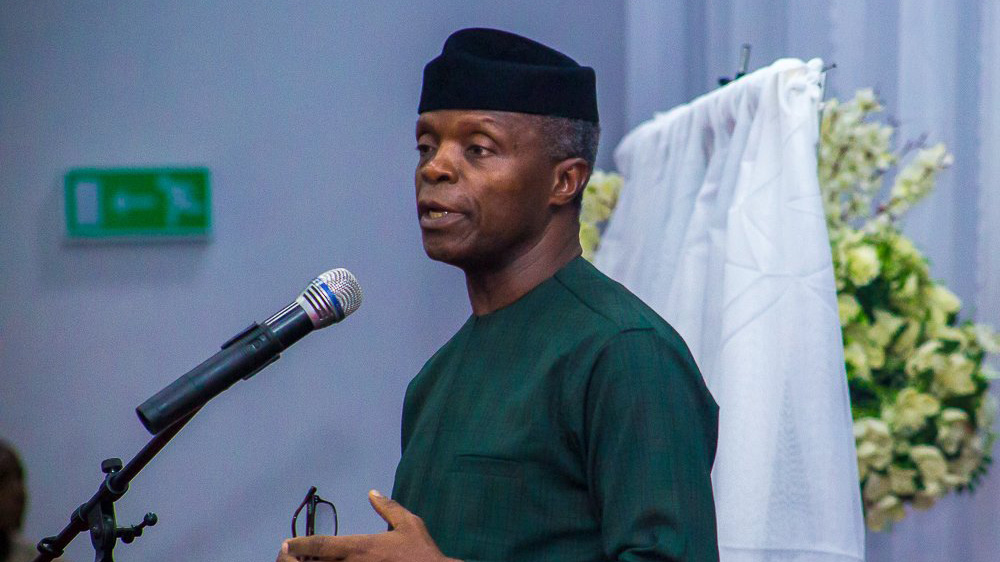
During the occasion, Vice president Yemi Osinbajo (SAN) commended Sir Ahmadu Bello Sardauna, adding that “[He] was a man of peace and courage, as well as a nurturer of traditional institutions, who demonstrated fairness and justice.”


Concerning insecurity bedevilling the North, the Vice President said that the federal government would employ technology in surveillance to fight the increased terrorism and insurgency in the country effectively.


He said: “We will also continue to ensure collaboration between the Federal Ministry of Justice, state counterparts and law enforcement agencies – to ensure that those apprehended for terrorism and violent crimes are effectively and speedily prosecuted.”


“This is a fight for this nation, and we are determined to win by the grace of God. All these evil forces will be eliminated.”

Letter to late Sir Ahmadu Bello, the Sardauna of Sokoto and Premier of the defunct Northern Region

With pain and anguish, I decided to make this communication with your soul, which I believe is resting well. I must confess that I do not know you personally, as I was not born when you held sway as the Premier of the defunct Northern Region. However, I have heard so much about you from my late father. He narrated stories about how you conducted your political activities geared towards our region’s progress.

Today, things are no longer at ease in Arewa. The land of our great ancestors is in chaos and anarchy while life has become nasty, brutish and short. Arewa has been turned to a killing field by terrorists with the blood of innocent people crying for vengeance. The elites that took over the mantle of leadership from you have destroyed all that you laboured to build. They live in luxury and great comfort while most people are dying in poverty and hunger. Their children study in Ivy League schools in the West with public funds and return home to take the best jobs while the children of the poor are roaming the streets and eating from the dust bin. Many families can no longer eat three meals per day, as good food has become a luxury. The cost of living has continued to rise with stagnant wages.

Sardauna, you are known as a warrior who strived hard during your era to emancipate the poor by ensuring that parents sent their children to school, which was free those days. Your late daughter Hajiya Aishatu, whom I interviewed at her residence in Sokoto in 2013 during my stint with THISDAY Newspaper, spoke extensively on how you carried all along and worked tirelessly to ensure unity in the north irrespective of tribe or religious affiliation.

It is no longer at ease at the moment. The children of the poor that you trained free with the resources of the Northern region before Nigeria’s independence, and those who came after them, have ruined your efforts. They have become feudal lords and turned out to enslave us. They have sold all the assets that you and other great northerners toiled to build over 60 years ago, while organisations you set up like the New Nigerian and textile industries in Kaduna, among others, have all collapsed. They not only mismanaged these organisations but also destroyed your legacies. Many people in northern Nigeria have been homeless and are currently in IDP camps, frustrated and dehumanised. They have been sacked away from their villages by terrorists while vast agricultural lands have been left fallow without any farming activities.

Today our region is littered with many orphans and widows whose husbands have been hacked to death by bandits. We have so many children (Almajiris) roaming the streets without any future while the elites do not care. Some of the Almajiris, neglected by the society, lack basic education and opportunities, unleash terror on the society that neither cared for them. Your grandchildren no longer have access to what the people you earlier trained free in some foreign institutions enjoyed a few decades ago. Today the children of the poor no longer have access to quality education, as they study in dilapidated primary and secondary schools. At the same time, the political elites send their children to study in private schools both locally and overseas.

The painful aspect of this is that they now packaged a man without empathy and presented him to us as a messiah in 2015. Our people heeded the call and voted him into power, believing that he would usher us into prosperity. Since then, our region has never known any peace. Bandits have taken over our major roads in the north, especially Abuja-Kaduna road, kidnapping people for ransom. Families have been compelled to sell their properties to raise money for ransom. These hoodlums kill their victims, especially those whose families cannot pay the ransom, while their remains are thrown away in the forest.

Similarly, our farmers in rural areas can no longer go to their farms in peace for fear of being killed. Those who managed to plant their crops could not harvest them, as the crops were set ablaze by these urchins. The agricultural foundation of the region is being destroyed while those at the helm of affairs do not care.

Inequality is at its peak in Arewa. The political leaders are using politics and religion to balkanise our society. In fact, as a journalist who worked in the region for over a decade, I had it on good authority from a reliable source that some politicians are behind the killings in Arewa. I am, indeed, aware that you did not amass any wealth before your death. But the people that came after you have stolen our commonwealth and used the funds to purchase mansions and exotic houses in London, New York, Paris, Switzerland, Malaysia, Dubai and other top cities in the world. They do not care if our region goes up in flames because they believe they have a place to hide in case of an outbreak of war.

Today our people are being killed daily by primitive herdsmen while our women are raped indiscriminately in remote communities. The political elite in cahoots with the traditional rulers have neglected a large segment of the society. The clerics who are supposed to serve as a beacon of hope for the masses have been compromised. They have become silent and afraid to speak out for fear of the unknown. Those Islamic scholars, who had the courage to speak, admonished our youth not to protest but engage in fervent prayers. Allah will come down to fight our battle if our youth refuse to take action.

The painful aspect of this is that even the activists who protested a few days ago to create awareness about the ongoing genocide by Fulani bandits in rural areas of Sokoto, Zamfara, Katsina, Nigeria and other northern states have been threatened by the officials of the Department for State Security Services (DSS). So, who will fight for the poor and downtrodden and fight for the orphans and widows?

Our people have become hopeless. The issue that has been bothering me is what the Arewa dream is? Of course, it won’t be easy to answer at the moment. An average Arewa youth is just focused on marriage. That is the dream for many of our youth. Illiteracy, drug abuse, unemployment has become recurring decimal. Is our society on the brink? Are we heading towards a state failure? Who will rescue our people and wipe away our tears? Should we take the law into our hands or hearken to the voice of reason? What is the way out of this misery?

History will always be kind to you, Sardauna, as all and sundry adore you due to the sacrifice you made for the development of Arewa. However, history will not be kind to the present crop of leadership in Arewa, as they have mismanaged your legacies and our patrimony, thereby plunging millions of our people into misery. May you continue to rest in peace, and I pray Almighty Allah to forgive your mistakes and grant you Aljannah Firdaus.

Yours sincerely,

Aminu Mohammed

The writer is at the school of Sustainability, Christian-Albrechts Universität zu Kiel Schleswig Holstein, Germany. He can be reached via gravity23n@gmail.com.