ADC

Groups call on Kwankwaso to join ADC

By Ibrahim Yunusa

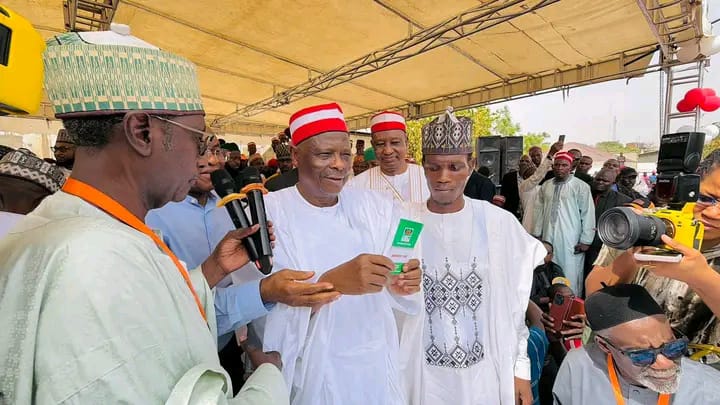
Amid tensions in the Kwankwasiyya movement and Kano NNPP, fueled by speculation that Governor Abba Kabir Yusuf might defect to APC, the ADC Youth Mandate, with ADC Waziran Waziri, urged Senator Rabi’u Musa Kwankwaso to join other national stakeholders under ADC to help rescue Nigeria from worsening socio-economic and security crises under the APC-led government.

The coalition pointed to worsening economic hardship, insecurity, and governance failures, expressing fears over the ruling party’s push toward a one-party state. They emphasised the need for a united front of progressive leaders to offer Nigerians a credible and people-oriented alternative.

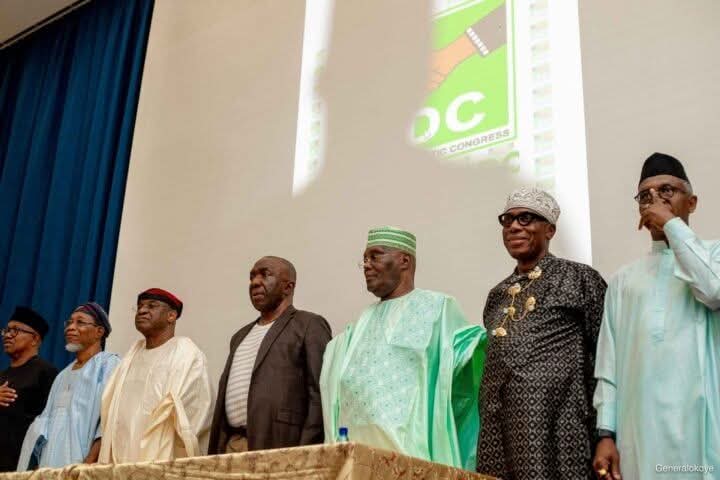
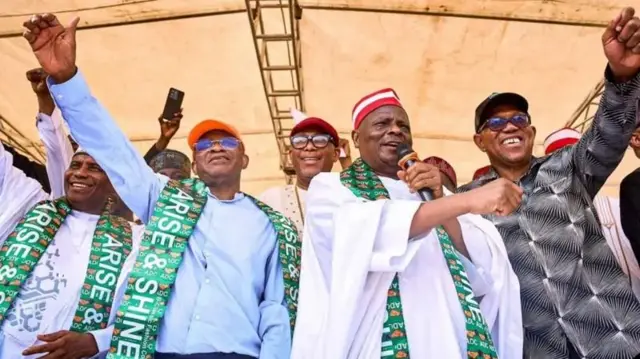
Speaking on behalf of both groups, Engr. Ammar Hamisu Dandago, the Coordinator of ADC Youth Mandate, stressed the political value of Kwankwaso’s experience and mass grassroots appeal. He expressed confidence that Kwankwaso, in collaboration with other prominent figures like Atiku Abubakar, Peter Obi, Rotimi Amaechi, and Nasir El-Rufai, could form a formidable force capable of unseating President Bola Tinubu.

The statement concluded with a renewed commitment to youth mobilisation, national unity, and support for genuine efforts to provide competent leadership and restore hope across the country.

Wike: The deepening threat to Nigeria’s democratic landscape

By Abba Hikima

It is clear to even the most daft Nigerian that Nyesom Wike, a serving member of President Tinubu’s Federal Executive Council, is only in the PDP to sabotage it and clear the path for his benefactor, the President, come the 2027 elections. What may not, however, be clear is the extent to which Wike’s tactics and antics can undermine Nigeria’s democracy.

Whether you are APC, PDP, ADC or even politically indifferent, Wike’s actions should bother you, as long as you dream of a truly democratic Nigeria where institutions transcend whimsical meddling of the few.

From any angle, one sees a deliberate pattern that systematically seeks to dismantle the country’s main opposition party and tilts the political landscape dangerously toward one-party dominance.

The recent Federal High Court injunction, restraining the PDP from holding its planned November 15 National Convention, issued by Justice J. Omotosho, only reinforces this pattern. It aligns with a string of judicial outcomes and political manoeuvres that have consistently favoured Wike’s factional interests, all at the expense of Nigeria’s fragile democratic balance.

Between 2023 and 2025, Wike’s loyalists seized the PDP’s national secretariat at Wadata Plaza, installed their own acting chairman, and plunged the party into even deeper crisis. Earlier, he had been linked to moves to demolish the PDP headquarters in Port Harcourt and to lawsuits that derailed planned conventions.

These deliberate acts of sabotage are calculated to dismantle opposition structures and weaken the political alternatives that every democracy relies on. In Nigeria today, prominent political opposition actors are crosscarpeting from their political parties to the ruling APC, not because the APC is doing better, but to salvage their seats and realise their aspirations, which appear rather vivid with the APC.

In saner climes, inclusion of opposition figures within ruling governments is a laudable means of promoting national unity and bridging gaps. But in Nigeria’s case, Wike’s dual role, serving as a federal minister while wielding extraordinary control over an opposition party, is clearly a means of manipulation.

It blurs ethical boundaries and deprives citizens of genuine democratic alternatives.

Even more disturbing is Wike’s perceived closeness to certain segments of the judiciary- what Professor Chidi Anselm Odinkalu aptly described as a “pathological fixation.”

From 2019 to 2025, at least five major cases tied directly or indirectly to Wike’s interests have been heard before the same judge, fueling concerns of judicial clientelism —a scenario where powerful litigants can select their forums by proxy.

The danger goes far beyond politics.

If political elites can manipulate opposition parties while simultaneously bending judicial processes to their favour, then democracy becomes mere theatre. A performance that preserves power and erodes accountability.

Having said this, the National Judicial Council should randomise the assignment of politically sensitive cases and ensure that no single judge repeatedly handles matters involving the same litigants. A stronger ethical firewall must also be built between judicial officers and politically exposed persons.

Politically, Nigeria must introduce conflict-of-interest rules that bar sitting ministers or presidential appointees from exerting control over opposition parties. Democracy cannot thrive when the same hand both governs and manipulates its opposition.

Coming this far, we must accept that reform is not optional; it is existential.

Abba Hikima, Esq. wrote from Kano, Nigeria.

ADC condemns Tinubu’s new fuel tax, warns of worsening hardship

By Abdullahi Mukhtar Algasgaini

The African Democratic Congress (ADC) has vehemently opposed President Bola Tinubu’s approval of a new 15% import duty on petrol and diesel, labelling it an “insensitive and misguided” move that will deepen the economic crisis for Nigerians.

In a statement released by its National Publicity Secretary, Mallam Bolaji Abdullahi, the party warned the administration against “pushing the people to the wall” with policies that exacerbate suffering.

The ADC cautioned that the new levy could force the pump price of petrol beyond ₦1,000 per litre, making life “even more unbearable” for families, commuters, and businesses already struggling with the removal of fuel subsidies and currency devaluation.

The party also questioned the government’s rationale for the tax, which is purportedly to protect domestic refining investments.

It pointed to the recent collapse of the rehabilitated Port Harcourt refinery just five months after a $1.5 billion overhaul as evidence of a flawed strategy.

“While we support private investments in the energy sector, policies meant to protect such investments must also protect the people and put their interests first,” the statement read.

The ADC demanded the immediate reversal of the import duty, asserting that a government unable to run its own refineries has no business taxing those who rely on imported fuel.

“Nigerians deserve a government that plans, not one that panics,” the party stated. “Economic growth that condemns the majority to a life of hardship and misery is ultimately destructive.”

ADC Kaduna factions clash, expel members, appoint new coalition leaders

By Abdullahi Mukhtar Algasgaini

The Kaduna State chapter of the African Democratic Congress (ADC) has announced a major shake-up, expelling several high-ranking officials and appointing new leaders for its opposition coalition.

The decisions were unveiled at a press conference held at the Golden Orange Gate Hotel in Narayi on Sunday, October 26, 2025.Senator Nenadi Usman was returned as the Chairman of the state’s opposition coalition, with Hon. Bashir Saidu reaffirmed as its Co-Chairman.

The coalition stated that the duo will serve as the “rallying point” for activities aimed at reorganizing the ADC in Kaduna State.

The move comes amidst allegations of infiltration by the ruling All Progressives Congress (APC). Coalition leaders accused the APC of sponsoring “mercenary politicians” to undermine opposition unity and impede the ADC’s growth.

As part of this alleged scheme, the group claimed that some individuals had illegally attempted to suspend the State Chairman, Elder Patrick Didam Ambut, and had instituted a court case against certain leaders, including former Governor Mallam Nasir El-Rufai and the party’s National Vice Chairman (North-West), Mallam Jaafaru Sani.

In response, the ADC State Working Committee, led by Ambut, endorsed the expulsion of nine party officials. Those expelled include the Deputy Chairman, Alh. Ahmed Tijjani Mustapha; the State Publicity Secretary, Engr. Idris Musa; and the State Legal Adviser, Danlami Dabai.

Furthermore, the coalition announced a blacklist on Hon. Adamu Ahmed Dattijo, Alh. Suleiman Abdullahi, and Senator Musa Bello for their role in initiating the court case.

The leaders accused them of acting with “ulterior motives” and “underhand dealings” with the APC, bypassing the party’s internal dispute resolution processes.

The coalition has called on ADC leaders at the national level and the general public to cease all dealings with the blacklisted individuals concerning the party’s activities in Kaduna State.

The restructuring is framed as a strategic move to build a disciplined leadership capable of uniting the people of Kaduna State to “end the current hopeless APC regime of tyranny” in the 2027 elections.

The political identity crisis in a “horse” race for power

By Abdulrahman M. Abu-Yaman 

The title race is between two horses and a little horse that needs milk and needs to learn how to jump. –  Jose Mourinho

When the controversial Jose Mourinho made this statement above, it was about football and the race to the Premier League title in 2014, but we never knew a time would come when it would be more suitable to fit into the Nigerian political context as it relates to the switch and frequent change of allegiance from one political party to another.

THE FIRST HORSE

The first horse, being the All Progressives Congress (APC), is the current defending champion in political power and the acclaimed favourite to retain the presidential title going into 2027, based on the power and influence that come with being an incumbent leader in Nigeria. Only once has it occurred since the fourth republic that an incumbent was defeated, and even that took what some have tagged as a miracle when President Jonathan made the famous call to the late former President Muhammadu Buhari (of blessed memory) and conceded. 

This horse has taken on different forms over the years and has been given various names by the political power brokers who have bet on it to win. Part of its defunct origin was the All Nigeria Peoples Party (ANPP), formed in 1998, a year before the fourth republic general elections. However, its popularity was quite limited to the northern part of Nigeria, not as pronounced in other regions of the country. Former President Muhammadu Buhari had contested twice and lost under the ANPP in 2003 and 2007, respectively.

Another major segment of its primordial origins emerged from the Action Congress of Nigeria (ACN), which was formed in 2006. It was formerly known as the Action Congress, which in turn was formed from the merger of its factions with minor political parties, including the Alliance for Democracy (AD), the Justice Party (JP), and the Advanced Congress of Democrats (ACD), among others.

Then came the Congress for Progressive Change (CPC), founded in 2009. It gained significant influence due to the impact of late Muhammadu Buhari and his millions of supporters in the northern part of Nigeria, who contested under the party’s platform in the 2011 elections. 

In 2013, the progressives and congresses in some major political parties with these words present in their acronym merged into one; the Action Congress of Nigeria, Congress for Progressive Change (CPC), a faction of the All Progressive Grand Alliance and finally, the All Nigeria Peoples Party (ANPP) to form the All Progressives Congress (APC) – the most formidable opposition group as a party in Nigeria since the return to democracy in 1999 to unseat any incumbent President in power.

THE SECOND HORSE(S)

The second horse(s) in the race are obviously divided and sharing that position based on recent trajectories and events that had left one of the horses deemed as second favourite to crumble and hanging on a thin thread; speaking of the Peoples’ Democratic Party (PDP), as long as it still has time to regroup and put its house in order, it cannot be ruled out of the race based on its political structure long established that cuts across all states in Nigeria.

The PDP was formed in 1998, in the twilight leading up to the 1999 general elections, by a group of political bigwigs who adopted Chief Olusegun Obasanjo, a former military head of state and a prisoner released from the dungeon after the end of the Abacha era. Obasanjo, coming from the south-west region of the country, was seen by many as the best candidate to step into what would have been Chief MKO Abiola’s rightful position as winner of the annulled June 12 elections if he had lived up to 1999 but for his sad and shocking demise in 1998.

The PDP won the 1999 election by a majority of votes and held a majority of seats in the National Assembly. In 2003, the party continued to dominate the political space in Nigeria, growing in influence and power, albeit under some questionable electioneering processes in 2003, 2007 and 2011, respectively, having spent sixteen years in power as the ruling party. During that period, it became the largest party not only in Nigeria but also on the African continent.

However, unfortunately for the PDP, their dream of achieving the milestone of twenty years in power was cut short in 2015 when the APC, a new, formidable force energised and regrouped, ran them out of control. 

Since then, the PDP has contested twice as an opposition party and lost to the APC in 2019 and 2023, but edged them out in 2015. The PDP has also had to lose some of its members who have decamped to the APC and has since struggled to remain as firm and relevant as it once was. The only reason it occupies the second spot as a favourite is its longevity, structural base, and the influence of some stakeholders behind the corridors of power, who are still salvaging what is left to stand firm.

Moving away from the PDP, the other second favourite only came to fruition and gained traction a few months ago, orchestrated by one man, Mal. Nasir El-Rufai, who initiated the movement that led to the formation of a coalition that later evolved into the political party rebranded as the African Democratic Congress (ADC). The party had been in existence before its formation in 2005 as the Alliance for Democratic Change. 

The formation of the ADC elicited mixed reactions in the Nigerian political space. While some saw it as the long-awaited vibrant opposition to challenge the incumbent party in power, others viewed it as a selfish endeavour created by those who had been bruised and pushed out of the epicentre of power, seeking to make a comeback by any means necessary. This notion was proven to be more relevant when the ADC reached out to past or aggrieved members of the APC and PDP to form part of its board and core membership from the official flag-off. 

Nevertheless, it is still considered the second favourite in the race because if history is anything to go by, just as in the words of Jesse Jackson: 

“In politics, an organised minority is a political majority”

Just as in the case of the APC, which was formed two years short of the 2015 elections and later emerged as the winner, the regrouped ADC party and its influx of new members can’t be underestimated.  

Another reason the ADC could be frontrunners could be their ability to capitalise on the harsh economic realities in the country that have affected the masses and present the party as an alternative to better their welfare, just as the same members of the ADC did way back in 2015 when they were members of the APC, which they now want to substitute out of power. 

THE LITTLE HORSE IN THE RACE

The little horse that needs milk to learn how to jump is the Labour Party (LP). It was also driven and triggered to relevance in the 2023 general elections due to the influence of one man, specifically Peter Obi, who was spoken of as the party’s flag bearer. The LP not only defeated the APC in their own stronghold in Lagos but also defeated the ruling party in the Federal Capital Territory, Nigeria’s capital and centre of governance. It was unprecedented and sent a clear message that the LP did not just come to make up the numbers like some minority parties. 

But be that as it may, their numbers in Lagos and Abuja, coupled with the ones from the east and the Niger Delta region, were not enough to put them in second position in the race. This is why it needs to spread its wings to cover all political nooks and crannies in other regions, especially northern Nigeria, where it is yet to get a solid grip.

The recent involvement of Peter Obi with the ADC could lead to a compromise and weaken the party’s strength, as it revolves around him. One of the LP’s former spokesmen also lamented him for not doing enough as a leader and his inability to resolve the party’s internal crisis. He also raised concerns about his failure to build a strong party base to secure the mandate. 

Still, the only reason the LP is coming in third in the horse race is because of the unexpected stunt it pulled and its potential to do more if, and only if, it can capitalise on its momentum to leap ahead like other horses in the race.

THE EXODUS AND CONVENIENT SWITCH BETWEEN PARTIES 

Nigerian politics and politicians tend to switch sides to any political party that offers them a higher chance of winning. It occurred in 1999, when the PDP was formed and founded by members of various political parties. 

In 2003, as the PDP grew in strength and power, it received more members, and others had to decamp from their prior political platforms to join it. It was beginning to look like the only way to win an election was to join the party that was already winning. 

2007 and 2011 were no different as the PDP retained power in government. However, the only parties that managed to maintain some of their strongest and most popular members were the ANPP in 2003/2007, and the CPC in the 2011 general elections, when they fielded Muhammadu Buhari as their presidential candidate in the respective years.

In the buildup to the 2015 election, a massive exodus of politicians decamped from the ‘umbrella’ that had sheltered them in political office to the newly formed APC, which was gaining immense popularity, especially in the northern and western parts of Nigeria. The presidential flag bearer was a familiar figure who was contesting for the fourth and possibly his last attempt, having been persuaded to do so. The APC, like the PDP in the past, also welcomed all members from other parties, irrespective of their past reputation or allegations while in office. In the end, the party grew from being the strongest opposition to becoming the favourite to win the election, which they eventually did.

LOST OF POLITICAL IDEOLOGIES/IDENTITIES

When we start seeing political players decamping at will, it is time to question whether any of the political parties place a high premium on their criteria for membership in relation to their ideologies before accepting any candidate into their fold. Do politicians care any less if the party they join aligns with their manifestos and visionary blueprint for good governance and leadership?

It is beginning to look like a game of chess, with calculated moves aimed at checkmating the ultimate power in the political positions they crave. The only pawns in this game are the masses who have yet to figure out that changing their clothes to another has nothing to do with the real person behind those clothes. A stained reputation, especially in previous leadership positions, coupled with a proven track record of underperformance and incompetence, cannot be covered by new political platforms.

However, the interesting aspect of all this is the emergence of a solid opposition to keep the ruling parties on their toes. Previously, with the decline and crisis in the PDP, Nigeria was moving towards a single-party state due to the frequent switch of its members to joining the APC. It is well timed that the LED coalition, which has resolved to adopt the ADC as its political platform, includes big names like former Vice President Atiku Abubakar, who is also a former PDP presidential aspirant. Peter Obi, the Labour Party’s presidential candidate, has also been seen and involved in some of their meetings. And for the first time since the APC’s ascension to power, they seem concerned about the growing popularity of the ADC and the threat it may pose to their hold on power. Deja vu?

Conclusively, all the parties involved in the horse race have exhibited similar symptoms of identity and ideological crisis in their consistent switch of allegiance to suit their needs. The thin line between them is getting blurrier in their actions and adoptions. Everyone is welcome to any party at any time. No litmus test, exceptional integrity, or individual evaluation criteria needed. Once you are in, all sins are forgiven, and then you are baptised as a new member. 

The ADC is not only like the APC alphabetically, but also in the content of its members and its contextual existence. The primary concern here is whether some members of the ADC could potentially break away from the party in the future, particularly in the event of any unresolved disagreement or fallout within the party. Are we to brace ourselves for another hypothetical ‘ABC’ party if it comes to that? Time is the ultimate revealer. 

Police summon ADC party officials over alleged incitement, violence

By Abdullahi Mukhtar Algasgaini

The State Criminal Investigation Department (SCID) of the Kaduna State Police Command has launched an investigation into several serious allegations against key members of the African Democratic Congress (ADC) in the state.

In a letter addressed to the Party Chairman of the ADC’s Kaduna Chapter, the police requested his presence alongside seven named party members to clarify allegations reported against them.

The case, filed under the headings: Criminal Conspiracy, Inciting Disturbance of Public Peace, Mischief, and Causing Grievous Hurt, was reported by complainants on Monday, September 8, 2025.

The individuals summoned for questioning are Mal. Nasir El-Rufa’i, Bashir Sa’idu, Jafaru Sani, Ubaidullah Mohammed (a.k.a 30), Nasiru Maikano, Aminu Abita, and Ahmed Rufa’i Hussaini (a.k.a Mikiya).

The police letter, which anticipates the party’s “timely response,” concluded with the regards and best wishes of the Commissioner of Police.

As of now, the ADC party leadership has not issued an official public statement regarding the summons or the specific details of the allegations.

Jonathan’s PDP comeback: A Political revival or vote-splitting sabotage? 

By Salisu Uba KofarWambai 

The latest buzz in Nigeria’s political arena is nothing short of explosive: former President Dr. Goodluck Jonathan is reportedly set to return and contest under the platform of the Peoples Democratic Party (PDP). The revelation has sent shockwaves across the nation and beyond. But beneath the headlines, a critical question lingers — what is the real motive behind this sudden political twist?

Before the emergence of the African Democratic Congress (ADC) as a viable coalition platform for the opposition, Nigerians had grown increasingly frustrated with what they saw as a weakened opposition front. The PDP, once a vibrant counterforce, had been reduced to what critics call a “toothless bulldog,” accused of being manipulated by President Bola Tinubu through Nyesom Wike, a PDP member who openly works in favour of the ruling party and now holds a position in Tinubu’s government.

Wike’s influence, according to party insiders, has been anything but peaceful. His repeated interventions and internal disputes have reportedly destabilised the PDP, a strategy many believe cost the party dearly in the 2023 general elections. With the backing of the current administration, Wike has consistently won key legal battles, tightening his grip on the PDP’s power structure.

Recognising the deepening crisis, several PDP heavyweights, including the party’s last presidential candidate, Atiku Abubakar, abandoned the PDP ship, aligning under the ADC banner to form a credible opposition. This development was warmly received by many Nigerians disillusioned by the ruling APC’s economic policies, from the sharp devaluation of the naira to the painful removal of fuel subsidies, policies they say have deepened poverty nationwide.

Alarmed by the growing acceptance of the ADC among struggling Nigerians, the APC-led government appears to be dusting off an old playbook. Just as they allegedly did with the Kwankwasiyya movement in 2023, they now seem ready to field a high-profile figure to split the opposition vote. This time, the role is reportedly being handed to none other than Jonathan — a move seen by many as orchestrated to weaken the ADC’s momentum.

For political observers, the pattern is clear: divide the opposition, consolidate power, and keep the electorate distracted, all while avoiding a united front that could unseat the government in 2027. What stings for some Nigerians is the idea of Jonathan, once the principal, now accepting political direction from his former protégé.

Whether Jonathan’s alleged return is a personal decision or part of a calculated strategy by the ruling party remains to be seen. But one thing is sure: the stage is set for a high-stakes political drama, and Nigerians will be watching closely to see how and where this political gunshot will be fired.

ADC leadership crisis deepens as Nafiu Bala claims interim chairmanship

By Abdullahi Mukhtar Algasgaini

A leadership crisis has erupted in the African Democratic Congress (ADC) after Nafiu Bala, the party’s 2023 Gombe State governorship candidate, declared himself Interim National Chairman on Thursday.

Bala, who previously served as the party’s National Deputy Chairman, announced his new role during a press conference in Abuja.

He accused former party leaders of abandoning their constitutional duties and handing over ADC’s structures to “powerful outsiders.”

The position is currently held by former Senate President David Mark, who was appointed interim chairman after an opposition coalition adopted ADC as its platform.

Bala, however, insists his assumption of the role is legitimate under the party’s constitution.

He called on the Independent National Electoral Commission (INEC) to recognize the leadership change, warning that failure to adhere to ADC’s constitutional guidelines could lead to legal action.

Bala vowed to restore internal democracy, stating, “No party leader has the right to transfer elected mandates to non-members.”

The development signals deepening divisions within the opposition party.

Bauchi’s unique politics and its swinging character

By Zayyad I. Muhammad 

Bauchi is one of the few states, perhaps the only one, in northern Nigeria that has consistently upheld a politics rooted in independence. The people of Bauchi are known for their distinct political culture: no candidate, political party, or ideology can be imposed on them. Incumbency holds little sway, and public or political office holders often fail to win elections.

From the days of the Northern Elements Progressive Union (NEPU) in the First Republic, to the politics of the Second Republic, and even the cult-like support for Muhammadu Buhari in more recent times, Bauchi has carved out a political identity that is both unique and enduring.

A review of Bauchi’s electoral history, particularly in gubernatorial contests, reveals a striking pattern of political independence that many analysts regard as unmatched in Nigeria. 

For instance:

In 1979, they elected Tatari Ali as Governor under the National Party of Nigeria (NPN) against their kinsman within the North East, in the person of Alhaji Ibrahim Waziri of the GNPP.

In 1992, they elected Alhaji Dahiru Mohammed Deba as Governor, alongside Alh Ibrahim Tofa of NRC, against the popular candidature of MKO Abiola 

Somehow in 1999, after a rerun election, PDP managed to win, and Adamu Mu’azu got elected as Governor, but later lost the bid to win senatorial elections after serving for 8 years as Governor. 

In 2007, Mal. Isa Yuguda won as Governor under ANPP against the incumbent PDP when Yar’Adua was president. 

In 2011, the state aligned with the opposition APC to produce Mohammed Abdullahi Abubakar as Governor, but lost his re-election bid despite being the sitting governor to the Present Governor Bala Mohammed of the PDP.

This pattern speaks volumes:

Abuja or any ‘interest’ cannot and has never dictated the governor’s emergence in Bauchi state. Imposing candidates rarely work. Incumbency does not guarantee re-election. High-profile public and political office holders have little impact. Governors have lost re-election, senatorial bids, and attempts to anoint successors in several Cases. The swinging nature of Bauchi politics is one of its most intriguing features

Equally remarkable is the background of those elected. Since 1999, Bauchi governors have consistently emerged from modest or unexpected circumstances- ‘Zero level, so to speak. Governors Adamu Mu’azu, Isa Yuguda, Mohammed Abubakar, and the present Bala Mohammed all came from zero disposition, meaning they did not hold a position or office for at least two years during the election period. This trend illustrates the state’s openness to merit and its resistance to political imposition.

Looking ahead to the 2027 elections, it appears to be the state with the highest number of contestants so far. 

1. Mohammed Auwal Jatau – the current Deputy Governor of Bauchi State

2. Muhammad Ali Pate – the current Minister of Health

3. Dr. Nura Manu Soro – Ex-Finance Commissioner and President Tinubu campaign Coordinator. 

4. Ambassador Yusuf Tuggar, current minister of foreign affairs. 

5. ⁠Senator Shehu Buba, a serving senator from the APC 

6. ⁠Alhaji Bala Wunti, former MD of NAPIMS

7. ⁠RTD Air Marshal Sadiq, former APC gubernatorial candidate 

8. ⁠Senator Halliru Jika, former senator 

9. ⁠Dr. MUSA Babayo, former chairman of TETFUND 

10. ⁠Senator Dahuwa Kaila, a serving senator, among numerous others. 

With such a lineup and Bauchi’s long history of voter independence, the 2027 elections promise to be as competitive and unpredictable as ever.

Bauchi’s politics remain firmly anchored in progressive and populist traditions. Candidates without a clear vision or strong grassroots connection are regularly rejected at the polls, and 2027 is likely to uphold that tradition.

Only time will tell.

Zayyad I. Muhammad writes from Abuja via zaymohd@yahoo.com.

The passing of Muhammadu Buhari: A political loss for both APC and ADC

By Zayyad I. Muhammad

The passing of former President Muhammadu Buhari marks not just the end of an era but also a significant political loss for two of the three key political parties in Nigeria, the ruling All Progressives Congress (APC) and the rising coalition force, the African Democratic Congress (ADC).

For both parties, Buhari represented more than just a former head of state; he was a political symbol with immense influence. His mere presence at a campaign rally, no matter how brief, would have carried tremendous weight, particularly among his loyal base, which is estimated to be over 12 million strong. These supporters, often described as a “cult-like” following, have remained fiercely committed to him since his early political days under the Congress for Progressive Change (CPC) and the Buhari Organisation. However, the number may have decreased by now.

In recent times, many former CPC loyalists and Buhari-era political operatives have appeared to find a new home in the ADC, reshaping its structure and lending it a dose of national relevance. This quiet but strategic realignment has positioned the ADC as a potential beneficiary of some of the Buhari political legacy, especially in northern Nigeria, where his influence remains deeply rooted. However, a good number of the CPC bloc and the Buhari Organisation have remained in the APC.

Had Buhari lived to make even a symbolic appearance at an APC campaign event, it would have significantly dampened the ADC’s momentum and reinforced the APC’s claim to his enduring political capital. Conversely, had he chosen to lend his image, even silently, to the ADC, it would have sent shockwaves through the APC, raising questions about its hold over his base.

Now, with his passing, both parties are left in a competitive vacuum, each scrambling to appeal to the millions who revered Buhari for his perceived integrity, simple lifestyle, and northern populist appeal. The political battlefield is wide open, and neither the APC nor the ADC can confidently claim to be the rightful heir to Buhari’s legacy.

However, President Bola Ahmed Tinubu may have gained an early edge. His respectful and dignified handling of Buhari’s death, marked by prompt tributes, state honours, and symbolic gestures, may resonate with many of Buhari’s followers. In Nigerian politics, such symbolic acts are never underestimated. They signal alignment, loyalty, and shared values, all of which matter deeply to a base that is emotional, ideological, and still seeking a new political anchor.

As the 2027 election cycle approaches, the real question becomes: Who will inherit the Buhari political machinery? The answer may shape the future of both the APC and ADC, and by extension, Nigeria’s political landscape.

 Zayyad I. Muhammad writes from Abuja via zaymohd@yahoo.com.