Dr Abdullahi Umar Ganduje

Gov. Yusuf meets designer of demolished Golden Jubilee roundabout, vows to rebuild it

By Uzair Adam Imam

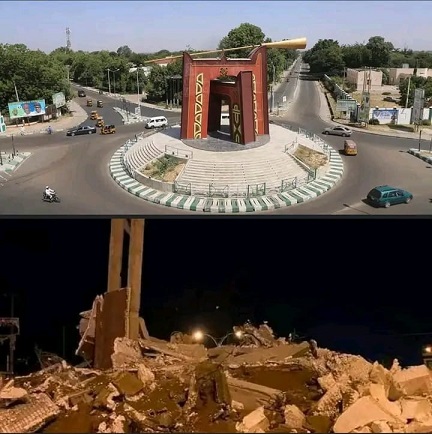
The Kano State Governor, Abba Kabir Yusuf, has met with the designer of the demolished Kano Golden Jubilee Edifice of the Government House Roundabout.

The governor who made this disclosure Monday on his verified Twitter handle, said the roundabout will be reconstructed along Na’ibawa Flyover, Zaria Road.

According to the governor, the demolition of the Government House Roundabout was for security purposes and structural considerations.

He stated, “Recently, we took the decision to move the Kano Golden Jubilee Edifice from the Government House Roundabout, due to security and structural considerations. 

“It was therefore in that regard, I met with its designer, at the structure’s new home, along the Naibawa Flyover, Zaria Road. 

“Our government is highly committed to the massive improvement of Kano’s infrastructural architecture, and its accessibility to all,” he added.

The Daily Reality recalls that the demolition of the roundabout a few weeks ago generated painful arguments with many people saying the demolition was meant to satisfy the political anger of the Abba’s Godfather, Kwankwaso, against the immediate past governor, Ganduje.

Restoring Muhammadu Sanusi II

By Dr. Aliyu U. Tilde

History repeats itself, they say. However, that recurrence was less frequent in the history of rulers of Northern Nigeria. While historians can remember two, we may be at a point of witnessing the third.  

Sometime in December 1652, Muhammadu Kakuna, the 33rd Sultan of Kano, was ousted under the influence of the powerful Maidaki Auwa, who installed her son, Soyaki. Kakuna retreated to Zaria and, within days, fought back his way to the throne just before the year ran out. That was the only time a ruler of Kano was restored.

In 1901, the British colonialists occupied Kontagora—tudu makwantar rikici—and deposed its 3rd Emir, Ibrahim Nagwamatse, for his notorious slave expeditions. They installed his son. For some reason, after just two years, the British returned Ibrahim from exile in 1903 and made him the Sarkin Sudan, and he reigned until he died in 1929.  

Muhammadu Sanusi II, the 14th Emir of Kano, may soon be the third. Like in the case of Kakuna, many saw his removal by Governor Abdullahi Umar Ganduje on the grounds of insubordination as a live specimen of highhandedness, intolerance, and vengeance. The Emir was arrested and banished to Loko, Nassarawa State, for confinement, an action which he successfully fought against before a federal high court in Abuja. On 30th November 2020, the court declared the internment and the Emirate Council Law under which it was undertaken unconstitutional. It restored the fundamental rights of the deposed Emir to human dignity and personal liberty.  

In contrast to Maidaki Auwa of 1652, Governor Ganduje went beyond the Emir and balkanised the Emirate. He divided it into five independent emirates to prevent the emergence of any strong Emir of Kano in the future. This act of downgrading the system, the first of its kind since Bagauda founded Kano 1,025 years ago, is understandably repugnant to the Kano ruling family and many of its subjects. If the malware, they argue, had only changed the driver file—in this case, the Emir—the system could tolerate that and continue with the same speed. But corrupting the entire system files and downgrading its performance to a status of a photocopier cannot be tolerated. A ‘system restore’ is necessary.  

Restoring the Kano Emirate system to its 9 March 2020 date is now on the fingers of the new administration in the State. It will undoubtedly be greeted with mixed feelings in the next few days, especially as it will portend restoring its unified disk configuration and the deleted driver file.  

History is about to witness that restoration if the feelers from Kano are accurate. How the ancient city would absorb the heat of the operation and bounce back as one of the most important emirates in the region is a matter of immediate concern to its citizens. As Nigerians, we can only hope that it does so without boiling.

Dr Aliyu is a former Bauchi State Commissioner of Education. He can be reached via Twitter @Dr_AliyuTilde.

Uproar over demolition exercise in Kano

By Bilkisu Kabir Ibrahim (Mrs)

It is often said, “Destruction is easy, but rebuilding takes more time to achieve.” 

Politics and governance are two sides of the same coin, as they are often used interchangeably even though they differ in veracity. In modern democratic societies, citizens (and leaders, by extension) fail to understand the difference between the two concepts in terms of meaning and operation. 

Barely less than two weeks after the swearing-in of the newly democratically elected governors and members of the states’ assemblies across the states of the federation, several governors focus on so many engagements as part of the fulfilment of their campaign promises, ranging from suspension and removing many top heads of the state’s ministries, departments and agencies alongside forwarding of new nominees to their respective state house of assemblies for various positions.  

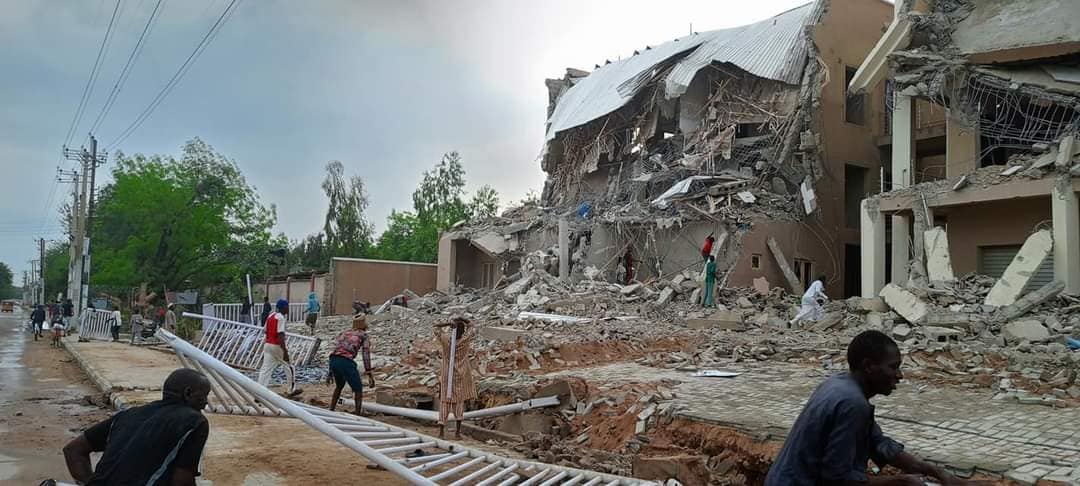
However, the reverse is the case in Kano State as the new governor fulfils his campaign promises where demolishing illegal structures is part. In his inaugural speech, his Excellency Abba Kabir Yusif revoked all sold public places and assets by his predecessor by ordering security agencies to take over such sites. A few days later, he began a demolition exercise with a 3-story building with 90No. Shops along Racecourse Road Nassarawa GRA which were reportedly owned by the son of the outgoing governor of the state, followed by another multi-billion Naira project via Public Private Partnership (PPP) arrangement initiated by his predecessor, situated at old Daula Hotel (state’s property) on Murtala Muhammad Way, Kano.

Nevertheless, several structures have been marked and knocked down as illegal buildings, which include; Eid-Ground Shops (Masallacin Idi), shops detached from Sani Abacha Stadium Kofar Mata and Buildings at GGSS Dukawuya Goron Dutse as well as some structures at Kano Hajj Camp among others. 

Subsequently, mayhem erupted in the state capital and neighbourhood when the governor ordered the demolition of the historic Kano roundabout structure in the early hours of Wednesday, 14th June 2023. The roundabout, known as Kano Golden Jubilee Monument, was erected in 2017 and conceived and designed by a young female architect to commemorate Kano’s 50-year attainment as a state.

While several indigenes and residents have condemned in totality the demolition of the monument, the press secretary to the governor, Sunusi Bature D/Tofa, in his reaction, revealed that the roundabout was demolished for security and safety reasons, “it also poses traffic challenges around the area due to its size blocking the view of drivers accessing all routes linked through the roundabout”. 

Nonetheless, mixed reactions become the order of the day; some residents are hailing the governor for staying firmly to his campaign promises, while many traders lament the demolition exercise as it truly affects their commercial activities by creating a hostile business environment forcing many of their customers from within and outside the state to stay away. During my interview sessions, a respondent feared the ongoing action as “it scared away private investments in the state, which is the time needed for a successful administration”. Another respondent (a victim) revealed that, on Saturday, he supplied aluminium and other equipment for a window project at Old Daula Hotel worth N30,000,000.00 but were all looted in the night immediately after the demolition, which the looters termed as “GANIMA” in Hausa. 

Similarly, it was reported that, in the heart-wrenching incident, a young boy lost his life after being struck by a truck during the demolition of a structure. The unfortunate event occurred amidst the efforts to clear the unauthorised constructions. The boy was not the only one affected, but also several individuals sustained severe injuries as they attempted to take advantage of the demolition exercise and loot multimillion items.

Some critical questions were asked about this light exercise. This government is supposed to concentrate on critical infrastructure and human development to overshadow its predecessors instead engaged in revenge and self-centred aggrandisement. 

His Excellency Abba Kabir may wish to remember that some projects need maintenance and sustenance to suit the rising demands of the good people of the state. Instead, the government should have to determine the legality or otherwise of the allocated lands by constituting high-powered technical committees to, among other things, investigate the following: 

a. Whether the due process for land allocation is followed;

b. Whether all building codes and regulations have been complied with;

c. The rationale behind the building purpose;

d. Was the land sold at market price, and whose account was the money deposited into or allocated as enshrined in the Land Use Act?

e. Was the land allocated to the rightful applicant? 

f. Was the roundabout demolition in the interest of most of the populace? Etc.

g. The committee to proffer some recommendations to the government for a proper solution. 

To crown it all, the governor may further wish to recall the Oath of Office taken during the swearing-in session, that “….I will not allow my personal interest to influence my official conducts or my official decisions …” Surely, Almighty God will ask for such utterances. 

Bilkisu Kabir Ibrahim (Mrs) wrote from Kano state, Nigeria. She can be reached via bilkisukabir1@gmail.com.
Counting the cost of Kano demolitions

By Mohammad Qaddam Sidq Isa (Daddy) 

Notwithstanding the appropriateness or otherwise of the recent and unprecedented wave of demolitions in Kano by the newly inaugurated governor, Abba Kabir Yusuf, it may have triggered a vicious circle of the incumbent governors and their predecessors taking turns revoking, converting and reallocating public land and facilities in the state. 

Though purportedly guided by relevant legislation and overriding public interest, successive Kano state governors have been involved, to various extents, in controversial public land and facility-related scandals. However, the immediate past governor, Abdullahi Umar Ganduje, having literally overdone it, has been particularly notorious in this regard. 

Now with the recent demolitions, Governor Abba has proven that it’s indeed his turn. The way they were conducted, which made the operation look more like mob action, has been effectively set as a precedent for future similar operations in the state. 

So, unless this looming vicious circle is averted, Kano may, after every four or eight-year tenure, witness similar operations with persistently worsening intensity and impacts.   

Having monitored the situation from afar, thanks to the viral video clips on social media, I felt not only sad but extremely embarrassed watching helplessly how my city, a supposedly aspiring mega city, was being systematically bastardized.

I watched in shocked dismay how the lives of innocent traders, who simply happened to be tenets in the targeted buildings, were being turned to, perhaps, perpetual misery overnight by crowds of sadist creatures feigning being human looting their (traders) merchandise. Some buildings had already been looted even before the demolition team got there. There are verified heartbreaking stories about the plights of many victims. In a particular instance, one was reliably reported to have gone mad out of frustration. 

The sheer ferocity with which the mob plundered traders’ goods suggests deep-seated populist sadism and sheer envy in a society where tacit gloating over the misfortune of any real or perceived wealthy person has become normal. I have also observed tacit attempts on social media by many otherwise reasonable people to underestimate the plights of the victims and even put the blame on them for their ‘failure’ to evacuate their goods in time. 

Meanwhile, the cumulative impacts of this vicious circle on the state’s economy and other strategic interests cannot be overestimated. It’s already seriously affecting local investor confidence, for no one will consider the viability of any significant investment, especially in, say, real estate development and other related sectors, knowing that the land allocation is prone to arbitrary revocation and the structures are subject to impulsive demolition at any time. 

Equally, banks and other financial institutions will have to discontinue recognizing Kano government-issued certificates of property ownership as collateral, knowing that they may at any time be rendered as worthless as takardar tsire. 

Likewise, the state’s attractiveness to direct foreign investment (if there is currently any) will be hit even harder, for no prospective foreign investor, being typically particularly sensitive to any red flag suggesting policy inconsistency, will consider investing in Kano knowing that whatever policy or incentive attracted him can be impulsively terminated at any time. 

Now, obviously, Governor Abba is aware deep down that that wasn’t how he was supposed to handle the situation in the first place. His approach is enough to vindicate those who insist that he is simply on a vengeance mission with a premeditated resolve to settle scores with political opponents and their associates on behalf of his political godfather, Rabi’u Kwankwaso. 

He can address whatever land use abuses his predecessor committed, which are so many, by the way, but he should do it in a civilized way through due process leading to the demolishing of what indeed deserves to be demolished and sparing what deserves to be spared for the purpose of reclaiming and converting it into a public facility. 

Mohammad Qaddam Sidq Isa (Daddy) wrote from Dubai, UAE, and can be contacted via mohammadsidq@gmail.com.

Ganduje plans to rig Kano guber and Fagge supplementary elections, NNPP cries out

By Ahmad Deedat Zakari

The New Nigeria Peoples Party, NNPP, have raised concerns over the alleged plot by Kano State Governor, Umar Ganduje, to rig the incoming gubernatorial election and supplementary election in the state.

The Chairman of Kano NNPP, Umar Haruna Doguwa, made the disclosure in a press statement on Sunday.

Mr Doguwa appealed to President Muhammadu Buhari, the International Community and the Security agencies to foil Ganduje’s plan.

He alleged that Ganduje’s interest goes beyond election rigging, but the total breakdown of law and order in the state is also among his evil machinations.

Part of the statement reads:

“The Kano State NNPP has noticed that some attempts are being made by unscrupulous elements in conjunction with some INEC officials to manipulate the collated results as we also noticed improper conduct by some INEC ad hoc staff. We, therefore, call on Presidency, security agencies, election observers, and the international community to beam their searchlight on INEC, especially on the concluded position to conduct supplementary election in the 15 affected polling units at Fagge. Any shift, either in a number of the polling units or continued cancellation of other polling units, will meet our stiff resistance.


“We are also aware that plans are being nursed and sponsored by the State government to cause a total break down of law and order in the state during the upcoming gubernatorial and state assembly elections. While we call on security agencies to take adequate measures on this, otherwise, we as a party and citizens of Kano State have the capacity to defend ourselves and our votes.”

Kano State Gov’t promotes 132 workers, sacks 3

By Muhammad Aminu 

Kano State Government has elevated 132 civil servants in the state’s civil service for July 2022. 

Kano State Civil Service Commission Chairman Uba Idris Karaye disclosed this during a monthly commission meeting for senior staff promotion exercise held at the conference hall of the commission. 

According to Karaye, 53 promoted workers are between the grade level 08-09; 75 others are from grade level 10 – 14 while others are 15 to above respectively. 

Karaye, represented by the Permanent Commissioner ll, Saleh Adamu Kwaru, urged promoted employees to reciprocate the kind gesture by being committed and hard-working in discharging their duties for maximum results.

He, however, explained that the commission had approved the sack of three civil servants for gross misconduct that contravened civil service rule.

He similarly said the commission approved the transfer of service for seven staff to different MDAs.

In his remarks, the Permanent Secretary of the commission, Balarabe Hassan Karaye, commended members of the commission for their zeal and urged them to be upright and be guided by the scheme of service before taking any decision for effective and efficient service delivery in the state.

Tricycle operation in Kano: To ban or to regulate?

By Tijjani Ahmad

Before banning the use of commercial motorcycles, popularly known as “Achaba”, most of us couldn’t imagine life in Kano without them. At that time, most Kano metropolis residents relied on Achaba as a means of local transport. 

The business of commercial motorcycles was booming and popular during that time, known for its lucrative nature, employment generation and ease of use to residents. 

Suddenly, the then governor of Kano State, Dr Rabiu Musa Kwankwaso, announced the ban on 22 January 2013. The government explained that many crimes, particularly attacks on security operatives in the Northern Nigerian state, were carried out by men on motorcycles.

Even though there was no specific arrangement for the alternative means from the government’s side, the ban was effective and gave birth to the rise of the tricycle popularly known as “A-Daidaita Sahu”.

A Daidata Sahu was not new in Kano because it was first implemented by the then Kano State governor, Malam Ibrahim Shekarau, in 2005 but was not popular because of Achaba. 

However, immediately after Achaba, investors started diverting their investment to A Daidaita Sahu. And residents accepted it since there were no alternative means of transport. It was reported that most of the Achaba riders also followed their investors and started trooping the streets of Kano.

For almost a decade, A Daidata Sahu has been found wanting in many offences, from criminal to civil. On that account, the government took many decisions to regulate the operation of commercial vehicles generally in Kano.

Unfortunately, the purpose of these decisions has been defeated by concentrating on the monetary aspect of most of the policies meant to curb insecurity and regulate motorists’ activities within the state.

Now, Kano State Government placed another ban on A Dadaita Sahu – restricting its operations at night, from 10:00 pm to 6:00 am. The question is, how sure are we this will solve the problem of insecurity?

Kano, one of the largest cities in Africa – known for commerce, agriculture and industrialisation, is becoming more sophisticated as its population grows, new businesses emerge and naturally expand. Therefore, whatever policy we bring, we should consider the consequences on the populace, businesses and the environment. 

Despite these, it seems like proactive measures are not what we are interested in; we are instead scratching the surface. That’s why it is always quick banning, restrictions, curfew and many more reactive moves. 

If we are indeed serious, we don’t need to borrow money and install CCTV in the name of curving insecurity. All we have to do is regulate the activities of commercial vehicles within the state and block the leakages of revenue generated from their activities. This will go a long way in checking the crimes and improving the overall revenue of the state.

Three years ago, my friend, a key player in the industry, asked my opinion on whether the government should ban it due to insecurity.

I said this could be done through an effective and efficient database where all the players within the industry, from owners, riders, sellers and service providers, and warehouses. The data must be linked with BVN and NIN. To be part of the industry, you must comply with the requirements. 

By doing so, no motorcycle or any player within the industry should be seen on the street or within the city without registration. Furthermore, each person’s number or tracking ID should be placed on the bike and should correspond with what is in the database. So that whenever any player perpetrates a crime, all you have to do is to know the tracking number. 

This can be used to know the owner and the rider of the motorcycle used to commit that crime. My friend is trying to implement this within their company. Where all their riders can be tracked in real-time using GPD enable tracker. Thus, this is all we need: regulation, not reactive measures such as banning.

Tijjani Ahmad wrote from Kano via ahmatee123@gmail.com.

Ganduje to Wike: You will lose 2023 presidential election

By Muhammadu Sabiu

Governor Abdullahi Ganduje of Kano State has predicted that Nyesom Wike of Rivers State will lose the presidency in 2023.

Wike, according to Ganduje, would be a good loser because he is courageous.

He made the remarks while receiving the presidential candidate from the Peoples Democratic Party, PDP, in Kano.

Ganduje said, “So, you have come to see your brothers and sisters. Good. You are aspiring for the president of the Federal Republic of Nigeria. We see your efforts.

“And at the end of it, you’d lose, but you’ll be a good loser. I appreciate good losers because they have courage. And since you are doing it peacefully, you’ll live long to fight again. I congratulate you, Mr ‘Wise’ Wike. Thank you, and God bless.”

Recall that the Rivers State governor has recently shown his aspiration to govern Nigeria in 2023, noting that he stands a good opportunity to clinch power from the All Progressives Congress, APC.

The Kano APC ship on the verge of capsizing

By Musa Sa’adu

Political parties remain the only vehicle or platforms for candidates/politicians to aspire for political offices. This, however, leads to the emergence of various interest groups within a party. The groups work harmoniously together to pursue their common goals. However, the success or otherwise of a political party depends mainly on how the stakeholders manage these interest groups in the distribution of party positions, party tickets, appointments and the traditional largesse as the case may be. Failure to do these for any reason has, on so many instances, led to the internal party crises.

Kano APC faces the formidable opposition PDP-Kwankwasiyya that is waxing power to unseat them. Yet, the party is bedevilled with internal crises that by day slim and reduce its electoral chances comes 2023. Internal party crises are the primary driving force that negatively affect party performance in a poll. Before governorship elections in Kano that spring surprises are born out of internal party squabble and wranglings.

The 1983 election that produced Senator Sabo Bakinzuwo against a well-performing Governor Abubakar Rimi, seeking reelection resulted fromf party crises. The PRP crises that metamoposed into ‘Tabo‘ and ‘Santsi‘ factions, led by Malam Aminu Kano and Rimi respectively, forced Rimi as a sitting Governor to dump PRP for NPP to seek reelection. However, this was one of the cardinal reasons behind his Waterloo despite his performance in office throughout Kano and Jigawa.

In the botched Third Republic, one can learn a lesson from it. The popular and well-accepted SDP lost the Governorship election to NRC due to the internal crises in SDP, which was an offshoot of Santsi and Tabo from the Second Republic. After about three primary elections that produced an independent candidate, Engr. Magaji Abdullahi against Aminu Inuwa of Santsi faction and Ahmad Rufa’i of Tabo faction. The wrong choice of Ahmad Rufa’i as running mate to Magaji Abdullahi led to Santsi group to revolt and enter an agreement with NRC candidate Kabiru Gaya. This development changed the election outcome in favour of the NRC candidate.

Senator Rabiu Musa Kwankwaso, Malam Ibrahim Shekarau and, of course, Dr Abdullahi Umar Ganduje are no doubt the principal actors of the Fourth Republic Kano politics. The three have benefited and suffered the consequences of internal party crises.

Our memories are still intact on how the political hullabaloo, shenaniganism and internal party wranglings ruined the reelection bid of Governor Kwankwaso during the 2003 Governorship election. The defection of Danhassan, crises between Kwankwaso and some members of the National Assembly, notably the then speaker of the House Of Representatives, Hon. Ghali Na-Abba and perhaps General Buhari factor were among the contributing factors that led to the Kwankwaso/Ganduje downfall and the emergence of Malam Shekarau.

Likewise, Shekarau suffered the repercussions of internal party crises; his anointed candidate Salisu Sagir Takai was defeated by Kwankwaso/Ganduje. The crises between Shekarau and his deputy, Abdullahi Gwarzo, popularly known as Ruwa Baba, the over fifty thousand votes garnered by him during the Governorship election, has smoothly leveraged the second coming of Kwankwaso and Ganduje in the 2011 election.

The current turmoil rocking the Kano APC is a cause of concern to any committed party member. The internal crises that paved the way for two parallel conventions that produced Abdullahi Abbas and Haruna Zago representing Ganduje and Shekarau led factions respectively will create a hole that will gradually sink the Kano APC ship, and neither the Ganduje nor Shekarau will survive the mishaps including their supporters.

In politics, number matters; everyone is important! Don’t tell me someone who’s Governor for eight years and a serving senator doesn’t have political influence, and these G-7 members, as they fondly called themselves, are blessed with sturdy supporters and resources to bankroll political movements that can make or mar an election.

With the Tuesday court verdict favouring the Shekarau-led faction and considering the nature of Nigerian litigation processes, I’m afraid that whichever faction the pendulum swings and even if they won the general polls, the replica of Zamfara 2019 is imminent.

Both Ganduje and Shekarau should tread with caution; there is still time. They shouldn’t listen to the sycophants instigating the crises. Let them sit, discuss and iron out the grey and problematic areas and find out political solutions; otherwise, Kwankwaso will send them to political oblivion.

Musa Sa’adu wrote from Sumaila and can be reached through musasaadu0181@gmail.com.

Kano deploys modern technology to tackle insecurity – Ganduje

By Uzair Adam Imam

Kano State Governor Dr. Abdullahi Umar Ganduje has stated that his administration has deployed modern technology gadgets such as CCTV to tackle the challenges of insecurity and ensure safety of its citizens and their properties.

The governor made this disclosure in a release signed Monday, 15th November, 2021 by the Chief Press Secretary to the Deputy Governor of Kano State, Hassan Musa Fagge.

It was gathered that Ganduje, who was represented by his deputy, Dr. Nasiru Yusuf Gawuna, was said to have stated this while receiving the General Officer Command of the one division of Nigerian Army Kaduna, Major General Kabiru Imam Muktar who paid him a visit at the Government House, Kano.

According to him, installation and deployment of modern technology has assisted greatly in curbing the criminal acts that before are bedevilling the state.

Ganduje also noted that, Kano is today one of the most peaceful states in the country due to prayers and synergy between the government and all the security agencies.

The statement read: “In Kano we hold regular security meetings so as to analyse our operations and chart ways foward, infact we have included paramilitary agencies into the state security council”.

“The Commander 3 Brigade, I am sure will brief you about our efforts in provision of adequate logistics,” Ganduje said.

He then assured of continued support and cooperation to the Nigerian Army towards ensuring peace and safety of Kano citizens.

Speaking, the General Officer Commanding of the One Division,Nigerian Army Kaduna, Major General Kabiru Imam Muktar said he is on a visit to the Army units and formations under his command in Kano State.

He explained that the first hand information they received from the citizens has assisted them alot in combating crimes.

“The cooperation and support given to us by Kano people has helped tremendously in our effort to contain criminality to the bearest minimum”.

“We are grateful to the traditional rulers and the citizens for their role in curtailing the farmers and herders conflict in the State”.

“I am indeed happy with the cordial relationship between the 3 Brigade and Kano people,” he said.

Major General Muktar while reiterating their commitment towards ensuring security of lives and properties of Kano people, commended the Governor for executing laudable projects in the State.