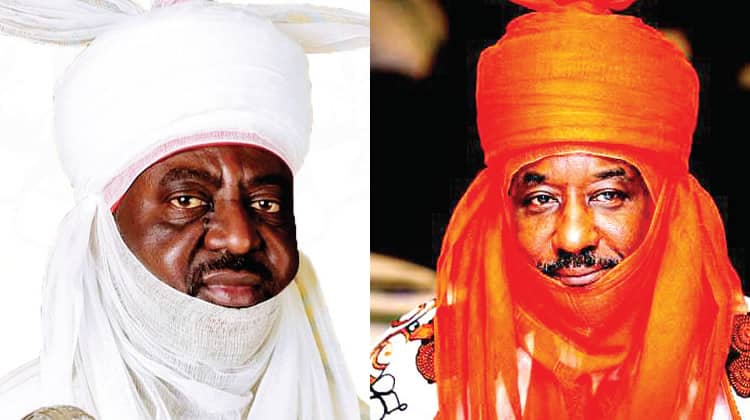
Abba Kabir Yusuf

Court postpones ruling on Kano Emirates Council repeal law

By Sabiu Abdullahi

A Federal High Court in Kano has postponed its ruling on the validity of the Kano Emirates Council Repeal Law 2024 to 2 pm today.

The judgement was initially set for 12 pm but was shifted before midday, and all parties in the suit were notified. 

The Kano Emirates Council Repeal Law 2024 was recently passed by the Kano State House of Assembly and signed into law by Governor Abba Yusuf.

The law led to the dethronement of Emir Aminu Ado Bayero and the reappointment of Muhammadu Sanusi II as the 16th Emir of Kano.

It also reversed the creation of four emirates established by former governor Abdullahi Ganduje in 2020. 

However, Sarkin Dawaki Babba, Aminu Danagundi, challenged the legality of the new law and asked the court to declare it null and void.

After hearing the motion last Friday, Justice Abdullahi Liman of the Federal High Court sitting in Kano adjourned the ruling till today. 

Counsel to the State House of Assembly and its speaker, Eyitayo Fatogun (SAN), informed the court of a notice of appeal filed at the Court of Appeal, seeking a stay of proceedings.

However, Justice Liman noted that there was no evidence that the appeal had been entered nor any formal application for a stay filed. 

The court’s ruling today will determine the fate of the Kano Emirates Council Repeal Law 2024 and its implications for the emirates in Kano State.

Kano CP denies Govnor Yusuf’s disobedience allegations

By Uzair Adam Imam

Kano State Police Commissioner, Usani Gumel, has vehemently denied allegations of disobeying Governor Abba Yusuf’s orders and taking instructions from unknown sources.

Gumel reiterated his commitment to maintaining peace and order in the state, citing his track record as a champion of community safety and sustainable peace.

The denial comes on the heels of accusations leveled by the state Attorney General, Haruna Dederi, who alleged that Gumel consistently disobeyed the governor’s instructions and unilaterally banned Eid-el Kabir festivities without consultation.

Dederi further accused the police commissioner of attempting to undermine the constitutional authority of the governor by taking instructions from unknown sources.

The ongoing crisis in Kano State revolves around the contentious emirate issue, with two claimants, Aminu Ado Bayero and Muhammadu Sanusi II, vying for the throne.

This has created palpable tension in the state, prompting the police to ban traditional Sallah Durbar processions to maintain peace.Gumel expressed shock and surprise at the allegations, noting his dedication to upholding the law and maintaining order in the state.

He reassured the public that the police would enforce the existing court order and work to resolve the emirate issue, prevailing on the two contending parties to respect the law.

Governor Yusuf accuses CP of disobeying orders

By Uzair Adam Imam

Kano State Governor, Abba Kabir Yusuf, has accused the State Police Commissioner of disobeying his directives, particularly regarding the banning of Eid-el-Kabir festivities.

The Commissioner’s actions have been described as “disheartening and dangerous to peaceful coexistence” by the State Attorney General and Commissioner for Justice, Haruna Isa Dederi.

The government explained that the Commissioner’s decision to ban the festivities was unilateral, without consulting the Governor or the State Security Council.

This has raised concerns, as the Governor is the Chief Security Officer of the State.

The government also addressed the recent judgment by the Federal High Court No. 3 in Kano, which claimed that the former emir’s fundamental rights were infringed upon, including allegations of house arrest.

The government disputed this, stating that the former emir was not forced into Gidan Nassarawa, a government property, and was accompanied by security guards.

The government reiterated the Governor’s constitutional duty to ensure the protection of lives and properties.

They urged the people of Kano to continue their legitimate activities peacefully and promised to keep them informed as events unfold.

The government called on well-meaning Nigerians and international friends to intervene and allow the people of Kano to live in peace, stating that any attempt to undo the peace is an assault on democracy.

Correspondents’ Chapel boycotts Kano govt activities over alleged maltreatment

By Uzair Adam Imam

The Correspondents’ Chapel of the Nigerian Union of Journalists (NUJ) in Kano State has announced a boycott of all Kano State Government activities, effective immediately.

This decision comes in response to the alleged persistent mistreatment of chapel members by the government and its agents while carrying out their duties.

According to Aminu Ahmed Garko, Chairman of the Correspondents’ Chapel, despite efforts to engage with the government to address these issues, there has been no improvement.

Members continue to face harassment, intimidation, and physical assault while performing their duties.

The government’s prioritization of non-professionals over trained journalists has also been criticized, with the chapel stating that this has become a state policy to sideline those best equipped to handle the job.

As a result, the chapel has announced that its members will no longer participate in press conferences, cover government events, or conduct interviews with state officials until a tangible commitment to press freedom and journalist safety is seen.

All members have been directed to comply with this directive and join the protest against the ill treatment of journalists in Kano State.

The chapel believes that a free and independent press is essential to a functioning democracy and will not stand idly by while its members are mistreated and intimidated.

Garko stated that the chapel will only reconsider its position when the government demonstrates a genuine commitment to addressing these issues and ensuring a safe and enabling environment for journalists to perform their duties.

Court halts reinstatement of Sanusi as emir of Kano

By Uzair Adam Imam

A Federal High Court in Kano has issued an order halting the reinstatement of Muhammadu Sanusi II as the Emir of Kano.

The court’s decision came in response to a lawsuit filed by Alhaji Aminu Bappa Dan Agundi, also known as Sarkin Dawaki Babba, on Thursday.

Justice A.M Liman, the presiding judge, granted an interim injunction suspending the implementation of the repealed Kano Emirate law, which aimed to reinstate Sanusi II as the Emir.

The court ordered that the operation of the Kano State Emirate Council (Repeal) Law, 2024, be suspended, affecting all offices and institutions created under the provision of the Kano State Emirate Council Law, 2019.

The court also restrained the 5th to 8th respondents (not specified in the report) from enforcing, executing, or implementing the repealed law.

Additionally, the court ordered the maintenance and preservation of the status quo by all parties involved, pending the hearing and determination of the plaintiff’s originating motion.

The court also granted an order for an accelerated hearing on the matter.

This development means that Sanusi II’s reinstatement as Emir of Kano has been put on hold pending the court’s further decision.

Sanusi Lamido reinstated as Emir of Kano, dothroned emirs ordered to vacate palaces

By Uzair Adam Imam

Governor Abba Kabir Yusuf of Kano State has reappointed Malam Muhammadu Sanusi II as the Emir of Kano, a position he was removed from in 2020.

The governor announced the appointment on Thursday at the Government House, shortly after signing the Kano Emirate Law as amended.

The signing ceremony was attended by the Deputy Governor, Speaker of the State Assembly, and other principal officers of the government.

With this development, Sanusi II has been officially reinstated as the Emir of Kano.

In a related development, Governor Yusuf has directed the five former emirs of Kano, Bichi, Rano, Gaya, and Karaye to vacate their palaces within 48 hours, starting from 5:00 pm on the day of the announcement.

They have also been ordered to hand over all properties in their possession to the Commissioner for Local Government/Deputy Governor.

This move is seen as a reversal of the decision made by former Governor Abdullahi Ganduje, who had dethroned Sanusi II in 2020 following a personal rift.

More details to follow…

JUST IN: Kano assembly repeals emirates council law

By Uzair Adam Imam  

The Kano state house of assembly has passed the Kano Emirates Council Law (Repeal Bill) 2024 after scaling its third reading.  

The law has abrogated the establishment of five new Emirates in the state. All offices established under the repealed law have been set aside by the new bill. 

Also, all district heads elevated or appointed under the repealed law are to revert to their previous positions. 

The Kano State Emirates Council (Amendment number 2) Law, 2024, was sponsored by the Majority Leader and member representing the Dala Constituency, Lawan Hussaini Chediyar Yan Gurasa.  

The law, which created five new emirates, was first assented to by ex-Governor Abdullahi Umar Ganduje on December 5, 2019. 

A principal officer of the assembly, who did not want his name mentioned, said, “No Jupiter can stop the assembly from amending the law.”

Amendment of Kano emirates council law scales first reading

By Uzair Adam Imam

Heavy security was present at the Kano House of Assembly on Wednesday as lawmakers commenced the amendment of the State Emirates Council law that created five Emirates.

The amendment, sponsored by the majority leader and member representing Dala constituency, Lawan Hussaini Chediyar Yan Gurasa, scaled its first reading.

Armed security operatives from the police and Nigeria Security and Civil Defence Corps (NSCDC) took over strategic places at the assembly complex, while journalists who came to cover the day’s proceedings were asked to identify themselves before they were allowed entry.

All roads leading to the assembly complex were barricaded.The Kano state emirates council law, 2019, which created five new Emirates, was first assented to by the ex-Governor Abdullahi Umar Ganduje on December 5, 2019.

The governor assented to an amendment to the law on October 14, 2020, and signed another amendment on April 11, 2023.

Section 3(1) of the law established five distinct Emirates of Kano, Bichi, Rano, Gaya, and Karaye, with Kano and Karaye having eight local government areas of jurisdiction each, while Bichi and Gaya Emirates share nine local government areas of jurisdiction each, and Rano emirate enjoys jurisdiction over 10 local government areas out of the 44 local councils in the state.

Section 4 of the law established the state council of chiefs membership, which includes the five emirs, secretary to the state government, commissioner for local governments, and five chairmen, with one each from the Emirates, as well as 10 kingmakers and representatives from the business community and the security agencies, and not more than two appointees by the governor.

Section 5 provides for the chairmanship of the council of chiefs, which shall rotate among the emirs. When Emir Muhammad Sanusi, who chaired the council, was deposed on March 9, 2020, the law was amended to read, “there shall be the chairman of the council, who shall be the emir, Kano emirate.”

A principal officer of the Assembly, who does not want his name mentioned, said, “We were ready for this a long time ago, and only God can stop this amendment.

“We wanted all these emirs to go 20 days after this administration was inaugurated, but here we are. So, tomorrow (Thursday) there would be a special session of the assembly to consider and pass the amendment.”

However, the minority leader of the assembly, Abdul Labaran Madari, told BBC Hausa, “12 APC members in the assembly were not opposed to the amendment, provided none of the five Emirates would be dissolved, and the Emir of Kano, Aminu Ado Bayero, would not be deposed and replaced with Muhammad Sanusi.”

Madari said, “Though the NNPP lawmakers in the assembly have the numbers to effect the amendment, the opposition members would ventilate their opposition.” He added that the ruling party had perfected its plan to dissolve Bichi Emirate, as well as reinstate the deposed Emir Sanusi.

“The other emirates would be left with three local government areas of jurisdiction each.”

Ramadan: Kano governor urges reopening of borders to ease food crisis

By Uzair Adam Imam

Kano State Governor, Abba Kabir Yusuf, has appealed to President Bola Ahmed Tinubu to consider reopening the country’s borders for the importation of foodstuff in order to address the current food crisis.

Governor Yusuf stressed that the closure of the borders has had a significant impact on the people of Kano State, leading to increased food prices and suffering.

In a statement issued by the governor’s spokesperson, Sunusi Bature Dawakin Tofa, Kano Governor Abba Kabir Yusuf called for the reopening of the country’s borders to address the current food crisis.

The statement was released following a meeting between the governor and the Controller General of the Nigerian Customs Service, Alhaji Bashir Adewale Adeniyi, at the Government House in Kano.

Governor Yusuf noted the critical condition of hunger and starvation in the country, which has been exacerbated by the sharp increase in commodity prices.

The statement read in part; “We wish appreciate the President’s intervention on the ongoing national food initiative which he considers Kano as the host for the initiative to be launched believing that the programme will cushion the effects of food scarcity if implemented”

Governor Yusuf stressed the urgent need for intervention, including the reopening of the borders to allow for the importation of commodities.

In his meeting with the Controller General of Customs, Bashir Adewale Adeniyi, Governor Yusuf highlighted the hardships faced by the people, particularly during Ramadan.

He stressed that the opening of the borders would be a crucial step in alleviating the distress of the people.

In addition to advocating for the reopening of the borders, Governor Yusuf commended the Customs Service’s initiative to distribute food items to the people of Kano, who have been facing hardship and hunger.

He urged the Customs Service to ensure that the food reaches those who are most affected. The governor also pledged his support to the Customs Service in its efforts to benefit the people of Kano and Nigeria as a whole.

In his response, Adeniyi emphasized the importance of building strong ties between the Nigerian Customs Service and the Kano community.

He emphasized the Service’s commitment to collaboration and constructive dialogue, and pledged to implement policies that would improve business processes and strengthen engagement with all stakeholders.

In addition to his interaction with stakeholders, the Controller General Adeniyi revealed that the Customs Service had made extensive plans to address the challenges of food scarcity and hardship in Kano. This includes the distribution of food items to the people of Kano.

Unraveling the power of PR in the conflict between Sheikh Daurawa and governor Abba Kabir

By Auwal Sani

In the heart of Kano State, recently, conflict ensued between the state’s religious police popularly known Hisbah [Command], Kano State government and the controversial TikToker, Murja Kunya. This conflict has not only sparked public debate but also highlighted the critical role of effective public relations (PR) in governance.

It all began with Kano State Governor, Abba Kabir Yusuf’s critique of Hisbah’s modus operandi, particularly in response to perceived deviations from the established laws. The governor’s remarks triggered a flurry of reactions, especially online, culminating into the unexpected resignation of Hisbah’s Director-General, Sheikh Aminu Ibrahim Daurawa. This abrupt departure further fueled tensions and political discord within the state.

However, amidst the turmoil, the saga took an intriguing turn with the involvement of Murja kunya, an ardent supporter of the Governor and his party (NNPP). Murja’s arrest by Hisbah and her miraculous release from prison without proper legal procedure raised eyebrows from various quarters, prompting questions about influence and justice.

Central to this unfolding drama is the apparent lack of effective PR strategies employed by both the government and Hisbah. A failure to conduct thorough situational analyses, engaging stakeholders, and maintaining open communication channels exacerbated the crisis, leading to a breakdown in trust between the authorities and the public.

Governor Yusuf’s comments, though well-intentioned, underscored the importance of a robust PR team to navigate sensitive issues and convey messages effectively. Collaborating with Hisbah’s leadership could have fostered dialogue and addressed concerns constructively, preventing further escalation of the situation.

Furthermore, the need for a crisis communication response team within the government and Hisbah is imperative. Timely and convincing damage control measures are essential to clarify intentions and restore public confidence in governance institutions.

Equally crucial is, the proactive engagement of relevant stakeholders by Hisbah before undertaking operations. Consultations with religious, governmental, and civil society leaders, among others, would ensure a comprehensive approach to addressing societal issues while mitigating potential conflicts.

Moreover, adequate training of Hisbah members on legal frameworks and rules of engagement are essential in preventing human rights violations and ensure professionalism in their duties. Additionally, investing in PR expertise within Hisbah’s communication department is essential to bridge the gap between the organization and the general public.

In hindsight, the confrontational response of Hisbah’s former Director-General to the governor’s criticisms highlights the need for professionalism and diplomacy in addressing internal challenges. Written correspondence or a formal meeting could have provided a more constructive platform for dialogue and resolution.

As the saga begins to fade, however, it serves as a stark reminder of the intrinsic link between effective public relations, transparent governance, and social harmony because, only through proactive engagement, strategic communication, and a commitment to openness can institutions like Hisbah navigate the complexities of contemporary society while upholding their mandates with integrity and accountability.

Auwal Sani writes from Kano State and can be reached via auwalsani986@gmail.com