
By Dahiru Ƙasimu Adamu
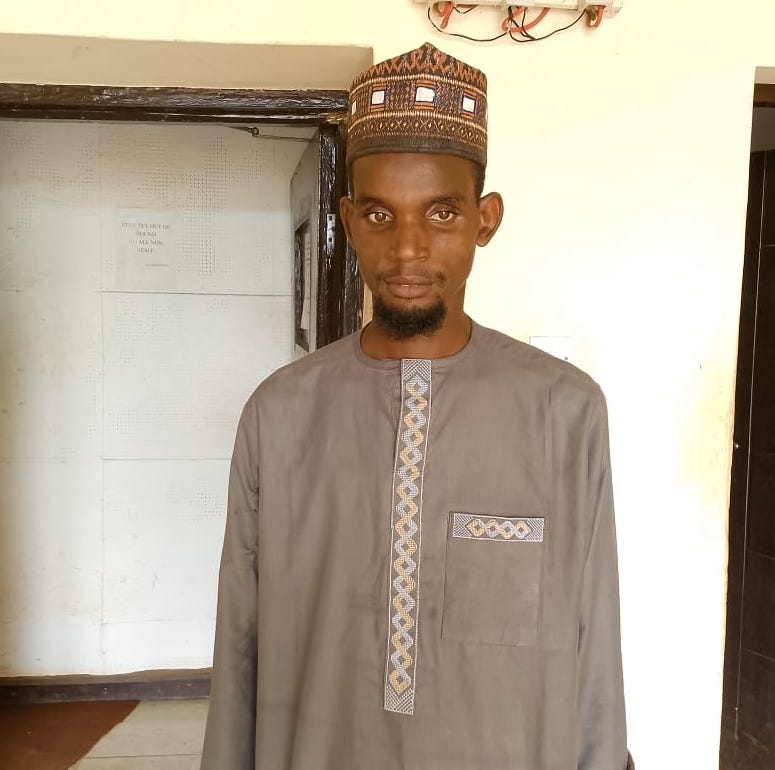
In northern Nigeria, disability has long been viewed as a one-way ticket to a life of begging. But Imrana Aminu Sifawa is rewriting that narrative through academic achievement.
When a child is born with a disability in northern Nigeria, tradition often dictates their future: they beg. It’s a grim expectation that has consigned countless individuals to a life of dependency rather than dignity.
But Imrana Aminu Sifawa refuses to be a statistic. Born completely blind in 2001 in Sifawa town, Bodinga Local Government Area, Sokoto State, this young man has spent his life shattering stereotypes and reaching academic heights that many sighted individuals never reach.
Imrana’s educational journey began at AA Raji Special School Sokoto, where he completed both primary and secondary education. But he didn’t stop there.
He later earned his National Certificate in Education (NCE) in Islamic Studies, with a specialisation in Special Education in Islam, from Shehu Shagari College of Education, Sokoto. Today, he is pursuing a degree in Islamic Studies at the same institution, affiliated with Usmanu Danfodiyo University, Sokoto (UDUS).
Recognising that the world is moving rapidly toward technology, Imrana earned a Diploma in Computer from Kebbi State School for Special Needs in Birnin Kebbi, where he mastered computer operation and networking.
“I have knowledge of operating computers,” Imrana declares with quiet confidence. “Even now, if you bring one to me, I will operate it. I understand its features, how it works, how letters are arranged, and how to type.”
Imrana’s intellectual pursuits extend beyond secular education. He has completely memorised the Holy Qur’an and studied Hadith extensively. His command of Islamic scholarship is evident when he quotes Imam Shafi’i: “Kulli yaumil zadal ilmi zadani ilmul bi jahali…” (Every day knowledge increases, and my knowledge of my ignorance increases…)
In Fiqh (Islamic jurisprudence), he has studied Mukhtasarul Khalil, Lawali, and Sani, among others.
What drives this remarkable young man? A deep-seated rejection of the fate society had planned for him.
“I grew up disinterested in begging, and I completely hate it,” Imrana states firmly.
His determination was fueled by his father’s unwavering support; his father, a retired civil servant, said that politicians and wealthy individuals never helped with his school fees.
Imrana’s path has been anything but smooth. He openly acknowledges the discrimination he has faced.
“The challenges are many, but to mention a few: discrimination,” he explains. “Whenever I set foot in education, some thought I could not do it. Some lecturers clearly hated me. Nevertheless, I endured, I resisted, and now I have attained it.”
He draws strength from the teachings of Ta’alimil Mutaalim: “Bijiddi la bi jiddi kulli muhataji…” (With effort, not with mere desire, every seeker achieves…)
Imrana is unequivocal in his message to people living with disabilities: shun begging, citing a powerful Hadith of the Prophet Muhammad (peace be upon him). He warns: “Anyone who engages in begging on the Day of Judgment will wake up without any flesh on his body; it is the sign of beggars.”
In another tradition, he notes that anyone who begs invites poverty through their own actions.
“Begging is not good,” Imrana insists. “Most of those who rely on begging have many cows and flocks of sheep, but they cannot leave it; they have become addicted.”
Rather than begging, Imrana advocates for entrepreneurship as a path to dignity and self-sufficiency.
When asked about his own source of income, he reveals: “Walima (ceremonial gatherings) is one of my sources of income. When people have occasions like marriages or naming ceremonies, they invite me to present and educate attendees, and I earn income through that.”
Imrana urges wealthy individuals to provide people with disabilities with capital for investments that enable them to pursue their dreams and become stable, contributing members of society.
Several other people like Imrana can do better but have yet to receive encouragement and support.
If our society truly wants to thrive, we must stop discriminating against people with disabilities. Instead, we must encourage them, integrate them, and support them in learning modern skills that will benefit them, their families, and society at large.
Imrana Aminu Sifawa’s story is not just about one man’s triumph over blindness; it’s a testament to the power of education, the strength of human will, and the urgent need to change society’s view of disability.
Imrana Aminu Sifawa’s message is clear: Disability is not a barrier. Begging is not a destiny. Education is the tool for success.