
In gun duel, Nigerian soldiers neutralise 3 gunmen
By Muhammad Sabiu
Nigerian soldiers working under the platform of Sector 5 of Exercise GOLDEN DAWN in Enugu have successfully neutralised three unknown gunmen who raided a police checkpoint on October 7.
This was announced today by Brigadier-General Onyema Nwachukwu, the Director of Army Public Relations, via the Nigeria Army’s official Facebook page.
The soldiers engaged the gunmen in a shootout which forced the latter to flee the duel scene, and the soldiers recovered one vehicle and two motorcycles.
However, Mr Onyema regrettably stated that one soldier lost his life.
The southeastern region has been seeing a series of tensions and rampant attacks on government facilities by suspected IPOB members, which could not be unconnected with their secession agenda.
IPOB and the myth of the rising sun
By Tahir Ibrahim Tahir (Talban Bauchi)
We went on a trip a while ago to Jama’are local government in Bauchi state for the turbaning ceremony of my cousin as the Ubandoman Jama’are. Jama’are is a 2-hour journey from the Bauchi metropolis. On our way there, we ran into a pothole, and we got a twisted tyre. After our event, we proceeded to Azare, another local government in Bauchi, a 30 minutes drive from Jama’are, hoping that we would get a tyre to replace our damaged one. We were directed from one shop to the other, and each time we arrived at any of the shops, we met them all locked up. We got the puzzling explanation that one of the shop owners lost his father and that he and all his brothers had gone for the burial. They meant that Igbos owned all the shops, and they were the only ones that sold the size of tyres we were looking for. We had to manage the twisted tyre all the way back to Bauchi because Chinedu’s uncle had died, and nobody else sold proper tyres in Azare, a whole local government, deep in the North East!
At Emab plaza in Abuja, I dare not step in to buy even a memory card, and my ‘customer’ NG, who is Igbo, would jokingly hound me for not telling her that I was coming to buy a phone! She was a shop attendant to her brother, who is a friend of mine. He had opened new outlets, and she became the CEO of the Emab division. I dare not buy what she sells from elsewhere. I’m off the hook and free to spend my money at any other shop, only if she doesn’t have what I’m looking for. My relationship with my Igbo friend’s shop is not less than 15 years old!
There’s a car service place at Wuse 2, on the famous Adetokumbo Ademola Crescent in Abuja. They usually get your tyres checked, balanced and aligned, and all that car check routine. An Igbo guy, Pat, hangs around there; when you have to get a new tyre, Pat is there, ready to get you all the brands, from Korea to Japan, China, France — you name it, and he’s got it. So Pat is the go-to guy even when I’m far away in Bauchi, and I need to get the accurate market prices of tyres from different brands. This is a ‘customership’ that has spanned over 15 years as well!
So goes with the guy at the Barbing Salon. Chike is about the nicest hairdo guy I have ever known. Courteous, cheerful, hardworking and good at his job. For the entire corona lockdown year, I left my clipper with him. Finally, a good one year after, I hop into town, and there is my clipper, safe and sound. It was serviced and polished, looking even newer than I left it. Chike’s courtesy leaves you scraping through your pockets to get something for him, aside from the shop’s charges. From working in his Oga’s shop, he had moved to his own place, with a few of the other barbers he worked it.
Igbos own an estimated 60% of land, property and businesses in Abuja. There is no denying them being industrious, hardworking and very enterprising. They are all over the country, handling numerous firms and bossing most of the trade they engage in. That is why it is super difficult to understand the meaning, purpose and direction of the Indigenous People of Biafra (IPOB). Biafra is all over Nigeria, and it is just silly to try to corner it to a cranny as small as Niger State! If you alienate yourself from Nigeria and create your own country, do you expect to keep all the businesses all over Nigeria and get patronage from Nigerians? Isn’t this a money-wise, pound foolish idea? The whole concept of self-determination and the attendant superiority complex is eating up the UK now – albeit they may not accept it publicly. It is the same trap that awaits Biafra, should it see the light of day.
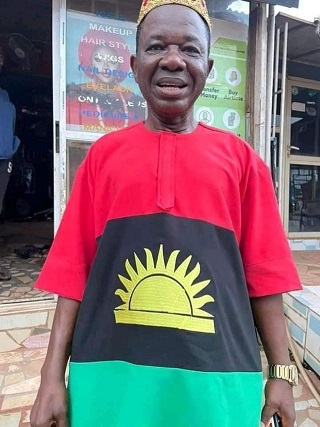
The Nigerian army recently rolled out Operation Still Water, an ember months programme, to maintain security during the festive period. It is a continuation of the previous operations such as Crocodile Smile, Python Dance, and so on. In the midst of it, popular actor Chiwetalu Agu was arrested at Upper Iweka Road, Onitsha, Anambra state, for inciting public members and soliciting support for IPOB. He was donning an IPOB attire when he was arrested. The army denied maltreating him, as was widely reported. A video surfaced later, which gave a snippet of what their interaction with him was like. He said that the Sun showing on his cloth was a rising Sun and that the colour combination was just coincidental and didn’t signify IPOB. He said he was educated enough to know where to go to and where not to go to. He squarely denied IPOB and said he had nothing to do with it. So many Igbos are coming out of their shells to deny IPOB and publicly give their activities a dressing down.
The Igbos we relate with every day are not the ones that IPOB represent, right? So the barbaric activities of the group need to be clamped down by the Igbos themselves. They must make it clear that the narrative of that movement is not theirs and is not in their own interest.
Joe Igbokwe’s house was razed in his hometown of Nnewi, Anambra state. Dr Chike Akunyili was killed in the Idemili North local government of Anambra state. A fire that seems to rage on from a distant neighbour’s residence clearly indicates that your own house is not insulated from the same kind of fire. A proverb in Hausa says, “If you see your neighbour’s beard in flames, you must hurry and rub your own with water.”
The tiny flame that started in Borno has spread like cancer to the entire North. South easterners should not allow this in their backyard. The earlier the Igbos rise against this so-called rising Sun, the better for us all. We have a risen Sun to be grateful for already. There is no need to go looking for more Sun. The heat would definitely be unbearable!
Tahir is Talban Bauchi can be contacted via talbanbauchi@yahoo.com.
Igbonomics in Northern Nigeria
By Ahmadu Shehu, PhD.
My previous article titled If there was Biafra generated debates around Biafra’s disadvantages (and advantages) to the Igbo people. Many of these comments were very insightful, and in line with the thoughts I presented. While I cannot respond to all the commentators, I will briefly address the most salient rejoinders. But, once again, let me quickly state that this conversation does not target the Igbo as an ethnic group. Instead, I aim to provide an outsider view to these pressing issues of national unity on which all Nigerians share equal rights and responsibilities to tell ourselves the home truth.
Some commentators say that the article was biased as I only focused on the disadvantages and neglected the “obvious” advantages the Igbo will gain from Biafra. However, I do not see a single demographic, economic, geographical or even political advantage the Igbo will gain by simply seceding from Nigeria. That is the thesis of the previous article. In fact, the post-exile writings of Odumegwu Ojukwu, the architect of Biafra himself, buttress this point.
The most critical observations from many prominent Igbo elites and friends claim that as much as the Igbo people enjoy Nigeria’s unity from both economic and political perspectives, we should equally be thankful to the southeasterners for the jobs they create for other Nigerians. In other words, the Nigerian market saturated by Igbo traders is also lucky to have the Igbo money as capital for the employment of other Nigerians.
Well, this claim might seem valid at face value. Still, it may not be entirely accurate when Igbonomics – a term I use here to refer to the economic strategy of the Igbo people – is subjected to a critical view. In the said article, I noted that one of the weaknesses of the southeastern economic model is that it is closed to other Nigerians. The resentment the Igbo folks have against the majority of Nigerians do not allow “strangers” from any region of the country to freely establish or run businesses in Igboland. That is why most Igbo billionaires today were made one hundred per cent in and by other regions of this country, but not the other way round. There is hardly a non-Igbo billionaire made by or in the southeast.
This xenophobia is not only applied against the Hausa-Fulani northerners or the Yoruba south-westerns but also their closest cousins, the Niger-Deltans. This approach is based on three exclusionist strategies of Igbonomics: First, the market and product, and indeed the value-chain must strictly remain an Igbo affair. Second, other regions’ markets, their products and value-chains must be proportionately shared with the Igbos. Third, to drift public attention from this ongoing reality, maintain the victim card by crying louder than the bereaved – the real victims of marginalization. While the first two tenets are lawful but greedy, the third is a clear case of hypocrisy. Here is a simple example to foreground this scenario.
The Igbo form the largest group of Nigerians in the diaspora. Since Nigeria is an import economy, the Igbo people in diaspora serve as business agents for their brethren in Nigeria. Therefore, the import business is basically an Igbo – Igbo transaction. Here in Nigeria, these goods are transported mainly to the southeastern markets, such as Abba and Onitsha. Instead of Lagos or Port Harcourt, most Igbo traders, who are widely dispersed across the nooks and crannies of this country, buy their goods mostly from Igbo distributors in the southeast. Another Igbo – Igbo transaction.
Up here in the north and other parts of the country, the Igbo employ strictly Igbo artisans, mostly from their own villages or communities in the east, and in some cases, the so-called northern Igbos. From sales girls and boys to messengers, marketers and suppliers, the Igbos domiciled in the north only trust their own ethnic brothers regardless of the opportunities employing locals might portend to their businesses.
For instance, you find a single Igbo shop owner in a village. By the following year, s/he has brought two, three or four Igbo artisans, thereby growing in population, manipulating the resources and seizing the business opportunities further away from the local people.
In most cases, the deal is that a separate business in the same line is established for the younger artisan, expanding further the grip of the Igbos in that line of business in the communities they are domiciled. Thus, the profits, gains and resources of the business in any of these communities become an Igbo affair entirely. Therefore, in this arrangement, the Igbo create jobs primarily for themselves while other sections of Nigeria serve as their consumers.
While the Igbos living in the north own properties and investments in the region, they return their proceeds to their homelands. Thus, I can bet my last penny that Igboland has more properties and investments built from profits and wealth acquired outside the Igboland than those made from the businesses run within the Igboland. Moreover, I had said earlier that businesses domiciled in the southeast largely depend on the larger Nigerian market to thrive.
Therefore, it should be clear from the foregoing that Igbonomics in the north is an Igbo economic affair that largely – if not only – benefits the Igbos. The brutal truth is that the Igbo are NOT marginalized in Nigeria. Instead, they are playing a victim card to maintain the economic status quo. While the various sections of this great country have a lot to thank one another for, none of these sections should claim any superiority. Neither should any of these play a gimmick of marginalization. We are equals in the hands of God and our country.
Dr Ahmadu Shehu is a nomad cum herdsman, an Assistant Professor at the American University of Nigeria, Yola, and is passionate about the Nigerian project. You can reach him via ahmadsheehu@yahoo.com.

Celebrating Governor Bala Mohammed at 63
By Sulaiman Maijama’a
What aspect of life deserves celebration, and what parameters do people use in deciding whose life is worthy of celebration? Becoming a celebrity? No! Obtaining a university degree? No! Getting married? No! Accumulating wealth? No! To give you a clue, who cares to celebrate a person whose life has no impact on their fellow beings? Only people of thought who see beyond the surface; whose life is inspiring and motivating; whose track record speaks volumes, deserve this celebration!
It is not how much but how good. Not the quantity but the quality. It was, however, narrated in an authentic tradition, our beloved Prophet (peace be upon him) said that “the best of human beings is the one whose life is elongated and his deeds are good, and the worst, on the other hand, is the one who is privileged to live long, but his works are bad.”
Governor Bala Mohammed of Bauchi State has had a good fortune to join the cadre of the chosen few, spared to witness sixty-three (63) years of existence on earth and, most importantly, serving humanity throughout the journey. This is, coincidently, coming few days after the Federation of Nigeria celebrated her 61st independence anniversary.
Born on October 5th, 1958 in Duguri to the royal family of the District Head of Duguri in Alkaleri Local Government Area of Bauchi State, little Bala Mohammed, as it is with tradition in Northern Nigeria, was enrolled in Qur’anic school where he was well trained, given strictly regimented orientation germane to Islam, in order to toughen him up to face the realities of life early. He, after that, had his primary education in Alkaleri from 1965 to 1971 and started his secondary school from 1972 to 1976.
Coming from a Royal Family, Bala Mohammed began to exhibit leadership traits in his teenage age by being so dutiful to his elderly, generous to people, and affectionate to younger ones. His selflessness in serving humanity, devotion to duty and sense of humour made him beloved to his family, friends and all people, thereby making him attractive like a magnet, and his name echoing in their village.
In 1979, Bala Mohammed went to the famous University of Maiduguri and obtained his First Degree, graduating with BA in English in 1982. Upon graduation, in 1983, he worked as a journalist with The Democrat as a reporter and later News Agency of Nigeria (NAN). After that, he rose to the pinnacle of journalism as the editor of The Mirage Newspaper.
Mohammed later quit journalism and joined the civil service as an administrative officer from 1984 to 2000. He bowed out of public service as Director of Administration in the Nigerian Meteorological Agency. He then took a Political Appointment as a Senior Special Assistant to Governor Isa Yuguda from 2000 to 2005. He was also Director of Administration at the Nigerian Railway Corporation from 2005 to 2007.
Bala Mohammed ventured into partisan politics in 2007 when he was elected to the Senate representing Bauchi South Senatorial District under the All Nigeria People’s Party (ANPP). As a lawmaker, he was among the pre-eminently vibrant members who stood firm to ensuring that positive policies and programmes were made in the interest of their constituents.
In 2010, Senator Bala Mohammed put party politics aside for the country’s interest and moved the “Doctrine of Necessity” motion on the floor of the Senate, which gave way for the then Vice-President Goodluck Ebele Jonathan to emerge as Acting President. Bala then was a senator under a defunct All Nigerian People’s Party (ANPP), but he stood for Jonathan, who was in the People’s Democratic Party (PDP). Consequently, President Goodluck Jonathan appointed him minister of the Federal Capital Territory (FCT), despite being a member of the ANPP.
As FCT Minister, Bala Mohammed brought extensive reforms to the FCT. He sanitized the land administration of the FCT and expanded the airport roads of Abuja. He built many roads, including the Kubwa expressway expansion. He also built the rail track from Abuja to Kaduna and Idu rail station from the $500m loan that the Nigerian government secured from China. In addition, he introduced the land swap policy that used the land as a resource to fast track infrastructural development in the FCT.
In 2018 Senator Bala Mohammed emerged as the Peoples Democratic Party governorship candidate for Bauchi State and was elected as the governor in 2019.
Ever since he came on board as the Executive Governor of Bauchi State, the state has been undergoing an extraordinary and unprecedented metamorphosis in infrastructural development, health, education, agriculture, among other sectors.
In the area of infrastructure, Bauchi State has witnessed what could have taken others long to complete within the two years of Bala Mohammed’s led administration. The governor has completed over twenty (20) road projects with an aggregate of 286.7 kilometres long. This excludes the recently awarded massive projects across the state. Today, Bauchi State is a gleaming new city with roads and 12-hour uninterrupted streetlights.
Beyond constructing roads, the governor has procured 251 vehicles and 1000 Keke Napep through Kaura Economic Empowerment Project. This has greatly impacted positively on the transportation industry in the state.
As the saying goes, “health is wealth” Senator Bala has renovated 126 primary health care centres in less than two years, constructed 12 new world-class hospitals and a primary health care centre in Dorawar Dillalai, Bauchi. Additionally, many general hospitals across six local government areas are currently under renovation. The governor also actualized a Molecular Laboratory in the State for testing of COVID-19, Lassa fever, Yellow fever and other hemorrhagic diseases.
In Education, Governor Bala Mohammed, in less than two years, has constructed over 270 new classrooms and renovated over 405 across the state. In addition, these projects were expanded into hard-to-reach areas of the state to ensure that quality education isn’t the prerogative of only urban dwellers.
On the other hand, in July 2020, under the leadership of Governor Bala Mohammed, Bauchi State became the first and only state in the North-Eastern region of Nigeria to domesticate the VAPP Act since it was enacted. The VAPP Act is the single law that transcends the criminal and penal code in guaranteeing justice and protecting the rights and properties of victims of sexual and gender-based violence across the country.
Please show me your Governor; here is mine! Dear my Governor, do not relent, do not give up and do not listen to predators and political gladiators who do not mean well for our state, whose aim is to distract you from taking the state forward. The sky is not your limit; even the orbit is limitless.
Fatan alkhairi, Allah Ya qara tsawon kwana da rayuwa mai albarka, ameen.
Self-styled investigative journalist Hundeyin under fire over anti-Arewa tweet
By Muhammad Sabiu
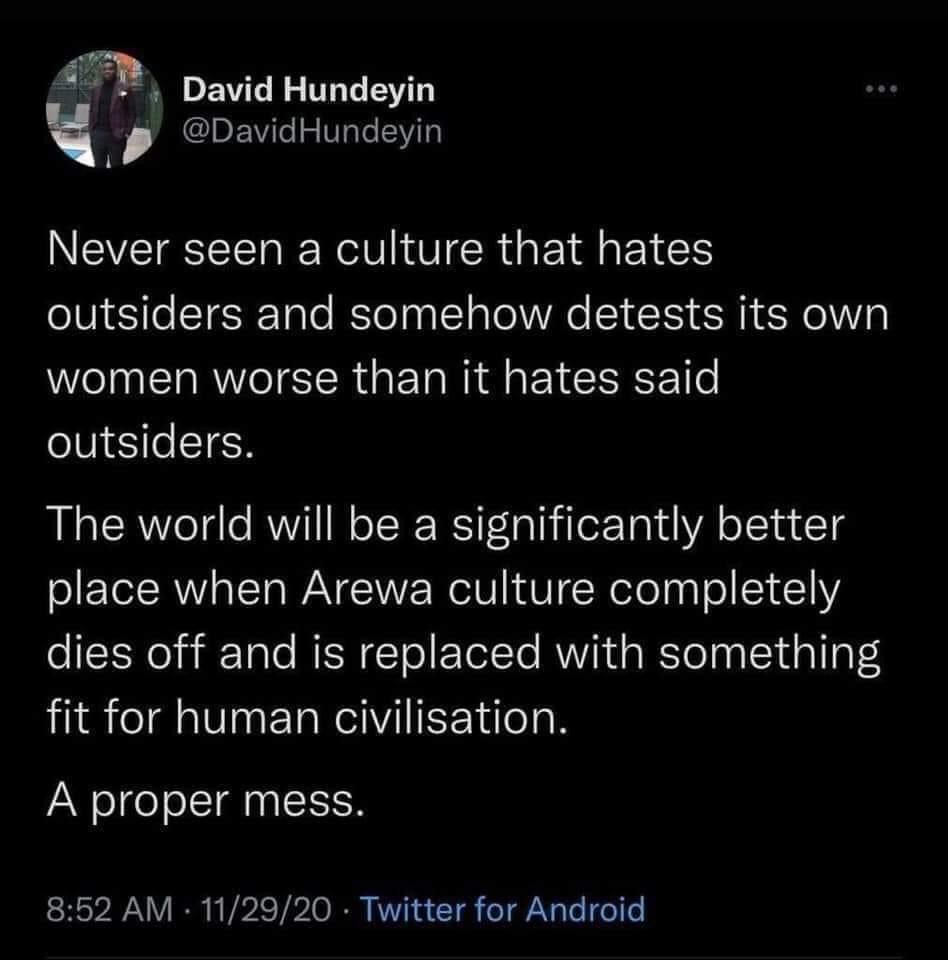
David Hundeyin, a self-styled investigative journalist who has in recent months become popular on social media, has come under fire over his about-a-year-old tweet condemning “Arewa” and its culture.
According to Mr. Hundeyin, the world would be a better place to live in without the “uncivilised” Arewa culture because he has“[n]ever seen a culture that hates outsiders and somehow detests its own women worse than it hates [the] said outsiders.”
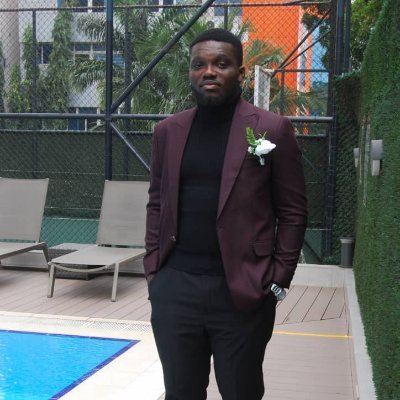
“The world will be a significantly better place when Arewa culture completely dies off and is replaced with something fit for human civilisation,” he added.
The digging up of the tweet could not be unconnected with a recent, viral, controversial article he wrote titled “Cornflakes for Jihad: The Boko Haram Origin Story”, in which he tried to give the history of Boko Haram in Nigeria and presented what many described as “conspiracy theories” and “hasty conclusions.”
Airing their grievances against Mr. Hundeyin’s derogatory tweet, many Facebook users from the North took the issue to their timelines.
For instance, Dr. Ahmad Shehu suggested that legal action should be taken against people making such negative stereotyping.
“The north should make an example of these idiots. I hate it when we seem passive against these kinds of bigots. I enjoin our legal activists to take these kinds of people to court for stereotyping,”Dr. Shehu wrote.
Similarly, another user, who goes by the name Abubakar Sulaiman, sees him as somebody with a dangerous mindset. “The question that crosses my mind is simply why do they hate us? This is the dangerous kind of mindset David Hundeyin and his ilks use to delve into archives.
“So what was made to look like an investigative journalistic endeavour by the likes of David Hundeyin was simply a pre-conceived idea supported by witty though foolish biased selection of data while ignoring a significant portion of related data that may contradict that pre-conceived idea. A clear case of cherry picking,” he said.
Also, according to Adam Baba Yamani, Hundeyin is nothing but a bigot and hater of anything that has to do with the North and Muslims.
He wrote,“Hello my people of the North (Arewa), if you think David Hundeyin is not a bigot and a hater of anything North and Muslims, take your time and glance at what he wrote on his Twitter handle, don’t be deceived by the cloak of journalism he is wearing, his intent is to replace you, your culture and Way of life with the one of his choice, for those among us that are applauding David Hundeyin for his “Conflakes..”, please read, research and cogitate.”
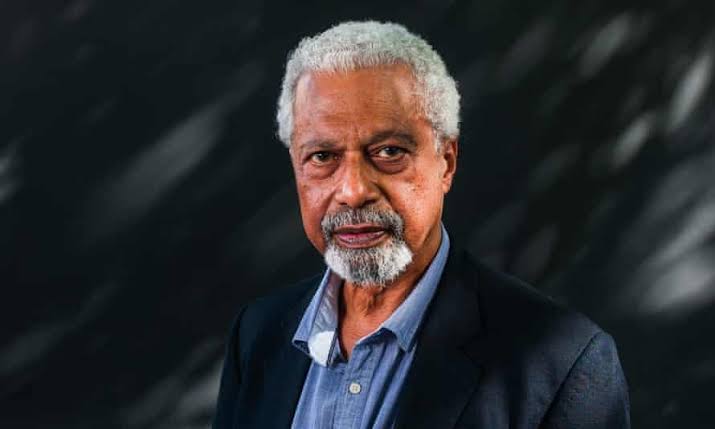
Former colleagues, students from Bayero University, Kano congratulate Abdulrazak Gurnah for wining the 2021 Nobel prize in Literature
Colleagues and former students of Abdulrazak Gurnah, from the Department of English and Literary Studies, Bayero University, Kano, congratulate him, as he emerged this year’s winner of the prestigious Nobel prize in Literature.
According to one of his former students, Ibrahim Garba, “we already foresaw than in him, since the 1980s when he taught us in the department, here in Bayero University, Kano, Nigeria. He deserves it. Gurnah has always been enthusiastic about Literature and today he attained the highest and most popular status. Congratulation sir”, he said. He added that “Bayero University, Kano would be equally happy and part of this achievement, as a place where Gurnah worked and served diligently.
According to the Guardian Newspaper, UK, the “Tanzanian novelist is named laureate for ‘uncompromising and compassionate penetration of the effects of colonialism’
The Nobel prize in literature has been awarded to the novelist Abdulrazak Gurnah, for his “uncompromising and compassionate penetration of the effects of colonialism and the fate of the refugee in the gulf between cultures and continents”.
Gurnah, who grew up on one of the islands of Zanzibar and arrived in England as a refugee in the 1960s, has published 10 novels as well as a number of short stories. Anders Olsson, chair of the Nobel committee, said that the Tanzanian writer’s novels, from his debut Memory of Departure, about a failed uprising, to his most recent, the “magnificent”, Afterlives, “recoil from stereotypical descriptions and open our gaze to a culturally diversified East Africa unfamiliar to many in other parts of the world”.
No black African writer has won the prize since Wole Soyinka in 1986. Gurnah is the first Tanzanian writer to win.
Gurnah’s fourth novel, Paradise, was shortlisted for the Booker Prize in 1994. Olsson said that it “has obvious reference to Joseph Conrad in its portrayal of the innocent young hero Yusuf’s journey to the heart of darkness”, but is also a coming of age tale, and a sad love story.
As a writer, Gurnah “has consistently and with great compassion penetrated the effects of colonialism in East Africa, and its effects on the lives of uprooted and migrating individuals”, Olsson told gathered journalists in Stockholm.
Gurnah was in the kitchen when he was informed of his win, said Olsson, and the committee had “a long and very positive” conversation with him.
Gurnah’s most recent novel Afterlives tells of Ilyas, who was stolen from his parents by German colonial troops as a boy and returns to his village after years fighting in a war against his own people. It was described in the Guardian as “a compelling novel, one that gathers close all those who were meant to be forgotten, and refuses their erasure”.
“In Gurnah’s literary universe, everything is shifting – memories, names, identities. This is probably because his project cannot reach completion in any definitive sense,” said Olsson. “An unending exploration driven by intellectual passion is present in all his books, and equally prominent now, in Afterlives, as when he began writing as a 21-year-old refugee.”
Afterlives by Abdulrazak Gurnah review – living through colonialism
Worth 10m Swedish krona (£840,000), the Nobel prize for literature goes to the writer deemed to be, in the words of Alfred Nobel’s will, “the person who shall have produced in the field of literature the most outstanding work in an ideal direction”. Winners have ranged from Bob Dylan, cited for “having created new poetic expressions within the great American song tradition”, to Kazuo Ishiguro “who, in novels of great emotional force, has uncovered the abyss beneath our illusory sense of connection with the world”.According to Ellen Mattson, who sits on the Swedish Academy and the Nobel committee: “Literary merit. That’s the only thing that counts.”
The Nobel winner is chosen by the 18 members of the Swedish Academy – an august and mysterious organisation that has made efforts to become more transparent after it was hit by a sexual abuse and financial misconduct scandal in 2017. Last year’s prize went to the American poet Louise Glück – an uncontroversial choice after the uproar provoked by the Austrian writer Peter Handke’s win in 2019. Handke had denied the Srebrenica genocide and attended the funeral of war criminal Slobodan Milošević.
The Nobel prize for literature has been awarded 118 times. Just 16 of the awards have gone to women, seven of those in the 21st century. In 2019, the Swedish academy promised the award would become less “male-oriented” and “Eurocentric”, but proceeded to give its next two prizes to two Europeans, Handke and Polish writer Olga Tokarczuk.”
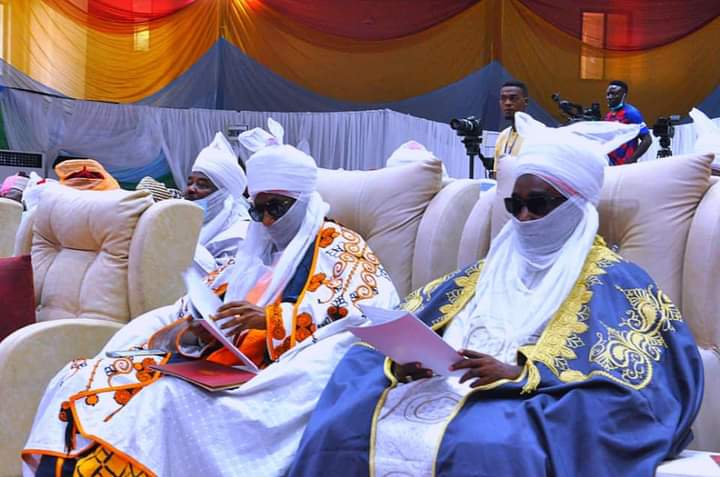
Namadi Sambo, Khalifa Sanusi, others, attend Emir of Zazzau anniversary lecture
By Sumayyah Auwal Ishaq
Former Vice President, Arch. Namadi Sambo, Khalifa Muhammadu Sanusi II, the Deputy Governor of Kaduna State, Dr Hadiza Sabuwa, representing Governor Nasir El-Rufai among other dignitaries, are attending a public lecture in celebration of the one-year anniversary in office of HRH Ambassador Ahmed Nuhu Bamalli, the 19th Emir of Zazzau at Yaradua Hall, Murtala Square, Kaduna.
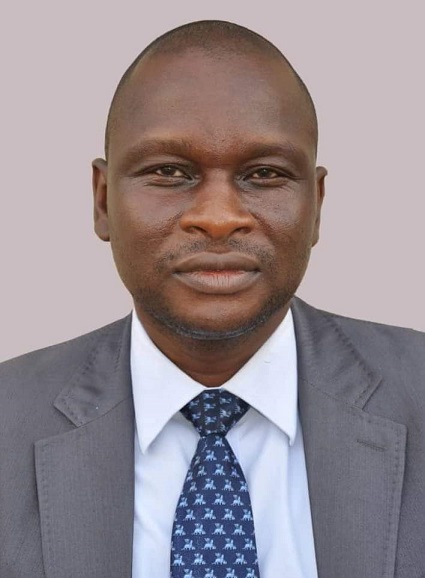
Nigeria at 61: A giant with challenging crises amid opportunities
By Terhemba Wuam, PhD
As Nigeria marks its 61st anniversary of independence, its citizens are stuck in general anomie of despondency. This is due to general insecurity in the country, rising unemployment and high cost of living.
It is also an age of anxiety, with many measures of Nigeria’s socio-economic progress painting a picture of a nation in great distress. Nigeria’s economy has been stagnant, growing at less than 1% cumulatively during the past six years, far below population growth of 2.6%. It also has about 40% of the population of about 200 million living below the poverty line.
The country is equally beset by security and political challenges. Boko Haram insurgents still operate in the North-East. In the North-West, bandits are overwhelming the security forces. In North-Central Nigeria, deadly clashes between farmers and herders continue. And separatist and irredentist agitations resonate in the South-East and the South-West of the country.
Despite these problems, Nigeria has made substantial socio-economic progress, at least since 1999 when it returned to democracy after decades of military rule. It is also a country with huge resources that have yet to be fully tapped. The biggest of these is Nigeria’s educated citizens. The country had a literate population of less than 5% at independence. Now, more than 60% of the population is literate. Also, enrolment into tertiary education keeps increasing.
The past 60 years
A review of the past six decades shows that the Fourth Republic, which took off in 1999, has been Nigeria’s golden era in terms of economic and social indicators. This reality is, however, a difficult one to present to the millions of unemployed who are out of work and struggling to cope with inflationary pressures on food and other basic livelihood requirements.
Since 1999, Nigeria’s economy has grown more than sevenfold. A big chunk of this is explained by the rebasing of the economy in 2014. It was found that the economy was 60% bigger than previous estimates.
Before 2014, Nigeria had been using the 1990 prices and the composition of the economy to determine its size. Yet, a lot had changed since then. For example, telecommunications had grown substantially with the introduction of mobile telephony. Nollywood, Nigeria’s movie industry, has also expanded and morphed into a more professionally organised and run sector.
Nigeria moved from lower-income to lower-middle-income status, based on national income per head of population, during the Fourth Republic. That’s based on World Bank rankings. Other countries in this category include Algeria, Egypt, Kenya, Tunisia, India, Iran and Ukraine.
Economic difficulties
Nigeria’s economic difficulties started in the mid-2010s. Nigeria’s economic fortunes are closely aligned with oil prices which showed a sharp decline between 2014 and 2016.
The World Bank has described the 70% drop during that period as one of the three biggest declines since World War II, and the longest lasting since the supply-driven collapse of 1986.
In response, Nigeria’s economy, which had recorded an average growth rate of 6.68% between 1999 and 2015, has plunged in and out of negative figures since 2016. Within this period, it entered recession twice. Cumulative growth since 2016 has averaged below 1%.
Nigeria has taken steps to reduce its reliance on oil. These measures include the revival of the agricultural sector as well as reducing government reliance on oil revenues by tax revenue from other sources. These have yet to pay off. And the COVID-19 pandemic has aggravated the economic downturn, plunging more people into unemployment and poverty.
Nigeria’s government has invested in agriculture and has articulated economic programmes for other sectors, progress has been hampered by inflationary pressures, low oil prices and a weak currency. The government’s inability to arrest the security crises in several states has also affected agricultural productivity. Other factors include the government’s inability to articulate a clear economic agenda for the country. In addition, its monetary and fiscal policies favouring dual exchange rates, and restrictions on foreign trade through border closures have limited recovery and growth.
A national call to action
Nigeria requires a national leadership with the understanding and capability to set the tone and direction for national growth and development. This must incorporate all citizens, irrespective of ethnic or geopolitical affiliations in a grand vision of collective dynamic growth.
A lack of such political leadership denies the country the possibility of meaningful growth and critical citizenry.
Nigeria remains a country of great potential. Her fountain of possibilities can be found in its growing population of educated citizens. The population of the educated at this very moment in the country’s history is at the threshold or point of national acceleration. An example is the country’s burgeoning tech ecosystem largely driven by young people. It is at a point conterminous with those of the Asian Tigers before their rapid transformation to the developed world and high-income status.
All the fundamentals are indicative of a country at the point of a great leap forward, the role of an enlightened and well-educated population is crucial to that process.
Despite limitations in the education sector, Nigeria has more than 190 universities, the largest university and tertiary education sector in Africa. The country churns out millions of graduates annually, creating the most educated workforce on the continent.
This growth represents both a challenge and an opportunity. It will be a challenge and a huge economic burden if productive opportunities are not found for their engagement. Gainfully employed, these educated millions can be harnessed to drive Nigeria’s economic growth, thus promoting social stability.
Political leadership
Nigeria challenge is not that its political leadership has been corrupt, but that it has had limited ability to govern the country effectively. Nigeria needs a modern political administration where the state is not about maintenance of the status quo and the mere allocation of existing economic values for project and self-aggrandisement.
The state should be reoriented and directed purposely towards a more expansive interpretation with a focus on rapid economic growth and the provision of public goods that empower citizens to become meaningful actors in the overall positive transformation of their society.
Such purposeful action by the national leadership, who must be clearly reformist, is required to alter the trajectory of poor economic growth. It is also required to foster sustained productivity gains in the country’s economy to generate growth to average 6%-10% annually. Such growth is what will enable Nigeria to triple and possibly quadruple its economy within the next 10-15 years in a repeat of the first 20 years of the Fourth Republic.
Inevitably, a growing economy represents the best pathway toward addressing many of the social and economic challenges Nigeria now faces in its seventh decade of independence.
Dr Terhemba Wuam can be reached via terhembawuam@yahoo.com.
BUK student abducted in Kano
By Muhammad Sabiu
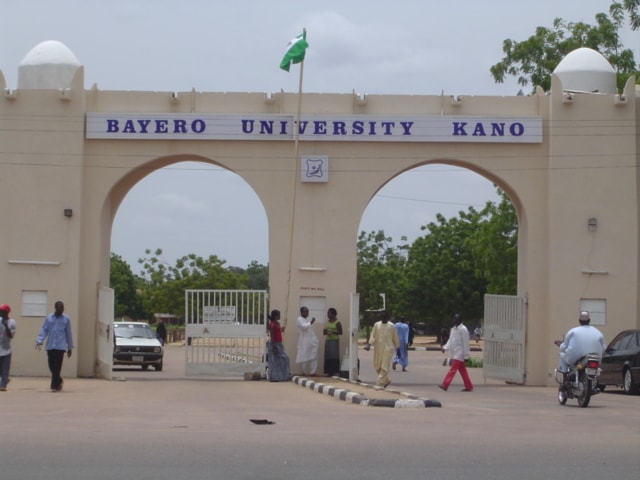
A 23-year-old female student of Bayero University Kano (BUK) has on Tuesday afternoon been abducted around the Rijiyar Zaƙi area in Kano State.
The student identified as Sakina Bello is a botany student at the university.
Hours after the abduction, reports have it that the kidnappers of Sakina have demanded N100 million ransom from her family.
A source, who is in the know of the incident, was quoted by an online newspaper as saying, “She left home around 3 pm on Tuesday and could not come back until this moment. She was supposed to go to Janbulo from our house in Rjiyar Zaki.
“They called her elder brother around 9 pm and informed him that she was in their den and that they would call back on Wednesday. And the next they do is to demand N100million ransom,” the source added.
Unlike Zamfara, Sokoto, Katsina and other terrorised northwestern states, kidnappings and killings are not incessant in Kano.
That essay, Cornflakes for Jihad!😃
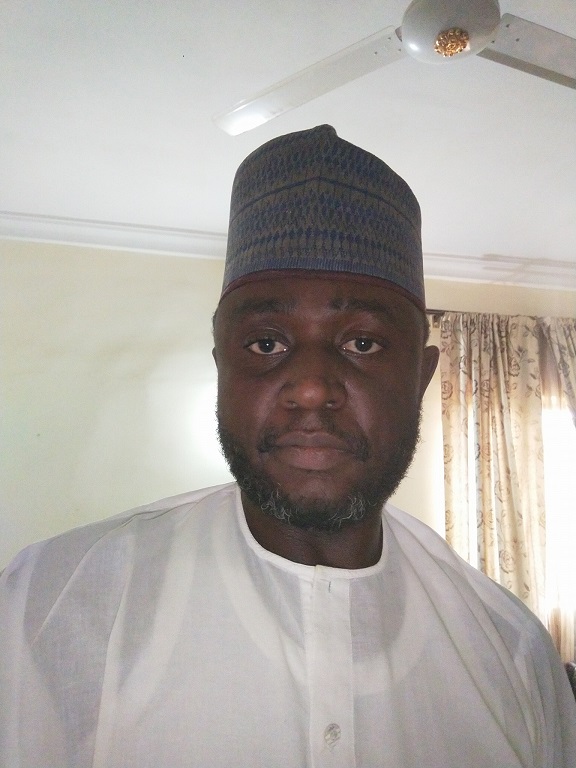
By Ibrahim A. Waziri
To most non-Muslims researching and writing about Boko Haram, the problem generally begins with Muslims and Islam in Northern Nigeria and, to some degree, across the globe.
To them, BokoHaram is synonymous with the issues of ontology and epistemology of Islam. That is why their narrative of it can encircle Shehu Dan Fodio, Late Sheikh Mahmud Gumi or even Ahmadu Bello Sardauna, the Premiere of Northern Region, during Nigeria’s first republic. They also do find its bits of ideological nuggets in the earliest of the Islamic literature!
But to most Muslims or their sympathisers, Boko Haram is a persistent story of fringe, rebellious elements among the larger Muslim population across history. These elements are primarily rigid and resistant to any contemporary interpretation of the Islamic canons, which goes with the present circumstances and gives maximum peace, harmony and cooperation among Muslims; and between them and non-Muslims.
The non-Muslim researchers generally point to Islam as the source of the problem. The Muslims point at Khawarijism (rebellion) against any Muslim broad social consensus (like Nigeria as it is presently constituted), at a particular point, as the problem.
The non-Muslims argue that the problem is profoundly historical. So they travel back the archives and exhume positions, at one time, of individuals, such as Sheikh Daurawa, Sheikh Gumi, Sheikh Dahiru Bauchi, Sheikh Auwal Albani, Sheikh Jaafar Mahmud, etc., to drive home their points.
While the Muslims are inclined to reject such a notion, arguing that social consensus is a transitional thing by nature, and Muslims embody the concept of Transition Personalities most. [Transition person as a concept is sufficiently delineated by Stephen Covey, in his, The Seven Habit of Effective People].
That, it is embedded in Muslims traditions and part of their essential social jurisprudence, that what is a norm today may not necessarily be the norm tomorrow. And that, the internal problem of the Muslim communities are those fringe elements who do not reflect the power of transition and acknowledge the value of consensus building, with new variables that new situations always present.
The very recent article by a certain David Hundeyin making waves through social media, Cornflakes for Jihad, also reflects the usual sentiments identified with many non-Muslims types of research about BokoHaram.
Apart from the basic factual errors it contains – which Abdulbasit Kassim diligently pointed out – it also concluded with logic barren childish conspiratorial arguments that send us millennia backwards in our struggle searching for the appropriate problem definition, analysis and solution recommendations on the issues of BokoHaram.
Contrary to the essay’s claims against Ahmed Idris Nasiruddeen (NASCO), Nasiruddeen has lived a life of a pious Muslim who was using his wealth to help Muslim friends, associates and organisations.
Of course, as any other friend or associate one might have helped, they too are naturally transitioning personalities (not necessary in the positive sense) living in a transitional world. One can help a person or an organisation, for a specific general reason or objective, only later in life for them to shift their objectives, metamorphosing into something different.
The fact that the NASCO conglomerate was once allegedly accused of financing terrorism (by whoever) does not mean it intentionally did that. Likewise, Sheikh Yakubu Musa was once allegedly accused of funding terrorism (by whoever) does not mean he is guilty.
Until we begin to look at the ontology and epistemology of issues around BokoHaram in this kind of light, our analysis about it will always leave undesired dangerous results born of misdiagnosis. We may begin to indict people like Alhaji Aliko Dangote and Abdussamad Isiyak Rabiu (BUA) because we are likely to find that the Imams, Mosques or organisations now or in the future they have once helped are enmeshed in terror wave of related accusations. Then we will begin to write warped essays like Cement or Sugar for Jihad.
Writing informed public commentaries or being a sound public intellectual is beyond the ability to flawlessly and flowerily write essays, making endless references to a large swathe of literature and records. No. It requires multidisciplinary insights, a great deal of patriotism, a deep sense of intuitive social measurement, appreciation of people and cultures from both etic and emic perspectives, history, and sound ability in social system projections.
Indeed, one cannot have a Nigeria of great value today or in future if they have a large heart sufficient enough to accommodate Ahmadu Bello, Sheikh Gumi, President Buhari, BokoHaram founder, Muhammad Yusuf and Abubakar Shekau, lumping them as the same people, who worked or are working, to turn Nigeria into an absolutely imaginary Islamic state.
Ibrahim A. Waziri writes from Zaria, Kaduna.