

PWI at 6: A Northern Nigerian Literary Voyage
By Shehu Mubarak Sulaiman
“I believe that the best learning process of any kind of craft is to look at the works of others” – Wole Soyinka
About a month ago, I woke up to a message on my Facebook Messenger. I was perplexed as to why a message would come in that early. It was dawn, and the skies had not brightened significantly enough for the layman’s morning to be declared.
The sender was someone who had once informed me of his interest in poetry. He had slid into my inbox a couple of months ago, and had registered his love for my writings, after which he requested that I mentored him.
Without wasting much time, I had introduced him to Poetic Wednesdays Initiative and urged him to follow-up on their activities. I had also introduced him to similar platforms, like the Poets in Nigeria Initiative Facebook Group.
A week later, I sent him a flyer for a forthcoming workshop and asked him to register. The workshop was organized by Poetic Wednesdays Initiative, and was to be facilitated by top-notch poets: Umar Abubakar Sidi and Dr. Ismail Bala. To cut the long story short and hit the nail on the head, Abdul-Rahman Jafaru Wali, a medical student of Ahmadu Bello University, Zaria was the person in my inbox.
He had messaged me that early to inform me of his emergence as one of the ten winners of the recently-concluded “The Nigeria I See” poetry competition organized by MOP (Movement of the People). His feat had come just about a month after he had registered for a workshop organized by Poetic Wednesdays Initiative.
That is a practical portrayal of how much of a platform Poetic Wednesdays Initiative is, one does not come and leave empty-handed.
For three years now, I have been approached consistently by people slightly younger or even older than I am. Their solicitation has over the years lost every element of surprise. Whenever I receive a message from a stranger on Facebook, half of the time, it’s about poetry writing or writing pertaining to other genres of literature.
The question had always been the same from all of these people. They keep asking: “How can I learn poetry?” This is such a difficult question to answer, as there is a never-ending debate about whether poetry writing is an innate or a learnt skill.
Regardless, I refer back to Wole Soyinka’s quote about learning the craft of writing; how it relies heavily on imitation, and Poetic Wednesdays Initiative had always been my first recommendation for them.
First, if the advances are offline, I will ask them if they have a Facebook account. And if they answer in the affirmative, I’d urge them to like the page, and submit poems of any quality every Wednesday of the week. Over the years, I have lost count of people I had introduced to this platform. Some of them have now grown to become a significant fraction of the finest writers that we have around.
The journey of these wonderful poets and wannabe poets reminds me of my own journey. I had started just like them, a newbie, and a sprouting seed. In the concluding months of the year 2016, I had grown tired of talking about my dream of becoming a writer. The more I talked about it, the more I felt like a fraud, my impostor syndrome was becoming more and more intense that I had contemplated giving up writing altogether.
I was at the crossroads, one road led to an Eldorado of a life I had always made up in my head; the fantasies of what a celebrated writer’s life seems, and the other led to a path of giving up, a one-way route to despair.
Being a science student was more than enough deterrent already. I talked to a friend who had graduated from the university a year before me and who I believe had more life experience than I. He spoke of his friend called Salim Yunusa, who has founded this small literary platform that aims at nurturing young talents in literary-inclined endeavors.
I talked to Salim Yunusa and he introduced me to a platform called Poetic Wednesdays, that was before it became Poetic Wednesdays Initiative. It was the newly-founded platform of his. I had written a couple of poems before then, but I had posted none, they were all in my phone’s notepad, longing to be seen.
So, all I did was waited for that fateful Wednesday before making my entry. My poem was handpicked and afterwards posted on the page. I followed the poem up, and relished some of the praise-coated comments. That was my first official encounter with poem writing.
As time went by, submissions from me became more and more regular. I enjoyed every bit of it; the praise, the feeling of having written something someone else enjoyed reading. Amidst all that nursing school monotony, consistent memorization, and voracious reading to stay afloat, I found an escape.
I had started to look forward to every Wednesday, it felt refreshing reading through poems on the page, and sometimes using them as a blueprint to craft mine. I started to make friends online, Facebook transfigured from a place where I come to catch up on viral gossip, or post pictures, to a place where I have direct contact with intellectuals and like minds. My time online started to become more of an educative endeavor rather than a fun-seeking one.
Weeks passed by and I had started to play with different themes, I had become a favorite on the platform. People looked forward to every Wednesday, so they could catch a glimpse of my poem and savor all its flavors. I had copied styles of poets like Maryam Gatawa, Salim Yunusa, Sani Ammani, Nasiba Babale, and a host of others, before I had come to find my feet.
In 2018, there was a literary hangout somewhere in Ahmadu Bello University, Zaria organized by this selfless platform. We dined, and recited poems for the relish of fellow poets and literature lovers present. We had a swell time. In 2019, I rendered my masterpiece titled “I AM NORTH” at one of Poetic Wednesday Initiative’s get-together at Kongo Campus, Ahmadu Bello University, Zaria.
It is the reception it received that had led me to promoting it on different platforms. The video of the poem was played at the 2020 edition of the Nigerian Students Poetry Prize event that held in Lagos. The written form of the poem was published on Daily Trust Newspapers, Yasmin El-Rufai Foundation official website, and other notable platforms in Nigeria.
The creatively titled essay of Sa’id Sa’ad “Poetifying the North” is not a coincidence. I particularly love the witty coinage of the word ‘Poetifying’. Indeed, the North has been ‘Poetified’. Today, in northern Nigeria, as opposed to the nearest past, there is a resurgence of literary activities and discussions like never before. There has been a fast-rising awareness of what literature stands for, and many have continued to embrace it.
Virtually all the states in northern Nigeria have one festival or the other, celebrating literature and further educating young minds on the importance of both literature in English as well as in other indigenous languages. This is not to say that the region had always been dormant in the realms of literature and arts, that won’t be fair to a region that has produced notable writers like Helon Habila, Abubakar Imam Kagara, Abuabakar Adam Ibrahim, Ahmed Maiwada, Ismail Bala, Aliyu Kamal, Victor Dugga, Maria Ajima, Zainab Alkali, Abubakar Gimba, and many others.
It is to say that the awareness about writing, reading, and other literary-inclined endeavors has been quite unprecedented in the last decade. Many young people have come to find it as interesting as any other thing young people enjoy. There are now more festivals, literary contests, literary magazines, literary organizations, school-based literary clubs and so on.
The younger generation had come to transform reading and writing from a tortuous exercise to something exceptionally pleasurable.
The perception towards literature has taken an entirely different dimension. If I am asked to pinpoint literary organizations in the north that have contributed immensely to this growth and literary resurgence, I will place Poetic Wednesdays Initiative amongst the first five on my list.
For the fact that it deals basically with young people and neophytes who may have or have not written anything before, it lays a solid foundation for those who develop cold feet when literary matters are being brought to the table.
This is quite hypothetical, but if one is to assemble ten young writers in northern Nigeria today, I am rest assured that two to three of them would attribute their literary indoctrination and growth from having to read, follow, or interact with poets and literature lovers like the likes of Salim Yunusa, Nasiba Babale, Aliyu Jalal, Mujahid Ameen Lilo, Abdulbasit Abubakar Adamu, Abdul-Rahman Abu-Yaman, Hajaar Muhammad Bashar,Usman Karofi, Maryam Gatawa, Sani Ammani, Abduljalal Musa Aliyu, Sa’id Sa’ad Ababakar and many more.
These writers that I have all had or still have something to do with Poetic Wednesdays Initiative. Nothing makes one more proudhearted.
Poetic Wednesdays Initiative’s six years anniversary is a celebration of poetry, literature, passion, creativity, community development, man-power development, and social change. As it stands, the initiative has organized offline creative writing workshops for more than three hundred secondary school students in Kano, Katsina, Yobe, and Kaduna. It has organized several literary hangouts for free, while also partnering with literary organizations like PIN (Poets in Nigeria), Ahmadu Bello University Arts Festival (ABUFEST), The Arts-Muse Fair, Open Arts, Creative Writer’s club, ABU, Minna Book and Arts Festival (MinnaBAF), Hausa International Book and Arts Festival (HIBAF) and many others, all to promote literary activities, especially in northern Nigeria.
If this literary organization is assisted in its selfless strides, the future of literature in northern Nigeria will be as rosy as it could ever get.

ICPC arraigns professor over $40,000 bribe
By Ibrahim Nasidi Saal
The Independent Corrupt Practices And Other Related Offences Commission (ICPC) has arraigned Professor John Kester Ifeanyichukwu over allegations of bribery and inducement of officers of the Commission.
In a single-count charge brought before Honourable Justice A.O. Otaluka of the Federal Capital Territory (FCT), High Court 12, sitting in Apo, Abuja, ICPC is accusing the Professor of issuing a cheque valued at $40,000 to a staff of the Commission.
The cheque was part of the $50,000 and a house in Abuja, promised to the officer to compromise the investigation by retrieving the accused person’s devices, Macbook S/N Ciml8bugdty3, Macbook S/N W80204j7atn and iPhone Pro11 which were in the custody of ICPC for investigative activities.
John Kester Ifeanyichukwu had earlier been reported to the Commission by the Presidency for alleged acts bordering on corruption, extortion and money laundering.
ICPC, in a charge No: CR/025/2022, informed the court of how the defendant induced one of its operatives to smuggle out a particular iPhone and a laptop and replace them with a dummy that was to be provided by his personal assistant.
The accused person’s action is contrary to section 18 (B) and punishable under section 18 (D) of the corrupt practices and other related offences act, 2000.
He pleaded not guilty to the charge when it was read to him. Therefore, he was admitted to bail in the sum of N10 million and two sureties in like sum. The sureties must be residents within the court’s jurisdiction, and one of them must have a landed property n Abuja.
The trial judge also ordered that the defendant’s international passport and other valid travel documents must be submitted to the court before the next adjourned date; otherwise, his bail will be revoked.
The case has been adjourned to June 21, 2022, for the commencement of the hearing.

Kano court restrains Sagagi-led PDP executives
By Ibrahim Nasidi Saal
A Federal High Court sitting in Kano on Tuesday granted an order of interim injunction restraining the Shehu Sagagi-led executives of the Peoples Democratic Party, PDP, in Kano from exercising any power pending the hearing and determination of the Motion on Notice.
Mr Sagagi is allegedly loyal to a former governor of Kano State and national leader of the New Nigeria Peoples Party, Rabiu Kwankwaso.
The case was filed before Justice A.M. Bichi by one Bello Bichi against INEC, PDP and 40 others.
The order is as follows:
“That in order not to create a serious power vacuum In the party at the State level and to prevent any anarchy which could result from such a vacuum, an order of interim injunction is granted restraining the 3″‘ to 42nd Defendants from parading or continuing to parade themselves as the Party Executives of the PDP in Kano State, from exercising any power pursuant thereto, or doing anything in that purported capacity pending the hearing and determination of the Motion on Notice herewith filed, which is fixed for hearing on the 24th day of May, 2022.
“That an order for leave is granted allowing the substituted service of the Court Order and the originating and other subsequent processes on the 3rd to 42nd Defendants by leaving same with or at the office of the 25th Defendant, Mr. I. Wangida, Esq.”
The daily Reality reports that on April 28, another court of concurrent jurisdiction, the Federal High Court sitting in Abuja, had reinstated the Shehu Sagagi-led state and 44 local governments’ executives of PDP, pending the determination of the substantive case before it.
Ruling on the matter, Justice Taiwo O. Taiwo granted all the prayers of the Sagagi-led executives and warned the PDP national leadership against taking any action that would undermine them.

On learning to let go before it’s too late
By Aisha Musa Auyo
When I was in primary school, my grandmother visited us, and she was mesmerized by our nature-friendly environment. She said we were wasting resources by not utilizing the space with livestock. So she suggested animal rearing, that she would send a sheep first, and if all goes well, that sheep will give birth to many others, and in a few years, we will have a flock. She kept her words and sent a pregnant sheep. It was assigned to me since I’m the eldest.
The Fulani in me took over, and the bonding was natural for my sheep and me. I fed her morning and night. I brought her out and tied it with a rope in the afternoon for grazing. I then returned her to the barn in the evening. On a fateful Friday afternoon, I brought her out and tied her to a guava tree in our compound so that it would graze as usual.
I can’t recall what happened, but she cleverly freed herself. (That euphoria when a captive gains independence ). She walked, played, jumped and danced! Then, when she became aware of her absolute freedom, she began to run, somewhere far away from our house, and I followed her. The race continued, but I managed to hold the rope.
My sister went in to let my parents know of the happening. I was still holding the rope, but I fell while that ‘wicked’ sheep was still running. I was somersaulting and screaming but still managed to see my parents laughing like crazy outside. My world was spinning, and I had bruises all over my face.
Finally, when I couldn’t bear it anymore, I let go of the rope, thus the sheep, and as I managed to open my eyes, my parents were at the spot to pick me up, but still laughing at my stupidity. ‘Yar fari’ (first daughter), they all chorused! Firstborns are believed to be idiots!
They calmed me down, soothed my wounds and finally, they said, “This could be avoided. You should have simply let go of the rope and the sheep. She will come back”.
This is a life lesson I learned the hard way. I’m glad it happened in my early days of life, as within two days, the wounds healed, and all the bruises disappeared in a week. All thanks to the fruits and medication that I’ve been taking. But from that day, I learned to let go of anything I perceive as a threat to my life or my happiness with immediate effect.
My instincts always alert me of immediate danger, and I respond unhesitatingly. Sometimes even too early that people around me think I do not give people or situations the benefit of the doubt or that I make early conclusions. Still, better early than late. Letting go comes easy because I’ve learned before that holding on to what doesn’t want to stay leads to bruises, wounds and pain.
The recent trends in domestic abuse have made me think, how can we reduce this menace in the upcoming generations? How can we raise mentally sound and selfless generations that will not abuse and tolerate abuse? What are we doing in our power to sensitize our wards of this growing menace?
People, especially women, tend to hold on to their mental and physical abusers be they friends, husbands, relatives, house helps or any other person. They endure all kinds of pain and suffering while trying to hold on to what they think is theirs until they are finally bruised, injured, suicidal, or killed. That’s when they let go. No, this has to stop!
I’m not in the position to punish abusers, but the little I can do now is to enlighten you, the reader, to learn to let go of that which harms you or threaten your happiness and or well-being. Learn to follow your instincts, they are there for a reason, and most often than not, they don’t fail us.
May Allah protect us from abusers, amin. May we never abuse anything under our care, amin. May Allah give us the strength to leave that which will harm us. May we never get attached to what isn’t ours, amin. May the love and respect we give be appreciated and reciprocated, amin. May we see the light even in darkness, amin.
Aisha Musa Auyo is a Doctorate researcher in Educational Psychology. A mother of three, Home Maker, caterer, parenting and relationship coach. She can be reached via aishamuauyo@gmail.com.

Kano: Government clarifies news on explosion
By Ahmad Deedat Zakari
The Kano State Government has clarified the fake news on explosion. An explosion rocked Kano at the early hours of Tuesday, May 17, 2022.
It was earlier reported that it was a bomb blast on many social media platforms. However, the State Commissioner for Information, Malam Muhammad Garba, has dismissed the erroneous claim.
On the other hand, the Kano State’s Police Commissioner, Sama’ila Shuaibu Dikko, said it was a gas explosion.
“It was a gas explosion. There was a welder around the area and his gas cylinder exploded just very close to a private school… we have recovered four casualties, including the welder and a female. No child was affected,” Dikko told journalists after the incident.
While cautioning people to desist from sharing unsubstantiated stories, the Commissioner added that further investigations were underway.

Kano based lawyers sue Pantami, MTN, others . . . demand 600 million damages
By Aisar Fagge
One of the leading telecommunication companies, MTN Nigeria Communication PLC, has been sued at Federal High Court for poor quality service delivery, invasion of privacy and nonchalant attitude towards genuine complaint of the plaintiffs’ request and therefore demands over 600 million naira as damages.
Nigeria Communication Commission (NCC) and Minister of Communication and Digital Economy, Prof. Isa Ali Pantami were also part of the suit for breach of statutory duty to protect the interest of the plaintiffs and ensure compliance with the Nigeria Communications Act, 2005.
The case was filed by the plaintiffs’ counsel, Barrister Abdulkarim Kabiru Maude and the defendants were served with about 150 pages of process on May 12, 2022, and were given 30 days to respond or face the wrath of the court.
According to the plaintiffs, Barrister Ishaq Abubakar Baba and Barrister Shamsi Ubale Jibril who is the staff of Kano State Polytechnic, on November 24, 2021, between the hours of 8:00 pm and 12 midnight, and also on December 13, 2021, around 7:40 pm and 8:45 pm, the MTN Nigeria PLC deprived them a business opportunity with their clients all because of their poor network service delivery which has caused them serious economic loss and mental injury.
In addition, the plaintiffs also complained of receiving disgusting unsolicited SMS from third parties which were allowed by the MTN. This constitutes a violation of their privacy of telephone conversation and telegraphic communication guaranteed to them by the Constitution of the Federal Republic of Nigeria, 1999 (as amended).
The counsel of the plaintiffs seeks “An order of this honourable court awarding the sum of N 50,000,000 (fifty million naira only) against the 1st defendant (MTN) in favour of the plaintiffs for invasion of their right to privacy . . . .”
“An order of this honourable court awarding the sum of N 500,000,000 (five hundred million naira only) to the plaintiffs as exemplary damages against the 1st defendant (MTN) for aggravating their damage through its act of continued . . . “, part of the process reads.

Dear children of the masses, wake up
By Hassan Ahmad Usman
What else do we need to see before we believe that we don’t have anyone to cry out to, fight with, or even be our hope?
Two things happened over the weekend that explained clear how dualism exists in Nigeria. First, the gap between the so-called “elites” and the masses is so wide that you can’t imagine these two people living and sharing a country. It is a clear call for us, the less privileged children, to have sense and redirect where we burn our energies and pursue a realistic future.
First, when airline operators announced their resolution to stop operations on May 9 due to the ever-increasing prices of aviation fuel, we thought it was time for them too (elites) to feel how discomfort Nigeria can be and how a malfunctioning Nigeria is not suitable for anyone. But our curiosity got punctured when we woke to the news that the operators had suspended the planned stoppage of operations. Why? How? We only have one answer – it is something that has to do with them (“elites ” or “big men” if you like). They don’t deserve humiliation. On the contrary, they deserve a swift response to what affects them (even behind closed doors). They are the true Nigerians.
How do you expect an Atiku, Tinubu, Moghalu, Wike, Amaechi and the rest to campaign without air transport? Osinbajo will undoubtedly use the presidential fleets. So he’s a bigger boy.
On the hand, ASUU announced the end of their warning strike of three months with another three months of strike ( it doesn’t even sound logical). How can you go on strike while on strike? So it is another painful morning for the children of the poor and their parents.
It is high time we understood that to survive in Nigeria with these same elites; we must go beyond being their praise singers or political foot soldiers for actualizing their political dreams. We must understand that our unborn children deserve much more than we have.
Our schools have been closed for a quarter of this year, and we’ve braced up for another quarter to go unaccounted for. Unfortunately, given the political atmosphere looming for the next general election, the ground is set for them to cultivate many young, hungry people for political thuggery with the help of our lecturers who never see sense in keeping us in school to shape us for the future.
My dear children of the masses, our lives and future are not and never tied to any politician. Therefore, despite our condition, we can dream and aspire just like their children. What we need is to focus and keep building in ourselves.
Let’s equip ourselves with relevant skills. The certificates ASUU and the Federal Government of Nigeria are denying us are becoming irrelevant on the global stage. Yes, education is good, but there is no specified timeframe for it. We can build ourselves before going back to classes. So, let’s endeavour to show that we’ve not only come of age, our senses, too, have come of age.
Hassan Ahmad Usman writes from Lafia, Nasarawa State, Nigeria. He can be reached via basree177@gmail.com.
Just In: EFCC nabs Nigeria’s accountant-general
By Muhammad Sabiu
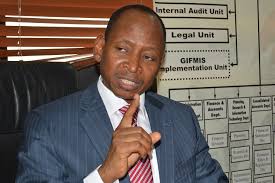
Ahmed Idris, Nigeria’s Accountant-General, has reportedly been arrested on suspicion of money laundering and misappropriation of state monies.
According to sources familiar with the situation, Mr Idris was apprehended in Kano by men of the Economic and Financial Crimes Commission (EFCC) on Monday evening and is being taken to Abuja, Nigeria’s capital, for questioning.
According to sources who spoke with news reporters, the EFCC has been looking into a case of at least N80 billion in public funds being diverted through fake contracts.
According to investigators, the firms utilized to launder the monies were linked to family members and acquaintances of the accountant-general.
Mr. Idris, who was appointed by President Buhari on June 25, 2015, was said to have been avoiding honouring a series of invitations from the anti-graft agency.
The source was quoted as saying, “We kept inviting him but he kept dodging us. We were left with no choice than [sic] to keep him under watch and arrest him.”
However, the spokesperson for the EFCC did not comment on the matter as he could not be reached.

Kano prison warder kills trader ‘over cigarette’
By Uzair Adam Imam
An official of Goron Dutse Correctional Centre in Kano, who is yet to be identified, has gunned down a trader for refusing to give him a stick of cigarette. This development shocked people around.
The Daily Reality gathered that the bullet fired at the trader went through his stomach and later hit another person on the leg.
The trader was confirmed dead after reaching the Murtala Muhammad Specialist Hospital, where the two victims were rushed to.
It was gathered that there had been a misunderstanding between the two persons after the trader refused to sell the cigarette to the officer; which made him angry.
According to a witness who spoke to the Daily Trust, “We can’t really say, but, it seemed like the officer was owing the trader and this time around, he refused to sell to him, which triggered his response as he suddenly shot him.”
Abdullahi Haruna Kiyawa, the Kano Police Public Relations Officer, confirmed the incident.
He added that the police were still trying to ascertain the identity of the slain trader.

Almajiri System: The way out of the Armageddon
By Lawi Auwal Yusuf
I have been keenly following the recent raging altercation aroused by the hard-hitting comments of Nafisa Abdullahi. Many people have voiced their diverging opinions; some took an affirmative position while others came out against her. However, there is a consensus between the different parties that Almajiris are in a dire condition. Hence, no one would like to see his son in such a critical situation.
Though everybody has the leeway to express his mind, why are we wasting our energies on arguments that will come to nothing? These children are clamouring for justice, not a palaver over their plight. Such wrangle will never let us escape from the shackles of mutual antagonism. I believe that this issue is beyond mere accusation and counter-accusation. On the contrary, we have to go the extra mile. We have to give it our best shot to mark a turning point in this issue. Thus, we must debate matters that will help us clinch a victory over the problem. Put another way, it is more important to shift our attention from pointing accusing fingers at each other and focusing on the solution. This tendency to emphasise the problem rather than the solution is deeply entrenched in society and ravages our daily lives. Instead, it is more logical to put the solution above the issue.
Concentrating more on the problem will put us on a road that goes nowhere. It will keep us going around in circles, remain coasting and yield no helpful result. It will always go against us while our efforts remain in the doldrums. If you think this is the right way to ward off the problem. Indeed, you are living in a dream world. It is time to stop the dispute, draw a line under the issue and face reality, as this intractable desertion is getting out of hand.
Those on the same wavelength with the actress should know that not all the children they see on the street begging are actually Almajiris. Many children from impoverished homes disguise themselves as Almajiris to beg for food or scavenge through garbage, looking for valuable materials to sell for a living.
Furthermore, I want to remind those lilliputians that ridicule the Tsangaya that immensurable successes had been achieved through the system. It was the only institution that catered to the educational needs of our people before the inception of Western education. It was the bedrock of our ancient civilisation that paved the way for modern civilisation. It was the institution upon which the foundation for the development of society rested. It was attended by both the nobles and the commoners.
The Sultans of the Sokoto Caliphate, emirs of its semi-autonomous city-states and other members of the aristocratic class all went to Tsangaya. Also, they received their leadership skills training there and trained other administrators who served in different capacities. Moreover, Tsangaya scholars designed the constitution used to govern such a gigantic empire effectively. In addition to all these, it rolled out the khadis (Shari’a court judges) that administered justice, the Imams that led prayers, and Muftis that issued verdicts to guide authorities and the people on both their spiritual and worldly affairs. They also served then as the think tank.
Similarly, great scholars impart knowledge, herbalists that cure ailments, astrologists that determined praying times, crescent sighting, weather forecasts and navigation routes came from such a school system. On this basis, Northerners were proud boastfully that they were literates with a systematic way of life even before the imperialists invaded the region. So, we must be grateful for that.
On the other hand, those who take an unfavourable position from the Kannywood model should understand that the system now doesn’t go; it has a lot of issues and needs momentous changes. It is not what it used to be before. It has taken a different dimension in the last decades. We can’t keep going like that. The Tsangaya must be radically renewed, and these downtrodden children must be liberated from such bondage. Their future must be secured. They need to be under the vehement supervision of their parents, accompanied by their affection, psychological support and care. They have to enjoy the comfort of their homes and the bond of kinship ties, as we have all enjoyed. They deserve a decent life.
Lastly, politicians that have been dilatory in dealing with this problem and wash their hands on the matter must back away from such attitude. They must show genuine commitment to eradicating this menace. We must help these children to salvage the country because we have no other country than Nigeria. IT’S OURS!
Lawi Auwal Yusuf wrote from Kano, Nigeria, via laymaikanawa@gmail.com.