




Worsening Insecurity: Our lives latter
By Najeeb Maigatari
The recent attack on travellers along the Abuja-Kaduna road is shocking. The fact that those ‘terrorists’ could now detonate explosives before killing and kidnapping innocent people is damming and quite alarming. It says a lot about our security system.
It also sends a clear message to everyone that no one is safe. We are all in this mess together; the ordinary people and the ‘elites’ alike. No transportation system is secure in the country. One could now be attacked when travelling by road, railway or even by air.
The unfortunate train attack is not the first of its kind- and will seemingly not be the last unless the needful is done. The only difference is that this time around, unlike other attacks before, the ‘terrorists’ appear well-armed, more audacious with the hunger to kill, which shows their daunting strength.
Those terrorists have been attacking villages and killing people, especially in the northern part of the country, where such attacks have become the order of the day. They have established themselves as an authority with several villages under their control. Some of their brutal attacks and heinous crimes are underreported in the news media.
According to the Nigeria Security Tracker (NST), in a report published from January to February, at least 1761 people lost their lives across the country in incidents related to insecurity and protracted armed violence.
Under our noses, our beloved country, once a nation of peace and tranquillity, is gradually turning into the likes of Somalia, Libya, and Afghanistan or worse; today’s Nigeria has become a slaughterhouse, and its citizens turned into walking corpses.
Even worse, most of those killed are people trying to make a living for themselves and their families. People are killed in their homes, offices, markets, on roads, and virtually everywhere. It’s practically killings everywhere at every turn under every circumstance.
It suffices to conclude at the moment that there’s seemingly the creation of ‘a state within another’. On the one hand, there’s almighty sovereign Nigeria – that continually fails to protect its citizens – and on the other hand, the hypothetical terror nation ruled by such terrorists as Boko Haram, bandits, kidnappers and the likes.
The government is evidently failing – woefully so – in its fundamental responsibility of securing the lives of citizens, as they swore to do before taking over from the previous administration.
Therefore all hands must now be on deck to nip in the bud this issue that threatens our existence irrespective of gender, ethnicity, religious or political affiliations.
To begin with, the government should be bold enough to fish out and address the ultimate cause of all these crises, such as answer the question as to the genesis of the terror groups, their sponsors, financial channels, sources of arms and weaponry, contacts in the community, etc.
In addition, such factors that tend to inflame the situation as poverty, social injustice, illiteracy, etc., should also be proactively addressed by devising measures to assuage people’s suffering and displeasure.
Furthermore, the security forces should be well equipped with state-of-the-art weapons to take the war to the terrorists’ camp. They should also engage the public as people. If people can get trained, they can be utilized for intelligence gathering, informant tracing, reporting suspicious activities, etcetera.
In conclusion, the people should also cooperate and work hand-in-hand with security forces and other relevant government agencies in every way legally possible in order to curtail the worsening insecurity crisis ravaging the country once and for all.
Our lives must matter as long as we continue to call this our homeland. We should not allow those ‘terrorists’ to take over our homes and rule our lives in perpetual fear. If those in authority cannot secure our lives, they should honourably step aside and let competent individuals take over the helm of affairs in the country. Enough is enough!
Najeeb Maigatari writes from Jigawa State and could be reached via maigatari313@gmail.com.
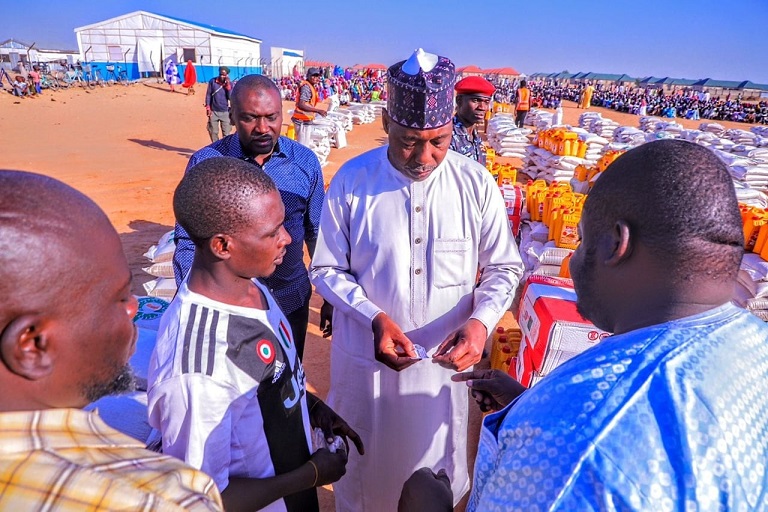
Ramadan: Zulum distributes food, cloth, N5.7m to 285 Gov’t House cleaners
By Uzair Adam Imam
Governor Babagana Umara Zulum of Borno State has distributed food items, cloth and combined cash of five million seven hundred thousand to 285 cleaners, messengers and other lowest rank individuals working at the Borno State government house.
The Daily Reality gathered that each beneficiary received a bag of rice, sugar, cooking oil, textile and N20,000 as support for the Ramadan activities.
The development, which took place on Monday, has grabbed the attention of many people who commended the governor for the kind gesture, especially when people face hard times all over the country due to hikes in prices and insurgency.
The Governor showed appreciation to the workers for their services, saying they are critical to the operations of the Government House.
Zulum further swore to sustain welfare support to the workers.
He also promised to improve the condition of their services.

An unpopular view of the post-conflict dilemma in Sokoto and Zamfara
By Khairat Suleiman Jaruma
I sat down in the car, slightly annoyed that the Corolla 2003 didn’t have a Bluetooth connection. I love to listen to music when travelling and I was tired of using my AirPods. I was travelling from Kano to Kaduna, and the driver had stopped at Zaria to pray. We parked inside an obsolete filling station.
I was getting bored in the car, so I decided to get out and stretch my legs. So, I walked to the roadside; many people were standing. They seemed to be waiting for travelling cars, so I went closer and figured they were all going to Abuja. Considering the road condition, especially these days, I wondered why someone would be heading to Abuja from Zaria by 4 pm. Anyway, I walked back to the car and sat down, and the driver came, and we continued our journey.
We kept on seeing more people that would scream “Abuja” if the car slowed down. Finally, I could not hold it anymore, so I decided to ask the driver since he travels a lot. I asked him why there were so many people (mostly youths) desperately going to Abuja at this unsafe hour. He said they were all “yan cirani,” meaning unskilled “migrants”.
I kept quiet for a moment, then I went ahead to ask him where they were migrating from, and he said most of them were youths from Zamfara and Sokoto who had lost their families and means of livelihood. Some were even students who could no longer afford to pay tuition fees or even feed themselves. I felt a sharp pain in my heart.
But then, I was wondering why Abuja? We all know the cost of living in Abuja is high; why not Kaduna or Kano? Unfortunately, I have not been able to answer these questions. The main point here is that you will agree with me that there are no jobs for these people in Abuja. The number of people I saw was alarming, and I was told by the driver who plies the road every day that sometimes there are even more people than this number. These people are most likely to become a nuisance to society if they eventually arrive in Abuja and are forced to face the reality of unemployment.
Another sad part is that these are youths that are expected to push this country forward with their innovative ideas. These are the young people we want to see as part of governance. But these young people have been failed and abandoned by their government. So while trying to end insecurity, it is imperative that the government addresses unemployment and creates an effective post-conflict reconstruction for affected areas. Prevention, they say, is better than cure.
Khairat Suleiman Jaruma wrote from Kaduna via khairatsuleh@gmail.com.
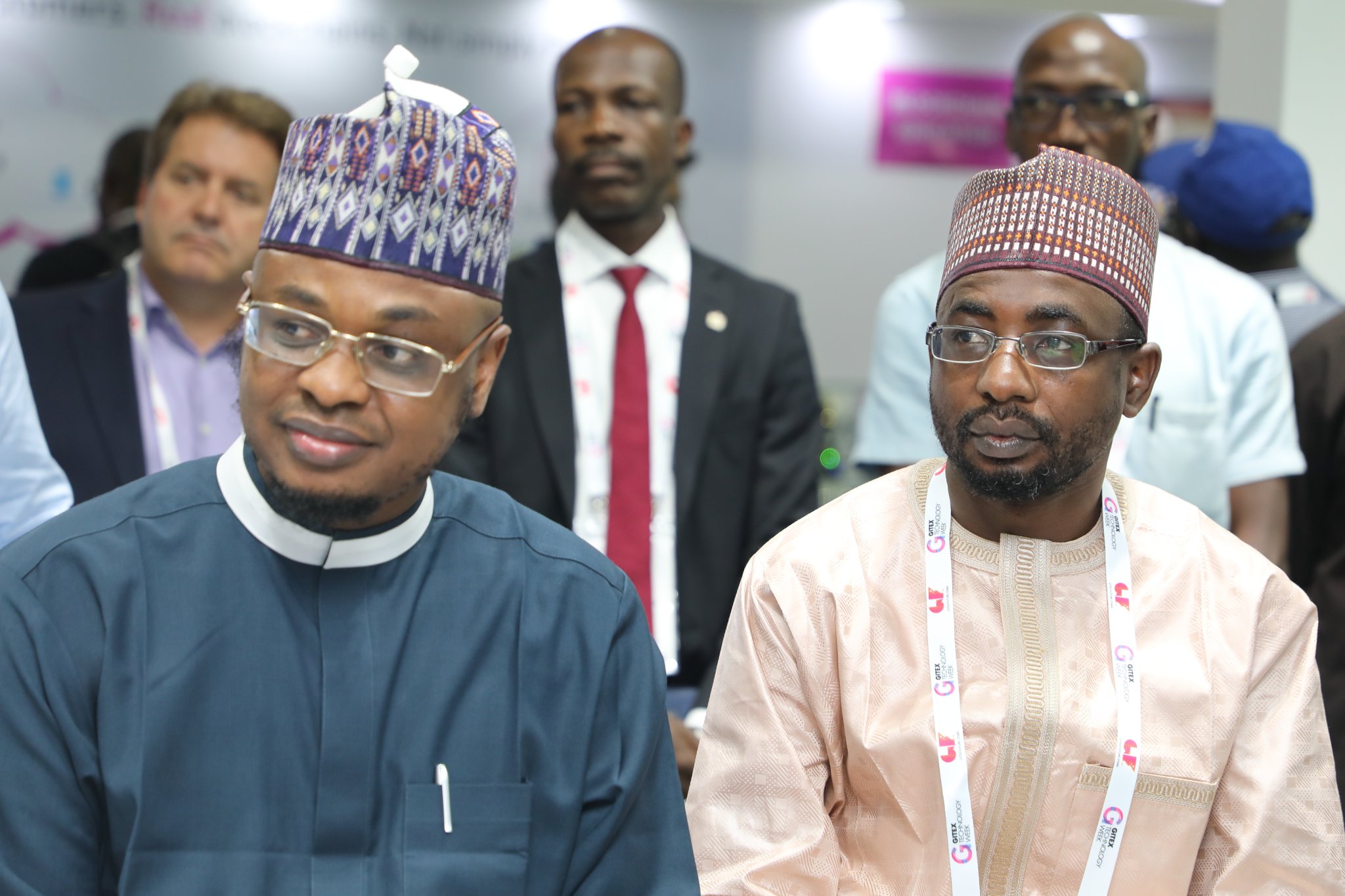
Pantami’s ministry and NITDA responsible for prolonged strike, says ASUU
By Ahmad Deedat Zakari
The Academic Staff Union of Universities (ASUU) has asked Nigerians to hold the Ministry of Communication and Nigerian Information Technology Development Agency (NITDA) responsible for the lingering impasse between ASUU and the Federal Government.
ASUU Zonal Coordinator, Buchi Zone, Professor Lawan Abubakar, briefed reporters on Monday, March 4, 2022, in Jos, where he alleged NITDA is misleading Nigerians on the credibility and acceptability of UTAS which he said has passed the integrity test.
“Ironically, NITDA, in conjunction with its parent Ministry (The Ministry of Communications where Pantami is minister), is seriously sabotaging the government at resolving the impasse. This is obviously capable of prolonging the current strike, thereby bringing untold hardship on Nigerian University students and the University System.” Prof. Abubakar stated
He further explained that NITDA, who scored UTAS high in the past, can not suddenly say UTAS failed integrity test.
“After scoring UTAS this high, NITDA went further to contradict itself by making a fallacious statement that UTAS has failed integrity tests. The union wonders how a score of 97.4% will amount to failure.
“The Union still agreed to another Test by NITDA on March 8, 2022, in the presence of observers front the Federal Ministry of Education/National Universities Commission (NUC), Federal Ministry of Finance/OAGF, Federal Ministry of Labour and Employment and the National Salaries, Income and Wages Commission.
“This most recent test still scored UTAS 99.3% in all the Tests metrics. ASUU is Therefore surprised that NITDA, having scored UTAS this high on two different occasions, unpatriotically went to the press to deliberately mislead the public into believing that UTAS has failed Integrity tests again.” Prof Abubakar clearly explained.
Therefore, he called on Nigerians and the Federal Government to call the Ministry of Communications and NITDA to order to resolve the labour crisis.
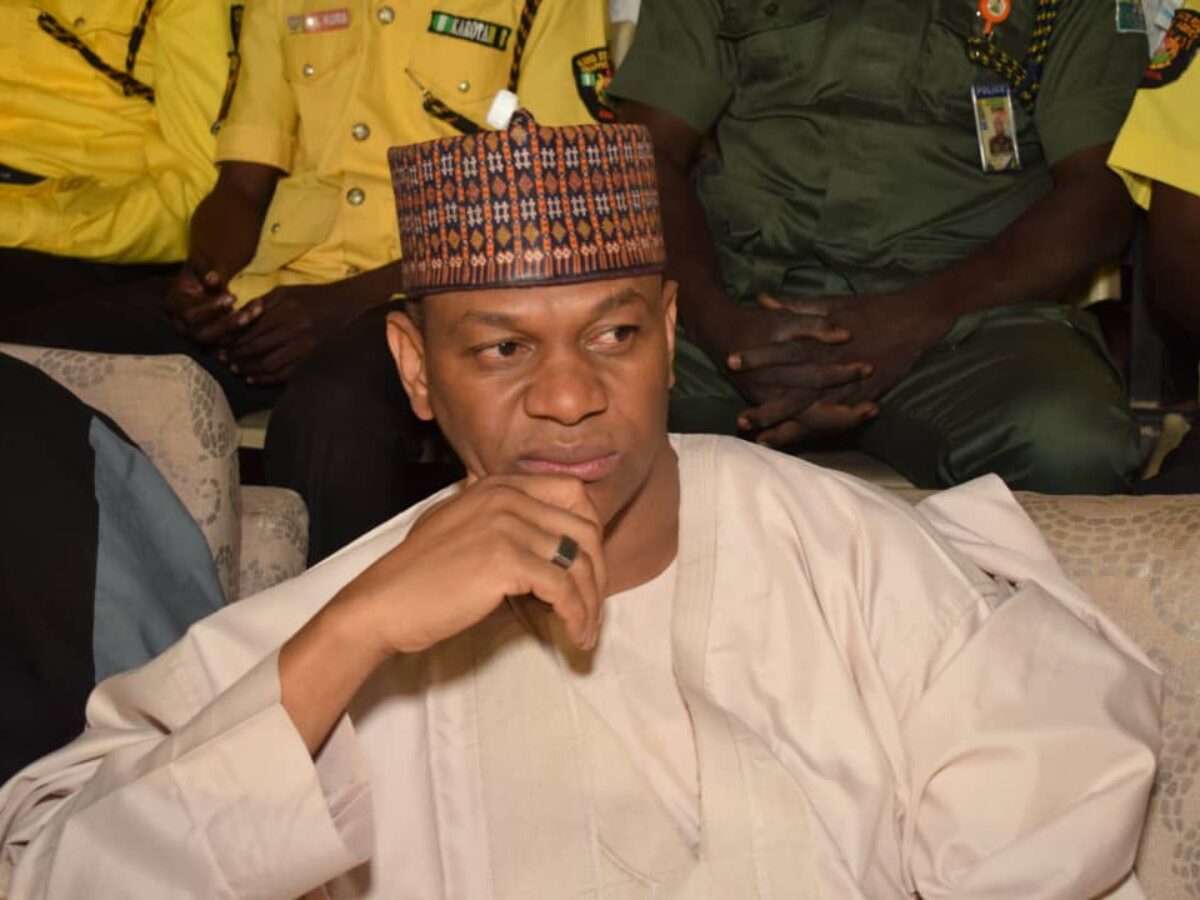
2023: Ganduje rejects my resignation, KAROTA boss
By Uzair Adam Imam
The Managing Director, Kano Road and Traffic Agency (KAROTA), Baffa Babba Danagundi, said he wished to resign, but Governor Abdullahi Umar Ganduje denied him the warrant.
Danagundi disclosed this in a chat with the Daily Trust on Monday.
He added that Ganduje, through the Acting Governor of the state, Nasiru Gawuna, refused to let him leave the job.
It was gathered that Gawuna rejected the resignation of Danagundi on the orders of the governor, who is currently in the United Arab Emirates.
Danagundi intended to resign to enable him to contest an elective position in the forthcoming election of 2023, as the Electoral Law requires.
Danagundi said, “it is true I tendered my resignation, but the governor rejected it. Hence, I have to take whatever he tells me.”
“The Governor has done a lot for me; he elevated me as Managing Director and did other things politically.
“Honestly, I will not go contrary to whatever decision the governor made on my resignation because he knows the best for me”, he said.

PDP and consensus presidential candidate
By Zayyad I. Muhammad
The 2023 presidential elections will present to the Peoples Democratic Party (PDP) a golden opportunity to wrestle power from the ruling All Progressive Congress (APC). However, the greatest challenge facing the PDP is how to utilize this opportunity seamlessly by presenting a candidate that can secure for the party sufficient votes throughout the country.
Today, all indices indicate that the APC’s presidential candidate may come from the southwest. Since 2015, APC’s trump cards have been the north and the southwest. However, the north may be APC’s biggest dilemma in 2023- the party has to appease the north while striking a balance on Nigeria’s complexities- this is where the PDP can take advantage if it plays its own cards very well.
Former Senate President Bukola Saraki, Governor Aminu Tambuwal, and Governor Bala Mohammed, all presidential aspirants on the PDP platform, have kick-started a move for the PDP to present a consensus candidate for the 2023 presidential elections. Saraki said the reason they were pushing for a consensus candidate was to reduce the likely rancour in the process of choosing the party’s flag bearer. Apart from having a rancour-free process, a consensus candidate will give the PDP an opportunity to pull resources together for a common goal. Furthermore, the party will have ample time to campaign for the general elections, as it has eliminated the long and tedious campaign for the primaries.
The big question is, who is PDP’s ideal consensus candidate among all the aspirants? The person should be someone who is well-known, have a network and connection, and is sellable across the country.
As a matter of real politics, the PDP may consider a one bloc vote. That is the Buhari cult-like followers, who, as of now, have undecided votes. The PDP can win the vote of that bloc vote and combine it with its own traditional votes by presenting someone different from Buhari but acceptable to Buhari’s cult-like followers. In addition, a consensus candidate should be someone who knows the Nigerian political terrain –and is acceptable to the common people- someone who Nigerians see as capable of tackling the current problems in the country.
If the PDP agrees to go for a consensus candidate- the party should do this based on certain logic. Firstly, the PDP should analyze the North and Southwest- two parts of the country with the highest number of voters- to define which of them will give the party some cutting-edge advantage. The party should then present a candidate that can bring the votes from that region.
Secondly, as the APC is looking southwest, the PDP should analyze the entire south and do its arithmetic with an open heart on just how to win the election.
Thirdly, PDP’s ideal consensus candidate should be chosen relative to the APC’s likely presidential candidate. It should be someone from the PDP ranks who has the clout, the political structure, the war chest, and the human resources to face any candidate from the APC.
An open discussion among the PDP presidential aspirants can produce good results for the consensus candidate. Though some of the aspirants will fizzle out from the race if the party does not use a zoning formula because their aspirations are based on permutations that the ticket is zoned to a particular section of the country.
Consensus is good for an opposition political party with an opportunity to get power. But some observers are of the view that a primary election will eliminate any hassle for the good candidate- as he may be tied down with many demands from other aspirants and interests.
If the call for a PDP consensus presidential candidate by Bukola Saraki, Governor Tambuwal, and Governor Bala is without any ulterior motive, it will be a welcome and excellent idea for the PDP. Former Vice President Atiku Abubakar said, all the presidential aspirants don’t have issues with each other, once they sit down in a room, they will select the best candidate among themselves. Most political observers said Atiku made the statement because he is fully aware that, as of today, all the odds are in his favour – either consensus or primary election.
Zayyad I. Muhammad writes Abuja via zaymohd@yahoo.com.
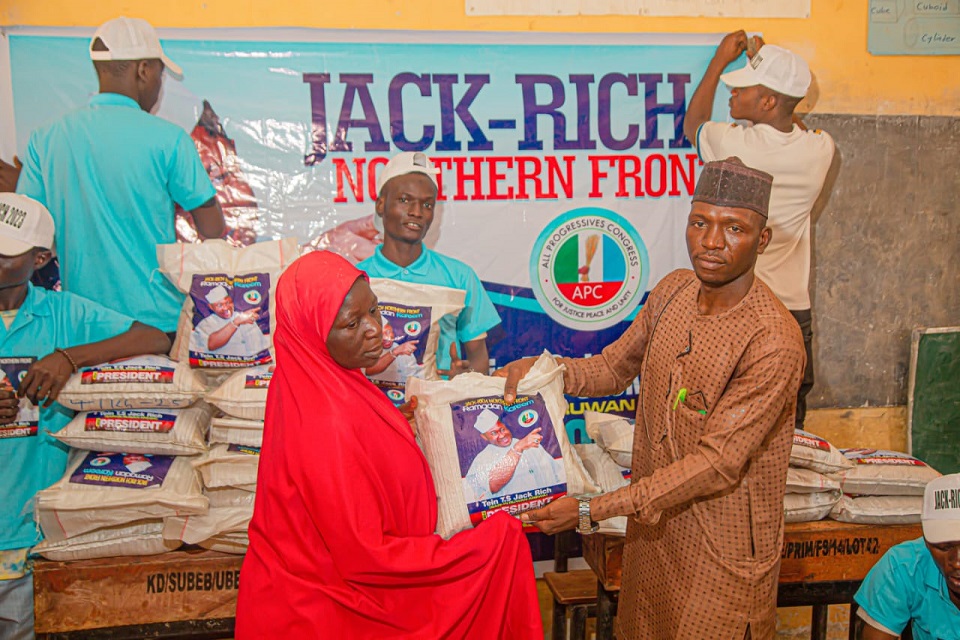
Jack Rich Northern Front distributes Ramadan packages in Kaduna
By Sumayyah Auwal Ishaq
The Jack Rich Northern Front has distributed Ramadam items comprising rice, sugar, and millet, among others, to widows, orphans and the less privileged in Kaduna state. The distribution took place at the Kawo LEA primary school premises with the beneficiaries in attendance.
Speaking at the event, the Front coordinator, Dr Ibrahim Abdulkareem, said the initiative was necessitated by the neglect and abandonment being suffered by widows, orphans and the less privileged in society, especially during the month of Ramadan.
One of the beneficiaries, a mother of three who lost her husband two years ago, Malama Halima Mukhtar, expressed gratitude for the gesture and called on well-meaning people to pray for the success of the Fronts’s activities.
The organization has given similar assistance as its Ramadan welfare package to other orphans across some states in northern Nigeria.
CBN vows to punish banks over deposit of mutilated naira notes
By Ahmad Deedat Zakari
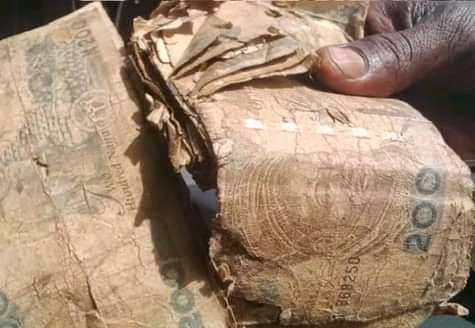
The Central Bank of Nigeria, CBN, has announced a plan to punish banks for depositing mutilated naira notes.
This was made known to the public in Abuja through a circular signed by CBN’s Director of Currency Operations, Mr Ahmed Umar, over the weekend.
According to Mr Umar, the warning to the banks to stop depositing mutilated and composed banknotes will take effect from Friday, April 1, 2022.
“The management of the CBN observed with concern the increase in the number of composed banknotes deposited by DMBs and request for replacement of such banknotes by members of the public.
“The existence of composed banknotes in the economy falsifies the true value of currency in circulation, and can also be avenue for fraudulent activities.
Consequently, any composed banknote discovered in the deposit of DMBs shall attract penalty of 400 per cent of the value,” The circular reads.
Composed banknotes or mutilated Naira notes usually comprise several parts of different banknotes of the same denomination.
How ASUU strike cripples businesses in BUK and Yusuf Maitama Sule varsities (I)
By Aminu Adamu Naganye
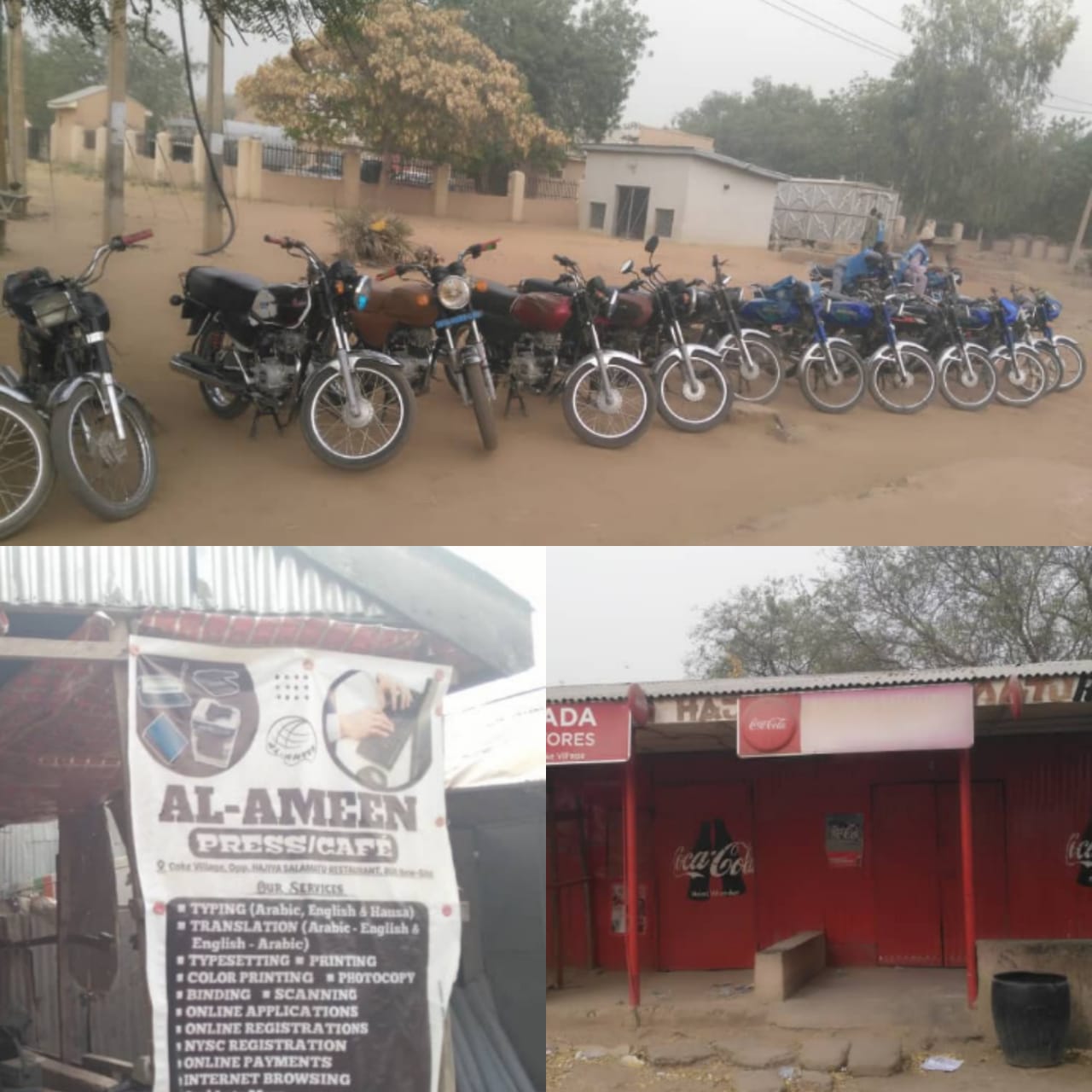
Campus-based businesses in and around Bayero University and Yusuf Maitama Sule University Kano have mostly closed following strike action by the Academic Staff Union of Universities (ASUU), leading to the loss of multiple jobs amid the harsh economic situation in the country.
The strike, apart from terminating academic activities across the campuses of the Universities, has left the institutions desolated as the absence of students grounded business activities to a halt.
A cross-section of petty traders, okada riders, restaurateurs, typesetters and other campus-based artisans have complained about how the strike is taking a toll on their businesses, scuttling their means of livelihood amid soaring inflation in Nigeria.
Nigerian public universities have been on industrial action since 14th February 2022 to pressure the government to fund the universities and settle some outstanding issues as contained in the 2009 Memorandum of Understanding (MoU) and 2020 Memorandum of Action (MoA) as negotiated by the Union of the University teachers and the Federal Government.
Why is ASUU on strike?
The university teachers signed an agreement with the Federal Government of Nigeria in 2009 for the revitalisation of public universities, which will enable the ivory towers to access 200bn annually for six consecutive years. The FG reneged as it only released once in 2013.
Government’s inability to implement other issues of 2009 MoU and 2020 MoA, such as salary upward review after three years relative to the strength of naira-dollar, payment of Earned Academic Allowance (EAA), etc.
The continued use of the controversial Integrated Payroll and Personnel Information System (IPPIS) did not capture university peculiarities and refusal to accept ASUU’s alternate payment system called University Transparency and Accountability Solution (UTAS).
Another point of concern by ASUU is the proliferation of universities by the federal government without adequate funding for the existing ones, which the union argues will further jeopardise the entire Nigerian public university system.
From warning strike to “extended” warning strike
The university dons have completed a 4-week long warning strike in an effort to press home their demands for the Government to honour the agreements. However, after a series of talks between government delegations and the leadership of ASUU, the union extended the warning strike by another eight weeks “to give the government enough time to implement the agreement”, according to ASUU President Prof. Osodeke.
Equally, meetings between the minister of education and the leadership of the National Association of Nigerian Students (NANS) did not yield the resolution of the bone of contentions.
Businesses disrupted, livelihood lost
As the industrial action continues, its effect is taking a toll on businesses and vocations on and around the campuses, with many business owners facing bankruptcy. Although most businesses, such as petty traders, cafés, restaurants, typesetting and photocopying centres, barbing shops etc., have closed down, the remaining few yet to close narrate their harrowing experiences at Bayero University Kano and Yusuf Maitama Sule University.
Ummi Abdulaziz, whose shop in BUK could not sell goods of N1000 a day due to the absence of students, described the ongoing ASUU strike as unfortunate, adding that “The strike affects us really seriously. There are no customers now. There are no people around. We open our shop, but there are no buyers. We are adversely affected. Sales have drastically reduced or even stopped. I can’t even make 1k a day now…”
Ummi, who called on the Federal Government to meet up with ASUU’s demands, said the plight of students and campus-based business people should not be allowed to suffer for long. She urged the two parties to have “A discussion and resolve this problem once and for all.”
Another business owner who identified himself as Sarkin Noma Maitireda BUK said the strike had brought misery and deprivation to their lives as his sole means of survival was being threatened. He was thinking of moving out of campus to find ways to feed his family.
Maitireda further lamented, “Honestly, we are not happy with the strike. We are pained because of our business. Everything on the campus isn’t functioning now. We only sit down by our stalls and shops sometimes to even nap. It badly affects our lives negatively.”
He recalled nostalgically how he survived past strikes partly by leaning onto his savings and ultimately on support from family and friends, saying, “We used to survive on our savings, then we borrowed from friends and family. When the strike ended, and businesses normalised once again we repay our debts”.
He decried that the current situation in the country makes it extremely difficult for him to obtain any support from friends and family, saying “everyone is battling with his challenge.”
“We call on the Federal Government to consider their demands so that they resume their activities and our university to reopen.” He appealed as he narrated how he naps by his stall due to no patronage.
Adamu Aliyu, who used to rake N30, 000 daily on average through his stationery stall but now less than N1000, argued that business people suffer the multiplier effects of the strike more than other members of the university community, including students.
Adamu called on the Federal Government to fulfil its promises to the academics and observed that “the situation in the country today is very terrible. So, I call on the FG to consider the situation of the country generally and consider the students and campus-based businesses specifically.”
Mohammed Kabir of Chiroma Business Centre in BUK, whose typesetting and stationery business vicinity remain desolate, said the strike alongside soaring inflation in the country makes his survival as a father and a husband very difficult.
Narrating his challenging sailing through the harsh reality of the economy compounded by the ongoing strike noted that “it has been difficult for me to survive because before now we were feeding from hand to mouth because of the economic situation. Most of the materials we were using have skyrocketed because of inflation…and now strike….”
Kabir lamented further that, unlike previous university strikes where few works were available, currently, “Probably due to the economic situation of the country, everything stopped. Nothing comes.”
Kabir pleaded that in the interests of students and the nation, even if business owners would not be considered, the two parties should resolve their differences to allow academic and business activities to return to universities as soon as possible.
”As a matter of urgency, the Federal Government and ASUU should come together and have a dialogue to resolve the issue. For the interests of the students’ even if they won’t recognise us, business owners… FG should fast track implementation of the issues so that at least the strike can be called off”, he further stressed.
It is no different at Yusuf Maitama Sule University (YMSU), as academic and business activities are grounded following the declaration of the strike. Unfortunately, like students, most businesses on the campus have closed due to poor patronage created by the vacuum left by students.
Abdussalam Adam was among a few business owners that come around to open their business for a few hours daily but now is considering total closure.
His business centre that provides Café services, typing, printing and photocopying to students has been badly hit by the ongoing strike. As a result, his average earning of N5000 has been depleted to around N500.

“Seriously isn’t easy for us that have business here on campus. The strike isn’t affecting students alone. It affects us. When the students were around, there was much work to do. I used to make 5k, 6k a day but now ….since morning I am just having 500 naira with me”, he complained.
He stated that “If I have the opportunity to talk to the federal government, I would advise them to consider ASUU’s demands and resolve the issue. They spend more than what ASUU is demanding on their personal issues. Why not on universities?”
“New World Cyber Café has already temporarily disengaged its staff because of the strike, but they will resume work when the university’s academic activities resume’’ said Bitrus Monday, who operates the biggest cyber café at BUK.
Bitrus Monday, who decried that strike is becoming habitual in Nigerian public universities, stated that there is an urgent need for the parties to have dialogue that will lead to settlement of the burning issues soonest.
“We are negatively affected. They should help us settle themselves. They should have a round table discussion and sort things out. It is obviously becoming a yearly habit in our universities.” He said.
Food and vegetable sellers worse hit
Food-related businesses that serve the universities and their communities are currently facing unique challenges that differ from their past experiences during varsity strikes in the past.

Shamsu Haruna, whose famous Gurasa Joint at BUK serves hundreds of students, staff and other university community members daily with this Kano delicacy, appeared visibly hapless due to the destructive effects of the strike on his business.
Shamsu soberly recalled how busy and deeply engaged his staff were when students were on campus. He noted that more than ten people were fully engaged in full-time jobs in his Gurasa Business but now are rendered jobless because of the strike.
He reminded the relevant authorities of the ephemerality of power and authority should they fail to discharge it for the public good, adding that “Other powerful, influential people have gone so also the current leaders will go. But what they do now is what they will be remembered for. They should try and leave a good legacy. They should consider the situation of the country and resolve the problem.”
He further noted that although members of non-teaching university staff are not on strike, his business has lost over 85% of its customers, expressing that “As we are in a very difficult situation because if you consider the market, we’ve already lost over 85% of our customers. This is not a small loss in business. We pray that God intervene in this situation… But Federal Government and ASUU should remember that life is transient.”
Restaurateur Fatima Ibrahim owns Al-Khairat Restaurant and has been in the campus-based food business for years, but the current strike is giving her a hard knock.
The strike is painfully touching for Fatima as her once-booming food business is struggling to recover after a near-death experience occasioned by the corona pandemic lockdown. “I used to go to the market to supply foodstuff on a daily basis, every blessed day, but now we go to market once a week. Unfortunately, after you prepared the food, there were no customers. Sometimes you sell, some other times you dispose of it.” she noted, adding that “FG and ASUU should please sympathise with the students and us to solve this conundrum so that they shouldn’t jeopardise the future of the students.”
Similarly, at Medinat Restaurant, the disturbance of the peace caused by the lingering university academics’ strike is making resilient Medinat Mohammed have sleepless nights. Her narration reverberated unpalatable experiences by other business community members of the university since the commencement of industrial action in public universities.

”I used to cook 4-5 mudus of rice and prepare other varieties of meals, but now half mudu doesn’t finish a day. No students. No teachers”, she bemoaned
Determinedly tenacious, Medinat said of her over 20 years of experience in the business, this is the most devastating strike she experienced, alluding to the spillover effects of coronavirus pandemic lockdown “Sometimes we take a loan and after the cooking children will eat, and we (staff) too eat from it and pay transport…for over 20 years selling food, this strike is the worse because we did not recover fully from corona lockdown. It is only through the grace of God that we survive.”
She appealed to the Federal Government to settle critical issues it had earlier agreed on with ASUU so that normalcy return to the university campus.
Unlike other businesses, vegetables and fruit sellers are the most hit, languishing in their anguish due to the perishable nature of their supplies. Their harrowing experience cannot be understood entirely from the outside as they had already lost some quantity of their goods the very first week students deserted the university as explained by Alh Isah Gurgu Maikayan Miya, “With this strike, our business was completely put to a halt, completely grounded. Things have turned off. Our reliable customers, students, are no longer on campus. Academic staff no longer come. Some vegetables decomposed the week the student left because we brought them much and no buyers. So to get our daily meal now proves to be extremely difficult.”
He sadly revealed how he is now making an average of N1000 a day which is far below his average daily sale of N10000 before the strike, which according to him, “cannot cater for my family needs.”
He urged the Federal Government and ASUU to “please sympathise with students and we business owners”.

The bleeding North and the executive inaction of its leaders
By Mohammed Baba Goro
God knows how hard I’ve been suppressing this uncontrollable urge to write about the damning insecurity, especially that of the bandits. Yes, our hues and heys do not matter, but the sigh that comes with someone pouring the biting grief of his heart out is a relief! Again, I wouldn’t want to get emotional in doing that, but the situation of insecurity is enough to cause any well-meaning leader to lose sleep.
I felt cold when all northern leaders could give President Muhammadu Buhari (PMB) during the convention as pass mark was hearty cheers, especially the remarks by the Senate President and Governor Atiku Bagudu of Kebbi State. The governor just lost over 60 vigilantes in one ambush, alongside police officers and a DPO. Yet, it all sounded like all was well with the North and the country.
The economy, insecurity, and corruption are the hallmarks promises of this administration, yet these are the areas the regime has failed the most. Even when you try to tinker with them because of some sparsely built infrastructures – though this is typical of every administration; the high economic numbers that have dragged more people into poverty keep staring at you in the face to have a second thought.
The recent attack on the Abuja-Kaduna train reaffirms that we don’t learn a lesson. The government is inactive, and this is an outright failure of leadership that has deserted the masses on the mercies of the Almighty.
All these tell us that, on the one hand, there is a disconnection between what those in the president’s echo chamber tell him and the reality the masses face. And on the other hand, the executive inaction of its leaders. If not, their remarks to Mr President at the convention shouldn’t have been praises alone but a mixture of some honest and collective concerns about the bleeding North and the urgent need to get to grips with it.
I hope and pray Mr President will write his name in gold, at least for his last days in office, to exterminate these destructive elements and redeem the promise of peace and security he made amidst tears to his Northern kith and kins, and for him to have a befitting retirement.
Mohammed Baba Goro writes from Mokwa in Niger State. He can be reached at: mohammedbabagoro3@gmail.com.