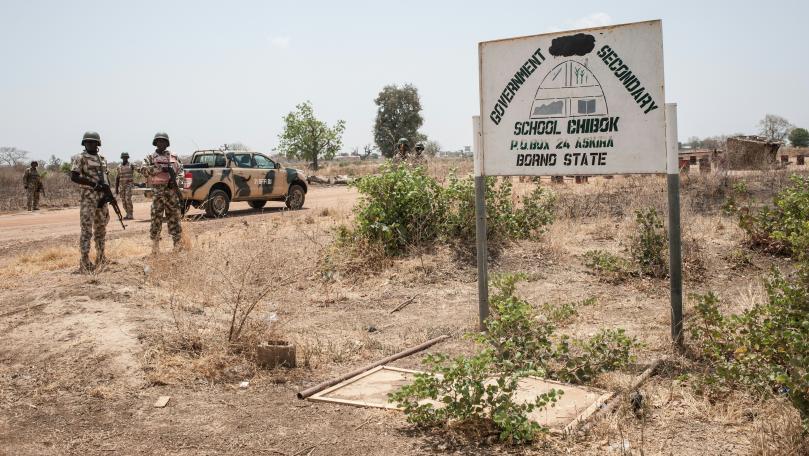
Nigerian military repel ISWAP’s attack, eliminate 5 insurgents
By Muhammad Sabiu
By Muhammad Sabiu
By Uzair Adam Imam
The Nigerian National Petroleum Company (NNPC) assured to have over 1.7 billion litres of petrol in stock, thereby making it unnecessary for the citizens to fear fuel scarcity.
This was made public in a release signed by the NNPC spokesperson, Garba Deen Muhammad stating that it is unnecessary to entertain any fear of scarcity of petrol throughout the festive season and beyond.
“The general public is hereby advised not to engage in panic buying of Premium Motor Spirit, more commonly known as petrol.
“The NNPC has over 1.7 billion litres of petrol in stock, and more product is expected to arrive into the country daily over the coming weeks and months”, the national oil company said in a statement on Monday,” the statement added.
However, the Nigerian Midstream and Downstream Petroleum Regulatory Authority (NMDPRA) also added that: “The NNPC is advising motorists and other consumers of petrol to maintain their regular pattern of the purchase of petrol without getting into a panic situation that may send the wrong signals around the country.
“The NNPC is also engaging all stakeholders to ensure smooth supply and distribution of products to every part of the country during the festive season and beyond.”
By Uzair Adam Imam
The Kaduna State Government has on weekend held a meeting with the stakeholders to brief them on the incessant security issues bedeviling the state for a very long time and other government policies.
The governor of the state, Malam Nasir El-Rufa’i, chaired the meeting which was held at the Murtala Square, Kaduna.
The purpose of the meeting, however, was to brief the stakeholders on security challenges, adding that the security operatives have been quite successful and security breaches have been reduced.
He added that: “We are not imposing hardship on certain people but they can see the benefits of the actions we have taken.
“We got good suggestions from stakeholders which would be used to modify some of our policies. It has been a very rich and engaging conversation,“ he disclosed.
The governor also promised of the other projects would be completed before he leaves the office, adding that: ” We are pleased with the support clerics were giving to the Religious Preaching Regulatory Council.”
Recalled that the council has been established to ensure that clerics are committed to peace in their preaching and sermons.
El-Rufa’i also assured the stakeholders that number of programmes would be introduced by federal and state governments to reduce the hardship faced by Nigerians.
By Hussaina Sufyan Ahmad
Lines of cars on heavy queues return to Kano filling stations on November 7, 2021, prompting some people to accuse the Independent Petroleum Marketers Association (IPMAN) of intentionally creating an artificial scarcity.
Most filling stations have been nil with no sign of activities, while motorists move about looking for the fuel.
Reports indicate that speculation of a possible increase in fuel price by the Federal Government might have resulted in the scarcity.
By Muhammad Sabiu
By Muhammad Sabiu
By Ishaka Mohammed
By Hussaina Sufyan Ahmad
The Nigeria Centre for Disease Control (NCDC) on Friday morning via it’s official website has announced the new toll of Covid-19 cases recording two deaths and 87 new cases of in the country.
The NCDC website said 87 new infections on Thursday was as a result of the infectious decrease from the 209 infections reported of on Wednesday.
The Public Health Institute added that the new infections were recorded across seven states of the federation and the Federal Capital Territory (FCT) on Thursday.
“Zamfara – 29, FCT – 25, Rivers – 11, Kano – 8, Bauchi – 5, Gombe – 4, Lagos – 3 and Taraba – 2.”
“While the latest report includes zero cases from Delta, Edo, Sokoto and Taraba States. Taking the country’s total confirmed cases to 212,446. However, 204,047 of those infected have recovered while 2,902 have died.
By Aminu Mohammed
“Aminu! I cannot travel to Afghanistan. I am afraid that the Taliban will kill me. I am not going anywhere and will rather die in Germany”.
These are the exact words by my friend and neighbour, Suroosh, who incidentally is from Afghanistan. According to him, going to Afghanistan is akin to signing his death warrant. Suroosh also narrated a gory tale about how a relative was hacked to death a few weeks ago by the Taliban just because he worked as a translator for the United States Embassy in Kabul.
This issue got me perplexed, and I became curious about why the Taliban wanted Surrosh dead. My neighbour revealed that he previously worked for an international non-governmental organisation in Kabul before moving to Germany for further studies. This alone puts him on target for elimination by the Taliban if he decides to visit Afghanistan.
I usually perform my Friday prayer at the Afghan mosque in my city here in Kiel. However, from my interaction with some Afghan nationals, I observed that feeling of hopelessness and agony. These people cannot go back to their country for fear of the unknown. Most of those I engaged in conversation with are afraid to go home for fear of being killed by religious zealots.
This article is not about the Taliban or Afghanistan; I want to draw our attention to the negative trend and how lack of proper understanding of Islamic tenets can lead to chaos and anarchy, resulting in mass suffering among the citizens. It should be noted that this discussion with my neighbour took place shortly after the Taliban took over the mantle of leadership in Afghanistan.
I have always refrained from engaging in any discussion about the myriad of challenges bedevilling Northern Nigeria. However, I realised that one could not continue to maintain silence when it comes to issues about one’s homeland. I am compelled to write this because I am worried about the current security situation in the North, especially kidnapping and banditry. The issue at home has become critical that we need to do whatever it takes in one way or the other to change the narrative.
I have observed with keen interest and dismay the incessant verbal attacks and altercation among our people, particularly our youths, over religious issues in various social media platforms and offline. We attack one another and show hatred and bitterness to our fellow Muslims just because of sectarian differences. This has degenerated to the extent that people within a particular sect will be tagging others who do not believe in their doctrine as infidels.
The Islamic scholars from various sects are not left out in this altercation and dangerous trend. Some make uncomplimentary remarks against other scholars and sects during their preaching and sermon, which always elicit amusement rather than condemnation from their audience. This has become constant and worrisome that we must try as much as possible to propagate against this; otherwise, it will not augur well for our society if we all keep quiet and refuse to act.
Let me, first of all, clarify some issues. First, I am not an Islamic scholar, and I do not claim to have a vast knowledge of Islam. However, having been taught by Sunni Islamic scholars from Pakistan, India, and Egypt at the College of Arabic and Islamic Studies, Afikpo, Ebonyi State, I can distinguish between right and wrong in Islam. Our teachers (at Markaz) never taught us to discriminate against other sects or abuse people that do not believe in our doctrine. I still don’t understand why our people dissipate energy on religious arguments and trivial issues to the extent of cursing one another.
Today, the North is no longer secure and safe. People are being hacked to death in large numbers. Religious intolerance has become a significant challenge in our society. We derive joy in casting aspersion on people and mocking those who do not believe in our ideology. This got me wondering whether there is something wrong with us. Why should we be fighting one another over different doctrines and sects? Is Islam in Nigeria different from the one being practised in other saner climes and countries?
Are we not concerned with the number of out-of-school children, illiteracy, industrial stagnation, high unemployment and the raging inflation in the North? Are the incessant killings of hapless villagers perpetrated by marauders and bandits in our rural communities not enough to wake us up from our slumber? I am afraid that if we continue on this trajectory, we will wake up one day and discover that we have no place to call home because of what we have done to ourselves.
Afghanistan is in chaos and ruins today because of this religious rascality, and I am afraid the North is heading in that direction. Prayer alone without action cannot stop the calamity that may happen if we fail to take action. Therefore, it behoves us as individuals and groups to start a conversation and see how we can live in unity and harmony with our fellow Muslim brothers irrespective of their sect and ideology.
We should learn to accommodate people in our midst irrespective of the sect they belong to or the religion they practice. We should endeavour to voice out against Islamic preachers who abuse other sects or do not share their ideology. Tolerance should be our watchword and the only key to our progress and prosperity as a people. We need peace and security for us to grow as a nation. Silence is no longer a virtue. We cannot remain silent and continue to watch as spectators while our region degenerates into anarchy.
Aminu Mohammed is at the School of Sustainability, Christian-Albrechts-Universität zu Kiel, Schleswig Holstein, Germany. He can be reached via gravity23n@gmail.com.
By Hussaina Sufyan Ahmad
There have been reports of attack by ISWAP fighters on a community hospital and telecommunication mast in the town of Mugumeri Local Government Area of Borno State on November 3, 2021.
It was gathered that the attackers stole some drugs and other medical consumables from the facility.
While the military exchanged gunfire with a group of the ISWAP fighters, the other group sneaked into the hospital to steal drugs, a refrigerator and some bedsheets, according to a source.
“They attacked the town from behind, burnt down Airtel mast and ransacked the hospital.
“They went away with drugs, a refrigerator and some bedsheets.”
Magumeri is about 40 kilometers away from Maiduguri, the state capital.