Kannywood

Kannywood actor Nabraska dumps NNPP for APC

By Hadiza Abdulkadir

Popular Kannywood actor Mustapha Badamasi Nabraska has defected from the New Nigeria People’s Party (NNPP) and the Kwankwasiyya Movement to the All Progressives Congress (APC).

Senator Barau Jibril, representing Kano North, announced the defection on social media, revealing that Nabraska visited his residence in Abuja, where he symbolically discarded his red cap—an emblem of the Kwankwasiyya Movement. Senator Ibrahim Lamido (Sokoto East) and Political Adviser Hon. Yusuf Tumfafi were also present to receive him.

Nabraska, known for his shifting political allegiances, previously worked under the APC-led government of former Kano governor Dr. Abdullahi Umar Ganduje. However, after the NNPP’s victory in the 2023 Kano governorship election, he switched sides, only to return to APC now.

The actor’s latest move has drawn mixed reactions. Many social media users mock his frequent party changes, suggesting they are motivated by personal gain rather than ideology.

Misguided Feminism: A call for thoughtful leadership in Northern Nigeria

By Isah Dahiru

The recent interview with popular Kannywood actress Nafisa Abdullahi has ignited a heated debate across the social landscape of northern Nigeria, capturing the attention of various commentators, particularly on social media. In her comments, Nafisa made a bold assertion, claiming she is in complete control of her body and mind, and no external pressure will sway her from dressing or presenting herself as she chooses. While many regard Nafisa as a rising icon in the realm of feminism, others view her stance as a challenge to societal norms, often overlooking moral values and even biological realities that define the differences between men and women.

However, I firmly believe that Nafisa and those who share her views are fundamentally misguided. Our bodies are not commodities to be paraded for public admiration. We are not here merely to fulfil some visual pleasure or as adornments for others’ gaze. Instead, we are human beings endowed with dignity and deserving of respect. As the saying goes, “Modesty is the garment of wisdom,” and our attire should reflect the strength of our character, not just the shapes of our bodies.

Some may view Nafisa’s perspective as a rallying cry for women’s rights, but we must question: at what cost? Feminism, when reduced to a struggle for the right to dress indecently or act without moral constraints, becomes an empty movement. True feminism should not undermine the fundamental principles of respect, but rather empower women to pursue their dreams, shape their futures, and contribute meaningfully to society. Yet, today, far too many feminists have turned their movement into a celebration of physicality and superficiality, often at the expense of deeper issues that affect women—such as access to education, healthcare, and opportunities for economic advancement.

“Not all that glitters is gold,” and the so-called “empowerment” that comes from making oneself a spectacle for public approval is fleeting at best. Our communities need leaders who inspire change through actions that address real problems, not through empty displays of vanity. Nafisa and her supporters must realise that feminism was never about endorsing self-destructive behaviours but advancing equality and opportunity for women, especially in the most critical areas—health, education, and justice.

Moreover, the widespread glorification of such behaviours leads to a dangerous distortion of the feminist narrative. In the pursuit of gender equality, many have lost sight of the core values that have guided humanity for centuries. As the Yoruba proverb says, “A child whose mother does not discipline will be disciplined by the world.” While Nafisa may feel empowered by her choices, she must ask herself whether these choices empower women or diminish their potential. Are they fostering respect, or are they merely setting up an unrealistic, unsustainable standard that undermines the integrity of the feminist movement?

The case of Nafisa is also emblematic of a broader issue in modern-day feminism: the movement has become entangled with other societal problems, including the normalisation of self-objectification. This is particularly damaging in northern Nigeria, where the pressures of social norms and expectations are often at odds with personal freedoms. It is one thing to advocate for women’s rights but another to ignore the vital cultural and moral fabric that holds communities together. The old adage, “When you are in Rome, do as the Romans do,” speaks to the importance of understanding context and respecting traditions that shape our societies.

Furthermore, it is essential to note that the modern feminist movement has, in many ways, become an outlet for personal grievances—whether stemming from personal insecurity or trauma. In some cases, it’s a response to physical abuse, neglect, or toxic home environments. Unfortunately, this mindset often distorts the movement into focusing on external appearance and aggressive defiance rather than internal healing and social harmony. Feminists like Nafisa who endorse such ideologies must ask themselves: Are we fighting for the right to make healthy, empowered choices, or are we simply reacting to our wounds?

“Empty vessels make the most noise,” the proverb warns. Feminism, when misdirected, can become just that: an empty echo of ideals without true substance or lasting impact. Instead of dwelling on appearances, activists should channel their energy into solving tangible issues affecting women daily. Why not focus on creating innovative solutions for women in business, technology, or healthcare? Why not work toward making pregnancy and childbirth safer for women in rural areas? Let’s think about addressing the millions of girls who are denied an education or the thousands of children living on the streets of cities like Jos and Kano. These are the real battles feminists should be fighting.

The world has always advanced through the cooperation of men and women, and both genders have vital roles to play in society’s development. Nafisa and her followers should consider taking a more constructive approach. Instead of focusing on outward appearances and ideological battles, they could use their platforms to bring about meaningful change. 

Let Nafisa invest her energy into projects to help women access technology, provide better healthcare, or champion the cause of good governance. As the saying goes, “A man with a good wife is like a man with a treasure chest”. True success comes not from looking beautiful for the world but from making contributions that endure long after physical beauty has faded.

Time waits for no one. The years spent in idle pursuits are years lost. Like all of us, Nafisa is in her prime, and it is her responsibility to use this time wisely. Rather than spending it on fleeting concerns like hair and makeup, let her invest in causes that uplift women and contribute to the collective well-being of society. Her legacy can be more than just a pretty face—it can be one of deep, transformative impact. “He who does not cultivate his own field, let him not expect to reap the harvest.”

The choice is hers—will she become a true role model, not just for how she dresses, but for the change she brings to the world?

By focusing on true empowerment and social progress, Nafisa can transcend the superficiality of celebrity culture and contribute to a more meaningful, lasting legacy for herself and the women who look up to her.

Isah Dahiru is a pharmacist who wrote via easerdahiru@gmail.com.

A frank review of the Pandora Award 2024 winners

By Sulaiman Ibrahim Lala

The Pandora Awards is an annual event organised by Mama’s Boy Entertainment that aims to recognise outstanding contributions from public figures in northern Nigeria across various fields. The latest edition, held in Kano on Wednesday, January 15, 2025, honoured several notable figures, including footballer Abdullahi Shehu, celebrated Kannywood scriptwriters Fauziyya D. Sulaiman (Uwar Marayu) and Yakubu M. Kumo, social media personality Abba Pantami, among others.

Upon closer examination of the awards ceremony, it becomes apparent that the Kannywood/entertainment industry categories, encompassing music and film, favour familiarity and personal connections over genuine merit. This raises concerns that deserving artists may have been overlooked in favour of those with closer ties to the organisers.

I wholeheartedly agree with some awards, particularly MANYAN MATA, as Best Web Series. Similarly, DJ AB as Best Hip-hop Artist and Sadiq Sani Sadiq’s honour as Best Actor of the Year are also well-deserved.

However, I have reservations about the remaining awards. Some other projects and individuals demonstrated exceptional work and dedication, making them more deserving of recognition.

I am surprised by some of the award outcomes. For instance, Hamisu Breaker took home an award despite not releasing any notable hits in 2024. Meanwhile, Sadiq Saleh’s impressive ‘Da Ransu’ album featuring the standout track ‘Mai Kishina,’ arguably one of the most impactful Hausa songs of 2024, was overlooked.

I also believe the Best Music Video award should have gone to ‘BANI’ by Ado Gwanja, skillfully directed by Jafs, rather than ‘Zuciya’ by Auta Waziri.

The award results were met with surprise and disappointment. NGULDE took home the Best Comedian of the Year award despite Jok3r (Anty Maina) having a more impactful year. Abale’s win for Best Villain Artist over Sultan Abdurrazak, who consistently delivered strong performances last year, was also unexpected.

DEEZELL’s Best Collaboration win raised eyebrows given their lack of notable collaborations in 2024 since the release of ‘NAMIJI’ in 2023. Other nominees like ‘TAWAN’ by Nazifi Asnanic ft Naziru Sarki Waka, ‘Daga Ke’ by Lilin Baba, and ‘Aure remix’ by Boyskiddo seemed more deserving.

Additionally, Mummy Gombe’s Best Female Artist win over Firdausi Yahaya, who excelled in ‘Garwashi’ and ‘Labarina,’ was also surprising. MAISHADDA’s Producer of the Year win for ‘Gidan Sarauta’ over Umar Uk’s outstanding work on ‘Garwashi’ felt like a missed opportunity.

The Queen of the North award went to Fati Kinal despite intense competition from Hadiza Gabon, Rahama Sadau, and Nafisa Abdullahi, leaving some questioning the award’s credibility.

The Pandora Awards’ geographical bias is concerning due to a disproportionate focus on artists from Kano and Kaduna. Despite their significant contributions to the northern entertainment scene, talented artists from Jos, Kogi, and Benue were overlooked.

This regional disparity raises questions about the awards’ inclusivity and representation. The fact that the organisers are primarily from the North-West may have contributed to this bias, undermining the credibility of the awards and their ability to showcase the diversity of northern talent.

Note: These are my personal views as a dedicated fan and keen observer of the Arewa film and music industry.

Sulaiman Ibrahim Lala wrote via sulaimanibrahimlala@gmail.com.

Top 7 Kannywood Series of 2024

By Habibu Maaruf Abdu

For the Kannywood film industry, 2024 has been a remarkable year filled with unprecedented achievements and historic milestones. These include Ali Nuhu’s appointment as the Managing Director of the Nigerian Film Corporation and Rahama Sadau becoming part of the federal government’s Investment in Digital and Creative Enterprise Program (iDICE).

However, while the year was marred by the losses of veteran actress Saratu Gidado (Daso) and singer El-Muaz Birniwa, it also witnessed the emergence of fresh talent and a notable improvement in film quality. Big-budget productions like Nanjala and Mai Martaba achieved significant feats; Nanjala debuted in Turkey and the United States, and Mai Martabawas selected as Nigeria’s official entry for the 97th Academy Awards. Moreover, Sadau’s film Mamah was screened at the prestigious Red Sea Film Festival in Saudi Arabia.

Interestingly, despite the above-mentioned films’ successes, television and web series topped the charts in popularity throughout the year. Established series, such as Labarina and Manyan Mata, continue to reign supreme, with the latter’s instalment (Season 8, Episode 6) amassing over 1 million views on YouTube within 24 hours of its release in January. This success has paved the way for numerous new series. The following are the top 7 among them. Please note that the established series were not considered for this list.

1. Garwashi

Garwashi is arguably the most topical and stimulating series of the year. It confronts critical social issues such as widowhood, moral decay, reckless marriages and irresponsible parenting. The story mainly centres on Asmau/Ma’u (Fiddausi Yahaya), a widow who faces unrelenting adversity due to the cruelty of her in-laws. Her situation is further exacerbated by the greed and heartbreaking indifference of her father. The series is captivating and deserves praise for its engaging writing, intense drama, and realistic portrayal of everyday life. The actors deliver convincing performances, particularly Abubakar Waziri (alias Bado), who plays Asmau’s irresponsible father. His rendition of the Sokoto Hausa dialect is ultimately impressive. 

Additionally, the roles of Baba Lami (Balaraba Abdullahi), Gaddafi (Kabiru Sani), and Sameera (Aisha Humaira), among others, are outstanding. Co-produced by Umar UK and Fauziyya D. Sulaiman and directed by Yaseen Auwal, Garwashihas garnered widespread acclaim, generated buzz, and trended on social media. Other cast members include Yakubu Muhammad, Maryam Yahaya, Isa Adam, Hadiza Muhammad, Sabira Mukhtar, and Rukayya Sharada.

2. Gidan Sarauta

Premiered in 2023, Gidan Sarauta achieved greater popularity in 2024, becoming one of the year’s top series. This is because its episodes get no less than 600,000 views on YouTube weekly. The story follows a complicated love triangle involving two royal brothers, Prince Bello (Umar M. Shareef) and Prince Mu’azzam (Garzali Miko), and a poor daughter, Bintu (Mommy Gombe). Prince Bello initially hides his feelings for Bintu, treating her like a sister and even arranging her marriage to his brother Mu’azzam. Meanwhile, he marries Gimbiya Fa’iza (Aisha Najamu), his cousin whose father (also his uncle) holds the throne. The two couples live together in the royal household, where Bello and Bintu’s bond deepens despite being married to different partners. The drama escalates as Mu’azzam discovers their secret romantic exchanges, leading to intense confrontations and emotional fallout. The series features other compelling characters, such as Alhaji Mai Dala (Rabi’u Rikadawa), his wayward son Kaka (Daddy Hikima), and Tafida (Bashir Bala Ciroki), among others. It was produced by Abubakar Bashir Maishadda and directed by Ali Nuhu.

3. Allura Cikin Ruwa 

2 Effects Media’s Allura Cikin Ruwa revolves around Na’imatu (Ruky Alim), a charming young woman at the centre of attention with numerous men vying for her love. These include Maina (Yakubu Muhammad), Sadiq (Isah Feroz Khan), Dr Hashim (Adam A. Zango) and Alhaji Hadi Makama (Sani Danja). As the title suggests, Na’imatu is like a needle in a vast ocean, which Hausa wisdom says “only the fortunate can find”. Alhaji Hadi is that fortunate one, but he divorces her two days after marriage, adding complexity to the plot. Other characters in the series, such as Maina and his former wife (Fiddausi Yahaya), have interesting backstories that add depth to the narrative. The series features an ensemble cast, stunning visuals and evocative background music. It is also packed with twists and turns, which may hook the audience despite some minor flaws. Sani Danja produced the series, while Yakubu Muhammad directed it. Other casts include Aisha Najamu, Tijjani Faraga, Daddy Hikima, Amal Umar, Ramadan Booth, etc.

4. Darasi

Produced by Sadiq Shanawa and directed by Abubakar S. Shehu, Darasi stands out for its relatable themes, strong performances, and reasonable production quality. The series follows the lives of fresh graduates: Kabiru (Ibrahim Yamu Baba), Marwan (Shamsu Dan Iya), Sadiq (Sadik Shanawa), and Salma (Mommy Gombe), each navigating the challenges of life after graduation. However, Kabiru’s story turns dark after being heartbroken by his love interest, Rabi (Amal Umar), who leaves him for a wealthy son, Shehu Hutu (Abdul S. Tynkin). This betrayal drives him to join a secret cult, aligning himself with powerful influencers such as the corrupt politician Alhaji Audu Maye (Ali Nuhu) and the immoral tycoon Alhaji Maliya (Tanimu Akawu). As the story expands, events become intricately woven. The series is quite popular. It garnered widespread pre-release buzz thanks to promotional photos of Mommy Gombe and other cast members wearing NYSC attire.

5. Wata Rana a Kano 

Wata Rana A Kano is a 5-episode mini-series that addresses the pressing issues of thuggery and phone snatching, which have recently surged in certain areas of Kano State. It is exclusive to Arewa24 TV, unlike many other series that are also available on YouTube. The series exposes the heartlessness of corrupt politicians and their role in fuelling gang violence. It also explores the importance of community involvement in aiding security operatives in combating the problem. Besides its timely thematic relevance, Wata Rana A Kano stands out for its top-notch production quality. The cinematography is exceptional, with realistic portrayals of violence and bloodshed that leave a lasting emotional impact. Many viewers have confessed to crying during a particular scene where the character of Abba Jago (Daddy Hikima) kills Hassan (Adam A. Zango). Produced by Abubakar Bashir Mai Shadda and directed by Kamal S. Alkali, the series also features Mommy Gombe, Umar M. Shareef, Abdurrazak Sultan, Alhassan Kwalle, Abba El-Mustapha, Ali Nuhu, and others.

6. Zafin Nema

Sadik Sani Sadik and Tahir I. Tahir, known for their iconic roles in the Mati franchise as Mati and Lado, respectively, reunite in the topical comedy-drama titled Zafin Nema. The series explores themes of materialism and ambition through the story of two young men, Ilu (Sadik Sani Sadik) and Rabe (Tahir I. Tahir), from a poor background. The duo faces humiliation in their village, Tungan Barau, due to their poverty. Rabe’s father attempts to arrange his son’s marriage to Tala (Mommy Gombe), but her father rejects the proposal despite their familial ties. Similarly, Ilu loses his love, Saude (Maryam Yahaya), to the wealthy Alhaji Dangana (Shehu Hassan Kano). Driven by a desire for wealth, respect, and revenge, Ilu and Rabe embark on a journey to the city. Their misadventures unfold as they foolishly pursue get-rich-quick businesses. The series seamlessly weaves together humour and substance. The actors also deliver excellent performances. It was co-produced by Abdul Amart and Tahir I. Tahir and directed by Yaseen Auwal. Other casts include Al’amin Buhari, Jamila Nagudu, Minal Ahmad, Bello Mohammed Bello, Hajara Usman, Alhassan Kwalle, etc.

7. Umarni 

The series Umarni primarily deals with the issue of wife-mother-in-law relations in Hausaland. It explores the complex and often tense relationships, including jealousy and conflicts between them. In the series, Hajiya Binta (Saratu Daso) reveals her jealousy when her son Ahmad (Bilal Mustapha) prepares to marry his beloved Madina (Bilkisu Safana). She reduces the substantial trousseau he plans to take for the wedding and forbids him from living with his wife in their newly built home. Her intimidation continues while the couple lives with her in the family household. On the other hand, Salma (Sameera Sister) treats her mother-in-law (Asma’u Sani) poorly. Her husband, Sadik (Garzali Miko), initially sides with his mother but is eventually convinced to see her faults. The story evolves as new themes, characters, and conflicts are introduced. The series is generally enjoyable.

Umarni is likely the last film to feature the late veteran actress Saratu Daso. However, the rest of the cast comprises mostly rising stars who nonetheless deliver satisfactory performances. Seikh Isa Alolo directed it, while Naziru Dan Hajiya is the producer. Its second season, which runs during the writing of this review, was co-directed by Tijjani Mai jama’a.

Kannywood star Rahama Sadau celebrates birthday with big announcement

By Habibu Maaruf Abdu

Kannywood actress and producer Rahama Sadau celebrated her birthday Saturday with an exciting announcement for her fans. She revealed on Instagram that her upcoming film, “Mamah,” will be screened at the prestigious Red Sea Film Festival in Saudi Arabia.

She writes: “Thrilled to announce that our film “MAMAH” will be screened at the Red Sea International Film Festival in Saudi Arabia! 🤭💃🏻 @redseafilm

“This is one great achievement as it marks the FIRST HAUSA MOVIE to be showcased at this prestigious international festival. A proud moment for us as producers and actors, and a huge leap forward for Kannywood as a whole. 🫶🏻🙌🏻”

Sadau, who recently appeared in a Bollywood film, is clearly inspired by Indian actors. These actors often use their birthdays to reveal exciting news to their fans, creating buzz and excitement around new projects. Sadau’s admiration for Indian cinema is evident, as she speaks fluent Hindi and cites Priyanka Chopra as her role model.

The actress also made history last year with her film Mati A Zazzau, which became the first Kannywood film to stream on Netflix.

The upcoming film, Mamah is co-produced by Abdul Amart and Rahama Sadau and directed by Toka Mcbaror.

It stars Adam Zango, Nafisa Abdullahi, Rahama Sadau, and Falalu Dorayi. 

The premiere is scheduled for December 9th, 2024, at 10:00 am at the Red Sea Culture Square, Cinema 4.

KILAF 2024: Cultural imperialism killing indigenous and local film market – Dr Victor Okhai

By Anwar Usman

Dr. Victor Okhai, a seasoned filmmaker and critic in Nigeria, decried that cultural imperialism has made people forget about Indigenous films, which has caused a significant setback in the local film industries.

This was made known during the Kano Indigenous Languages of Africa Film Market and Festival (KILAF) conference, which was held on Monday at the Faculty of Communications, Bayero University, Kano.

He explains that ” one thing about indigenous film is that it contains a variety of activities. One can see how a particular culture operates, their way of life, and other things contained within that particular culture that people cannot know without being portrayed in a local movie.”

Dr Okhai further added that people mainly rely heavily on American movies. As such, they ignore their own heritage and embrace the Western way of life, which later cultivates them and makes them behave in a particular way the filmmakers want.

He also asserts that “through local films, individuals within a particular culture can be able to know their roots, what their forefathers have done which they might not necessarily know.”

“Indigenous film serves as an important medium of explaining cultural heritage, an avenue for generating revenue and an important tool for entertainment,” Okhai stated.

Nigeria selects Kannywood film ‘Mai Martaba’ as Oscars official entry

By Habibu Maaruf Abdu

Nigeria has selected the Kannywood film ‘Mai Martaba’ as its official submission for the Best International Feature Film (IIF) category at the 97th Academy Awards, also known as Oscars.

The 15-member Nigerian Official Selection Committee (NOSC) confirmed in its official statement that the selection was made after a rigorous voting session.

Mai Martaba is a historical epic featuring 500 actors that showcases northern Nigeria’s rich cultural heritage. It tells the story of the succession struggle between competing claimants for the throne of the fictitious Jallaba Kingdom.

Reacting to the selection, the film’s director, Prince Daniel Aboki, expressed his delight, adding, “It is a privilege to represent our country at this prestigious global event.” 

He added, “Mai Martaba is more than just a story; it’s a celebration of our culture, struggles, and triumphs as Nigerians. We’re bringing the voices and stories of our people to the global stage, sharing the heart of Nigeria with the world.” 

The film, which stands as the most expensive Kannywood production, was also selected for the Septimus Awards in Amsterdam before its theatrical release in Nigeria in July 2024.

The Academy of Motion Picture Arts and Sciences (AMPAS), which organises the Oscars, confers the IFF Award yearly to a feature-length film produced outside the US with at least 50% non-English dialogue.

A shortlist of 15 finalists will be revealed on December 17, 2024, followed by the announcement of the final five nominees on January 17, 2025.

This marks the second time a Hausa film has been selected for the Oscars, following The Milkmaid (directed by Ovbiagele, 2020).

However, unlike The Milkmaid, whose Kannywood identity is disputed, Mai Martaba is a bona fide Kannywood production, proudly representing the Hausa film industry’s cinematic talent.

The 97th Oscars will be held on March 2, 2025, at the Dolby Theatre in Ovation Hollywood, Los Angeles, and will be broadcast live to over 200 territories worldwide.

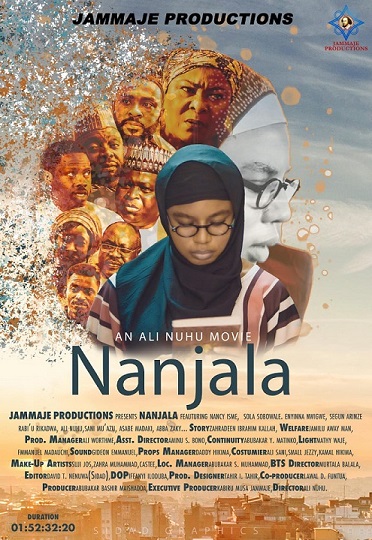
A feminist reading of Jammaje’s Nanjala

  • Production:    Jammaje production
  • Producer:       Abubakar Bashir Maishadda
  • Director:        Ali Nuhu
  • Cast:               Sani Mu’azu, Ali Nuhu, Nancy Isime, Enyinna Ngwige, Rabi’u Rikadawa, Segun Arzine, Abba Al-Mustapha, Asabe Madak, Abba Zaki.

Nanjala, an eponymous and one of the most expensive movies in the Kannywood industry by Jammaje Production, is a breathtaking movie that explores and thematises patriarchal power, domination and mistreatment towards women gender. Nanjala, a leading character, is victimised by her chauvinistic father, who disbands her for being a female in favour of a male child, Dititi (Abba Zaki). Captain Jimmoh (Rikadawa) becomes her adopted father and helps to actualise her dream of becoming a renowned journalist.

Furthermore, Captain Sembene’s family is set on fire as his beloved son, Ditit, becomes a spoiled child, drug addict, thief and clubgoer. Plus, his other female daughter, Jarry, takes a leave from home for her father’s chauvinistic mistreatment. Falmata, another victim of Captain Sembene’s chauvinism, befriends her biological brother, Ditit, with a view to wed him.

Nanjala becomes a renowned and influential journalist who tirelessly fights and exposes corruption in the government. She encounters obstacles along the way from the authority. She is detained in cells for exposing corruption. Finally, she appears triumphant.

Mistreatment and domination are long-held traditions shown to women by a patriarchal world. Women, as chauvinists maintain, are disaster and second-class citizens who can’t contribute to one iota of life. In those days, women had to cancel their identities to have their voices heard—the same as Nanjala has to take a leave from a patriarchal home to attain her potential. 

Thomas Aquinas (1274) opines, “A woman is really an imperfect man… an incidental being … a botched man’’. Nanjala’s treatment by her father affirms Aquinas’s stance that women are imperfect and a botched to her male brother, Dititi. Plus, according to Baudelaire, “woman is natural, that is abominable’’ Some men consider women disgusting. This perception runs through Nanjala’s father, who finds the female gender abominable – divorcing Falmata’s mother for carrying a female unborn child, making life unbearable to Majuma (Asabe Madaki) and causing a great aspersion on Nanjal and Jarry, whom all are females. They have to leave their homes to feel at home.

The belief that women are nothing but second-class citizens, abominable and sex machines for men to exploit became prevalent during the Victorian period (1837-1901) and also in plenty of their literature. We see the fate of Susan Henchad, who is auctioned in Thomas Hardy’s The Mayor of Caster Bridge (1886), women who are sexually exploited by men at Sixa in Mango Beti’s Poor Christ of Bomba (1956) and Firdaus’s sexual abuse by men in Women at Point Zero (1975). Likewise, patriarchal domination doesn’t put a halt here but tries to silence any emerging powerful female voice. 

Women like Gorge Eliat (1919-1880), Gorge Sand (1904-1876), Charlotte Bronte (1816-1855), etc., succumb to patriarchal pressure and accept defeat to vie with men intellectually and literarily. Comparatively, Nanjala encounters the same treatment, where patriarchs try to silence her intellect and voice. They envy her fame, success, and education. Men are jealous of women’s successes, but Nanjala struggles and succeeds. 

For women to succeed in the patriarchal world, they have to be educated, pushed, and struggled. We see how women break the bonds. Li succeeds in The Stillborn (1984) via struggle and education, as Ada in Second-class Citizens(1974). Also, we see in the Kannywood movies- Hauwa Kulu (2019) where Hauwa (Hasana Muhammad) and Laila (Hadiza Gabon) in Manyan Mata (2023 succeed through education. However, Firdaus in Women at Point Zero (1975) and Nnu Egu in The Joys of Motherhood (1980) fail because they are illiterate or barely educated.

Meanwhile, Simone De Beauvoir (1908-1986) asserts that “males define what it means to be human, including what to be female. Since the female is not male”. Beauvoir maintains, “She becomes another”. Indeed, this derogatory portrayal has been born by females throughout many centuries. In the film, Nanjala’s father has this perception run in his blood. He evidently defines who a human being is to him, his male child, Ditti.  He loathes all his three daughters – Nanjala, Jarry, Falmata and Majuma because they are “others”. Women become secondary or non-existent players. 

Finally, Beauvoir asserts, “Women must break the bonds of their patriarchal society and define themselves if they wish to be a significant human”. This is what Nanjala does, and she becomes a “being” in the patriarchal society. Meanwhile, Kate Millet (1970) says, “A female is born, but a woman is created”. As Nanjala defines herself as a true human being, discarding the notion of femaleness in her, she creates womanness, as Millet (1970) puts it, through hard work, education, struggle, and boldness.

By way of conclusion, Nanjala mirrors patriarchal society and uncovers stereotypical portrayal of women as “others”, Second-Class Citizens, incidental beings, imperfect men, and abominable and other derogatory names forced women to accept by men. The film depicts the power of education and struggles as the only means for women to break the long-held tradition enjoyed by men and bury women’s intellect.

If not for education, Nanjala would have been buried alive like other female characters. The film is a clarion call to women to be educated, to disown being relegated to non-existent players or “others”. Nanjala succeeds and becomes a “human being”, whereas Majuma, Jarry and Falmata become second-class citizens.

Reviewed by Abba Musa Ibrahim. He can be reached via abbamusa6888@gmail.com.

Kannywood Movie Review: MAI MARTABA

Company: Blackville Media

Director: Prince Daniel (Aboki)

Producers: Aliyu Ahmad, Egor Efiok, Bature Zambuk, Shehu Bala Kabara

Language: Hausa

Cast: Adam A. Zango, Ghali Abdallah DZ, Auwalu Isma’il Marshall, Fatima Muhammad, Maryam Usman Shuaibu, Mukhtar Aminu etc.

Release date (Nigeria): 19-7-2024

It’s no longer news that TV series have recently dominated the Kannywood filmmaking sphere. However, Prince Daniel Aboki produced an epic period film titled Mai Martaba in a bold move to revitalize the film industry. The film, roughly based on the popular Arewa Radio drama series Kasar Jallaba, has generated immense excitement among fans eager to see the gripping story come alive on screen.

Made on a sweeping budget of over ₦125 million, Mai Martaba surpassed Nanjala (which had a budget of over ₦65 million) to become Kannywood’s most expensive production. But does it justify this substantial investment? I watched it on Sunday, and here is my review.

Mai Martaba is an exciting tale of a succession struggle among competing claimants for the throne of the Jallaba kingdom. The storyline unfolds through an omniscient narrator, beginning with a few flashbacks of the kingdom under the previous reign of the Agadashawa dynasty. Now occupied by the Jallabawa clan, a sacred decree secures the throne.

Before death, each king must name a successor from within the clan, ensuring the Agadashawas would never return to power. King Mu’azu honoured this legacy by naming Sanaya (Auwal Ismail Marshall) his heir, with a written agreement that Sanaya would one day pass the crown to Mu’azu’s son, Magajin Gari (Ghali Abdallah DZ). But Sanaya breaches the agreement and crowns his daughter, Princess Sangaya (Fatima Muhammad), as his successor, setting the stage for an intense power struggle.

Will Magajin Gari reclaim his birthright? Who is the other claimant to the throne? Can a female monarch win over the hearts of the Jallaba people? Find out in the cinemas.

The movie is generally captivating. However, with a short runtime of less than 90 minutes, the screenplay fails to do complete justice to the compelling story. It features little action scenes and ends quickly when it is supposed to be at its climax. For instance, there is a brave bandit kingpin, Shugaba (Adam A. Zango), whose brother was killed in the kingdom. He is in alliance with Magajin Gari. Driven by revenge, the two could have been shown in a fierce battle against the Jallaba kingdom, adding a dramatic action sequence to the film.

Also, as an adaptation of the Kasar Jallaba radio serial, apart from the setting and select character names, Mai Martaba shares minimal similarity with the original sourcing material. It’s somewhat like the American TV series House of the Dragons, where King Viserys appointed his female child, Princess Rhaenyra, as heir to the throne. The theme of ‘succession war’ is also prominent in many other local and international movies.

However, Mai Martaba remains a satisfactory period drama, boasting a spectacular setting and near-authentic period costumes. It may not be the most engaging Kannywood epic, but it could be the best in general production quality. Its exceptional cinematography and technical excellence is a breakthrough in the Hausa film industry. I salute the director, executive producer, and all other crew members.

The cast should also not be forgotten. Though it consists of new actors, they deliver impressive performances with good dialogue rendition. Ghali Abdallah DZ stands out as the ambitious Magajin Gari, plotting political machinations to get the throne. As Princess Sangaya, Fatima Muhammad was not given much scope but showed confidence in every scene she featured. Adam A. Zango (Shugaba) and Auwal Ismail Marshall (Sarki Sanaya) also deliver solid performances, fitting their roles perfectly.

Overall, Mai Martaba sets a benchmark for cinematic excellence in the Kannywood film industry. It’s a lavish epic film that justifies its hefty price tag. I strongly recommend it. Rating: 3.5/5.

Habibu Maaruf Abdu wrote from Kano. He can be reached via habibumaaruf11@gmail.com.

Kannywood movie, ‘Mai Martaba’, wows audiences in Kano

By Uzair Adam Imam 

The highly anticipated movie ‘Mai Martaba’ (Your Highness) premiered in Kano on Friday, drawing a large crowd of enthusiastic fans. 

The film, directed by Prince Daniel (Aboki), is a historical epic showcasing northern Nigeria’s rich cultural heritage.

Produced with a budget of over N25 million, ‘Mai Martaba’ features a cast of 500 actors, including Kannywood stars Adam A. Zango, Shugaba, Ghali Abdullah DZ, and Muktar Aminu Haruna. 

The movie tells the story of an ancient kingdom’s rise and fall, exploring themes of power, love, greed, and betrayal.

According to the producer, Prince Daniel Aboki, the movie aims to bridge the gap between Kannywood and global filmmaking standards. 

With 99.9% of the actors being new entrants, Aboki believes this move will expand the value chain of the creative industry in northern Nigeria.

‘Mai Martaba’ has already been nominated for international awards, including the Septimius Awards in Amsterdam. 

The movie’s success was believed to be a testament to the growing talent and innovation in the Kanywood film industry.