Admin

ASUU Strike: A note to our students at home and the party delegates

By Prof. Abdelmalik Abdelghaffar Amoka

The strike is 14 weeks (1 semester) today and we don’t know how many more weeks we are going to spend at home before getting back to classes. The closure of the universities has afforded us to spend a lot of time on the net, especially on social media, and following the happenings around Nigeria and the rest of the world. It is no more news that primary elections are ongoing in Nigeria and delegates are trending. The best business at the moment is to be a delegate of any of the two major political parties and you make cool millions at the expense of Nigeria. From the State House of Assembly, House of Rep, Senate, Governor, and Presidential ticket of APC or PDP, it is for the highest bidder.

They said Nigeria is broke and can’t fund education but contestants paid so much for nomination and expression of interest forms and are buying delegates to get their party’s ticket to contest to lead Nigerians. They have also budgeted the money to buy votes for the main election. Is Nigeria really poor? Who pays so much to lead a broke organization? While ASUU is on strike because that is the only thing to get the attention of our leaders, the president is traveling around the world, his associates are moving around the country with billions of naira looking for tickets, and the students are at home on Instagram, Facebooking, tweeting, and tiktoking.

You would have expected the students to take their destiny into their hands, but they can’t. They are celebrating the withholding of the salaries of lecturers, queuing behind the politicians looking for tickets, and celebrating the highest bidders that got the ticket. A few weeks ago, the students said there won’t be a primary election in Abuja if the strike is not called off. But PDP just finished its primary election in Abuja in the game of the highest bidder. I actually did not take the threat from our new generation of student leaders serious looking at the “success” of their recent university of the street protest.

With our version of democracy, there will never be money for education, healthcare delivery, and other critical sectors since they have to recover the invested funds to get “elected” with interest. It’s difficult to fight corruption because the foundation of our democracy is corruption. The person expected to fight corruption is fully immersed in corruption. So, how is he going to get the job done?

Somebody once wrote that the government want to give a loan of 1 million naira to students and ASUU was against it. This is the scam. Do you still remember when DISCOs in collaboration with FG came up with electricity bills by bands in 2020? Less than 2 years later, the band on a minimum of 20 electricity per day now gets less than 4 hours electricity per day and no one to complain to and no compensation. That is what will happen to the student’s loan. They will give you the loan which you can’t pay back because there is no job except you the money to buy a job as is currently obtainable. After about 5 years later, the loan will stop and you are stuck with tuition that an average Nigerian parent cannot afford. But why is ASUU even bothering itself with this scam? Why is ASUU thinking for the parents and the general public? We possibly need to start thinking of letting it be and focus on our welfare. Let’s allow the government to introduce tuition and leave that to the public to deal with.

While the government is complaining of no funds for education and our universities are closed for 1 semester and still counting due to a crisis between ASUU and FG over university funding and welfare, the Petroleum Technology Development Fund (PTDF) has shortlisted 8,800 applicants for its overseas scholarship programme. This scheme is smoothly going on every year for over 20 years without any complaints. It is budgeted for and no need for a strike to get that done. Our universities are underfunded and we are shipping our limited resources abroad in the name of the overseas scholarship to contribute to the development of universities in Malaysia, the UK, Germany, France, and China through PTDF, TETFund, NITDA, etc.

These scholarship schemes have been on for over 20 years and we are gladly sending more for MSc and PhD abroad every year on public funds while public universities are underfunded and ASUU has to fight, the academic calendar distorted to get a little attention for our public universities. While the scholars on FG scholarship are living a comfortable life abroad, the students in Nigeria’s public universities are studying under pathetic conditions and have to suffer from the frequent ASUU strike.

Sadly, the bond signed by these scholars is just a formality as you don’t have to come back. Even the scholars that came back to the country are frustrated and can’t fit into the system that funded their scholarship as there is no preparation for their return. No provision for a conducive environment to enable them to be productive and train others.

You spent so much money to train scholars every year without any plan for them. If care is not taken, the amount of money spent on these scholarship schemes every year may be close to half of the money being requested for the revitalization of public universities. We are rich enough to keep funding overseas scholarship schemes to train individuals but too poor to properly fund public universities to develop better mass human resources for our system.

Meanwhile, what are the objectives of these scholarship schemes? What is the timeline to achieve it? It is definitely not for life. Has PTDF, TETFund, and NITDA sat down to evaluate how far we have gone and the impact of these schemes so far on the system with respect to the objectives? Where is the report? Haven’t we trained enough manpower to be empowered to train others in our universities in Nigeria? Why can’t we redirect these funds to our universities for these trained scholars to use to train others?

Unfortunately, we are developing individuals and not the system. The scholars are trained for themselves, the delegates’ vote is for the highest bidder, the highest bidder will bribe the voters to win the election, and the winner of the election will go there to help himself and leave the system poor. I watched a video recently where the wife of a governor was sharing 1 million naira each to her security staff. Where did she get the money from? State resources? She is not known for any business. Teachers in that same state are paid 17% of their salary. They don’t care what happens to public schools at all levels.

Dear Nigerians, as the delegates that you sent for the primary elections, are happily enjoying the money they were paid for their vote and you are celebrating the highest bidder that got the ticket and mocking those that could not afford to buy the delegates, just know that they have just been paid the money meant for education and other critical sectors. We have lost the moral right to complain about corruption.

Dear students, It is a vicious cycle and it ain’t going to change till we are willing to change it. The lecturers have taken their decisions and they are willing to stay off academic activities for as long as possible with or without salary, till their demands are met. The politicians don’t care that you are at home after all their kids are not in public school. They are bribing their ways to sustain their political and economic dynasty and the delegates are happily collecting it.

Meanwhile, who were the returning officers at the primary elections? Definitely not Professors. Tomorrow you will start blaming ASUU that Professors helped them rig elections. Politicians know how to rig the elections with or without the presence of the Professors that the INEC boss invited. So, use your head when you blame ASUU.

In conclusion, the people that can raise such an amount of money to spend to get political positions can also generate funds to save our universities from collapsing if they so care to lead you. It’s up to you if you want to remain at home, Facebooking, tweeting, tiktoking, and keep watching as the system keeps decaying. The ball is in your court.

Amoka is from Ahmadu Bello University, Zaria, Nigeria.

PDP will not win 2023 elections

By Aliyu Nuhu

When I analyze this election, you see some people shouting bias, especially when the prediction did not suit them. I said Atiku would clinch the ticket. I only stated the obvious fact based on my own calculations. It didn’t mean I liked Atiku or disliked Wike. Just that I knew Atiku mastered the art of political brinkmanship and he has experience and wider network and followers above all the contenders. He can’t be a vice president for eight years and run for president the sixth times for nothing.

Now I said Tinubu will take the APC ticket. The wait won’t be long but facts on ground support his candidacy. If it is about winning this election, APC can’t make the mistake of destroying the regional alignment that gave it power in 2015. North and Southwest can work together and cruise home to victory.

PDP will not win this election whether Buhari is popular or not. Whether his government failed to deliver on its promises and rubbished Nigeria’s economy and allowed insecurity to exacerbate people’s suffering is also immaterial. Performance is a good requirement but winning Nigeria’s election is not that straightforward because of the kind of voters we have who are largely poor and ignorant.

Democracy flourishes where there is prosperity and enlightenment among the voters. Stomach infrastructure plays a bigger role in Nigeria’s election. I am saying this to underscore the importance of having governors during presidential election. No party with a sitting governor will fail to get at least 25% of the votes of his state.

In this election APC has all the states where the numbers are concentrated and will surely deliver their states to the party. PDP has only four states in the North.

Having federal government is another big booster to APC. Security agencies always work for the government in power. There is also federal resources from CBN and NNPC and what the ministers will bring on the table from their ministries. Even INEC is working hands in gloves with federal government. APC has a big advantage there over PDP.

Some people will argue why PDP lost election in 2015 when it was in power. It was because the PDP broke to pieces before the election with all the important governors leaving the party. Jonathan was stoned in states where PDP had governors. If you don’t have governors that will work for you, forget presidential election. It is impossible to win Nigeria’s election without controlling states.

The danger of PDP relying on South East votes is that there are few voters there despite the region being notorious for voter apathy. Actions of IPOB will also stop people from voting, this is the reason why I say the region is not important in winning election. This a fact not a support for APC.

Atiku has tenaciously been in the race for Nigeria’s president and with his fierce independece and good health he will outperform other candidates. But this is a moment of truth. He is in the losing party and may have to wait for Tinubu to finish his eight year terms, besides the fact that the North cannot rule Nigeria forever. Power has to go to the South this time, and Southwest for that matter.

Last year I wrote on the biological retirement of older northern Nigerians and after 2023 if you add with years to their ages, most of them will either be in their graves or in their late seventies and eighties struggling with health issues.

Politics: The game of interest

By Muhammad Umar

This is the beginning of my participation in politics to the fullest, especially on social media. I am gradually learning one or two things from both the recorded victories and failures in some instances. I believe it’s unarguably a fact that, in it (politics), you either be on the winning or losing sides.

In times of political victory, you become so excited as if the happiness will never end. Likewise, failure makes you feel uncomfortable or like nothing is enjoyable to you in the entire world. You become frustrated. Some can even get out of their senses and do something regrettable without awareness.

Thus, some lessons I have so far learned are: 

1. Be careful of what you say, write and post on social media because it might one day come back and haunt you. Make sure whatever you write doesn’t involve insulting/harsh words and terms that can downgrade your integrity in the eyes of your followers and friends in struggle. 

2. Learn to be patient in whatever situation you find yourself in. Sometimes you might be provoked by the commentary of some people (your opponents). Be conscious of your wordings while responding to them in times like that. Though it’s not any comment worth your attention, you can neglect some of them to allow peace to reign. 

3. Choose whom to follow and associate with while participating in political activities. This could include your political mentors, guardians and other friends in struggle. Because sometimes, you could meet somebody who can help you, i.e. someone who can be a reason for you to become somebody in life. But if you choose the wrong person, they can be a disaster for you and your political carrier.

Please, be politically wise and active in all the activities that could bring changes to your (our) societies.

Regards!

Muhammad Umar wrote via muhammadumardanmasani@gmail.com.

Sadiq Abubakar, the APC’s new bride in Bauchi

By Tajuddeen Ahmad Tijjani

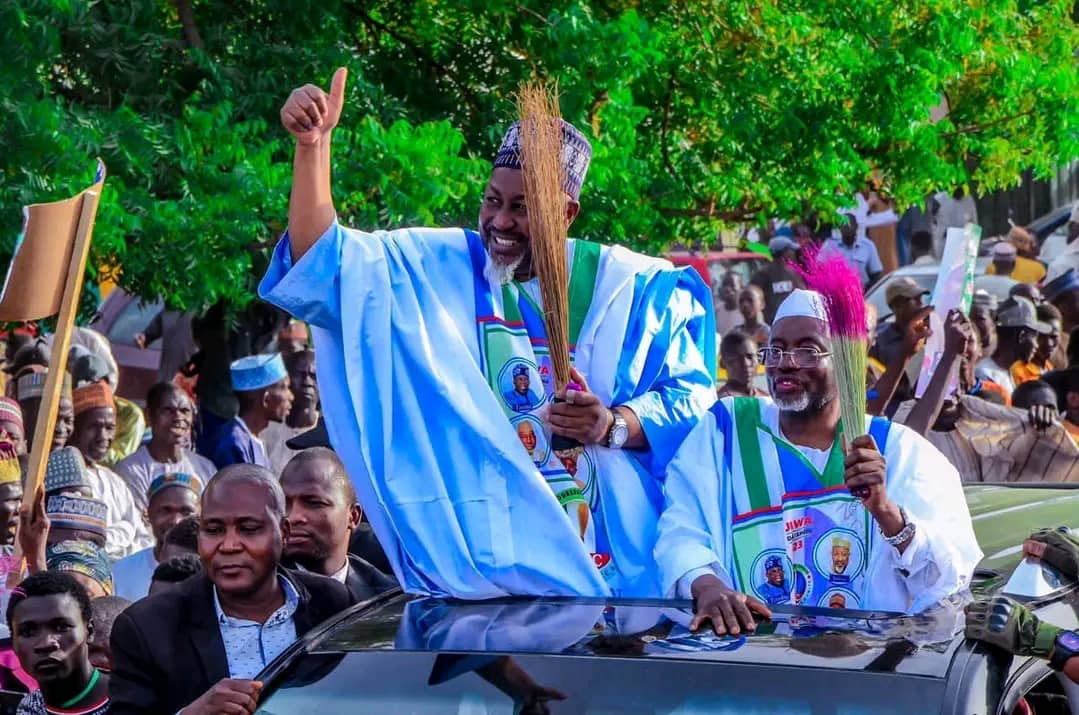
Air Marshall Sadiq Abubakar needs the support of the APC faithful and, by extension, the good people of Bauchi State to win the 2023 governorship election.

We hope his victory at the just concluded primary election will be a turning point for uniting the party and mark a positive difference – if God gives him the leadership of our dear State in the 2023 general election.

In terms of competence, yes, he’s indeed equal to the task to salvage the people of Bauchi and impact positively on our lives. 

The unity of our party at this juncture is paramount. Therefore, we call on other contenders and all stakeholders to rally around him in giving a new face to the progress and ideals of the party. It’s the foundation the party is built on. However, the task is not expected to be easy, but repositioning the party and moving Bauchi State forward is the people’s expectation. 

We shall move together to make APC’s success achievable in the forthcoming election. The new bride, who’s versatile and indeed a rare gem, can give us new hope for the betterment of our people.

So let’s rally around this formidable candidate with the capacity to take APC back to Ramat House in 2023, in sha Allah!

Tajuddeen Ahmad Tijjani writes from Galadima Mahmoud street kasuwar kaji Azare.

How to plan the prosperity of your family through Waqf  (II)

By Abdullahi Abubakar Lamido

Bleak Economic Future on Losing bread Winner

Think of it; the moment you die, the socioeconomic status of your children and wives changes. Your children (those young among them especially) become orphans, and your wives are called widows. While alive, you worked hard and earned for their feeding, clothing, shelter, education, healthcare and general wellbeing. The moment you die, they lose a breadwinner. If in your lifetime you have searched from the Islamic Sharī’ah, you would have learned the art and science of planning beyond your lifetime for these prospective widows and orphans. After relying on Allah, you would have built for them a prospect such that they would live a life of meaning, success, prosperity and contribution, insha Allah. And here comes the relevance of family waqf; waqf, in general, being the Islamic instrument for institutionalising philanthropy and ensuring perpetuity in giving!

Family Waqf as a superb socioeconomic institution enables one posthumously to maintain his parenthood and breadwinner status for his family, generates him reward permanently and preserves the dignity of his progeny everlastingly. In family waqf, you find one of the essential instruments for planning the future prosperity of your progeny.

Family Waqf as Solution

Family waqf, also called posterity waqf, is a kind of endowment created as a futuristic investment for the sustainable prosperity of the endower’s relatives or friends. It is often called a restricted waqf, distinct from a public waqf whose benefits go to an open class of beneficiaries. It can be for the immediate family; wives and children. It may also include parents. It can be made for the extended family, depending upon the financial capacity of the endower. One can make a family waqf for a child with a special need, say one with sickle-cell disease. The beneficiaries of a family waqf, in short, are those defined by the endower.    

Significantly, although the primary beneficiaries of this form of waqf are those pinpointed from the endower’s family, time may expand the scope of the recipients of its fruits. When, for example, the revenues generated from the waqf grow so large beyond the family’s need, or when the family gradually goes extinct after some long time, the waqf could be converted to a public waqf, expanding the coverage of those who enjoy its benefits. Therefore, what distinguishes a family waqf from a general public waqf is its scope of defined beneficiaries. Virtually all other rules of its governance are the same with public waqf. It can be made a direct waqf, one that creates direct benefits, on an investment waqf whose revenues are distributed to the designated recipients.   

Family waqf can be made for the provision of all forms of welfare and empowerment services for the family. It can be made for education, healthcare, feeding, clothing and other needs. It can also be made, specifically for the sponsorship of Hajj to family members. In this regard, instead of spending five million naira for two or three members of the family to perform Hajj this year, the same amount can be invested as a waqf, such that after its maturity, the proceeds from the investment waqf can be used to sponsor Hajj for a certain number of family members every year. With proper management and Allah’s barakah, instead of three family members, dozens of them can enjoy Hajj from the same seed money even long after the demise of the original donor. Waqf multiplies benefits and rewards manifold.

More often than not, you hear people complain over the demands of their family members overwhelming them even as they want to contribute. But little do they know they have a satisfactory answer in family waqf. For example, suppose you know you spend two million naira for the education of your children and extended family annually. Why not make an investment waqf so that the proceeds of the waqf relieve you of any spending in that direction in some years to come?

Form and Functioning of the Family Waqf

A person can build a rentable shopping complex, subscribe to Islamic bonds (Sukuk), buy shares of a halal company, and dedicate the same and profits thereof as a waqf for the education of his children and grandchildren. Likewise, one can build an orchard full of date trees, mango trees and other fruit-bearing trees, dedicating them as a waqf for the future specific or general financing of the needs of their children.

When the endower specifies in the waqf deed that it is only for the education of his children, then, as a rule, no part of the rentals shall be spent on other needs, just as the resources cannot be used to fund the education of children other than his, except when the yields grow far beyond the education of the designated siblings. If the endower dedicates it to education and healthcare, its proceeds cannot be diverted to feeding the family or other things except under absolute necessity. All this is to safeguard the sanctity of the waqf, ensure its sustainability, and guarantee the continuous flow of its yields in line with the overall goals and objectives for which it is created.

 The good thing is that, like all other waqfs, making it a family waqf makes the investment/asset inalienable. It prevents it from being counted among the inheritable wealth of the endower, as it will remain a separate entity that creates benefits perpetually to the entire qualified beneficiaries. The asset can neither be sold nor given as collateral. It remains a waqf asset. This way, even when the children need other things, they source them outside the waqf, allowing the waqf to maintain its defined purpose perpetually.  

The idea behind family waqf stems from Islam’s emphasis on ensuring the wellbeing of a person’s family and biological relations and the need to spend continuously on all aspects of their needs; spiritual, intellectual, biological, physiological, socio-cultural, and so on. Talking about spending, the Qur’an draws attention to prioritising spending on the family. When, for instance, the companions continued to ask the Prophet (SAW) how best to organise their spending, Allah intervened with a divine spending formula: that whatever you plan to spend for good or charity, direct it to your “parents, relatives, orphans, the needy and the traveller” (Qur’an 2: 215).

Your family, in short, occupies the first three spaces on your scale of spending preference. They are the primary beneficiaries of your giving, be it obligatory or voluntary. Now, if, as the Prophet declares, the most pleasing act in the sight of Allah is one that is perpetual and sustainable; then it becomes apparent that the most rewarding spending on the family is the “gift that keeps on giving”, that is a waqf that keeps bearing fruits to the family.

Start Early, Start Now!

It is important you begin the waqf plan early. Many people start their marital lives with moderate incomes, which, with little adjustments, a futuristic mindset and financial discipline, are sufficient to be divided into consumption, saving and little investments. However, financial shortsightedness often prevents them from allocating some portion of that “meagre income” to what would ease their financial burdens and create a sustainable flow of income – and reward- for themselves and their family in the future. Little do they realise that as their family grows, so do their financial burdens. If these are added to inflation and other economic unpredictables, the complexity of the situation worsens.

Many people do not also realise that the best immunisation from the negative socioeconomic consequences of shrinking disposable income is to begin early implementation of an effective financial plan. Many begin to regret when the regret cannot change anything; they would want to start to cry when the head is already cut off!  

So, plan for the future of your beloved wives, children and relatives. That is a Sunnah, a well-established one, for that matter. A viable and well-managed revenue-generating waqf can do that for you. You get double rewards; you safeguard your family’s future Islamically and earn rewards perpetually. Make an effective plan for their feeding, sheltering, education, medicine, and socioeconomic prosperity. Make a waqf for their Hajj, ‘umrah and general spiritual wellbeing. That is sunnatic. Do not miss the opportunity to practice this multidimensional Sunnah, the Sunnah of family waqf. Our dear mother and wife of the Noblest Prophet, Aisha, reports to us that the Prophet (peace be upon him) dedicated his seven gardens as waqf to benefit the clans of Banū Abd Muttalib and Banū Hāshim as recorded by Bayhaqi.

We also see emphasising family waqf in the guidance of the Prophet to his companions. After the revelation of the verse “By no means shall you attain righteousness/piety unless you spend of that which you love; and whatever good you spend, Allah knows it well” (3:92), Abu Talha met the Prophet and said, “This is what Allah has revealed, and the most treasured of all my wealth is this garden, Bayruhā’. I have set it aside as a adaqah to attract reward from Allah. Therefore, you should administer it the way you wish”. The Prophet was amazed by this gesture. And so he said, “Certainly your wealth is blessed. Having heard what you have said, I recommend that you dedicate it as a perpetual charity to your relatives”. Based on this Prophetic advice Abu Talhah made it a waqf for his close relatives and cousins (Bukhari and Muslim).

It is interesting also that most companions of the Prophet are reported to have implemented this Sunnah. For example, Caliph Abubakar dedicated a house as a waqf for his son, and Umar dedicated a waqf near Marwa to his son. Also, Zubayr endowed a house in Makkah, another in Egypt, and yet another in Medina as waqfs for his children. Amr b. ‘Āss endowed a house and another huge property in Mecca for his children, just as Hakīm b. Hizām also dedicated a house as a waqf in Mecca and another in Medina for his son. After reporting all of these, Ibn Qudamah says in al-Mughniy, “All this are intact till date”.

Family waqf is a Sunnah of the Prophet, his companions and generations of Muslims in the last fourteen centuries. It is a well-developed institution that grew as a robust instrument for family empowerment and societal development until it faced the orchestrated wrath of the colonial monsters. The colonialists saw it as an institution that gave families and societies independence against their mercilessness and hence officially abolished it in Muslim nations like Egypt, Morocco, and so on.

Sadly, there is hardly any evidence of its practice as enshrined in Islamic law and civilisation here in Nigeria. With the growing waqf awakening in Nigeria, one hopes that a new page would be opened for entrenching this all-important Islamic civilisational institution. The good news is that with each family doing it, we gradually build a new waqf generation. Through that, we give a big blow to poverty at family levels before we finally eject it out of our communities. The early we sow, the earlier we reap. The more we sow, the more we reap. May we begin this journey NOW.

Abdullahi Abubakar Lamido, Chairman, Zakah and Waqf Foundation, Gombe . He can be reached via lamidomabudi@gmail.com.

Nigeria Health Watch trains Kano journalists on ‘solution journalism’

By Uzair Adam Imam 

An online media platform, Nigeria Health Watch, has organised a workshop on promoting media adoption on Solutions Journalism (SOJO) in Kano state.

The one-day workshop titled “Integrating Solutions Journalism Practices in Media Production in Kano State” took place Saturday, May 28, 2022, at the GearHub, 45 Lamido Crescent, Nassarawa GRA, in the state.

The intent of the workshop was said to equip participants with the knowledge, skills, and networks they would need to consciously discover and report stories about people’s responses to social issues in their news bulletins and other forms of reporting.

However, solutions journalism is understood to mean investigating and explaining how people try to solve widely shared problems.

The idea was reportedly aimed at adding rigorous coverage of solutions rather than just reporting problems as “responses to problems are also newsworthy”.

Speaking at the event, the convener, Misbahu El-Hamza, stated that there was a need for journalists to embrace solutions journalism (SOJO) instead of the normal way of just reporting issues.

However, El-Hamza lamented that many people resisted patronising news to escape heartbreaking reports that ended in scaring people.

The participants that graced the event included journalists from various media organisations from Kano State.

A.A. Zaura emerges APC candidate for Kano Central

By Muhammad Aminu

Abdulsalam Abdulkarim Zaura popularly known as A.A. Zaura has emerged as the winner of the All Progressives Congress (APC) Kano Central senatorial district primary election.

A. A. Zaura polled highest number of votes, 758, to defeat his main challenger Senator Bashir Garba Lado who scored 77 votes to become a distant second.

Announcing the result Saturday evening, Senator Tijjani Yahaya Kaura who was the Chairman Electoral committee said A. A. Zaura returned elected after securing the highest number of votes.

The Star earlier reported that Sen. Lado accused Gov. Ganduje of manipulation the election for the benefit of A. A. Zaura, which he called on President Buhari and National leadership of the APC to correct the wrongs.

The other aspirants who would have participated in the process, stepped down from the contest following pressure from Gov. Ganduje.

The other two senatorial districts of Kano North and South are have single APC aspirants each.

Kano Central: Ex-APC Youths leader withdraws as Sen. Lado accuses Ganduje of manipulation

By Muhammad Aminu

Former National Youths Leader of the All Progressives Congress (APC) Barr Ismail Ahmed has withdrawn his aspiration to contest for Kano Central senatorial district.

Barr Ahmed announced his withdrawal on Saturday at the Sani Abacha Indoor Stadium, where the primary election is taking place.

A one-time presidential adviser to Buhari on Youths, Barr Ahmed, said Gov. Abdullahi Ganduje prevailed on him to withdraw from the contest earlier today, to which he obliged in the interest of the APC in the state.

Meanwhile, another aspirant and former senator representing Kano Central, Bashir Garba Lado, has accused Gov. Ganduje of manipulating the process to favour one of the aspirants.

Senator Lado alleged that Gov. Ganduje instructed party delegates and other stakeholders in the primary election to vote for his anointed aspirant, Abdulsalam Abdulkarim Zaura.

He said the conversations and instructions conveyed to delegates and other stakeholders can be retrieved from Gov. Ganduje’s and Kano State APC Chairman’s phone calls made from 11:am Saturday.

He called on President Muhammadu Buhari, APC National Chairman Abdullahi Adamu, Inspector General of Police and other heads of security agencies to intervene to ensure a free and fair primary election is conducted to avert any possible breakdown of law and order as a result of governor’s interfere.

Like other states across Nigeria, APC in Kano is conducting primary elections for the three senatorial districts in the state, but the contest is heated in Kano Central between Gov Ganduje’s ally A. A. Zaura and Senator Lado while Aspirants for Kano South and North senatorial districts are unopposed.

Democracy or “delegatocracy”?

By Simbo Olorunfemi

It might yet turn out that, by some accident or slip on the part of members of the National Assembly, Nigeria might have stumbled upon a system that might yet become useful in retooling the mechanics of the Presidential system as we currently practise it.

Of course, the idea that the template that had been forced upon the political parties for the election of Candidates in this election will outlive this season is unlikely, as letting the Buhari ‘veto’ stay would amount to class suicide, with power of election/selection slipping out of the hands of those who had assumed the status of ‘statutory’ or ‘super’ delegates. The Legislators are unlikely to ever let that happen.

But I wouldn’t let that stop my interrogation of what is accidental, but I see as potentially beneficial intervention in the electoral system.

Whereas the idea of electing candidates through a collegiate system, made up of delegates is not new, what has played out this time around is one in which all the delegates who participated in the election of candidates were elected. Whereas these ones were supposedly ‘ad-hoc’, who were to be add-ons to the supermen and women who are automatic delegates by virtue of the offices they hold/held.

So, as the malfunction in the legislative process led to the omission of super delegates who had been the dominant players in the space, the task of producing candidates was solely left to the adhoc delegates, who suddenly became beautiful brides desperately sought by aspirants.

Whereas there has been a lot of talk about what has become a highly monetised delegates procurement process, my observation does, in fact, suggest that it is the statutory or super delegates who have constituted themselves into ‘cabals’ and pressure groups, taking advantage of their positions to put pressure on aspirants, leading to the monetisation of the process.

First, we have former members of the National Assembly, having formed themselves into groups, waiting for the period of elections to milk aspirants. Then, we have a situation in which the list of delegates tilts heavily in favour of these groups, making the system more susceptible to manipulation.

So, what is wrong with tweaking with this accidental system that we now have and explore the possibility of institutionalising it as a model for electing Candidates?

As we have it now, members of the party go through a process of election which see them emerging as ward, local government and State delegates, to be able to vote for candidates in the different elections.

Whereas the contest within the parties to qualify as a ‘Delegate’ was not one that had the big players contending, having already qualified to participate in the process as statutory delegates, I will argue for the idea of statutory delegates to be scrapped entirely.

I will argue for a system in which all delegates are elected by members of the party. This primary election had 5 delegates per ward (APC) and 3 delegates per ward (PDP) for the State House of Assembly Elections.

I will make a case for the primary election for the office of the President to be one delegate per ward, which would be the total number of delegates eligible to vote to 8, 813, just about what we had with statutory delegates participating in the process. But under this proposed arrangement, anyone who wants to be a delegate, either already elected into office or a political appointee will return to his ward to stand for election, and if qualified will serve as delegate at the Presidential primaries. Local government and states delegates will also emerge through the same process.

This system strengthens the party and returns power to the base, having within it some elements of the parliamentary system which I prefer and advocate a return to.

Simbo can be reached via; simboor@yahoo.com

Covid: CITAD awards Covid-19 champions on enlightening, countering fake news

By Uzair Adam Imam

The Centre for Information Technology and Development (CITAD) has trained 18 covid-19 vaccine champions on identifying, tracking and countering Covid-19 related fake news on social media platforms.

The program tittled “Public Education on COVID-19 Vaccine Project” was aimed at sensitizing the public on the importance of covid19 vaccine and the need to take it with a view to promoting uptake of the vaccine.

Supported by MacArthur Foundation, the centre is reportedly working with 18 partner organizations and social influencers to enlighten the public about the vaccine through various activities and programmes.

However, COVID-19 is a communicable respiratory disease that terrorises the entire wold, leading to the death of number of people and set the nationwide economic back.

The details on the event was in a statement signed Saturday, May 28, 2022, by the coordinator of the campaign, Mal. Hamza Ibrahim.

The statement reads in part: “CITAD received 93 applications from young people who want to be champions and 18 of them were selected from six northern states – Kano, Kaduna, Bauchi, Borno, Plateau and Kogi State and trained for two days.”

“After their training they embarked on daily campaigns on the vaccine on social media. They submit reports of their campaigns at the end of every month and the reports are shared with panel of judges who review and assess and subsequently select the best three.”

“So, there is competition among the vaccine champions every month and the best three winners are selected and rewarded with gifts. This month, Hadiza Aliyu from Kano emerged in the 1st position and got Hisense refrigerator. Ashafa Abdulkadir from Kaduna and Hauwa Shettima from Bauchi State were the 2nd and 3rd position. They received plasma television and mini laptop.”

It is not known whether there will be another new competition for Covid-19 vaccine champions after this campaign has ended.