Month: July 2022

Tinubu chooses Kashim Shettima as running mate

By Uzair Adam Imam

The Presidential Candidate of the All Progressives Congress (APC), has identified Senator Kashim Shettima as his running mate for the 2023 general election.

Tinubu disclosed this Sunday in an interactive session with journalists during a visit to President Buhari in Daura, Katsina State.

Reports had earlier hinted that The vice-presidential nominee may most likely be a former governor and senator from the Northeast part of Nigeria.

Recall that Governor Abdullahi Umar Ganduje of Kano State had on Saturday disclosed that Tinubu had settled for a Muslim-Muslim ticket.

Kashim Shettima was a Barno State former governor who served the state from 2011 to 2019.

SCAM: ‘NNPC is not recruiting’ – Management

By Uzair Adam Imam 

The Nigerian National Petroleum Corporation (NNPC) is not recruiting, the General Manager, Group Public Affairs Division, Mr Garbadeen Muhammad, said.

The General Manager made the declaration public in a statement issued in Abuja by the management. 

In the statement, Muhammad urged the general public to discard the rumour in the air that the company was recruiting. 

He reiterated that the information suggesting that NNPC Ltd. was recruiting was false and baseless. 

He stated, “the general public should please take note that NNPC Ltd. is not recruiting.

The statement noted that the NNPC has an official website to make announcements whenever the company intends to recruit. 

The official websites were identified as “(www.nnpcgroup.com); verified Twitter handle (@nnpcgroup); verified Facebook page (@nnpcgroup) and other credible media channels,” he stated.

Kaduna train attack: 7 hostages regain freedom, reunite with family

By Muhammad Sabiu

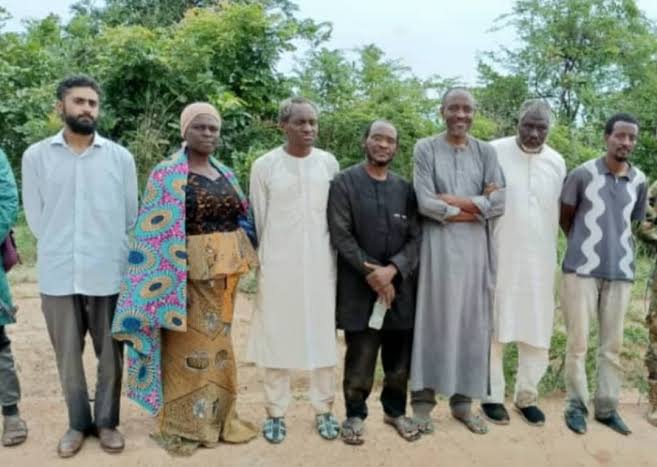
The families of the seven captives released by the terrorists who attacked the AK-9 Abuja-Kaduna train have been reunited.

On Saturday, the terrorists freed a further group of seven captives after more than a hundred days in captivity.

According to reports, the terrorists released 11 of the remaining 50 hostages from the 61 victims of the kidnapped train passengers three weeks ago, leaving 43 hostages in their hideout.

The release of the hostages and their reunion with their families was announced on Sunday by Mallam Tukur Mamu, one of the negotiators and the media advisor to Islamic cleric Sheikh Ahmad Gumi.

The hostages include Bosede Olurotimi, Abubakar Zubairu, Alhassan Sule and Sadiq Ango Abdullahi, Muhammad Daiyabu Paki, Aliyu Usman as well as only foreign national of Pakistani origin, Dr Muhammad Abuzar Afzal.

Advocacy, ethics and the trial of Abduljabbar Nasiru Kabara (I)

By Ibrahim Ahmad Kala, LL.M

The one-time Attorney General of the Federation and Minister for Justice in the Second Republic, Late Chief Richard Akinjede, SAN once asserted that oral Advocacy is a special science and art skill of good courtroom lawyers which is likened to the scene in Julius Caeser that took the form of funeral orations by Brutus and Antony over Ceaser’s corpse. Having just killed Ceaser, the conspirators wanted Brutus to assure the Romans that all was well and that Ceaser’s death was necessary to prevent tyranny. Antony, Ceaser’s close friend, feigned solidarity with the conspirators and persuaded them that he too should say a few words over Ceaser’s body.

In comparing Brutus and Antony as orators, we should remember two other classical orators: Cicero and Demosthenes. When Cicero finished an oration, the people would say: “How well he spoke”.  But when Demosthenes finished speaking, the people would say: “Let us March”. Brutus was like Cicero and Antony like Demosthenes. Brutus won respect, but Antony started a riot.

The funeral orations which exemplify an extraordinary example of how Shakespeare can bear on the law, underscore the effectiveness of oral Advocacy which a lawyer should read before addressing the court in a major trial.

Regrettably, like Antony, Bar Shehu Usman Dalhatu on 7/7/2022 in his appearance while defending Sheikh Abduljabbar Nasiru Kabara before a Sharia Court of Kano State, caused stirred on social media and openly accused the trial judge of being unlike Ceaser’s wife of not sitting above board in the case. As seen in a viral video, the counsel was heard castigating the court for allowing the prosecution to ask “all sorts of questions such as asking the defendant when his father died? Which he argued, is not contained in the charge,” during cross-examination,  and “denying his client right to make a no-case submission”, saying no prima facie case was established against him. According to the Daily Trust report, the mild drama led the defence counsel, Dalhatu Shehu-Usman to walk out on the judge.

The Kano State Government had charged Kabara with four counts, bordering on blasphemous comments against Prophet Muhammad (PBUH) on Aug.10, Oct. 25 and Dec 20, 2019.

With due respect to all, the entire scenario that played out in the court is, to say the least, highly nauseating and totally against the professional ethics required of players in the administration of justice in this country. In one of my previous articles on the relationship between the Bar and the Bench, I penned down as follows:

In R. vs. O’Connell (1844) p261 at 312-313 lifted from Oputa JSC’s book “OUR TEMPLE OF JUSTICE” p.14, Crampton J. said thus:

“This court in which we sit is a Temple of Justice, and the Advocate at the Bar as well as the Judge on the Bench are equally ministers in that Temple. The object of all, equally, would be the attainment of justice…”

Oputa JSC further distilled some guiding principles on the relationship between the Bench and the Bar as follows:

 “Lawyers and Judges being instruments of justice are honoured and honourable.

Such honourable men should not allow ‘the infirmity of human nature and the strength of human passion’ to lead them astray, let alone lead them to perpetuate an outright injustice.

The Legal profession is not just another avenue for quick money-making by hook or crook. To so conceive the profession, is to degrade it.”

Similarly, Richard Du Cann in his book: “The Art of the Advocate” speaking on the duty of the Advocate while quoting Lord MacMillan, a Lord Advocate-General in Scotland and a member of the Judicial Committee of the House of Lord’s declared the duty in fivefold as follows:

“In the discharge of his office, the Advocate has a duty to his client, a duty to his opponent, a duty to the court, a duty to himself, and a duty to the state. The duties, in fact, begin long before he rises to his feet resplendent in horsehair wig and stuff gown”.

Hence, it is not part of the duties of a Lawyer to win at all costs or at any cost. There is rather a heavy cost to winning at all costs and that cost is disdain and dishonour and the desecration of the sacred temple of justice. Judges and Lawyers have a prior and perpetual retainer on behalf of the truth.

All these, therefore, reflect very much the tradition of the legal profession on the relationship between the Bar and the Bench, and which is one of reciprocity. The smooth administration of justice envisages the existence of courageous, efficient, honest and fearless Bar and Bench.

The Bench is entitled to unqualified respect from the Bar and so expects it. The least Magistrate Court, Area, Sharia or Customary Court and the highest court of the land are equally entitled to this respect. Members of the Bar stand up when they address or are addressed by the Bench.

The counsel who easily picks up quarrels with the Bench acts in contravention of this important duty. The duty of respect which is as old as the profession itself is highlighted under Rule 1(a) of Rules of Professional Conduct as follows:

It is the duty of the Lawyer to maintain toward the Court, a respectful attitude, not for the sake of the temporary incumbent of the judicial office, but for the maintenance of its supreme importance. Judges not being wholly free to defend themselves against criticism and clamour. Whenever there is a proper ground for a serious complaint of a judicial officer, it is the duty of the Lawyer to submit his grievances to the proper authority. In such cases, but not otherwise, such charges should be encouraged and the person making them should be protected.

This aged-long tradition of respect has crystallized into a solid cornerstone in the edifice of the Bar-and-Bench relationship. You alone cannot change the position overnight. The tradition is so well established at the Bar that, even when counsel has nothing but rude remarks to make, by tradition he is expected to start by saying: “With respect”.

These ethics demanded the best of Man: obedience and decency, as it was demanded that Adam (A.S) should keep his own part of the bargain, and he did not; that was unethical and there came his fall.

The court is where counsel will spend the rest of his years at the Bar trying to persuade to his view. One cannot carry it along with him if, by lack of manners, one alienates its feelings beyond recall or consistently.

To be continued

Ibrahim Muhammad Kala Esq is the Head of Litigation Department, Court of Appeal Gombe division and can be reached via ibrokalaesq@gmail.com

Kannywood Film Review: ” There is a way”

By Anna Mohr

The movie, There is a way, directed by Falalu A. Dorayi and produced by Abba El-Mustapha, is a simple but effective feel-good movie retelling popular tropes and stories in a predictable but heartwarming way. Following the recipe of Shakespearean dramatics and clichéd Disney movies in the 2000s, such as Cinderella Story or High School Musical, it easily can stand on its own while also covering issues of the Hausa society and giving insights into its culture – an entertaining and so sweet movie you can taste the sugar on your lips.

Isham is a middle-class university student with a pure heart who wants to get his degree through hard work. He falls high over heels for Fadilla, the daughter of a wealthy businessman. The two desperately want to be together but must face several problems threatening to destroy their relationship.

There is a Way was the first Hausa movie I watched, and although the story has already been told a thousand times, I easily became invested with it. Even though I rarely watch romantic movies, I have a soft spot for them. The quality of the film is fitting to the story itself: simple but refreshing. Please, do not expect finesse camerawork or outstanding dialogues – you will surely be disappointed. But the blunt storytelling is made up of dramatics that can easily compete with those of the Bollywood film industry.

The movie itself is certainly no piece of art. It is amateurishly made: the camera is wiggling, and the lighter colours in the scenes are sometimes glaring and unnatural. At the same time, the movie uses effects such as slow-motion, certain scenes are muted to create tension and dramatic music is played in between.

The story itself is predictable as typical for a romantic movie and has similarities to our Western fairy tales and Elizabethan or ancient love stories: Man meets a woman and falls in love at first sight, but their love is doomed, and they have to face challenges before being together. Also, the poor protagonist and his rich-born love interest are no rarity in this genre. Another aspect I recognized in the film is the flat characters: We have a pure-hearted hero who cannot do wrong. But instead, tragedy happens to him, and his pureness is challenged. I found that quite wasted because characters are made to make mistakes. They can only grow when they do wrong and when they fail. There is a sense of relatedness that I miss.

The characters themselves are introduced in simplicity. When Fadilla’s parents appear on screen, they are introduced with “Hello Mum” and “Hello Dad”, which is blunt and unimaginative to share the family ties with the viewer. The dialogues are just as direct. The movie is in English, and there is no dubbing involved, meaning that Hausa people speak a language that is not their own. That includes that the dialogues are often wooden and lacking finesse. “I will tell you the secret of …” is just one example of the movie’s very direct way of communication, and I daresay that it would have been more natural if the characters had spoken in their own language. The English script has some sentences that are generally not used, leading to many exaggerated dialogues. For example, “you harbour a criminal” when Isham is accused of cheating in an exam.

So, why do I like this movie?

Easy: Because it has charm. It is charming how Isham and Fadilla are swooning about each other. How they tell each other Shakespearean confessions of undyeable love as if they just teleported into one of his sonnets; how they are the embodiment of a Greek tragedy, a Hausa variant of Romeo and Juliet; how the world is joined against them, but they are still standing side by side.

Viewing the Hausa society and culture in the movie is also fascinating. When watching it, you may recognize that male and female characters are never touching each other – not mother and son, not father and daughter, nor the lovers. In addition, women are wearing scarves – hijabs – around their heads, so you cannot see their hair.

Another interesting fact is the mention of Allah instead of God, which I needed some time to get used to the first time I watched the movie. Also, certain issues are discussed: For example, the gap between poor and rich, the importance of education and the problem of corruption and blackmailing at university. These aspects convey the information I would not find out otherwise and give more insights than any textbook in school.

To put it all together, the movie is a people pleaser. You can easily be invested in the plot and follow the relationship between Isham and Fadilla, although the story itself is simple and predictable. At the same time, there are interesting aspects of culture and society. So, I recommend watching it!

Anna Mohr studies at the University of Cologne, Germany. She can be reached via amohr9@smail.uni-koeln.de.

Kogi: Disguised Sallah guests abduct petrol station CEO

By Uzair Adam Imam 

Alhaji Muhammed Jamiu Idris, the Chief Executive Officer of Always Petroleum Energy Services, has been abducted by unknown gunmen. 

Our reporters gathered that Idris was abducted at his residence in Idare in Okene Local Government Area of Kogi State.

However, he was said to have been beaten mercilessly before being whisked to an unknown destination.

A family source disclosed that the men disguised as Sallah visitors before they eventually brought out sophisticated weapons and instructed Idris to follow them.

The source added that the kidnappers shot sporadically to scare people who attempted to resist the kidnapping of Idris.

The Kogi State Police Command has confirmed the incident to journalists. He stated that the abductors went to the house shortly after the Eid prayers.

The kidnappers had not made any contact with his family as at the time of this report.

APC urges Nigerians to pray for Buhari over rising insecurity

By Uzair Adam Imam 

The All Progressives Congress (APC) has urged Nigerians to pray for President Muhammadu Buhari as insecurity exacerbates in the country. 

Barr Felix Morka, the APC National Publicity Secretary, disclosed in a Sallah message to Muslims on Saturday. 

Morka said Nigerians should put the interest of the nation first, adding that Nigerians should pray for Buhari to end the security challenges bedevilling the country.

The party said, “We urge Nigerians to continue to support and pray for the government of President Muhammadu Buhari as it tackles our national security challenges just as we continue to reject insensitive and unpatriotic attempts by some partisans to politicise security breaches by enemies of our land.

“On this occasion of Eid-El-Kabir, we urge all Muslims to pray for sustained peace, security and prosperity of the country as the APC-led government continues to prioritise the wellbeing and safety of all Nigerians.

“On this occasion of Eid-El-Kabir, we urge all Nigerians to place national interest first in all dealings. We must not yield to retrogressive elements who seek to divide us through terror and hate.”

The sociology of Eid festivals in Nigeria 

By Hassan Idris

It’s quite important to demystify the fact that in the festivity of the Eid festival, which is a religious celebration amongst Muslims all over the world, there is quite a lot of sociologically significant display, which demands sociological explanations and outlooks. Religious festivals such as Eid hold greater importance to sociologists like Emile Durkheim (1858-1917). He developed a widely used theory for explaining what holds society and social groups together through his study of religion. He identified core aspects of religious structure and participation that sociologists today apply to the study of society in its entirety.

This includes the role of religious festivals and rituals in bringing about social cohesion, social solidarity and people together around shared practices and values. It also comprises ways that participation in religious festivals and rituals reaffirms shared values and thus reaffirms and strengthens the social bonds between people and the experience of “collective effervescence,” in which people tend to share in feelings of excitement and are unified in the experience of participating in religious festivals and rituals together. The Eid festival, an Islamic holiday celebrated by many Muslims as a religious holiday with religious rituals, values, and relationships, is one of them.

Thus, Durkheim defined religion as a“unified system of beliefs and practices relative to sacred things. Sacred to him meant extraordinary—something that inspired wonder and that seemed connected to the concept of “the divine.” He argued that“religion happens” in society when there is a separation between the profane (ordinary life) and the sacred. A rock, for example, isn’t sacred or profane as it exists. But if someone makes it into a headstone, or another person uses it for landscaping, it takes on different meanings—one sacred, one profane. Durkheim, who’s generally considered the first sociologist to have analyzed religion regarding its societal impact, believed that religion is about community. It binds people together (social cohesion), promotes behaviour consistency (social control), and offers strength during life’s transitions and tragedies (meaning and purpose).

With the applicability of the methodology of natural science to the study of society, Durkheim held that the source of religion and morality is the collective mindset of society and that the cohesive bonds of social order result from common values in a society. He contended that these values need to be maintained to maintain social stability, to which explanations of Durkheim on the importance and functionality of religion would be used to explain and understand the religious Eid festivals celebrated by all the Muslims in the world.

However, the word “Eid” means festival or feast. Therefore, it depicts the event that is being celebrated. Muslims celebrate two types of Eid yearly following two significant acts of worship. The first is called “Eid Al-Fitr”, which means “the fast-breaking Festival” celebrated after fasting the entire month of Ramadan. The second, known as “Eid-ul-Adha,” meaning “the festival of sacrifice which is celebrated immediately upon the completion of Hajj, the annual pilgrimage to Mecca. The Eid Al-Adha entails going for a pilgrimage to Mecca performed by millions of Muslims simultaneously once a year. Through Eid Al-Adha, the sacrifice Abraham was willing to make to God and the mercy God had upon him becomes celebrated and manifested.

Muslims celebrate the day by sacrificing a sheep or so and sharing it not just with family and friends but also with the less privileged. This celebration lasts four days, beginning the day after the completion of Hajj. The celebration of Eid Al-Fitr lasts one day, starting with the sighting of the new moon, which marks the end of the Islamic month of Ramadan and the beginning of the following month. During Ramadan, Muslims fast to purify themselves and get closer to God. Ramadan is like a retreat, a time to step aside worldly worries, focus on spirituality, and improve connections with the one who gave them life and blessings.

After going through a long spiritual retreat for a maximum of 29 to 30 days, it is only logical that a feast is held to mark the end of the month. This is what Eid Al-Fitr is all about. Like Ramadan, Eid Al-Fitr begins with the first sighting of the new moon, so most of the time, Muslims have to wait until the night before Eid to verify its date. If the new moon is not visible, the month lasts 30 days. The date changes annually on the Gregorian calendar and varies from country to country, depending on geographical location.

Though, in declaring the start of Eid, Muslim-majority countries depend on the testimonies of local moon sighters. The Judicial High Court then decides if Eid has arrived. When the sighting has been verified, Eid is declared on television, radio stations and mosques. The celebration of Eid Al-Fitr lasts one day, starting with the sighting of the new moon, which marks the end of the Islamic month of Ramadan and the beginning of the following month.

The first Eid Al-Fitr was celebrated in 624 CE by the Prophet Muhammad (PBUH) and his companions after their victory in the battle of Badar, a turning point in the prophets’ struggle with his opponents among the Quraish in Mecca during the early days of Islam. Inasmuch as all Muslims celebrate the festival, there are many doctrines and ways of celebrating it which are sociological and are of paramount interest and importance to sociologists and Anthropologists. However, the traditions of Eid Al-Fitr entail ‘Sawm’ ( fast), which is the practice of fasting during the holy month of Ramadan and is one of the five pillars of Islam.

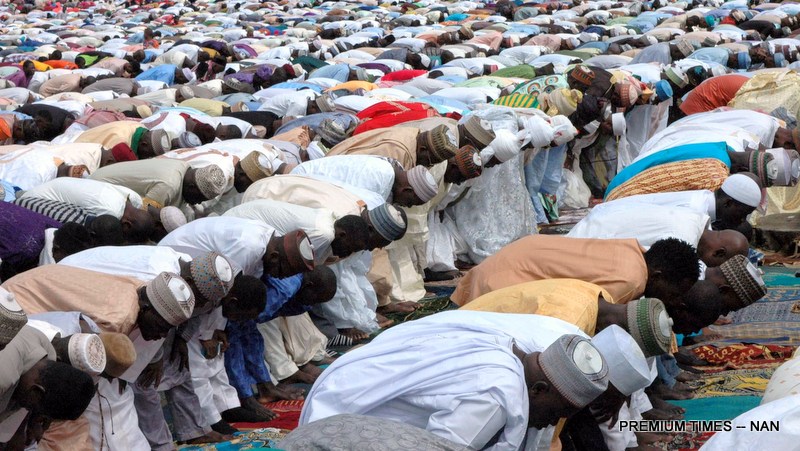
Muslims believe that during Ramadan, the Qur’an text was revealed to the Prophet Muhammad (S.A.W). Muslims celebrate Eid Al-Fitr with “Salat Al Eid” (Eid prayers). There is no audible call to prayer for the Eid prayers. Muslims will gather in mosques or open spaces and offer two units of prayer–called “Rakat”. The prayers are followed by a sermon, in which the Imam asks for forgiveness, mercy, and peace for every being worldwide.

To further bolster the sociological social solidarity and love in Islam, which clarifies Durkheim’s postulation, the other key element of the Eid festival is giving money to the poor alias ‘Zakat al-Fitr’, sending Eid greetings and feasting with families. For many Muslims, Eid al-Fitr is a festival to show gratitude to Allah for the help and strength he gave them throughout the month of Ramadan to help them practice self-control. The phrase commonly used by Muslims as a greeting on this day is “Eid Mubarak”, which is Arabic for ‘blessed festival’.

Muslims begin Eid with the observance of the Eid congregational prayer, sometimes in the mosque but usually in an outdoor location. Before going for the Eid prayer, it’s encouraged to take a bath, wear the most befitting clothes, and look dignified for the celebration. On the way to the Eid Prayer, Muslims recite the words: Allah is great, Allah is great, Allah is great. There is no other God but Allah. Allah is great; Allah is great. To him belongs all praise. And after the Eid prayer, people gather to feast with their families and friends, where they get to savour the taste of various dishes.

Some even travel to their hometowns or home countries to celebrate with their extended families and rekindle the bond of kinship. There is a rich tradition of gift exchange during Eid. For example, it is customary to gift new clothes and shoes to children in Nigeria. Sometimes, the children receive money to buy sweets and snacks to enjoy with their friends and cousins. In western countries, however, children receive gifts instead of cash, and parents decorate their homes to create a mood of excitement for the family.

Finally, Eid is meant to celebrate the completion of spiritual duty and a time to bond and exchange hugs, kisses, and laughter with family, friends and the community. Each country has traditional foods, and sweets prepared ahead of Eid or on the morning of the first day. These foods range from special biscuits and bread to cakes and puddings. On the first day of Eid al-Fitr, voluntary fasting is not allowed as Muslims are encouraged to feast and celebrate the completion of a month of worship and abstinence from food.

Greetings for Eid also vary depending on the country and language. For instance, in Indonesia, Eid is called Lebaran, so Indonesians would say, “Selamat Lebaran”, which means Happy Eid. Other variations of Happy Eid are “Barka da Sallah” in Hausa, a Nigerian language. In addendum, with clothes being an essential marker of Eid, some people wear traditional clothes from their culture, while others pick out something new to wear. Eid is a time for every Muslim to share and express love, peace, and friendship worldwide and extend hands to their non-Muslim neighbours and friends during this festival.

Hassan Idris wrote from Kogi State via idrishassan035@gmail.com.

OBITUARY: Nura Mustapha Waye, the genius behind ‘Izzar So’

By Habibu Maaruf Abdu

On Sunday, July 3, 2022, Kannywood lost a colossus and a rare talent, Nura Mustapha Waye. Thousands of condolences started pouring from all angles as soon as the news of his death broke. Waye was the director of Izzar So and many other series and feature films. His sudden death came as a tremendous shock and left the Kannywood members and millions of their audience with tears in their eyes.

“Waye’s death is a significant loss to Kannywood, for he’s, I believe, the most prolific director today.” So says the Kannywood leading scholar-cum-critic, Dr Muhsin Ibrahim, in his short tribute to the late director.

Nura Waye, or Malam Nura, as he was respectfully called, proved unique among his peers in the Hausa film industry. He neglected its favourite musical love stories to make topical Islamic compliant productions. His dream of educating the audience prompted him to incorporate Qur’anic verses and prophetical sayings into the dialogues of his most of his films.

“In filmmaking, there are messages you could send and get a divine reward from the Almighty Allah… I take film as a medium for propagating a particular policy or ideology. This is what primarily inspired me to venture into it,” he once told VOA Hausa in an interview.

Waye began his Kannywood journey in the late 1990s. He was an actor throughout his first five years in the industry. He, afterwards, switched to director to realize his ambition of making films with a didactic tone. His early films left no mark, and he remained unnoticed for over a decade. Kuru-Kuru (2018) was, perhaps, his first movie to get critical attention.

The movie, which deals with the issue of ‘incest’, revolves around a new bride whose husband finds to be pregnant. After a lengthy investigation, it’s discovered that her uncle is responsible for the pregnancy. The movie received positive reviews and was generally praised for its theme and steady plot. But Waye would never rest there.

He reached the pinnacle of his career in 2020 after creating the YouTube series IZZAR SO. It was a sensational hit, and it went on to become the most-watched Kannywood series on YouTube. Its remarkable success dictated the migration of the Hausa film business to the online platform. Muhsin describes it as a ‘game-changer’ and opines thus:

“There might be a few YouTube series before Izzar So, but many more emerged following its unprecedented success. This has inspired many filmmakers, both struggling and established, to resort to making series, serials and feature films for YouTube.”

For Waye, however, Izzar So was not just a success but a fulfilment. This is because it catapulted him to the top of his career, which was his ultimate goal. “I want Allah to elevate me to its top,” he said when asked about his dream in the filmmaking business.

Nonetheless, Waye’s films are only one aspect of his legacy. He, on another side, had a reputation for being a very gentle, peaceful man. He was also so decent that he hardly features an actress wearing a tight-fitting dress in his movies. These, together with his vivid love for the Prophet (S.A.W), endeared him to the Hausa-Muslim populace despite their hostility towards Kannywood members.

Finally, as a Kannywood movie reviewer, I affirm Nura Mustapha Waye’s rare creativity. I believe he will always be remembered as a socioreligiously-committed filmmaker who led to Kannywood’s migration to online space and, above all, ‘the genius behind Izzar So’.

Habibu Maaruf Abdu wrote from Kano, Nigeria, via habibumaaruf11@gmail.com.

Tribute to my late mother, Zainab Basiru (1957-2022)

By Nasiru Manga

My dear mother, as pilgrims converge at Mount Arafat today, marking the climax of this year’s Hajj, I can’t help but shed tears, remembering that it was one of the lifetime ambitions you didn’t live to fulfil as you passed on precisely 155 days ago. Had you been alive and healthy, you could have been among the over one million pilgrims standing at the plain of Arafat today in observance of one of the five pillars of Islam that not every Muslim is lucky to perform.

I know you craved nothing in this world more than seeing yourself circumambulating the house of God, Kaaba al-Musharraf, in Makka and visiting the holy prophet of Islam (PBUH) in Madina. This informed my decision the first time I was blessed with fortune enough to sponsor your pilgrimage about three years ago.

I remember your reaction vividly when I broke the good news to you as I was seated a few meters away, facing you after you finished your Duha prayers one Saturday morning. Your face radiated with joy instantly upon hearing my plan, and for the first time in my life, I noticed tears of joy cascading down your cheeks despite your effort to stifle them. This image of you has kept flashing on my memory all these five months since you met your creator. I remember how you made me blush as you kept showering me with prayers and words of blessings as it was your wont in every little thing done to you.

We started all the necessary preparations for your Hajj. That was when I got to know your actual date of birth, as I had never discussed it with you before. You told me you were sixty-four and born on Sunday, the 7th day of Ramadan. So, using the Hijri converter, I arrived on 7th April 1957, the date we used in all your official documents to anticipate your lifting up to the holy land.

I remember how we had an animated conversation over the phone on the first day you started attending the weekly lessons organised for intending pilgrims in Dukku. You excitedly told me what transpired at the session in minute detail from the attendants, the number of lessons’ teachers and all each of them said, while I was keenly listening, interrupting you only for more clarification. However, we were disappointed when the organisers brought the session to an end a few weeks later. To our disappointment, we learned that there would be no hajj in 2020 due to Covid-19 pandemic restrictions in the world, including the Kingdom of Saudi Arabia, thereby upending your plan to fulfil your lifetime ambition of answering the call of Prophet Abraham (PBUH).

I remember your response when it was suggested that you perform Umrah, when the Kingdom of Saudi started relaxing its Covid-19 restrictions. You told me over the phone that I should allow God to decide. You insisted that it should be Hajj first before Umrah. And you added: “If Allah so will that I will be there, they will push me even in a wheelbarrow, but if it was already written in lauhul mahfuz that I will not perform hajj, there is nothing you can do about it”.

Your health condition started deteriorating during the Covid-19 imposed two-year hiatus from Hajj. You had been a hypertensive patient, a regular visitor to the Federal Teaching Hospital Gombe, but you were never on admission until barely six months before you departed us. And even during your on and off admissions to the hospital, you were hopeful that the restriction would soon be lifted, and you would witness this day on the mount of Arafat. In fact, it was why you agreed to be hospitalised after your grandchildren convinced you that you should take your treatment seriously for this important day.

When I last saw you on a hospital bed, along with my wife and your grandchildren, you looked frail and not the spirited and good-humoured Maama I knew who would tease her grandchildren lovingly. But despite your condition, you were conscious of time for five daily prayers. The following day when I visited you, I heard you complain in a barely audible and soft voice about how your granddaughter did not wake you up in time to observe Subh prayer. I take consolation like a soothing balm in knowing that, as a follower of Tijjaniyya Sufi order, your mouth was full of Azkaar when you were placed on a ventilator about an hour before you took your last breath on 2nd Rajab 1443 (4th February 2022) after Juma’at prayer. It was around 3 pm that I received an unforgettable call from my kid bro and your youngest child informing me of the inevitable.

It’s been five months since you left us, Maama, but we have yet to come to terms with the vacuum you created. It has left an ineffable deep void in our hearts. Now I feel down every morning I wake up. I cannot hear your voice over the phone; listen to your never-ending prayers for me until I cut off the call. Your prayer for me, which I believe catalyses my success, is what I miss greatly. Images of you kept flashing in my memory when I last set my foot in your room which was a source of comfort and joy to everyone around you, especially your grandchildren, who thronged it for the daily goodies you preserved for them. My last call with you was on Wednesday, two days before your death, when I informed you of having an additional grandson, and I remember how you teased the new child calling him Moɗadimbo since his elder brother was called Moodibbo.

You taught me in your words and deeds how I should be generous and a happy giver, believing that what I give out to others is what’s mine, not what I spend on myself. I also learned altruism from you, as you were always concerned about the well-being of others above yours. The first time I brought you some stuff, you shared almost everything in my presence. This taught me a lesson not to buy things for you alone: I had to include my stepmother and uncle’s wives.

I remembered when once I visited you and discovered that your fan was not working. After buying you a new one, you insisted I  should do the same for my stepmother as her own wasn’t functioning too. Any time I visited, you would remind me to see so and so person, and while on the phone, you would tell me to call and felicitate or commiserate with so and so person, and you would ask me the next day whether I carried out your command.

I often felt guilty for hiding some of my problems from you because of your extreme care and concern for me. However, this was out of my respect for you, too, as you became more affected by my problem than I do. Missing you now is a heartache that will never go away.

On this Arafat day, which you had been longing for, I pray to Almighty Allah to grant you al-Jannatul Firdaus and forgive your shortcomings.

Nasiru Manga wrote from Dukku, Gombe State, via nasman@gmail.com.