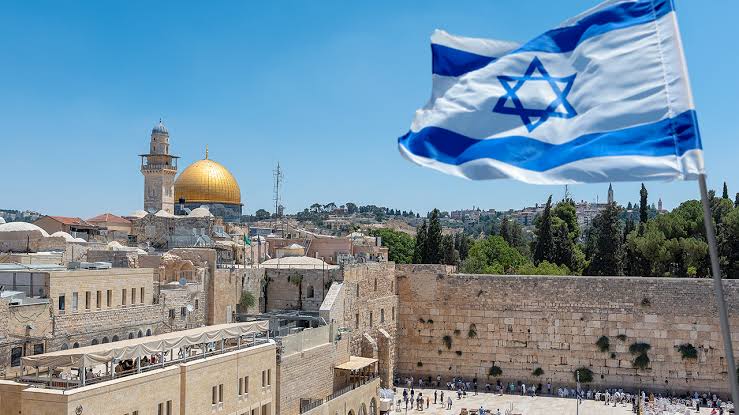
Judaism and Zionism: Untangling Faith from Politics in a Time of Middle Eastern Turmoil
By Dr. Umar Musa Kallah
As missiles continue to criss-cross the skies over Iran and Israel, and as the devastating consequences of the February 28, 2026, coordinated United States–Israeli strikes reverberate across the region , claiming the life of Iran’s Supreme Leader and exacting a heavy toll on civilians on every side, it is imperative that we, as Nigerians who hold faith dear, approach these events with clarity rather than confusion. The images of suffering from Tehran, Tel Aviv and beyond remind us that war spares no one. As a Muslim who abhors violence in all its forms and yearns only for peace to reign across the globe, for the sake of everyone, regardless of creed. I write not to inflame passions, but to illuminate.
Let us begin with precision. Judaism is an ancient monotheistic religion, spanning more than three millennia. It is anchored in the Torah, the prophetic tradition and an enduring covenant between the Divine and the Jewish people. At its core, Judaism is a spiritual and ethical path, one that calls believers to prayer, justice, charity and moral conduct. It is faith, pure and profound.
Zionism, by contrast, is a modern political ideology that emerged in the late 19th century amid the harsh realities of European antisemitism and pogroms. Conceived largely by secular thinkers such as Theodor Herzl, it sought to establish a national homeland for Jews in historic Palestine as a safeguard against persecution. While some religious Jews later embraced a variant known as Religious Zionism, the movement itself remains fundamentally political, an expression of national self-determination rather than religious doctrine. Importantly, Zionism does not equate to Judaism, just as nationalism does not equate to any faith. And crucially, Zionism is not an ideology directed against Muslims; it is a political project whose ramifications, displacement, conflict and geopolitical realignments, have touched the entire human family, inflaming tensions that now threaten wider instability, economic disruption and the loss of innocent lives far beyond the Middle East.
History bears witness to a different reality before these political currents reshaped the landscape. For more than fourteen centuries, Jewish communities thrived as protected minorities “People of the Book” , under Muslim rule in lands from Baghdad to Cordoba, from Fez to Tehran. They contributed as scholars, physicians, merchants and counsellors. Iran today still hosts one of the largest Jewish populations outside Israel, with citizens enjoying legal recognition, synagogues and parliamentary representation. Similar communities once flourished across the Muslim world. Their peaceful coexistence endured until the political realities surrounding the establishment of the State of Israel, coupled with ensuing wars and nationalisms, altered longstanding neighbourly relations. Zionism transformed the narrative; it did not define the faith.
Even now, Jewish voices are not uniform. Many observant and secular Jews from organisations such as Jewish Voice for Peace to progressive rabbis and ordinary families have openly opposed escalation, calling for restraint and compassion toward Iranian and Palestinian civilians alike. Iranian Jews themselves have largely distanced themselves from the conflict, prioritising their safety and loyalty to their homeland. Faith and political allegiance, once again, prove distinct.
To my Christian brothers and sisters across Nigeria, whose devotion often finds heartfelt expression in solidarity with “Israel,” I offer this reflection with utmost respect and sincerity. The modern State of Israel is a sovereign nation whose population is approximately 74 per cent Jewish, 18 per cent Muslim and merely 2 per cent Christian. Its policies and security concerns are those of a state, not a church. Judaism, as the elder sibling in the Abrahamic family, gave the world the Hebrew Scriptures that Christians revere as the Old Testament. Yet Judaism does not perceive Christianity as Christians perceive it: practising Jews do not accept Jesus as the Messiah or the Son of God, nor do they regard the New Testament as scripture. They await their own promised redeemer. This theological distinction is not a source of animosity but a simple fact of differing paths within the same monotheistic heritage.
Understanding this does not diminish Christian love for the Holy Land or the Jewish people; rather, it prevents the conflation of ancient faith with contemporary politics. Supporting the legitimate security needs of any nation is one matter; assuming the State of Israel embodies Christian doctrine is quite another. Zionism is the political vehicle of Jewish national aspirations in the modern era, related to Judaism by heritage, yet separate in essence and execution. Clarity here fosters wiser solidarity, rooted in truth rather than assumption.
In this hour of missiles and mourning, as a Muslim who prays daily for the cessation of all bloodshed, I beseech every Nigerian Muslim, Christian and beyond to rise above partisan slogans. Let us distinguish religion from politics, faith from ideology. Let us condemn violence wherever it appears, whether in state actions or retaliatory strikes, and advocate instead for dialogue, de-escalation and the protection of all minorities, including Iran’s Jewish citizens. True peace will serve every soul on this earth : Jew, Muslim, Christian and those of other persuasions alike.
May the Almighty, in His infinite mercy, grant wisdom to leaders, solace to the bereaved and swift healing to a wounded region. May bombs fall silent, so that mothers from every shore may once again embrace their children in safety. For in the end, the greatest victory belongs not to any flag or doctrine, but to humanity itself, united under the banner of peace.
That is the fervent prayer of one Nigerian Muslim who believes, without reservation, that only understanding and compassion can light the path forward.
Dr Umar Musa Kallah, a writer and community advocate, can be reached via yakubunasirukhalid@gmail.com.