Zamfara State Government

Bandits and Betrayal: Why negotiation is not the answer

By Muhammad Isyaku Malumfashi

There are people within this government who support negotiations with bandits, and this piece aims to address them. I wrote against former Governor Masari’s governance when he had negotiated with bandits in an article published by The Daily Reality newspaper, titled “How Governor Masari is Wrongly Governing Katsina State.” I’m doing the same to refute any move to negotiate with bandits at the expense of the government’s power.

Meanwhile, apart from the government’s “data boys,” the problem we now have is the “negotiation lawyers” who protect the government from criticism of negotiating with terrorists. As I have been saying, it is a failure of the government to negotiate with terrorists.

Not only I, but many security experts have opined that negotiating with bandits is futile. In fact, the governor himselfDr Dikko Umaru Radda, admitted during a call-in interview with Channels Television that he wouldn’t negotiate with bandits at their weakest point. We all applauded, as they have no justifiable reason for their actions and hence no grievances to present to the government for it to listen to. They should either surrender and cease fire, or the government should use force to wipe them out.

We’ve seen many such negotiations with bandits in both the previous administration and the present that have not borne fruit. Perhaps the Fulani terrorists breached the truce by breaking the agreement, thereby continuing to commit crimes against innocent citizens. 

The biggest problem is that they will come into town with weapons, as we’ve seen in the Kankara Local Government area, until people become accustomed to seeing them. Then, some will start to befriend them, so they, too, can get the opportunity to handle weapons. Thus, the country might become like Libya – God forbid – where arms became available to citizens as a result of government carelessness in the name of self-defence, and subsequently turns into a lawless state.

Because in Libya today, one with more sophisticated arms is the most feared and powerful being, just like a government. They can do and undo as they want. Nigeria, particularly Arewa, might face a similar fate, but I believe God will embarrass them. The worst thing about this negotiation is that even if there is negotiation, these Fulani bandits won’t take up any job that will earn them money. Instead, they’ll move to another town where there’s no security problem and continue their terrorist activities. If there’s another negotiation, they’ll move forward.

They wanted to pursue an agenda of conquest with great force, as in the 1804 Jihad. I know historians among us will relate better, though I’m not one; I’m a history enthusiast and studied it in secondary school. Thus, we’re not ignorant of the past. If we don’t forget, those Fulani bandits camped at the Kankara forest under the notorious bandit leader Babaru, aka, had to negotiate with the people of Yar Goje town, before they could target some villages.

Then, they got the opportunity to attack the Mantau village in Malumfashi, where they killed many worshippers during dawn prayers in the mosque and thereafter kidnapped many residents and took them to their camps. Although they later released them, the government claimed the release was due to a firefight with troops, but Zuma Times reported the opposite. We believe the latter, as the government didn’t present any evidence of casualties.

The Mantau village has been a headache for the bandits for years. They’re well-prepared and gallant, and on many occasions, they’ve hidden at routes where bandits pass by to attack and kill them. The village was a no-nonsense and fearful place for bandits. Even the day they attacked them, it was a raid, not face-to-face, which shows an act of cowardice. Therefore, the Fulani won’t stop terrorising; they’ll move forward until they’ve conquered the Hausa land entirely, as captured and masterminded by their ancestors for centuries.

Negotiation with bandits, even though it has never happened at the state level but at the local governments’ level, as seen in Jibia, Batsari, Kurfi, Kankara, and others, makes us suspect that even those that happened at the local governments’ level were with the governor’s consent. He doesn’t want to admit his failure or is afraid of reversing his stance on non-negotiation with bandits.

The idea is totally archaic and reckless because not everybody will sit down and watch people who killed their loved ones or bankrupted them through ransom payments be forgiven and allowed to roam freely, while the people they killed are no more. The properties destroyed or collected for ransom are not compensated.

Even the government’s careless move to empower repented bandits is not welcoming because they have enough money collected from ransom payments. Why should the government empower them with our money? I think the best approach is to empower the victims, not the repentant bandits. The government should also reintensify its security approach, especially given the recent surge in banditry attacks in eastern and southern Malumfashi over the past two days. May Allah restore absolute peace and stability in our towns, states, and the country at large.

Gumi backs Matawalle, calls for non-kinetic approach to insecurity

By Hadiza Abdulkadir

Prominent Islamic scholar, Sheikh Ahmad Mahmud Abubakar Gumi, has publicly endorsed the appointment of former Zamfara State governor Bello Muhammad Matawalle as Minister of State for Defence, arguing that his approach to insecurity prioritises dialogue and community engagement over purely military solutions.

In a post shared on his Facebook page, Gumi said security experts have long maintained that communal conflicts cannot be resolved through force alone, noting that military action accounts for “only about 25 per cent” of effective conflict resolution. He described Matawalle as one of the few political leaders who recognised this reality during his tenure as Zamfara governor.

According to Gumi, Matawalle’s outreach to aggrieved groups significantly reduced banditry in the state at the time, reopening major roads and markets that had been shut for years due to insecurity. He cited personal travel experiences along routes such as Gusau–Anka–Gummi and Wurno–Isa–Shinkafi–Gusau, which he said had become safe during that period.

“Cattle markets were opened, and life was returning to normal,” Gumi wrote, adding that the gains were later reversed following what he described as “military non-cooperation,” which led to renewed hostilities.

The cleric argued that Matawalle’s current role at the Ministry of Defence places “round pegs into round holes,” urging Nigerians to set aside “petty local politics” in support of what he called a new federal government paradigm shift in addressing insecurity. He concluded by praying for unity, peace, and progress for the country.

Gumi’s intervention has once again sparked debate, given his controversial role in public discussions on banditry and insecurity in northern Nigeria. While some supporters credit him with advocating dialogue as a pathway to peace, critics have accused him of being sympathetic to armed bandits—allegations he has repeatedly denied.

Security analysts remain divided on the effectiveness of non-kinetic strategies, with many arguing that dialogue must be carefully balanced with law enforcement and accountability. The federal government has yet to officially respond to Gumi’s remarks, but officials have consistently maintained that Nigeria’s security challenges require a mix of military action, intelligence-led policing, and community-based initiatives.

As the administration continues to recalibrate its security strategy, Gumi’s comments contribute to the ongoing national conversation on how best to end violence and restore stability across conflict-affected regions.

I can end Zamfara banditry in two weeks if given security control—Gov Lawal

By Uzair Adam

Governor Dauda Lawal of Zamfara State has accused political interference and lack of cooperation from security agencies of frustrating efforts to end the decade-long banditry crisis that has devastated the state.

Speaking during a media briefing with local journalists in Gusau on Monday, the governor lamented that despite deploying modern surveillance technology capable of tracking the movement of bandits, his government remains helpless because he lacks direct control over security operatives.

Governor Lawal said, “Sometimes, I can see the bandits moving around on my phone because of the technology we are using. I know where they are, where they go, and where they come from.

“But I cannot stop them because I have no power to command the security personnel. If I had that authority, I swear, within two weeks we would end this problem.”

Lawal disclosed that his administration has engaged more than 2,000 hunters and vigilantes from Yobe and Maiduguri, placing them on monthly salaries and equipping them with vehicles and weapons.

However, he expressed frustration that at one point, these recruits were barred from engaging bandits in Shinkafi after a directive was issued to halt their operations.

The governor noted, “This is our biggest challenge. We have men on the ground, well-motivated and ready to confront the bandits, but sometimes they are told not to act. What then do we do?”

Despite the setbacks, Lawal said his administration has spent heavily to support conventional security agencies, including the purchase of 150 new vehicles recently distributed to them.

He explained that he made the tough decision to provide such resources, even though accountability could expose his government to criticism, because he believes leadership is a trust from God.

Zamfara State has in recent years become the epicenter of banditry in northwestern Nigeria.

Armed groups kill, abduct, and displace villagers, often operating in broad daylight. The violence has left many women widowed and children orphaned, while farmers are prevented from cultivating their lands.

Kidnapping for ransom has become a routine source of funding for the armed gangs, worsening poverty and instability across the state.

The governor, visibly emotional, admitted that the situation sometimes moves him to tears, confessing, “There are moments I cry. I see where bandits should be stopped, but nothing happens because instructions have to come from Abuja.

“I have handed everything to God, but I will never stop doing what I can to restore peace to our people,” he added.

He also questioned the motives of the attackers, asking why they target poor villagers who can barely afford food. “What has the common man done to you?” Lawal asked.

He further pledged, “If you want schools, I will build schools. If you want hospitals, I will provide hospitals. If you want water, I will ensure you get water. All so that we can have peace.”

Governor Lawal accused political actors of exploiting insecurity for selfish interests, warning that such actions harm the entire state.

“Security has been politicized,” he said.

He declared, “Anyone enjoying this situation, or trying to use it for politics, may God disgrace them and expose their secrets. If they seek power, may God deny it to them. And if they already hold power, may God take it away, because the injustice has become too much.”

Despite the challenges, the governor reassured Zamfara residents of his determination to defeat banditry, vowing that his government would not relent until peace and stability are restored.

Zamfara govt halts political gatherings amid rising tensions

By Uzair Adam 

The Zamfara State government has banned all political gatherings and rallies across the state, citing the need to maintain peace and stability.  

The restriction, which immediately applies to all political parties, was announced following a political clash in Maru Local Government Area.  

Speaking with BBC Hausa, Mustapha Jafaru Kaura, the Senior Special Assistant to the Governor on Broadcast, Media, and Public Affairs, said the decision was taken to prevent further unrest after a recent incident in Maru that resulted in casualties and property damage.  

He clarified that the ban is temporary, not intended to suppress political activities but to ensure public safety. Security agencies have been instructed to enforce the directive.  

However, the opposition All Progressives Congress (APC) has rejected the move, arguing that it infringes on their rights. 

The party’s spokesperson, Malam Yusuf Idris Gusau, described the decision as politically motivated, claiming it was triggered by a recent APC gathering that unsettled the state government.  

“There is no law that permits the banning of political gatherings. Our party is registered at the national level, and our members are law-abiding citizens who will not engage in actions that threaten peace,” Gusau stated.  

The ban has sparked debate, with concerns over its implications for political engagement in the state.

Matawalle shuts down media over covering Zamfara PDP rally

By Uzair Adam Imam

There has been tension among journalists in Zamfara as the state government shuts down all the federal and private media houses for covering political rally of the Peoples Democratic Party (PDP).

The state’s Commissioner of Information, Ibrahim Magaji Dosara, in a statement made available to journalists, disclosed on Saturday.

Dosara said the state governor, Bello Muhammad Matawalle, also directed the State Commissioner of Police to arrest all pressmen that attended the event.

The Daily Reality gathered that the event was organized by the PDP governorship candidate, Dr. Dauda Lawal Dare.

Several reports indicated that Matawalle earlier announced a suspension of all political activities in the state over the resurgence of insecurity.

However, the PDP went ahead with its inaugural rally which enjoyed media coverage by the affected media.

Radio Nigeria Pride FM Gusau, NTA Gusau, Gamji Television, Vision FM, Al’Umma TV are among the media affected by the order.

Gov. Matawalle should not open a Pandora’s box

By Mallam Musbahu Magayaki

The Zamfara State Government has officially directed the inhabited communities of the state to carry arms for self-defence as a result of the insurmountable bandit’s attack shattering the state, leading to the destruction of lives and personal possessions of the zone’s commoners. This action, however, would add fuel to the sad development unfolding in the state and beyond by potentially making it unmanageable because everyone would have a gun to protect himself from these foreboding omens. This defensive stance would lead to an offensive.

The government should therefore be conscious that the Ukraine war, which induced President Volodymyr Zelensky to ring up civilians to take up arms in defence of Russia’s invasion of their state, was the result of Russia’s military outmatching Ukraine’s on every level. This implies that the Ukrainian military may be unable to withstand and deter a full-scale invasion.

Mexico should be a case of study as it became a precedent in the past that was destabilised by its innermost citizens when they were constitutionally allowed to hold weapons for self-defence. As such, we need to be thoroughly observing the situations in those developed countries and be capable of identifying those areas where they erred so that we would avoid repeating what they did.

Although Nigeria is one of the biggest African countries with military power, the one million dollar questions are: is our military number insufficient to strike back against these outlaws’ threat? Or are they not functioning effectively in this hazardous assignment? This action would seriously make the efforts of our brave military less appreciative as, in reality, they have been audaciously doing their best to safeguard our lives and properties day-in-day-out.

In a country like Nigeria, where a breach of law has prevalently become the norm, what can be expected to happen devastatingly if a citizen takes up arms? This is a wrong decision that should be changed to a better option. Moreover, what is the essence of creating various security units in the country if they cannot be utilised to defeat those terrorising the country?

Instead of coming up with this irrational idea, why not engage the state vigilantes, empower them with advanced sophisticated weaponry, and train them with military tactics to strengthen our military capacity? Zamfara government should, head over heels, request support from the Federal Government in employing more civilians for this vigilante unit in different angles of the state to fight these law violators.

Simply put, the government has shown its ineptitude in the fight against terrorism. Nonetheless, Borno State has faced more challenges from Boko Haram militias than Zamfara State, but its governor has never come up with the wrong notion of state dwellers carrying arms.

Mallam Musbahu Magayaki wrote from Sabon Fegi, Azare, Bauchi State via musbahumuhammad258@gmail.com.

Mixed reactions trail Matawalle’s N85m donation for Inyass Maulud

By Uzair Adam Imam

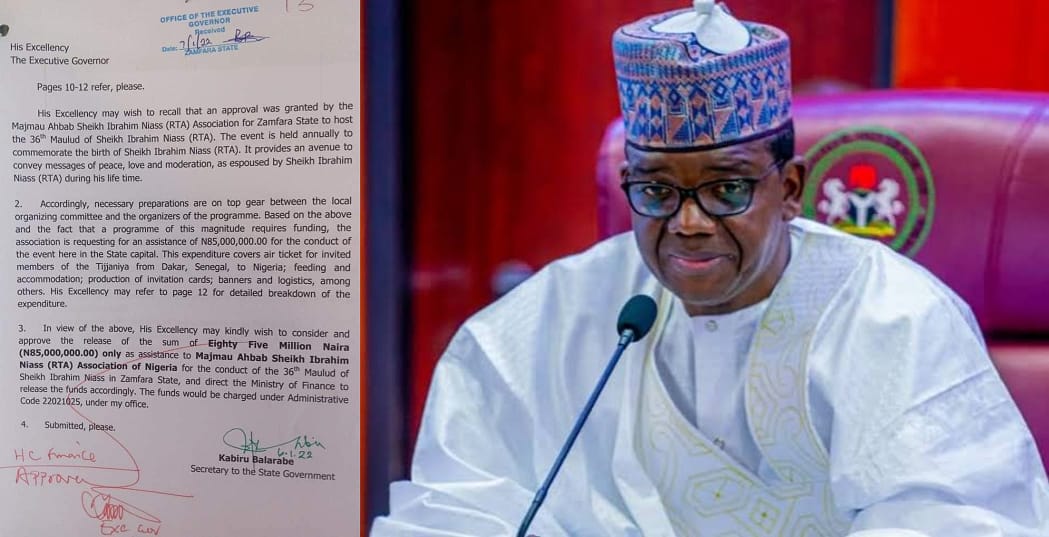
Mixed reactions have continued to trail Zamfara State Governor Bello Matawalle’s donation of N85 million for the conduct of the Maulud of the leader of the Tijjaniyya movement, Shaykh Ibrahim Inyass.

The state is fast making preparation to host 1.5 million Tijjaniyya followers for the event. The money covers air tickets of Tijjaniya leaders from Senegal, their accommodation, feeding, and other logistics for conducting the 36th Maulud Celebration.

Zamfara has been in the news following armed banditry and kidnapping for ransom that have claimed hundreds of lives, displaced thousands of others and destroyed property worth millions of naira.

The crisis has spilt over to neighbouring states like Katsina, Sokoto, Kebbi, Kaduna and Niger.

According to Zamfara Commissioner for Humanitarian Affairs, Disaster Management and Social Development, Hajiya Fa’ika Ahmad, there are over 785,000 internally displaced persons (IDPs), including women and children, in various camps across the state.

However, over 44,000 children were orphaned by the activities of bandits in the last nine years. Not only this, these orphans, who lost their parents to the blood-thirsty demons, are left to cater for themselves.

But since the donation was made public, individuals took to social media to condemn what they called ‘misplacement of priority’, saying the state government needs a rethink on the matter.

Misplaced priority’

According to Mrs Ahmad, there are more than 784,0000 internally displaced persons (IDPs), including women and children, in various camps in the state.

However, many concerned citizens described Mattawalle’s donation as a misplacement of priority, considering the number of people presently in dire need of support in the state.

An indigene of Zamfara State, Mu’azu Malami, said the money allocated for the procession should be used to address the plight of IDPs and fight insecurity.

Mu’azu Malami said, “In such a trying time, spending over 80 million naira on a one-day event, despite our challenges, is not but a misplacement of priority.

“By this time, the government should concentrate more on helping banditry-torn villages, especially women and children. They need to be provided with food, shelter and proper education.”

Abubakar Dahiru is another indigene who argued that the government should have initially declined the request.

He said, “The government should not think that it is helping Islam because only the leaders of this association will benefit and share the money among themselves.”

Isma’il Muhammad (not real name) said that the state government is confused.

He added, “IDPs in Zamfara should be the priority. The government should have done everything within its power to save their lives.

On the contrary, Anas Sunusi commended Zamfara State Government for the gesture, saying that other sects had received a similar kind of gesture from the state government.

Anas Sunusi, “I see nothing wrong in donating N85 million by the state government to commemorate the death of Sheikh Ibrahim Nyass.

“Izala had, at one time, received a similar gesture to build a university.”

He added that the amount could not stop the government from handling security challenges in the state, saying the gathering would be used as an avenue to pray for the state and the country at large.

We will bring peace to Zamfara’

In an interview with our reporter, a renowned Tijjaniyya cleric in Kano, Sheikh Nazirfi Alkarmawi, said the gathering is meant for prayer to reign in the state.

Alkarmawi said no matter what people say, the money would not be taken back.

He added, “Therefore, people must not grumble. The essence of this gathering is to pray for peace and prosperity across all states of the country.

“Concerning security challenge, we can only pray. The issue is beyond everyone’s expectations.”