Waste management

Waste to wealth: An introduction for students 

By Bilyamin Abdulmumin

A couple of days ago, the Lagos State government officially entered into an agreement with the Netherlands government to establish a waste-to-energy firm. 

The initiative was said to get rid of heaps of waste across the Lagos metropolitan area (about 2250 tons daily) and generate between 60 and 75 megawatts of electricity annually, providing some 40,000 homes. 

In addition, the Lagos State Governor Sanwo-Olu said the project will help cut down the country’s carbon footprint, as about 550,000 metric tons of carbon dioxide and other greenhouse gasses emitted daily from the dumpsite will be addressed. 

Singapore is one of the countries that is an embodiment of waste to energy. Singapore is said to have zero waste, thanks to its waste-to-wealth program. They completely convert their waste, partly into energy and other parts into recycling.  

Trust developed nations; they always think ahead. In Denmark, an innovative twist was added to this technology. Due to the extensive space occupied by the conversion centre, the top area of this facility would be transformed into a game reserve and tourist attraction. Who said you can’t kill two birds with one stone?

As Sanwo-Olu highlighted, the world is currently grappling with climate change, so several countries have been resorting to generating energy from biomass. This includes food crops (maize, sugarcane, cassava, etc.), lignocellulosic materials (e.g., woods), and waste (a mixture of biomass, petroleum products, and metals), the latest being the most expensive for conversion. By using waste to generate energy, countries would not only clean the environment but also cut down their carbon budget, hence mitigating the effect of the looming climate change. 

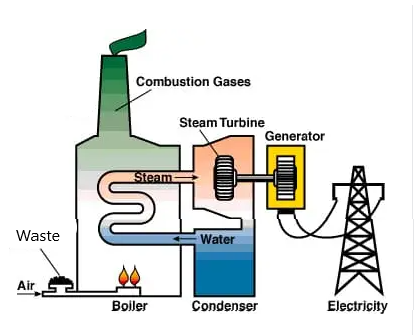
The most widely used technology for waste-to-electricity conversion is the combustion integration into steam turbines. In this process, the waste is burned in the boiler unit to generate steam, which generates steam channels to power the turbine and the movement of turbine generic electricity. But that is not all; the exhaust steam is channelled into a condenser unit, where the steam is converted back to the water, then finally the water is pumped to the boiler to complete the cycle.  

Applications of the laws of thermodynamics in each unit allow the energy usage analyses to make each step more efficient, that is, reduce energy waste in each section (boiler, turbine condenser, and pump). This technology is known as a steam turbine, one of the heat engines based on the principle of the Rankine cycle. A closely related heat engine is a locomotive rail or refrigeration and Air conditioning system based on Rankine cycles. 

 The second way to convert waste to energy is pyrolysis. In pyrolysis, waste is converted to oil instead of directly burning them. As mentioned above, these oils can then be burned in a boiler to generate steam and the cycle proceeds. Catalysts like zeolite can be used to upgrade the oil for use, such as petroleum.  The difference between pyrolysis and combustion is that in the former, oxygen is not allowed; in fact, pyrolysis means a lack of oxygen. In the former, oxygen is necessary; without oxygen, combustion will not occur, or there will be incomplete combustion if it is inadequate. 

The last category of technology for waste conversion is gasification; in this process, waste is converted to carbon monoxide and hydrogen (syngas); these gasses can be burned in a boiler to generate steam, and the process proceeds just as mentioned. Similarly, the syngas can be upgraded to synthetic fuels using metal catalysts like iron through popular technology known as Fischer-Tropsch. Depending on the quality, synthetic fuels produced may be used as petroleum, too. Gasification differs in combustion in the oxygen usage; in the former, oxygen is meticulously controlled.

Wise students will check out abundant videos on YouTube demonstrating these three categories of biomass conversion: combustion, pyrolysis, and gasification, the principles of Steam Turbines, Heat Engines, the Rankine cycle, and the Carnot Cycle, the applications of the laws of thermodynamics, and the catalysis involved in the bio-oil upgrade and the Fischer-Tropsch process.

If you are in the secondary or early years of a degree program and already aware of this information, then you are a step ahead, and you are not only fortunate than your peers but most of us at your level.

Bilyamin Abdulmumin wrote via bilal4riid13@gmail.com.
My Journey to Kassel (Documenta Fifteen): Lessons for Nigeria’s waste management

By Ibrahim Uba Yusuf

Since I arrived in Germany to complete the last lap of my PhD studies, I intended to start a travelogue on cultural shock. Unfortunately, my quest suffered a setback for two reasons. Firstly, I have a tight working schedule for writing my thesis on the Culture Industry (Hausa home videos) and their contribution to peacebuilding in northern Nigeria. Therefore, dealing with various raw data, literature, doctoral colloquium, and conferences was overwhelming. Secondly and sadly, I lost my stepmother Hajja Aishatu (may Allah have mercy on her soul), who has cared for us, including our aged father, since my mother died in 2002. Her death threw me into a state of confusion and thus compelled me to suspend it.

Now to the issue: the journey to Kassel. It was Eid-el Adha globally. Since it is not the first time I am experiencing Sallah outside Nigeria, I envisaged it would be dry. So, after observing the two voluntary Eid Prayers at about 6:10 am (German time), I proceeded to Hauptbahnhof (the central train station). The journey is about an hour on the ICE train (the fastest train in Germany) and about three hours on regional trains (which are slow but relatively cheaper) from Hildesheim. The journey to Kassel marks the end of a week-long UNESCO Symposium on Artistic Interventions in educational and social contexts organised by the UNESCO Chair, Professor Julius, who doubles as my German Supervisor.  

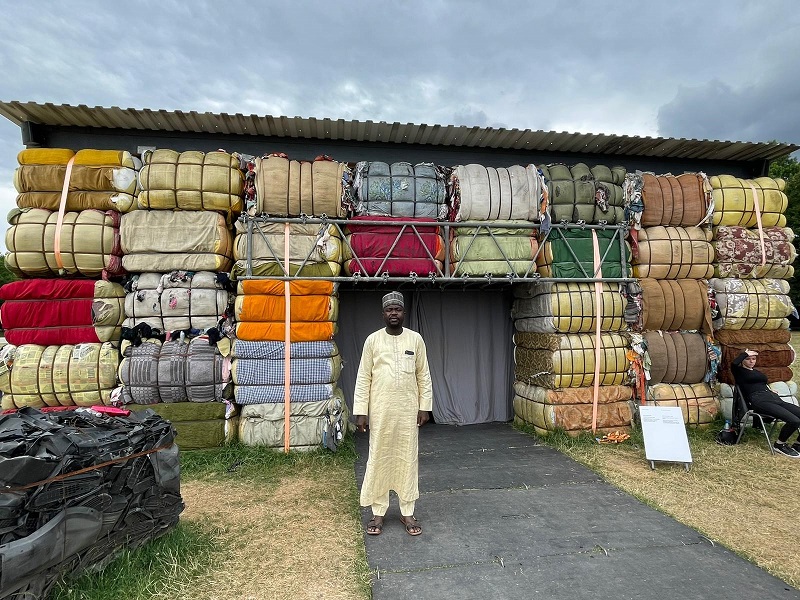
Documenta is one of the largest art exhibitions in Germany, which started in Kassel in 1955 with the sole aim of displaying a variety of contemporary artworks such as sculpture, film, photography and painting, among others. Held every five years, this is the fifteenth edition of the International engagement for arts. During the walk to various exhibition stands, I became interested in the open cinema in Karlswiese. This is due to my bias in broadcasting and film studies. The open cinema, a work by The Nest Collective, is tagged ‘Return to Sender—Delivery Details 2022’. It was locally constructed from dystopian waste to mimic the Global North. The dystopian waste was carefully packaged to serve as acoustic panels for the cinema walls to control external noise and echo.

In all honesty, this is my first time seeing such an amazing innovation. Scraps of electronic devices imported to the Global South were packaged and displayed for exhibition. The message embedded in this tag, ‘Return to Sender’, of course, suggests the frustration by the Global North and the radical position taken to mitigate not only importation but waste management. This dystopian waste introduces a new alternative to the existing acoustic panels in our television and radio studios, which is economical and easy to construct. In contrast to other acoustic panels, the installations offer a better aesthetic and sound control. I strongly recommend this innovation to our local cinemas (viewing centres), public and private broadcast stations, and Departments of Mass Communication and Performing Arts. I am not unmindful of the digitisation drive. While we continue the digitisation plan, I believe this can serve as an alternative that may be attuned to the sustainability discourse.

Unfortunately, Nigeria is among the countries with poor waste management. The Environment Performance Index (EPI) 2022 ranked Nigeria 168 out of 180 countries. Also, a United Nations Industrial Development Organization report shows that Nigeria produces 32 million tonnes of waste annually. With this record, Nigeria stands a chance of changing the negative discourse on environmental health, hygiene and sustainability.

Nigerians must change their nonchalant attitude toward indiscriminate waste disposal. As I write this article, one of my greatest challenges living in Germany is separating the waste into the appropriate trash cans. In Germany, paper, plastic and organic bio-waste are separated. Waste separation is comprehensive and taken seriously by both Germans and the government.

 While there is no Recycling Plant in the country, all those Baban Bola (scavengers) can be utilised and strengthened to ensure a clean environment. The services rendered by those people deserve special recognition. We must begin this campaign from our homes, schools, worship places, media and markets. Nigeria deserves to be clean.

Ibrahim Uba Yusuf wrote from Germany and can be reached at itsibrahimsite@gmail.com.

Youths tasked on eschewing hate speech, constructive use of new media 

By Muhammad Aminu 

Youths have been advised to eschew hate speech and use new media constructively for peacebuilding and sustaining peace and peaceful coexistence in their communities.

A communication expert and media scholar, Dr Ruqayya Yusuf Aliyu, gave the advice while engaging youths in a Critical Knowledge Production Dialogue Organised by the Center for Information Technology and Development (CITAD) on Wednesday.

Dr Ruqayya, who discussed the Roles of Youths in Peace Building From a Communication Perspective, said youths play active roles in conflict and peacebuilding situations due to their agility and activeness.

She reminded the youths that peace and peaceful coexistence are the bedrock for the development of any society.

“Youths can be used for good or bad, peace or violence; hence it’s imperative that they know the importance of their roles in peacebuilding in their communities.

“Although conflict is inevitable in any society, managing it matters most in escalating or de-escalating the situation, ” she added.

“You can be partisan, but avoid hate speech and use new media positively.

According to her, communication is relevant in peace building through mobilisation, advocacy, persuasion and behaviour change among the youths.

In another development, CITAD, in collaboration with eTrash2Cash, has trained 220 low-income women on plastic waste entrepreneurship in Bauchi.

Chief Executive Officer (CEO) of eTrash2Cash Abdullahi Salisu said the participants were trained to convert plastic waste into weaved bags, shoes, bangles, and flower vases, among others.

He said:” Items made from these wastes seem so original and authentic that one cannot tell if they are made from the “wastes” we improperly dispose of. Perhaps, one of the main reasons why so much keen interest is evident in the faces of the women beneficiaries.”

Some of the beneficiaries expressed their appreciation for the opportunity. 

Amina Bello and Hafsat Adamu said their newly acquired skills would enhance their living standard.

Hafsatu Adamu, while thanking the training organisers, said she benefitted greatly and had never known wastes could become useful in this way. “I’m proud to be a waste champion, and I will step down the training to my siblings, friends and immediate dependents,” she added.

According to Abdullahi Salisu, plans are underway to ensure that the trained women are continuously engaged and supported to keep cleaning the environment and support others to improve their lives and livelihoods.

Salisu said: “This social responsibility is continuous. It is non-stop. Other stakeholders have already expressed their interest to keep the impact going. We hope to keep engaging these beneficiaries through an innovation centre that will further help them in other areas of business development and entrepreneurship”.