Venezuela

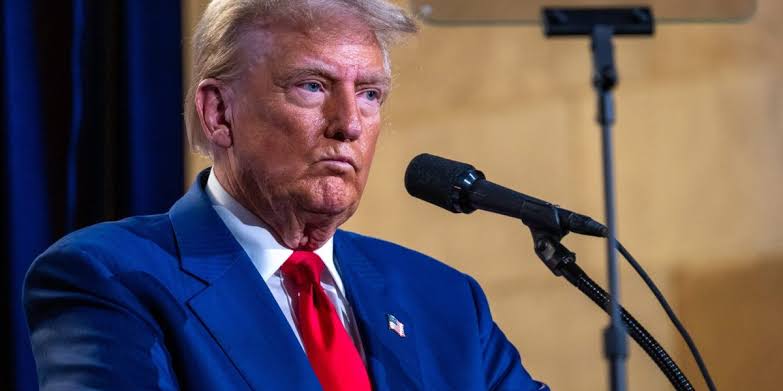
Trump parades himself ‘Acting President Of Venezuela’

By Sabiu Abdullahi

A social media post shared by United States President Donald Trump has stirred controversy across diplomatic and political circles worldwide.

Trump uploaded an image on his Truth Social account in which he was portrayed as the “Acting President of Venezuela.”

The post surfaced only days after he signed an Executive Order that declared a national emergency concerning Venezuelan oil proceeds kept in United States Treasury accounts.

The White House said the Executive Order was introduced to advance U.S. foreign policy and national security priorities.

According to official explanations, the order prevents any attachment, judgment, lien, execution, garnishment or other legal action against Venezuelan oil revenues and diluent sales deposited in U.S. Treasury accounts.

The monies, described as “Foreign Government Deposit Funds,” are to remain frozen except where specific authorisation is granted under the new directive.

The order further bans any form of transfer or commercial dealing in the funds. It also nullifies previous instructions that had guided or limited such transactions.

Authorities maintained that the revenues remain the sovereign property of Venezuela but are held in U.S. custody for governmental and diplomatic purposes only and cannot be accessed by private individuals or companies.

The U.S. Embassy has also raised concerns about Venezuela’s security climate. It advised American citizens not to travel to the country and called on those currently there to leave immediately.

In a security advisory dated January 10, 2026, the embassy restated warnings that have been in effect since 2019, when the United States withdrew its diplomatic staff from Caracas and halted consular services.

On January 3, 2026, U.S. military forces carried out a targeted mission in Venezuela which resulted in the capture of President Nicolás Maduro and his wife, Cilia Flores.

More than 200 U.S. Special Operations troops carried out a pre-dawn raid in Caracas. The mission, named Operation Absolute Resolve, focused on several sites, including the Fort Tiuna military complex.

Reports indicated that U.S. forces “dragged” Maduro and Flores from their residence inside the complex. They were transported to the USS Iwo Jima and later flown to New York City.

No American casualties were reported. However, reports said that dozens of Venezuelan security officers and Cuban special forces members acting as bodyguards to Maduro were killed.

Following the operation, Venezuela’s Vice President, Delcy Rodríguez, took the oath of office as acting president through the National Assembly.

She described the raid as a “kidnapping” and accused the United States of breaching Venezuela’s sovereignty.

American authorities described the mission as a law enforcement action. After Maduro and Flores arrived in New York, prosecutors unsealed an indictment.

The charges included narco-terrorism conspiracy, cocaine importation conspiracy and weapons-related offences.

The U.S. Department of Justice alleged that Maduro had presided over what it called a “cocaine-fueled” administration for decades.

Nobel Institute says Peace Prize cannot be transferred to Trump after María Corina Machado’s suggestion

By Hadiza Abdulkadir

Venezuela’s opposition leader Maria Corina Machado has said she would consider giving her Nobel Peace Prize to former U.S. President Donald Trump, drawing swift clarification from the Nobel Institute that such a move would not be possible.

Machado made the remark during a public discussion about international support for Venezuela’s democratic struggle, suggesting Trump’s foreign policy pressure on Caracas deserved recognition. Her comments sparked widespread reaction on social media and prompted questions about whether a Nobel Prize can be transferred.

In response, the Nobel Institute said the rules governing the Nobel Peace Prize are clear and final: once awarded, the prize cannot be given, reassigned, or donated to another individual. “The decision is final,” the institute said, underscoring that the prize is granted solely to the named laureate, to her in this case.

Machado, a former National Assembly member, was barred by authorities aligned with Nicolas Maduro from running in Venezuela’s 2024 general election.

She backed a stand‑in candidate widely considered to have won the vote, although Maduro claimed victory. Ballot audits by independent observers revealed irregularities in the official results.

Venezuela confirms at least 100 killed in U.S. raid that toppled Maduro

By Sabiu Abdullahi

Venezuelan authorities have announced that no fewer than 100 people lost their lives during a United States military operation that led to the removal of President Nicolás Maduro from office.

The country’s interior minister, Diosdado Cabello, disclosed the figure late on Wednesday. This marked the first official confirmation of the death toll since the operation took place on Saturday.

According to Cabello, “100 people died in the U.S. attack which removed President Nicolas Maduro from power on Saturday.” Officials had previously refrained from releasing a comprehensive casualty count.

Earlier, the Venezuelan military had released the names of 23 personnel who were confirmed dead. Government officials later stated that a significant portion of Maduro’s security detail was killed “in cold blood.”

Cuba also announced that some of its military and intelligence officers deployed in Venezuela died during the operation.Cabello further revealed that injuries occurred during the raid. He said that Maduro’s wife, Cilia Flores, who was detained alongside him, sustained a head injury. He also stated that Maduro suffered an injury to his leg.

The operation followed prolonged diplomatic and political tensions between Washington and Caracas. Over the years, the two countries have exchanged accusations over governance, security concerns, sanctions and diplomatic pressure. United States officials have repeatedly accused Maduro’s administration of failures in leadership and public security, claims that Venezuelan authorities have consistently rejected.

On Saturday, U.S. forces carried out a controversial mission in Venezuela that resulted in the arrest of President Maduro and his wife. American authorities later justified the action by linking Maduro to allegations of drug trafficking and narco-terrorism.

Federal indictments alleged that his administration aided the shipment of large quantities of cocaine into the United States. These allegations were presented as the legal grounds for his arrest.

After the operation, President Donald Trump publicly stated that the United States intended to assert control over Venezuela’s oil sector. He argued that the industry was built with American investment and accused Maduro’s government of taking over U.S. energy assets. In a post on social media, Trump said the United States would “run Venezuela and take over its oil” after Maduro’s arrest.

In his first public remarks following his transfer to the United States, Maduro described himself as “kidnapped” and maintained his innocence.

During a weekly broadcast on state television, Cabello announced that Venezuelan authorities had declared a week of mourning for members of the armed forces who were killed in the operation. He referred to the fallen personnel as “courageous.”

BBC bans use of “kidnapped” in Maduro arrest coverage, contradicts Trump

By Abdullahi Mukhtar Algasgaini

A directive from BBC News editors instructing journalists not to describe the arrest of Venezuelan President Nicolas Maduro as a “kidnapping” has sparked controversy, placing the broadcaster at odds with U.S. President Donald Trump’s own terminology.

Socialist commentator Owen Jones revealed an internal BBC memo on X, which stated that while journalists could use “captured” (if attributed to U.S. sources) or “seized,” they must “Avoid using ‘Kidnapped.’

“This editorial guidance clashes with comments from President Trump. When asked about Venezuelan Interim President Delcy Rodríguez’s use of the term “kidnapping” for Maduro’s detention, Trump told reporters aboard Air Force One, “It’s alright. It’s not a bad term.”

Maduro and his wife, Cilia Flores, pleaded not guilty in a New York court to narco-terrorism and cocaine importation conspiracy charges.

During the hearing, Maduro declared he was “kidnapped” and “a prisoner of war,” while Flores asserted her status as Venezuela’s first lady.

Following the operation, Delcy Rodríguez, Maduro’s former vice president, was sworn in as Venezuela’s new leader in Caracas. Trump asserted the U.S. was now “in charge” of Venezuela, warning its interim government to cooperate or pay a “very big price.”

U.S. airstrikes in Venezuela kill civilians amid capture of Maduro

By Abdullahi Mukhtar Algasgaini

A U.S. military operation to apprehend Venezuelan President Nicolás Maduro resulted in airstrikes across the country on Saturday, killing and injuring an undetermined number of Venezuelan civilians and military personnel.

The attacks have drawn international condemnation and plunged the nation deeper into crisis.

The strikes, which targeted locations including the capital Caracas, successfully led to the capture of Maduro and his wife, Cilia Flores. They have been flown to New York to be held in a Manhattan prison. The mission has polarized U.S. politics, with Democrats roundly criticizing President Donald Trump’s decision.

Venezuela’s government declared a state of emergency, condemning the action as “imperialist aggression.” The European Union stated it is closely monitoring the volatile situation.

The airstrikes mark an escalation of prolonged U.S. pressure on Venezuela. In preceding months, U.S. operations against vessels allegedly linked to Venezuelan drug trafficking had already resulted in multiple deaths at sea.

The incident occurs against a backdrop of severe domestic violence in Venezuela, where state security forces have long been implicated in extrajudicial killings and crackdowns.

Trump confirms US strike on Venezuelan vessel, 11 reported dead

By Sabiu Abdullahi

The United States military has launched an attack in the southern Caribbean, killing at least 11 people on board a Venezuelan vessel accused of transporting narcotics. Former President Donald Trump confirmed the strike on Tuesday.

Addressing reporters at the White House, Trump stated that American forces had “literally shot out a boat, a drug-carrying boat, a lot of drugs in that boat,” describing it as part of a broader push by his administration to confront cartels.

He later released a video on his Truth Social account showing a speedboat exploding in open waters.

According to him, those on board were members of Tren de Aragua, a Venezuelan criminal organization recently labeled a terrorist group by the U.S. Trump further alleged the group is “controlled by Nicolás Maduro’s regime” in Caracas.

“The strike resulted in 11 terrorists killed in action. No U.S. forces were harmed,” Trump announced.

Officials in Caracas quickly rejected Washington’s version of events.

Venezuela’s Communications Minister, Freddy Ñáñez, said the video posted by Trump appeared to have been produced using artificial intelligence.

Reuters reported that its initial review of the footage showed no indication of digital alteration, though the agency noted its verification process was still underway.

The Pentagon has not released specifics about the operation, including the quantity or type of drugs said to be on board.

This omission has drawn scrutiny from regional analysts. Adam Isacson, a security expert at the Washington Office on Latin America, cautioned, “This is highly unusual. Being suspected of carrying drugs doesn’t carry a death sentence,” pointing out that the operation resembled U.S. counterterrorism measures more than standard drug enforcement actions.

This was the first publicly acknowledged strike since Trump ordered seven American warships, a nuclear-powered submarine, and over 4,500 sailors and Marines into the Caribbean.

U.S. surveillance aircraft have also been active over the area in recent weeks.

Secretary of State Marco Rubio defended the strike, arguing that the narcotics “were probably headed to Trinidad or some other Caribbean country,” and pledged that the administration would continue targeting cartels.

The development has further strained relations with Venezuela, where officials accuse Washington of fabricating claims to justify military escalation.

Just last month, the U.S. doubled its reward for Maduro’s arrest to $50 million, alleging deep connections between his government and criminal organizations.

Caracas maintains that Tren de Aragua was dismantled during a 2023 prison raid and no longer operates in the country.

Venezuelans show support for Palestine during Quds Day event

By Sabiu Abdullahi

The Quds Day event in Venezuela’s capital, Caracas, attracted strong participation on Friday evening, with Venezuelans, local Muslims, and members of the Iranian and Palestinian communities attending in large numbers.

Speakers representing pro-Palestine organizations took the stage to denounce the actions of the Zionist regime and stress the importance of global backing for the Palestinian cause.

They noted, “The cause of Palestine is a cause of humanity,” reaffirming their dedication to standing against oppression and imperialism.

The event was held at Plaza de Juventud, a prominent square in Caracas, and included various programs such as live music and street theater performances.

These activities contributed to a dynamic atmosphere, further strengthening the sense of unity among supporters of Palestine.

Also, a declaration condemning Israel was publicly read during the gathering, and attendees were invited to sign a petition reflecting the same message.

To close the program, a short film titled Hide and Seek, directed by Iranian filmmaker Morteza Sazandeh, was screened for the audience.

The organization of the Quds Day event involved Venezuelan citizens, the country’s Ministry of Culture, the Cultural Attaché of the Islamic Republic of Iran in Venezuela, local NGOs advocating for Palestine, and Iran’s Art Bureau of the Islamic Ideology Dissemination Organization.