Umm Khalid

Marriage is doubles tennis

By Umm Khalid

I used to play tennis in high school on the girls’ tennis team. I always preferred playing singles to playing doubles.

Playing singles means you are playing by yourself with no one else on your team. You face off against another individual opponent. I found playing singles easier because it was simple: I knew that every ball that comes over the net was my responsibility. No one else was there to share the responsibility with. Playing a singles game is straightforward. One on one.

But it is exhausting. Every ball is your responsibility. There’s no one to help you, no partner to get the balls you can’t reach, no one to back you up. You have to run back and forth to cover the length and width of your side of the court by yourself.

Playing doubles tennis, on the other hand, means you have a partner and the two of you are a team facing off against another team of two. You and your teammate work together to hit the ball back over the net, so each of you has fewer balls to hit, less court space to cover.

But I hated it because it’s very easy to lose when you play doubles. Very often, the ball comes sailing right between the two of you as both of you look, startled, at one another and neither person hits the ball.

The first person assumed that the second was going to get it, and the second person assumed that the first person was going to get it. Neither gets it, and the ball bounces off the court and you lose the point.

Continue playing like this, and you lose the game, the set, and the match. You walk off the court, defeated and disappointed.

Marriage is a little like playing doubles tennis. The only way to win is to have well-defined tasks and to communicate CLEARLY with your partner. The two of you must coordinate so that nothing falls through the cracks. Each person knows exactly what he or she is going to cover. You know you’re on the same team and that you’ve got each other’s back–but you still need to talk about who’s going to do what and what your expectations are and ask for help when you need it.

To have a good marriage, the husband and wife need to work together like a well-oiled machine.

It is, of course, challenging to work so closely with another person, to coordinate tasks, to divide labor evenly based on each person’s strengths.

This is why many modern women prefer to just play singles games, living the single life without the hassle of being on a team or dealing with another person.

But living that single life is exhausting and lonely. Sure, you don’t have to work things out with anyone else and can do things all by yourself…but… you are all by yourself.

Marriage is a joint effort for the sake of Allah, a combined struggle of both the husband and the wife to build and maintain a strong Muslim family. The husband and the wife are a team: they each have clearly-defined assigned roles, but they also don’t hesitate to lovingly step in to help one another if it’s needed.

If you play it right, you can reap all the benefits of playing doubles tennis without the drawbacks.

Make sure that you:

  1. Have a clear division of labor, so each person knows which side of the tennis court they’re responsible for. In marriage, we call this gender roles.
  2. Communicate clearly, so no points are lost due to each person expecting the other to hit the ball. In marriage, the husband and wife have to communicate effectively with each other to decide which non-obvious tasks fall under whose domain so that all tasks are covered.
  3. Ask for help if you need it, so that unlike in a singles game, your doubles partner can bail you out or back you up if you try to hit your ball but miss. In marriage, each spouse has a well-defined role, but one of the beauties of marriage is the ability to ask your spouse for help if you need help. Marriage is a soft, loving relationship between a man and a woman who have love and mercy for one another. You have someone who will willingly step in to carry your load on the days you find it to be too heavy, until you get back on your feet.
  4. Be a team player, not selfish, self-centered, or negligent of your role. In our modern age, hyper-individualism has made many people selfish and narcissistic, putting themselves and their own individual whims above the needs of the group or their role in the collective. When you play selfish, whether in tennis or in marriage, you lose.

May Allah bless our marriages, our homes, and our families, ameen.

Easygoing, chill husband is an enormous blessing

By Umm Khalid

When I was in college and still single, I was considering a proposal from a certain brother (named Daniel).

I had a conversation with one of my closest friends about what qualities are important to look for in a husband. Alhamdulillah, this Saudi friend was 5 years older than me and had seen many of her peers get married, and she gave me some wise advice.

She told me, “After checking on the basics, his deen and his خلق (character), you know what the most critical qualities are? He needs to be هَيِّن لَيِّن.”

These two Arabic words refer to basically the same general characteristic: one of ease, leniency. A man who is laidback, relaxed, easygoing. Basically, he should be a chill dude.

Of course, he can’t be chill about everything. We all have to stand for something, to care deeply about SOME issues, to be strict in SOME matters. But he should be strict when it matters, when it’s warranted; like when it comes to the commands and limits set by Allah, for example. Then he should absolutely not be chill or lenient, as that amounts to negligence and abandonment of the laws of Allah, and that leads to destruction.

But when it comes to other matters, smaller issues of inconsequential everyday things, you want your husband to be laidback. Not uptight, nitpicky, rigid, inflexible, exacting, OCD about the littlest things, overly sensitive to every small detail. Some people, just by their nature or personality, would be classified by most as “difficult people.”

You don’t want this type of rigidity in a husband. It makes everyday life unnecessarily stressful. Life is already hard enough by itself, that the last thing we need is a spouse who nitpicks and needs everything to be just so. Then married life would be a nightmare.

A good husband is a man who is tough or strict when he needs to be, but with his wife in their home life, he is relaxed and easy. He has a fun side and a sense of humor about life’s ups and downs, and is understanding when things go south. He is lenient with her and indulgent and forgiving (up to a point, of course! Within reason!). He doesn’t, for example, ask her why she moved this small object from this side table to the coffee table, or castigate her for accidentally putting in the wrong address into the GPS, or flip out if dinner is 15 minutes late or on the verge of being under-salted, or interrogate her about small and inconsequential details that are innocuous. Someone who acts this way is usually not easy to be around or live with.

You want your husband to be easy to live with. Because… you will live with him.

Alhamdulillah, now looking back more than a decade later, I completely confirm that advice. An easygoing, chill husband is an enormous blessing.

Of course, the thing is: as a wife, don’t forget to return the favor! If you are blessed with a chill husband, extend the same courtesy back to him and let the little things go. Don’t nitpick or nag him when he annoys you. No person is perfect.

Homeschooling, “American Islam” as seen through a non-American Muslim’s eyes

By Umm Khalid

I was at a park yesterday with a couple of friends (other homeschooling moms) and our kids. A fellow Muslim woman passed by where we were sitting and we exchanged salams. She approached me and asked, “بتحكي عربي؟” (“Do you speak Arabic?”) “Yes, I’m Egyptian,” I told her in Arabic, shaking her hand and gesturing for her to sit and join us. The rest of the conversation flowed in Arabic, her Jordanian dialect and my Egyptian one.

She gave me many important things to think about in this exchange. She sat down next to me and looked around curiously at the large group of kids playing rowdily around us. “Are these all your children?” she asked. “Yes, it’s the three of us moms here and these are our kids,” I replied.” Are you guys related? Are you all Arabs? How did you get together/find each other?” she asked. “We’re all friends,” I explained. I gestured at my two non-Arab companions nearby, an African American mom and a Latina mom: “My friends here are not Arabs. This sister is American, a convert actually, and this other sister is Hispanic.” She was surprised and seemed riveted. “To be honest, I was so fascinated when I saw you guys from a distance and all your kids playing together so well. Black and white. I didn’t know there was a third ethnicity in there too!” She told me a bit about herself and her background. She was a Jordanian young woman, 24 years old. Just arrived in America last year from Jordan. She didn’t know the system here yet and was especially confused by the school system. She looked again at the kids, who were now piled on top of one another (there are masha Allah ten boys total, so there tends to be a lot of wrestling).

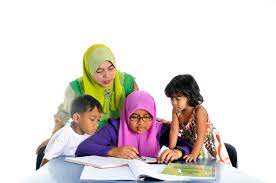
“Are they in school? Is today an American holiday?” she asked, probably wondering why all these school-aged children were roaming around at a park instead of seated at desks in a classroom somewhere.” No, it’s not a holiday today. We home-school (in Arabic: تعليم منزلي ).” She gave me an intrigued look, fascinated. “What does that mean? I don’t know anything about this. Is homeschooling allowed? So your kids are not associated with *any* school at all? Who teaches them?” “Me,” I said simply. “I teach them. No, they are not associated with any school at all. It’s not necessary. Homeschooling is allowed and many families home-school. I know that it’s not really a thing in our Arab countries. We don’t hear about homeschooling in Egypt, or in Jordan either. But here, homeschooling is a perfectly legal option and there are lots of homeschooling families, alhamdulillah.” She nodded, interested. “What do you teach them in your homeschool?” “Qur’an mostly,” I answered. “We spend most of our class time memorizing Qur’an, then learning Tafseer, some hadith, and Arabic class, in that order. Then we also have an English class, Math, science, and Art. Some of these other classes are weekly, not daily. We also work on projects that the kids are interested in.”

“Why do you homeschool?” she asked the question I get asked the most.” I don’t want my kids to be raised by people I don’t know and don’t share core values with. That’s how it is in American public schools. I know because I went to American public schools. And it’s only gotten worse since I was in school. It used to be that you’d see boys and girls doing all kinds of things in the hallway at school, or sometimes hear kids swearing or using foul language. Nowadays, it’s escalated like crazy. Now it’s two girls or two boys doing all kind of things in the hallway at school, and kids looking at porn on their phones and teaching one another immoral things. Not only is it the kids, but this over-sexualized and LGBT+- stuff has made its way into the school curriculum itself! It’s not just the kids, it’s in the textbook, the teachers! This is what they teach kids in school now. And this is only *one* of the reasons,” I told her.

She nodded, understanding dawning on her face. “Yes, I did notice that the LGBT thing is big in America. That’s actually one of the first things I noticed immediately upon coming to this country. It’s one of the things I still haven’t gotten used to even though I’ve been here a whole year now,” she said. I asked her, “I know! It’s a huge culture shock. What were some of the biggest things that have shocked you, coming from Jordan to America? “She thought for a second, then replied, “I’ve been shocked by the number of concessions ( تنازلات ) Muslims make in living here in this country. I hadn’t been aware of that in Jordan, and it caught me by surprise and I still haven’t gotten over it. I have two brothers in high school here, and they see all kinds of things in school and tell me about it. They are both forced to shake the hands of females, but it’s hard not to, because of the culture. We met some Jordanians here who told us that they use riba (interest). We can’t look around without our eyes falling on some haram thing. It’s concession after concession. And I’m shocked at the Muslims here who seem totally fine with it, even though none of this is part of Islam!” I shook my head, acutely aware of her pain. I feel it too, but it was different to hear such clear, honest words coming from a Muslim who was freshly arrived from a Muslim, Arab country and confronting the reality of “American Islam.”

What would this Jordanian girl say if she found out that there are American Muslim “shaykhs” who encourage Muslims to hold hands with gay activists? How would she react if she heard that famous American Muslims keep insisting that as Muslims, we support “the right” of people to engage freely in haram acts? How much more shocked would she feel when she heard that popular American “imams” and “shaykhaz” were pushing feminism like it was candy to the Muslim population? So I simply told her, “You are absolutely right. I am still shocked at the same exact things, and I’ve been here for decades. It is just shocking. I hope I never get used to any of this or start thinking any of these things are normal. And this is another reason why I don’t allow my kids to enter these schools; I don’t want any of this to be normal for them, either.”

“Going to American schools every day will definitely normalize a lot of things,” she agreed. “I worry about my brothers. But alhamdulillah, they are older going into it. At least they were raised in Jordan and know enough not to be too swayed by the stuff they see here in these schools. I’d be frantic with worry if my brothers were in elementary school here, for example.” “Yes, younger kids are more vulnerable. The first years of a child’s life are for building a foundation (تأسيس ), and it needs to be done right, especially for us Muslims. Unfortunately, what sometimes happens in this country is that Muslim parents aren’t paying attention, and their kids enter non-Muslim schools from age 4 or 5 until age 18, and the change they undergo is drastic. It’s like entering a machine: you go into it a Muslim on the fitra, and come out the other end either barely still Muslim with warped views, or just an atheist or an agnost, والعياذ بالله.

For me, homeschooling is not optional. It’s mandatory. I have no other choice. If it’s a choice between the Deen of my kids and literally any other thing, there is no choice in the matter. They are my amana (أمانة), my responsibility before Allah.” She surprised me by saying, “You know, you are the minority here. You are not like the rest of the Muslims I’ve met so far in America. None of them do this homeschool thing. They send their kids to regular American schools and think nothing of it. They’re even a little proud maybe, that their kids are going to be Americans and learn to act and dress and speak like Americans. They care about the material (الماديات) and don’t seem too concerned about the effect of this society on their kids. They worry about things like if their kids will be able to fit in or not, if their kids will get good jobs or not, etc.” Long after the conversation ended and the sister left, I sat pondering her words, her assessment of the American Islam she was confronted with upon her arrival to America.