UDUS

Tragedy of losing a mentor and father: Tribute to Prof. Yusuf Saidu

By Jamilu M. Magaji

In the weaving of life, exceptional individuals leave a lasting impression on the hearts and minds of those they meet. Today, I grieve the loss of a truly extraordinary person who exemplified greatness through his steadfast dedication to his beliefs, compassion for humanity, and inspiring leadership that influenced many lives.

I was tidying up titbits for the June issue of FUBK Chronicle Magazine when I received a call from my former senior colleague, Mal. Abubakar Adamu recently retired from Federal University Birnin Kebbi (FUBK). He delivered the shocking news that prevented me from continuing my work until the following day. Social media was flooded with continuous updates on the tragic event. I hurried to pick up my children from school and return home, filled with sorrow and dismay.

When I joined the services of FUBK in 2014, I questioned the future of my career progression in the newly established institution. I pondered the obstacles of starting a new department, particularly as a founding staff member. My encounter with Prof. Yusuf Saidu proved to be fruitful. I worked closely with him for nearly seven years, serving as Chairman and Secretary of various committees. He was crucial in establishing the Federal University Birnin Kebbi Seminar Series as the founding Chairman in 2015.

Prof. Yusuf Saidu exemplified integrity and exceptional qualities. His extensive administrative and professional expertise positively influenced my professional development and the institution we both served. I believed he was destined for greater achievements. His diligent work ethic and inspiring nature served as a beacon of motivation for many. His leadership approach was exceptional, earning trust in carrying out demanding tasks assigned to him.

Yusuf Saidu is a Professor of Nutritional Biochemistry at the Usmanu Danfodiyo University, Sokoto (UDUS), Nigeria. He graduated in 1990 with a B.Sc. degree in Biochemistry from UDUS, winning the Northco Holdings prize for the best-graduating student in Biochemistry. He obtained an M.Sc. in Biochemistry from the University of Jos in 1994 with distinction and had his PhD in Biochemistry from the UDUS in 2005. 

Bandits killed Prof. Yusuf Saidu on June 24, 2024, en route to Kaduna for an official engagement. Until his sudden death, Prof. Saidu was the Deputy Vice-Chancellor, Research, Innovation and Development of UDUS. He was the Director Research, Innovation and Development, UDUS and the University Governing Council member representing Convocation. He served as a member of the TETFUND Standing Committee on Research and Development and a member of the National Research Fund Screening and Monitoring Committee. He was equally a member of the Education and Training Committee of the International Union of Biochemistry and Molecular Biology. Prof. Saidu was the Head, Department of Biochemistry, UDUS (2018-2020) and the pioneer Head of the Department of Biochemistry and Molecular Biology, Federal University Birnin Kebbi. He also led many other ad-hoc and standing committees at UDUS and FUBK.

Prof. Saidu, a Fellow of the Nigerian Society of Biochemistry and Molecular Biology (FNSBMB), was widely published with over 100 papers and three (3) patents to his credit. He attracted research grants from the Education Trust Fund (now Tertiary Education Trust Fund), Abuja, Nigeria; the International Foundation for Science (IFS), Sweden; Raw Materials Research and Development Council (RMRDC) and Science and Technology Education Post Basic (STEP-B). His research interests are in oxidative stress and pathogenesis of diabetes mellitus/hypertension, as well as the elucidation of the mechanism of action of medicinal plants used to manage diabetes mellitus and infant and preschool children.

As a visionary leader, Prof. Yusuf Saidu motivated others to achieve their full potential and strive for excellence in all their endeavours. He set a remarkable example, guiding them with wisdom, patience, and unwavering support. His ability to lead with integrity and humility earned him the respect and admiration of all his colleagues, leaving behind a legacy of empowerment and growth that continues to influence those he mentored.

In 2021, I paid tribute to his appointment as the pioneer Deputy Vice Chancellor of Research, Innovation, and Development at UDUS. I recalled a citation from Prof. Sahabi Danladi Mahuta during Prof. Yusuf Saidu’s inaugural lecture in 2017, where he boasted of having a great friend in Prof. Saidu. I, too, celebrated and acknowledged him as a remarkable mentor. Today, with a sense of longing, I mourn the loss of my esteemed mentor.

Prof. Saidu was a leader, mentor and guiding light in a world often clouded by darkness. His remarkable attributes, profound religious dedication, compassionate qualities, and forward-thinking leadership have had a lasting impact on all who know him. As we say goodbye to a cherished mentor and father, let us carry on his legacy of love, empathy, and leadership, ensuring that his memory remains alive in those he influenced and guided.

I express my sincere condolences to the immediate family of the deceased. I also sympathise with all his extended family members in the academic community at UDUS, UNIJOS, FUBK and the entire country.

May his spirit continue to inspire us, his light keep shining brightly, and his legacy of exceptionalism always be cherished in our hearts. May Allah (SWT) grant him eternal bliss in Aljannah. Ameen

Malam Jamilu Magaji, Head of Information and Public Relations at Federal University Birnin Kebbi, wrote via mjmagaji@gmail.com.

I never chose Pharmacy, Allāh chose it for me – UDUS Pharmacy’s best-graduating student

By Mutalib Jibril

With ten awards and a CGPA of 4.88, Abdulsalam Ibrahim recently emerged as the best-graduating student of the Faculty of Pharmaceutical Sciences, Usmanu Danfodio University, Sokoto, for the 2022/2023 academic session. In this interview with Mutalib Jibril, after the Induction ceremony held on May 10, 2024, he speaks about his educational journey and how he achieved this feat.

Who is Abdulsalam Ibrahim?

Abdulsalam Ibrahim was born to the family of Alhaji Hussaini Abdulsalam and Hajiya Bashirah Ibrahim Abdulsalam in Minna, Niger state. I hail from Zungeru, Wushishi L.G.A of Niger State. I’m the fifth child of a family of six. I had my Primary and Secondary education at Minna before proceeding to the then School of Matriculation Studies, UDUS. I was admitted to study pharmacy at the most prestigious faculty of pharmaceutical sciences, UDUS.

With a Grade Index of 4.88, you emerged as the 2022/2023 best-graduating student of the faculty of pharmacy. How was this possible?

Alhamdulillah for the blessings of Allah upon me. Emerging as the best-graduating student is only possible because Allah has destined it to be so. Numerous factors contributed to this being a reality. Many of which are external and beyond my control. It couldn’t have been the hard work or the consistency. Many of my classmates were more hard-working and consistent. In summary, pray to the Almighty Allah always, try your best in a healthy manner and leave the rest. What Allah wishes for you will always prevail whether you like it.

Why did you choose to study Pharmacy?

 I never chose pharmacy. Allah chose pharmacy for me. After completing the school of matriculation studies, UDUS (2016/2017 set). I was admitted to study medicine and surgery at the university. However, due to some challenges the university faced with JAMB, some of our admissions had to be changed to other courses. It was a bitter experience for me because I wanted medicine. After attending some lectures on the History and Ethics of Pharmacy, a course offered at 100 level. I became interested in the profession and decided not to write another JAMB. The rest is history.

Would you say you knew you were going to be the bestgraduating student?

Not until some days before the induction did I know. Of course, the chances were high because I always had one of the best results in my class right from 100 level. The class was competitive with many hardworking, consistent, outstanding and intelligent scholars. Hence, the name “Mavericks” class of 2022”. The environment was encouraging because everyone contributed, and there was always much to learn. Alhamdulillah

What was your reading schedule like?

I don’t have a specific reading schedule. Pharmacy is overwhelming, with extended hours of lectures and practicals. The time available is always not enough. You keep studying even when you get tired. To pass a course with 50% as the pass mark is not for the lazy. Some courses even require a minimum of 60%. So, I was able to adapt to the system. The time at my disposal always determines my reading schedule for that particular time, except for my 100-level days when there was ample time to study during the day and sleep at night.

Which area of the course did you find most interesting?

Clinical pharmacy (therapeutics) and pharmaceutical microbiology.

How many awards did you receive? Please list them

10 awards, Alhamdulillah. These are:

– PCN award for the best-graduating student.

– Nigerian Association of Pharmacists in Academia (NAPA) award for the best graduating student.

– The faculty of Pharmaceutical sciences, UDUS award for best-graduating student.

– Award for the best-graduating student in clinical pharmacy and pharmacy practice.

– Board of Fellows of Pharmaceutical Society of Nigeria award for the best graduating student in clinical pharmacy and pharmacy practice.

– Award for the best-graduating student from Niger State.

– The faculty of Pharmaceutical Sciences has a UDUS certificate of distinction.

– PSN, Kebbi state cash award for the best-graduating student.

– Centre For Advanced Medical Research and Training (CAMRET) cash award for the best-graduating student.

– Bioraj Pharmaceuticals cash award for the best-graduating student.

Did you engage in extracurricular activities or take up leadership roles during your stay at the university?

Yes, there were some leadership roles. I served as the Asst. Sec. Gen., Pharmaceutical Muslim Students’ Society of Nigeria (PMSSN). I also served as deputy Ameer, PMSSN. I was part of the Imams at the Masjid in Amanawa Hostel for two sessions. I served as deputy Ameer Association of Muslim Health Students(AHMS).

I was Organizing Secretary NANISS Health wing (National Association of Niger State Students). I served as Sec. Gen., PANISS (Pharmaceutical Association of Niger State Students). And also President PANISS.

What was your best and lowest moment while in school?

My best moment was at the 200 level, when I passed all my courses with distinction, while my lowest moment was at the 300 level.

What are your future aspirations in your field?

I want to be a specialist in cardiovascular therapeutics or psychiatry. This will help me give back to society in a community or hospital setting. If Allah so wishes, I would like to be a researcher and teacher in clinical pharmacy or pharmaceutical microbiology.

What would be your advice to students aiming to attain academic excellence?

Restrict yourself from toxic situations. Know your limits. Maintain your physical and mental well-being. In academic settings, the brain does the work. You can easily achieve a lot in little time with a healthy lifestyle. 

Secondly, you need to start strong and be consistent throughout. Your academic performance is a cumulative result of your effort from the 100 level. Additionally, always start reading early to grasp the concepts efficiently. This also allowsfor repetitive study. Proper understanding always saves the day. 

Finally, always pray to Allah in everything you do. Eat well, sleep well, work hard, and trust in Allah.

Embracing local production key to tackling exchange rate volatility in Nigeria – Don

By Jamilu M. Magaji 

Nigerians from all walks of life have been urged to embrace local productions with a view to tackling exchange rate volatility and promoting sustainable economic growth in the country. A professor of Financial Economics from Usmanu Danfodiyo University, Sokoto (UDUS), Prof. AU Sanda, made the call at Federal University Birnin Kebbi (FUBK) during the 21st Seminar titled “Exchange Rate Volatility in Nigeria: Lessons and Policy Implications,” on Tuesday.

The Seminar, chaired by Professor AS Mikailu, tripartite former Vice Chancellor of UDUS, Kaduna, and Nasarawa States Universities, was attended by members of academia, Ministries, Departments, and Agencies, as well as other public and private organizations.

Prof. Sanda, a first-class economist of high repute, highlighted a number of variables that appear to correlate well with exchange rate volatility, which include interest rate, money supply, inflation (foreign reserves and for an oil exporting country) and crude oil prices. He described the exchange rate as the price of local currency in exchange for a foreign currency, noting that it is also an important economic variable with huge potential to affect lives and livelihoods, as Nigeria’s recent experience has simply demonstrated.

“Interest rate hikes to tame inflation have been accompanied by a surge in money supply, rendering the initial policy to stymie inflation difficult to achieve, He said.”

He lamented that when inflation rises, a country’s currency will depreciate, as experienced in Nigeria when petrol prices rose in response to President Tinubu’s announcement on May 29, 2023, of his government’s plans to remove fuel subsidies. He stressed that foreign reserves, when they are buoyant, could strengthen a country’s currency, while for oil exporting countries, an increase in the crude oil price should help strengthen the currency as long as the foreign exchange management system allows some flexibility.

“If you are engaged in purchasing whatever goods from outside the shores of this country, be it furniture or whatever, then you are a party to this”. He said

“So, taming this menace is a collective responsibility from fiscal and monitory authorities down to the citizenry. We all have a role to play by at least embracing local productions, a key to sustainability and economic growth,” he added

Prof. Sanda advised fiscal authorities to undertake policies that assist the monetary authorities in maintaining stability in the foreign exchange market, noting that growth in money supply should be accompanied by economic growth. He cautioned that where the former grows faster than the latter, inflation (and foreign exchange volatility) will be the inevitable consequence, and there is a need to adopt the proposed methodology for the measurement of the exchange rate of the naira.

In his remarks, Vice Chancellor of FUBK, Prof. MZ Umar, noted that the recurring exchange rate volatility in Nigeria is also associated with reckless hoarding and exchange of goods and services with foreign currencies. He called on government and other regulatory agencies to intensify efforts towards promoting economic growth and development in the country.

“The efforts of the CBN to calm nerves and reduce naira volatility in Nigeria is commendable, although more need to be done by the appex bank and other regulatory agencies in this is regard,” said the VC.

He thanked the presenter and participants, while pleading for sustained frequency of the seminar series in the institution.

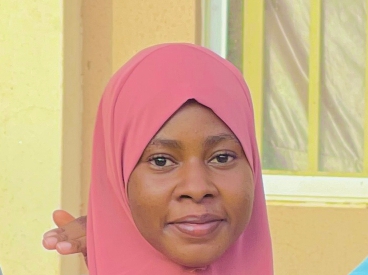
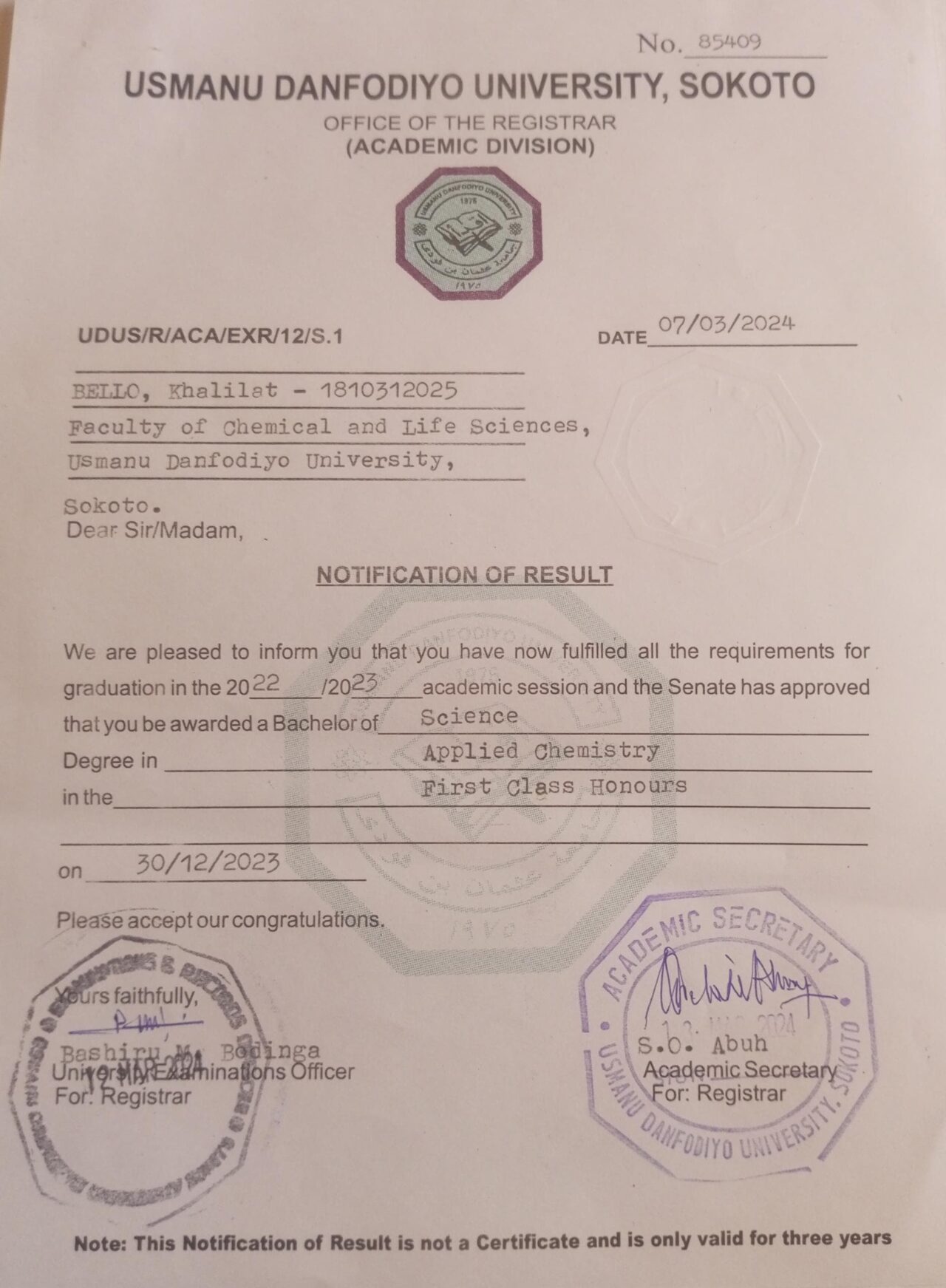
A’s or nothing: Success story of Khalilat Bello

By Wonderful Adegoke

In a Northern Nigerian region plagued by stereotypes and obstacles to academic success, Khalilat Bello’s unwavering advocacy for academic excellence has defied all the odds and carved a path to success. Her journey is not only inspiring but also a testament to the power of perseverance and determination.

Hailing from Offa Local Government Area in Kwara State, Khalilat came to terms with her fate of studying Applied Chemistry at Usmanu Danfodiyo University Sokoto (UDUS) after realizing that pursuing a medical degree would be a forlorn attempt. She accepted her new path and threw herself into her studies, determined to make the most of her time at the university.

Khalilat recounted, “Reflecting on the past, there has never been a record of my struggling in the field of chemistry. When I graduated from secondary school, I was awarded for being the best student in chemistry. Moving forward, my interest in the subject deepened.”

Khalilat’s Resolute Grit

Fully aware of undergraduates’ volatile academic experience, she subsisted her academic pursuits by attending lectures regularly and taking tutorials on obscure courses.

“Earning 4.89 on a 5.0 CGPA scale in 100-level compelled me to give it my all,” she enthused, revealing how she persevered among a class of brainy students who were in healthy competition with each other.

“As an ardent believer in hard work, I spent countless hours reading and writing, thoroughly studying the materials. Attending tutorials, brainstorming and sharing ideas with my classmates helped out in some challenging courses.

On the subject of long-term concentration during reading, “The goal I had in mind kept me going and helped manage distractions.”

Though actively involved in extracurricular activities and has served as the one-time Vice President of her departmental association, she added, “All engagements are brought to an abeyance during tests and exams.”

“I’m immensely grateful to God for being the top student in my department with the highest CGPA of 4.85. I attribute this achievement to the self-discipline I developed in my early days and the encouragement I received from my friends and family.”

Remain Committed — Khalilat advises undergraduates

Khalilat warns against inconsistency and advises undergraduates to be committed and hardworking. “Hard work helps mitigate against gratuitous results.”