TUC

Between the modern Dangote Refinery and the old-fashioned oil and gas unions

By Khalid Imam

Today, it is undeniable that only a handful of Nigerian workers’ unions genuinely care about or operate in the overall interest of their collective members without brazenly exploiting (or, if you like, say, robbing) their loyal members, who pay through their skin all union dues monthly, year in and year out. The leadership of these seemingly monopolistic and rigid unions often lives flamboyantly, like kings, in the public glare at the expense of their poorly paid or oppressed members. Mostly, we only hear the phrase “injury to one, injury to all” as a slogan, drummed up by greedy leadership when it fits their vested interests, not those of dutiful Nigerian workers. 

For instance, I have been paying NUT/ASSU dues nonstop for over 20 years now without any appreciable benefits – no workshops, nothing. Despite formally withdrawing my membership, along with other colleagues, our deductions continue to this day by the said self-serving unions, which have been overseeing the collapse of the education system for decades. This lack of freedom to associate or not, plus serious issues of accountability, raises many questions about unions’ purpose and continued relevance in the fast-changing world and strategic economic competitions and innovations we are witnessing, as Nigerians, in other sane nations now strategising to lead in industrialisation, investment, technology, and science, especially in artificial intelligence and artificial super intelligence.

One may ask: Are unions advocating for their members’ rights and welfare, or are they simply enriching only the vultures parading as their leaders? The answers to these questions are evident. Now more than ever before, Nigeria requires a radical systemic overhaul of the whole labour union system and operation, to ensure even unions and the country are rescued from the hawks called labour union leaders, if indeed the unions are to serve their foundation purposes – protecting members’ welfare, etc and helping to develop our betrayed and badly raped country, not enriching insatiable individuals living extravagantly unchecked.

Without genuine reform, unions like those fighting the Dangote Refinery now may continue to hold the entire country hostage. Patriotic Nigerian unionists must wake up from their docility to fight to save our unions. Subjecting all labour unions to public scrutiny should be our collective duty as citizens. Now, if any union with strategic responsibility fails to innovate, it should not blame anyone when it risks losing credibility and relevance in the scheme of things.

We must resist any attempt by any union to insist that Nigeria must live in the past, or Nigerians will continue to suffer in long queues buying fuel at a high cost. The world is fast-changing and innovating; the earlier our so-called labour unions wake up to these realities, the better. Change can’t wait for anyone, and Nigeria must reform to develop.

My sincere advice to serious investors like Dangote is that they should refrain from engaging in verbal battles or heated exchanges with PENGASSAN, etc., and instead focus on effectively mitigating their excesses by boldly advocating for a comprehensive overhaul of trade union laws in the country. There is no harm in pushing for new legislative bills or fighting hard in courtrooms to silence corrupt union leaders shouting about workers’ rights to join unions, all in the pretence of saving Nigerian workers from enslavement. Who is enslaving employees in the real sense: the oligarchy that hijacked the unions or employers striving to create more jobs for our teeming jobless youths while contributing billions to our national treasury? Aren’t most domestic union leaders, in some cases, in the forefront of enslaving Nigerian workers by living lavish lives with their union’s funds?

Yes, let there be unions, but not exploitative and monopolistic ones. I repeat, let there be unions, but not ones that block the country from progressive developments and innovative transformations, like the one we have witnessed with the arrival of the Dangote Refinery. Flexible labour union laws are the water and fertilisers Nigeria needs now. The Dangote refinery represents a significant step forward not only for Nigeria’s economic growth and development but also for Africa as a whole. Unions should support such initiatives rather than hindering them with outdated and rigid labour market laws.

At a time in the US President Trump, was and still woos American tech giant investors like the owner of Facebook to the White House to discuss the future of America, as a Nigerian with Nigeria first in my heart, I urge my President, Asiwaju Bola Ahmed Tinubu, to act as a strategic leader he has been since his days as governor of Lagos state. The President, more than any other person, now has an onerous duty not to allow unionists to prostrate national heroes like Dangote.

PBAT must, in the overall interest of present and future generations of Nigerians, wade in to champion flexible labour union market reforms. This is the best time, presenting him with a rare opportunity to put Nigeria first and attract numerous patriotic investments, not just from visionaries like Dangote, but from both domestic and international investors. Clinging to outdated and rigid labour laws is detrimental to our economy both now and in the future.

The flexibility of labour laws in countries like Germany and China has contributed to their economic stability and China’s soaring dominance amidst global competition. Nigeria should draw valuable lessons from these nations rather than adhering to outdated British-style labour laws that have hindered the UK’s economy from soaring like an eagle.

Finally, I invite all patriotic Nigerians to reject exploitative and monopolistic unions. Dangote is a national asset! His refinery is also a national asset. Dangote, too, must put Nigeria first, always. We have a duty to protect both Dangote and his refinery from vultures who have held our country captive for decades. May God bless Nigeria, Dangote, and his Refinery. Amin.

Imam is a Kano-based published writer of over two dozen books, a teacher, and an Art Administrator. He can be reached via email at khalidimam2002@gmail.com.
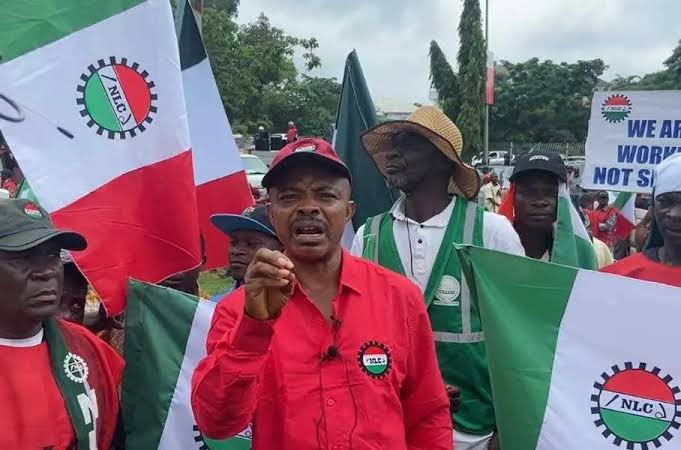
Workers demand action on killings, wages at May Day rally

By Uzair Adam 

At this year’s Workers’ Day celebration in Abuja, organised labour unions issued a strong 20-point demand to the Federal Government, calling for urgent measures to address Nigeria’s deepening socio-economic crisis, including rising insecurity and wage stagnation.

In a joint address, leaders of the Nigeria Labour Congress (NLC) and the Trade Union Congress (TUC) urged the government to end the widespread killings across the country and implement economic reforms that prioritise the well-being of citizens. 

They also advocated for justice, respect for democratic principles, and transparency in governance.

Themed “Reclaiming the Civic Space in the Midst of Economic Hardship,” the event saw the labour centres decry what they described as unconstitutional actions, particularly the suspension of the elected government of Rivers State through a declaration of emergency, which they argued lacked a legal basis.

Other demands included an immediate salary review aligned with the economic situation, clarity on the Pay-As-You-Earn (PAYE) taxation system, and the withdrawal of controversial tax bills before the National Assembly. 

Labour also called for more inclusive policymaking, emphasising that workers must have a seat at the table when critical decisions affecting their welfare are being made.

Details to follow…

Labour union’s meeting with Tinubu dead end, to continue next week

By Anwar Usman 

The president of the Nigerian Labour Congress (NLC), Comrade Joe Ajaero, said their position on N250,000 as the new national minimum wage still stands. 

While the Federal Government and Organised Private Sector agreed on N62,000, labour is insisting on N250,000. 

President Bola Tinubu had said he needed time to take counsel from other stakeholders before sending the bill for the new minimum wage to the National Assembly. 

While speaking with State House correspondents after he and other labour leaders met with President Tinubu on Thursday, Ajaero said labour leaders went for discussion, not negotiation. 

“In reality, it wasn’t a negotiation but a discussion; and we have had that discussion. We agreed to look at the real terms probably and reconvene in the next one week. So, that’s where we are. Because we didn’t go down there to talk naira and kobo. At least, there were some basic issues that we agreed on.” 

When asked if Labour is still insisting on N250,000, he said, “I remember mentioning that we didn’t go into Naira and kobo discussion. Now the status quo in terms of the amount N250,000 and N62,000 remains until we finish this conversation.” 

Trade Union Congress (TUC) President, Festus Osifo, said they discussed, and after explaining their position, the President also made his remarks. 

He said, “In the meeting, we tried to put the issues on the table. Issues that are bothering and biting Nigerians today, the economic difficulties and the value of naira, how it has also eroded, how these have affected the prices commodities and goods in the market.” 

“We tried to put these before the President because he is the president of the country and the bulk stops at his table. We have had all the conversations with all his agents, but today, we said let us meet with the father of the nation the and have this conversation and make the argument that Labour always make, we made all the arguments, the economic analysis, macro, micro, fiscal and monetary issues. 

“So, we put everything forward and in the end, the president made his remark as the president and we all agreed let’s go back, we internalize it, we have some conversation and by one we time, we will come back and we will continue the meeting.” 

On her side, Minister of State for Labour and Employment, Nkeiruka Onyejeocha, said, “It is a fruitful meeting, father, children meeting. I think we are hopeful that very soon everything will be resolved. Of course, when father and children talk you know what it is.That’s just exactly what has happened. It took us almost about an hour. I believe that it’s all for good.”

NLC, TUC Issue ultimatum to FG, threaten fresh nationwide strike

By Sabiu Abdullahi 

The Nigeria Labour Congress (NLC) and the Trade Union Congress of Nigeria (TUC) have jointly issued a stern ultimatum to the Federal Government.

The ultimatum comes as a response to the alleged failure of the government to fulfil a 16-point agreement reached with the unions on October 2, 2023. 

Expressing their dismay over the situation, leaders of the NLC and TUC affirmed their concern regarding the government’s apparent disregard for the welfare of citizens and workers.

Despite concerted efforts by organised labour to foster cooperation and address issues in the workplace, the unions claim that the government has remained indifferent to the widespread suffering and hardship experienced by Nigerians. 

In a joint statement, the NLC and TUC lamented the necessity of resorting to drastic measures, stating, “It is regrettable that we are compelled to resort to such measures, but the persistent neglect of the welfare of citizens and Nigerian workers and the massive hardship leave us with no choice.” 

The ultimatum issued by the unions gives the Federal Government a 14-day window, starting on February 9, 2024, to honour its commitments outlined in the agreement.

Failure to do so, as stated by the NLC and TUC, will result in the commencement of a nationwide strike. 

The looming threat of a nationwide strike raises concerns about its potential impact on various sectors of the economy and the well-being of the general populace.

It underscores the urgency for dialogue and resolution between the government and organised labour to avert the disruption and hardships that a strike could entail.

NLC, TUC declare strike amidst economic hardship 

By Sabiu Abdullahi 

The Nigeria Labour Congress (NLC) and the Trade Union Congress (TUC) jointly declared a nationwide strike scheduled to commence on Tuesday, October 3.

This announcement comes as negotiations continue between the unions and the government, with both parties striving to find common ground. 

In a press conference held in the capital city of Abuja on Tuesday evening, the NLC and TUC called on their state branches to mobilise workers and the public for a series of demonstrations and marches across the nation.

The unions have expressed their concerns regarding the economic hardships faced by Nigerians, particularly workers, following the removal of fuel subsidies. 

It’s worth noting that the NLC had previously initiated a two-day warning strike on September 5th and 6th, seeking to exert pressure on the government to address these pressing issues.

This move sparked ongoing discussions and negotiations aimed at resolving the issues. 

Emmanuel Ugboaja, the Secretary of the NLC, confirmed that the unions are currently conducting their meetings online, demonstrating their commitment to dialogue even as they announce the strike action. 

In response to the strike notice, Mr. Simon Lalong, the Minister of Labour, appealed to the NLC to reconsider their plans.

He reassured the unions that the government is dedicated to addressing their concerns.

Mr. Lalong also highlighted one recent achievement in their negotiations, where the government ordered the release of the head of the Transport Workers Union in the country.