Theft

Student dies following alleged phone theft at UNN

By Anas Abbas

A student of the University of Nigeria, Nsukka (UNN) has died in tragic circumstances following an alleged assault by fellow students who accused him of involvement in a phone theft incident.

The incident occurred at the Eni Njoku Hall of Residence, where the undergraduate was reportedly confronted by other students over suspicions that he was connected to the disappearance of a mobile phone.

Sources say that the confrontation quickly escalated into a physical attack, with several students and hostel residents reportedly administering a severe beating.

The victim was said to have suffered critical injuries during the altercation and was later taken to a medical facility, where he was pronounced dead.

Details about the identity of the deceased, including his name and level of study, have not yet been officially released by the university or law enforcement, but various posts on social platforms refer to him as a UNN student who was allegedly beaten to death on suspicion alone.

The Enugu State Police Command has reportedly initiated an investigation into the matter to ascertain the exact sequence of events and whether criminal charges are warranted. Authorities are reviewing eyewitness testimony and security footage as part of the probe.

UNN management has not yet issued an official statement confirming the student’s death, but the incident has sparked concern among students and advocacy groups over rising cases of campus vigilante justice and the dangers of taking the law into one’s own hands.

Further updates are expected as police continue their investigation and as the university responds to queries from the press and the public.

Public Warning: Surge in car thefts in Kaduna metropolis

By Suleiman Usman Yusuf

In view of the recent surge in car thefts across Kaduna State, particularly along Isa Kaita Road from the evening hours onward, it has become necessary to raise public awareness and caution all vehicle owners.

A few days ago, a brother of mine, who is a senior military officer, visited Kaduna and stopped at Corporate Plaza on Isa Kaita Road to run a few errands. Unfortunately, his car, a Pontiac Vibe, was stolen within minutes of parking it around 8:00 p.m.

Shockingly, his younger brother had experienced a similar incident some months earlier at almost the exact location (near Video Max) around 8:30 p.m., when his Toyota Corolla was stolen barely three minutes after stopping to buy shawarma.

About two months ago, I was on the same street around 9:00 p.m. and met a man whose Honda EOD had just been stolen moments before I arrived. While we were still discussing the issue, another person joined and narrated how two cars had been stolen along the same street not long before.

Sadly, this problem is not limited to Isa Kaita Road alone. Other incidents have occurred across Kaduna Metropolis. For instance, about a year ago, one of my elders had his Honda Civic stolen at Sultan Bello Mosque during Friday prayers. Around the same time, my uncle’s Toyota was also stolen at the Dan Fodio Mosque during Juma’at prayers.

A few months ago, a friend who owns a shop at Kaduna Central Market had his Honda Civic stolen from the KASUPDA Car Park. Another friend’s Toyota was taken from Barau Dikko Hospital’s parking area, despite the exit-card security system meant to prevent such occurrences.

I have personally witnessed the trauma many of these victims went through, including how their daily routines and family lives were disrupted. I have accompanied some of them to various police stations to report these incidents, yet none of the cases have yielded any feedback or results.

Please note: no matter the value or condition of your car, it can be a target. These criminals are always on the lookout, and it is important to take every possible precaution to secure your vehicle.

I am not certain how much the Kaduna State Government and relevant security agencies, including the NPF Kaduna and the Nigeria Police Force, are aware of these disturbing trends. Still, I am using this medium to draw their attention to the growing threat. I also urge His Excellency, the Governor of Kaduna State, Uba Sani, to take swift and decisive action to address this alarming situation.

It is worth noting that, in the first two incidents mentioned above, the victims received calls within 12 hours stating that some of their personal identification items (such as ID cards and national ID cards) had been found at Kwanar Dangora. This suggests that many of these stolen vehicles are quickly transported out of Kaduna shortly after the theft.

ADVICE TO CAR OWNERS 

To reduce your risk of becoming a victim, kindly consider the following preventive measures (though not exhaustive):

 1. Install a reliable car tracker if you can afford one.

 2. If not, use mechanical or pedal locks or other simple devices to reinforce your vehicle’s security.

 3. Avoid parking in dark or isolated areas, especially at night.

 4. Do not leave your car engine running while stepping out, even briefly.

 5. Even when your car is properly locked, take extra steps such as locking your steering wheel, using pedal or gear locks, and installing security alarms or tracking devices. Locking alone is often not enough.

 6. When visiting crowded public places such as mosques, markets, or hospitals, try to park in well-secured and well-lit spaces.

⚠️ DISCLAIMER (PLEASE READ)

This message is not intended to cause fear or panic, but to create awareness and promote vigilance. The rate of car theft in Kaduna is alarming, and the more we discuss it openly, the better our chances are of prompting action from the authorities and encouraging citizens to be more careful.

Let us all remain alert, report suspicious movements, and look out for one another. Together, we can make our communities safer.

Stay vigilant, stay safe.

Suleiman writes from Kaduna and can be reached via suleimanusmanbac@gmail.com.

Of shoes, sermons, and stealing saints: A comic tragedy of sacred thievery

By Isah Dahiru

There’s a Hausa proverb that says, Wanda ya saci akuya, ya saci itacenta—he who steals a goat has already stolen the rope tied to it. But who would have imagined that the sacred grounds of a mosque, a space where hearts are purified and souls are recharged, could become fertile ground for what I now call “holy heists”?

Last Friday, I attended Jumu’ah prayers like any regular seeker of divine mercy, looking forward to the serenity of the sermon and perhaps a gentle breeze under the neem tree afterwards. You know, that kind of spiritual therapy that reboots your inner battery. 

The Imam began passionately, with what I can only describe as a verbal balm for troubled marriages. He waxed poetic about marital life, reminding us brothers that a man’s greatness is not measured by how many goats he owns, but how gently he treats the mother of his children.

He quoted the Prophet (SAW), emphasising kindness, loyalty, and romance—even after ten years of eating her over-salted tuwo. He reminded us that he who denies affection at home may end up seeking counsel from side mirrors—and by side mirrors, I mean side chicks. It was a sermon of gold, and I had already drafted a mental apology letter to my wife (with a footnote asking for fried fish for dinner).

Then came the second khutbah—and brothers and sisters, the tone changed like NEPA light.

What followed was no longer spiritual nourishment—it was a full-blown security bulletin. The Imam, now resembling a mosque-based CNN anchor, solemnly announced the spike in theft within the mosque premises. Shoes, phones, even umbrellas—yes, umbrellas in dry season—had become an endangered species in the hands of holy day hustlers.

I blinked twice. “Wallahi, this must be fiction.”

Apparently not. The Imam cited examples. Men who had arrived barefoot left in polished Clarks. Samsung devices evaporated during sujud. One man reportedly came out of the toilet to find that not only had his shoes vanished, but so had his ablution kettle. An saci butar alwala!” someone muttered beside me.

My friend Musa Kalim, ever the idea machine, leaned in and whispered, “Wallahi Isah, the mosque should invest in designer shoes with trackers inside. Give them out before prayer. Anyone who deviates from coming to mosque without shoes to going home with a shoe—bing! The alarm goes off. ‘Thou shalt not misstep.’”

Another friend, Engr. After I narrated the ordeal and my frustration to him, Aminu offered another way to tackle the situation. Honestly, I laughed so hard I almost missed the supplication after the prayer had ended. But knowing that Aminu wasn’t joking made me return to my senses. This is the same man who once suggested using goats to deliver medicine in rural villages, and almost got a grant for it from Melinda and Gates Foundation.

I imagined it immediately:
“Mosque Sole Security (MSS): Track Your Blessings from Sole to Soul.”
A startup powered by shame and GPS.

But there’s a deeper sadness here. When the masallaci, the house of Allah, becomes the hunting ground for pickpockets, it signals a spiritual recession. It’s no longer just a pair of stolen shoes—it’s a metaphor for the theft of morals, the robbery of conscience, and the hijacking of trust.

There’s a popular Yoruba saying, “Ti ile ba n bajẹ, a fi ti ile ni nko,” meaning, “When a home begins to decay, it starts from the inside.” And truly, if criminals now comfortably perform ablution before proceeding to commit theft, then we must urgently recalibrate our moral compass.

Let’s consider the ridiculousness: someone prays beside you, says “Ameen” with gusto, maybe even sheds a tear during supplication—and minutes later, he’s making off with your Bata sandals like a post-prayer souvenir. What kind of shame is that?

The Prophet (SAW) warned us of a time when people would pray like angels and live like devils. Perhaps this is what he meant.

Maybe the solution isn’t just CCTV or Musa’s high-tech slippers (although I’d donate to that GoFundMe). Perhaps we need something more profound—a revival of taqwa, of God-consciousness, in our lives. Because let’s be honest, even if we padlock the ablution area, thieves without fear of God will find a way to sin in style.

Perhaps we need to return to the basics—teaching our children that a stolen shoe, even if it fits, carries the burden of its last prayer. Reminding our youth that every crime committed under the minaret echoes louder in the heavens than those committed in the market square. And as elders, we must not be afraid to call out wrongdoing—even if the culprit looks like a saint in a turban.

Until then, dear reader, as you go for prayers, carry your faith boldly—but your shoes discreetly. I suggest you start wearing bathroom slippers, the type no thief would proudly wear. And if, by misfortune, you find yourself shoeless at the end of the prayer, don’t wail. Just smile and say: “May the thief walk straight into the path of repentance—and a pothole.”

And should you ever catch one red-handed, don’t beat him. Sit him down, offer him zobo and a hard chair, and give him a khutbah so fiery, even his ancestors would consider refunding your shoes.

Isah Dahiru is a pharmacist and can be reached via easerdahiru@gmail.com.

NERDC seeks police help to combat insecurity and theft

By Abdullahi Mukhtar Algasgaini

The Executive Secretary of the Nigerian Educational Research and Development Council (NERDC), Prof. Salisu Shehu, has called for the assistance of the Nigeria Police Force (NPF) in addressing rising crime and insecurity, particularly the recurring theft incidents threatening the safety of the Council’s office.

During a visit to the Commissioner of Police (CP) of the FCT Command, Prof. Shehu emphasized the vital role the police play in ensuring the safety of NERDC’s operations, especially since the office is located on the outskirts of Abuja, making it more vulnerable to criminal activities. He appealed for enhanced security to protect lives and property at the NERDC headquarters.

“We need special attention and support to feel secure in our location,” Prof. Shehu stated, expressing concern over the vulnerability of the staff and office to security risks.

The Executive Secretary also brought up the recent case of stolen solar inverters, which is under investigation by the police. He urged that the case be thoroughly investigated and that the perpetrators be brought to justice, noting that past thefts within the Council remain unresolved. He expressed NERDC’s readiness to fully support the investigation to ensure accountability.

In response, the Deputy Commissioner of Police (DCP), Criminal Investigation Department, DCP Aliyu Abubakar, welcomed the NERDC management team on behalf of CP Olatunji Disu, who was unavailable due to national duties.

He reiterated the importance of collaboration between educational institutions and the police in ensuring the security of lives and properties, and assured that the police would continue to work professionally to resolve the case and bring the culprits to justice.

Again, N31m cash stolen at Katsina Government House

By Muhammad Aminu 

In what appears like a movie, a sum of N31 million naira has been stolen inside the Katsina Government House.

The Director-General to Governor Aminu Masari on New Media, Alhaji Al-Amin Isah, confirmed the heist at the account section of the State Government House on Thursday.

Isah, who did not disclose the exact figure, said that some of the suspects were investigated.

“Yes, it’s true that some money was alleged to have been stolen, as you have asked. We have already reported the matter to the police for investigation. I can not tell you the exact figure now, but those in the best position will give you more updates, please,” he added.

However, sources in the Government House confirmed that the money stolen was in the sum of N31 million.

The Katsina Government House experienced money theft in 2020 when unknown persons allegedly broke into the office of the former Secretary to the Government of Katsina State (SGS), Mustapha Inuwa, and made away with N16 million.

A few weeks ago, the police in Katsina State confirmed that it was investigating the alleged stealing of N61 million from a cashier at the office of the Secretary to the State Government, Aminu Darma.

The financial officer reportedly said he was attacked by shooters while travelling with three bags filled with N61 million cash. He was said to have been shot in the arm before the money was stolen.

According to reports, the shooters trailed Darma from the bank, where they reportedly ambushed him.

Police apprehend 198 suspected criminals in Kano

By Muhammad Aminu

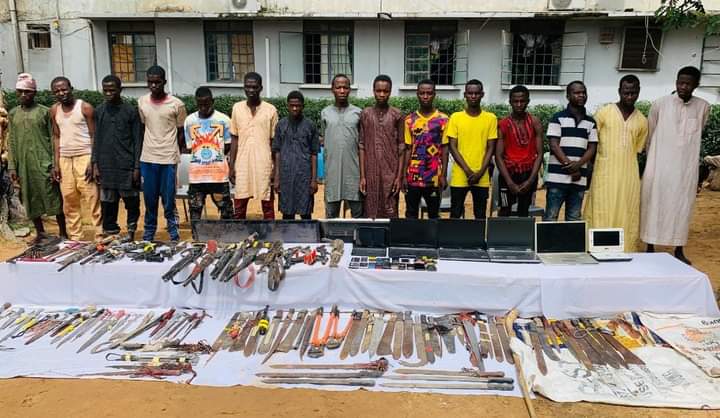
Kano State Police Command said it had apprehended 198 suspects for various criminal activities in the State.

Police Commissioner, Sama’ila Dikko, made l this known while briefing journalists on Thursday in Kano.

CP Dikko explained that the suspects were arrested between 27th June to 21st July in different parts of the State in their efforts to “protect with courage and serve with compassion”.

He stated: “From our last Press Release of 27th June 2022 to date, i.e. for 24 days, the Command arrested One Hundred and Ninety-Eight (198) suspects for major offences which include; Armed Robbery, Kidnapping, Car Theft, Fraud, Thuggery (Daba), Drug Abuse, etc., most of which were charged to court for prosecution.”

According to Dikko, the suspects arrested are “Forty-Two (42) Armed Robbery Suspects; Nine (9) Kidnapping Suspects; Sixteen (16) Suspected Fraudsters; Two (2) Human Trafficking Suspects; Twenty-Seven (27) Motor Vehicles and Tricycles Thieves; Twelve (12) Suspected Drug Dealers; Ninety-Two (92) Suspected Thugs (‘Yan Daba).”

The Police Chief further said they rescued trafficked persons and recovered weapons, “Five (5) Human Trafficking Victims; Twenty-Five (25) Rifles, including Three (3) AK-47s, One (1) Micro Uzi, One (1) Pistol, One (1) Pump Action, Ten (10) locally made Pistols and Nine (9) Den Guns; One Hundred and Twenty-Two (122) Knives and Ninety-Six (96) Other Rod-made Sharp Weapons.”

He said the command also recovered stolen vehicles and motorcycles “Twelve (12) Motor Vehicles; Seven (7) Tricycles and Three (3) Motorcycles.”

Dikko further revealed that some drugs and substances were found in possession of the suspects.

“Two Hundred and Sixty-Nine (269) Parcels and Two Hundred and Sixty-Five (265) Wraps of Dried Leaves Suspected to be Indian Hemp valued Two Million, Seven Hundred and Twenty Five Thousand Naira (N2,725,000:00); Seventy-Four (74) Bottles of Suck and Die Substance and Two Hundred and Eighty (280) Pieces of Exol Tablets.”

Other recoveries include four (4) laptop computers, 134 Mobile Phones and 16 Plasma TV.

He said the Police are committed to community-based and citizen-led policing in the State.

He applauded other security agencies, residents and civil society organisations for their support and cooperation toward ensuring a crime-free Kano State.

Police return seven stolen vehicles to owners in Kano

By Muhammad Aminu 

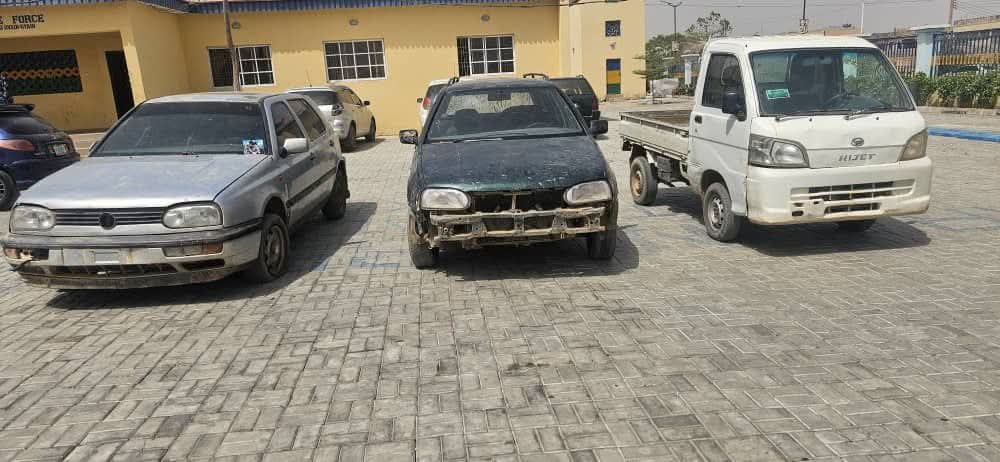
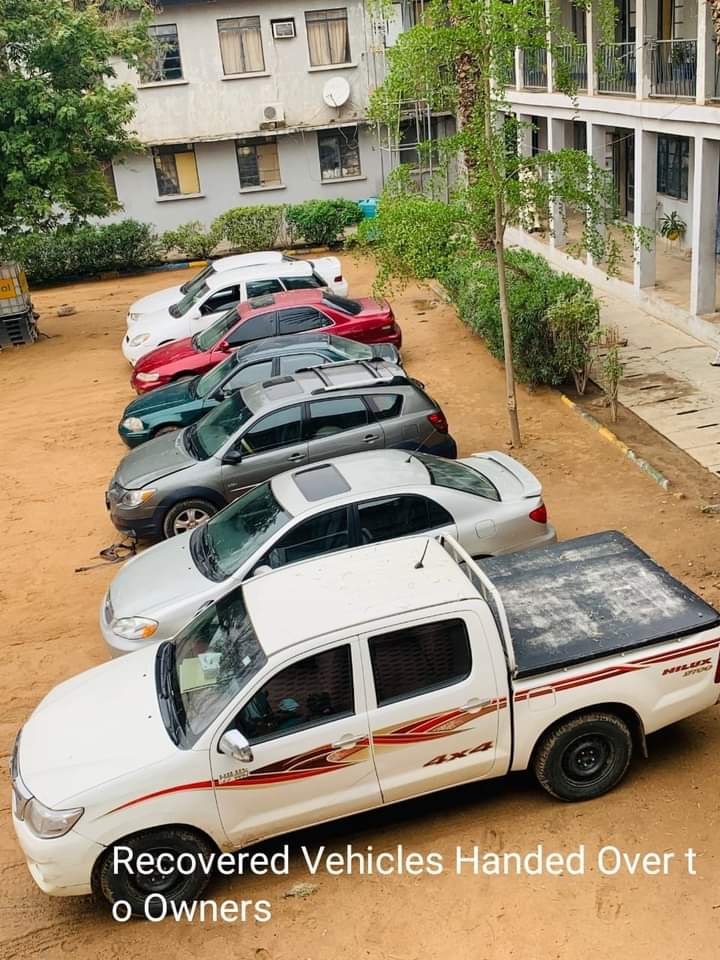
Kano State Police Command has returned seven (7) vehicles stolen from different parts of the State to their rightful owners after thoroughly investigating the suspects.

The Police Command said three other vehicles remain in its custody as nobody advanced any claim.

Police Public Relations Officer, SP Abdullahi Kiyawa, disclosed this in a statement to journalists in Kano.

SP Kiyawa noted that the arrest of Odinaka Godwin and two others with nine number plates led to further investigation that unravelled their activities in Kano, which enabled the police to recover ten stolen vehicles.

“In continuation of a case of suspected Motor Vehicles theft, where one Odinaka Godwin, ‘m’, and two others were arrested in possession of nine (9) Pairs of Motor Vehicles number plates, a total of ten (10) Motor Vehicles were so far recovered.”

“The Commissioner of Police had directed that seven (7) of the recovered stolen Motor Vehicles were handed over to owners; whereas, the following Motor Vehicles are yet to be claimed;

i. Toyota Camry LE Motor Vehicle, Golden Colour with Registration Number ADK-885AE, Ekiti 

ii. Toyota RAV4 Motor Vehicle, Black in colour with Registration Number APP-35BP Lagos 

iii. Toyota Camry LE Motor Vehicle, Ash in Colour without Registration Number, he narrated.”

According to Kiyawa, three other suspects were arrested for faking motor documents in the State.

“Discreet investigation also led to the arrest of one Abdulra’uf Olalade, ‘m’, 57 years old Fagge Quarters Kano. His accomplices, Abdullahi Suleman, ‘m’, 52 years old of Kurna Quarters Kano, and Suleman Ibrahim, ‘m’, 57 years old Haye Hotoron Arewa Quarters Kano, were arrested. 

“The suspects confessed to having specialized in producing fake Motor Vehicles Documents, he said

The Police spokesman further explained that the suspects would be charged to court after a thorough investigation.

He called on people whose vehicles were stolen with the above description to present themselves at the police public relations unit at Bompai headquarters.

“The discreet investigation is in progress, after which suspects will be charged to court for prosecution. 

“Anyone whose Motor Vehicle was stolen and discovered above should report it at the PPRO office, Bompai Police Headquarters Kano, or contact 08168629521, 08105359575.”

While commending residents of Kano for supporting the police, he called on the criminals to desist from their activities or face the full wrath of the law.

Kiyawa further warned the general public against taking laws into their hands.

High rate of stealing and its possible solutions

By Nasiru Tijjani


Doubtless, stealing is one of the social problems bedevilling the peace and stability of almost all human societies. Therefore, stealing means taking something away from a person, shop/store, etc., without permission and without intending to return or pay for it. The problem, needless to say, is known to every reasonable person who cares to look and discuss their societal issues. Quote me anywhere that no society can fully develop and excel in all spheres of life if its members are thieves, burglars or robbers. For clarity, thieves are persons who steal things, especially secretly and without using violence. Burglars usually get into a house, office, etc., especially by force, to steal stuff, while robbers steal property from a person or public place, especially using violence.


The rampant cases of stealing are gradually becoming a new normal in our society. The culprits are always employing different strategies to safeguard themselves against an unwarranted arrest by the security agencies and other community volunteers. The community members gradually become helpless and equally lose hope about when to live in peace and comfort with their property. I don’t need to justify anything here for you, or your brother might


Since time immemorial, stealing has been discouraged by Islam and Christianity. The duo has strongly warned their followers through a significant portion of scriptures that they should shun the attitude of taking someone’s property without the owner’s consent. Apparently, the act has been classified as taboo and unethical that can only be committed by the mannerless, heartless and idle good-for-nothing person whose faculty of reasoning is abysmal. The effects of their (thieves) actions negatively affect the peaceful co-existence of the entire society either by crippling the welfare of the people or creating an unresolved hatred and enmity.


What comes first on the list has to do with parents. To me, they should not be left blameless, for they have a role to play in the proper upbringing of their children. They have been saddled with the responsibility of meeting the needs of their children, right from appropriate education to marriage. Nowadays, children are left to stand on their own feet in all walks of life. Parents are gradually disowning the mandates of their children as enshrined in the religious and cultural provisions.


Coming next after the first is peer-group influence. Children usually commit crimes under the influence of friends. This is because they typically get to know the attitude of each other better during their friendship. Psychologists have identified imitation as one of the stages of cognitive development. Therefore, children effortlessly emulate the behaviour of their friends. A friendless child is safe for not associating with rotten eggs, for he is less likely to be influenced by peers.


It is a known fact that the care of children is being placed firmly within the domain of their parents. Therefore, they (parents) should ensure that they fulfil all the mandates saddled on them. They must be answerable for their children’s failure, either for poor upbringing or anything for that matter.


The influence of some films that are of no character-building is equally associated with the topic under discussion. For example, with the recent release of Kannywood seasons, youths learn different tactics of stealing and other unwanted behaviours. “A Duniya“, a new Hausa season produced by Tijjani Asase, is a classic example of such a film. Recently, the Kano State Censorship Board has cautioned its makers and asked them to reshape the season’s activities considering the negativity of some scenes.


The human being is a social animal that cannot live in isolation without associates. However, children/ youths should not be left under the control of friends. Instead, they need to be guided/assisted in choosing or deciding on whom to befriend/mingle with.


Besides, people should reduce their quest for materialism. For instance, youths should regulate their strong desire to possess smartphones, among other things. Parents and security personnel may begin to ask the owners to account for the source, originality and anything to do with the suspected phones or any other property.


In conclusion, stealing is a correctable problem like all other social vices. I can attest without any iota of hesitation that the above-stated recommendations will surely bring a lasting solution to the unwanted act if taken into consideration. Meanwhile, I fancy the idea of not forgiving the doers of the action, for they know not the purpose of being human.


Nasiru Tijjani, Gwaram Tsohuwa, Jigawa state. He can be contacted via tijjaninasiru@gmail.com.