Terrorists

Nigerian Soldiers Foil Terrorist Attacks, Seize Logistics, Arrest Suspects In North East

By Sabiu Abdullahi

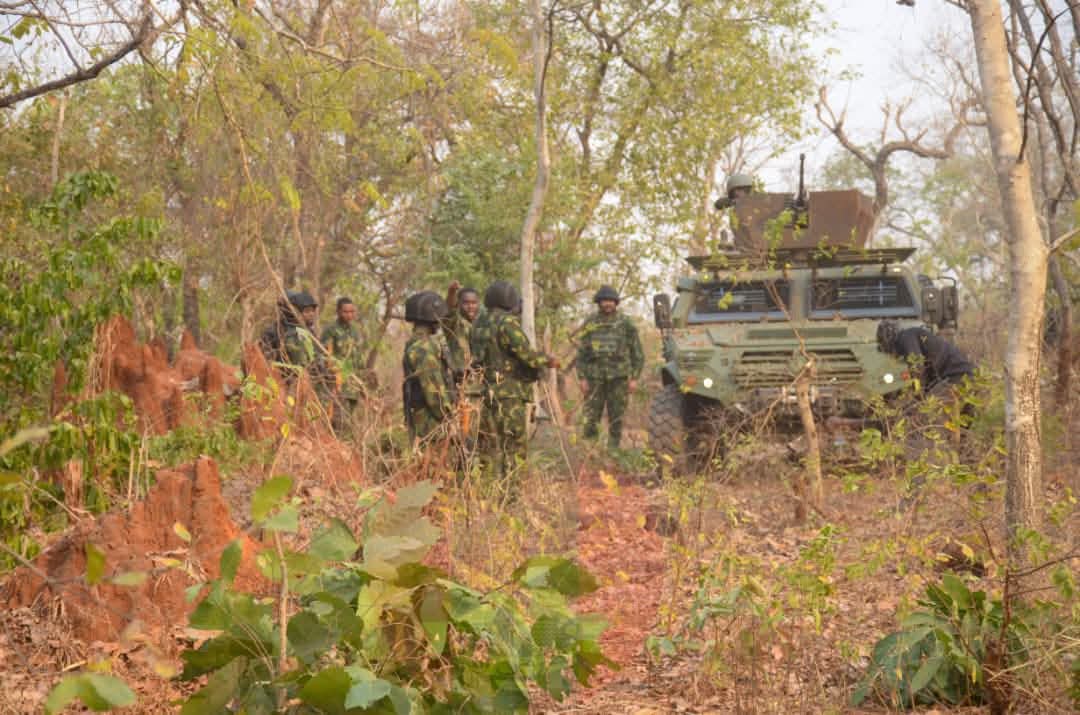
Troops of the Joint Task Force (North East) Operation HADIN KAI (OPHK) have successfully prevented multiple terrorist attacks and disrupted insurgents’ logistics networks across the North East between 28 and 30 March 2026.

This is contained in a Facebook statement signed by
Lieutenant Colonel Sani Uba, Media Information Officer at Headquarters Joint Task Force (North East) on 30 March 2026.

According to the statement, the soldiers stationed at Damboa stopped a planned Boko Haram/ISWAP attack after monitoring suspicious movements through surveillance systems.

The troops engaged the insurgents, forcing them to retreat in disarray. Follow-up operations confirmed that the attackers had withdrawn. Similarly, troops repelled assaults on farmers and communities in Gwoza and Askira Uba Local Government Areas of Borno State, pushing insurgents toward the Mandara Mountains and nearby areas.

The troops also discovered and safely detonated an Improvised Explosive Device (IED) along the Goniri–Ngamdu axis. “Recovered materials, including rail tracks used to canalise vehicles into a killing zone, highlight ongoing terrorist efforts to disrupt movement along critical routes,” the statement noted.

In operations targeting terrorist supply chains, two suspected Boko Haram collaborators were arrested in Molai while acting suspiciously in a defensive area.

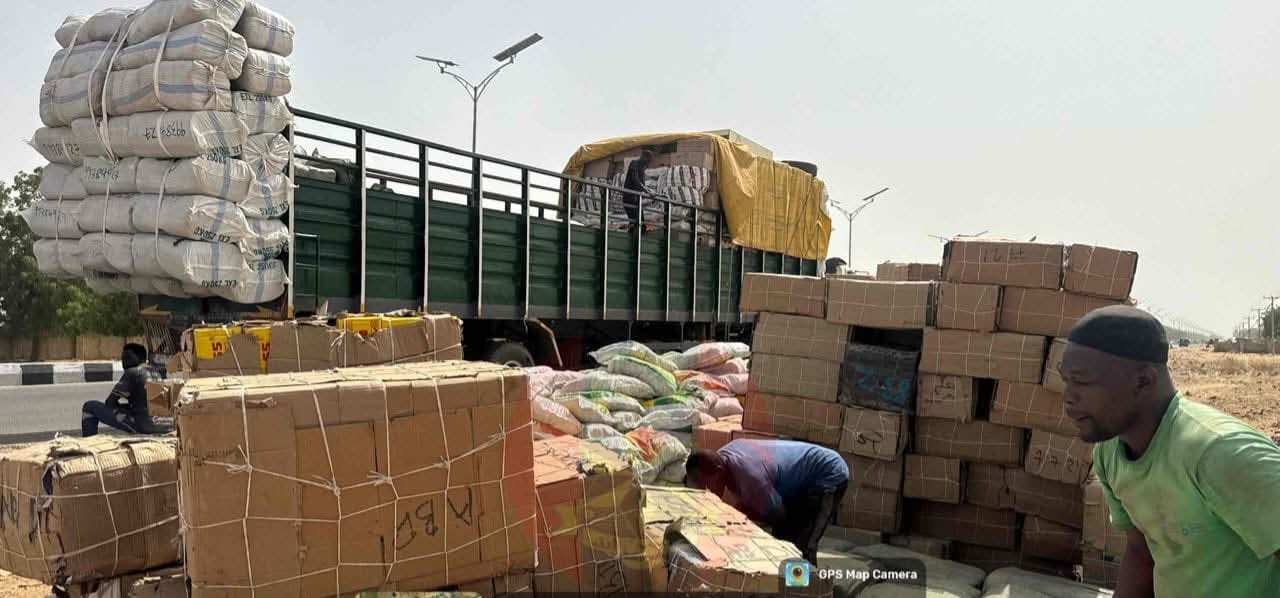
In Maiduguri, troops intercepted vehicles carrying large quantities of suspected terrorist logistics along the Maiduguri–Mafa road. The items, concealed in sacks and equivalent to two truckloads, included medical drugs, motorcycle tubes and tyres, mosquito nets, rolls of mats, air filter cylinders, and detergents.

Preliminary investigations revealed that the supplies were being transported without clearance toward Kusuri, a border community near Chad. The vehicles, drivers, and goods were handed over for further investigation.

Additionally, OPHK troops, working with Civilian Joint Task Force (CJTF) operatives, arrested Mohammed Adamu (26) at Muna Garage. “Items recovered from him include 25 litres of engine oil concealed in sacks, the sum of N624,900, a mobile phone, power bank, national identity card, and ATM cards. Preliminary findings indicate he had been supplying logistics, including motorcycle parts, to terrorists over an extended period,” the release said.

In Gubio, troops, intelligence operatives, and CJTF conducted targeted operations that resulted in the arrest of 13 suspected terrorist logistics suppliers and collaborators. Two additional suspects confessed to long-term involvement in supplying materials to insurgents.

Troops also apprehended Abubakar Ali, alias “Saina,” a suspected member of JAS/ISWAP, at Kilo Papa checkpoint while en route to Maiduguri. Interrogation suggested he was conducting a reconnaissance mission. He has been handed over to authorities for detailed investigation.

In other operations, a suspected kidnapper was arrested in Azir, Damboa Local Government Area. Clearance and cordon-and-search missions in Wulgo Junction, Gamboru Motor Park, and surrounding areas led to the recovery of 450 wraps of suspected marijuana and other illicit substances, while suspected drug peddlers fled on sighting troops.

The Military High Command commended the troops for their “resilience, vigilance, and professional conduct,” urging them to maintain the operational pace to deny terrorists freedom of action, which is critical for security and economic stability in the North East.
Despite Peace Deal, Terrorists Murder Islamic Teacher In Katsina Village

By Sabiu Abdullahi

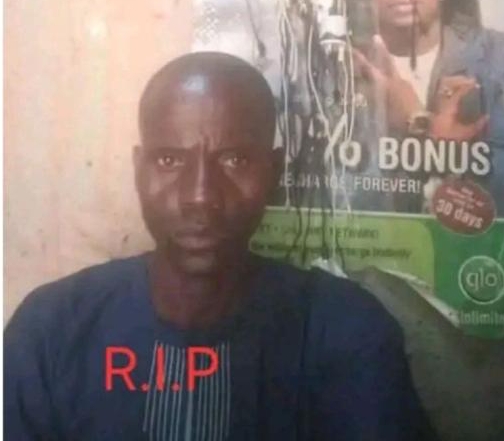
An Islamic teacher, Malam Murtala Saidu, was killed when terrorists attacked Garin-Gozai village in Na’alma ward of Malumfashi Local Government Area, Katsina State.

It was reported that the attack occurred on Sunday evening, shortly before Maghrib prayers, as gunmen stormed the village and opened fire indiscriminately. Saidu was reportedly shot while trying to escape the scene.

Security and intelligence expert Bakatsine confirmed the attack in a security alert issued soon after the incident. He noted that the terrorists moved freely and extended their assault to nearby communities.

“This evening before Maghrib prayers, terrorists stormed Garin-gozai village in Na’alma ward, Malumfashi LGA of Katsina State, killing a local Islamic teacher, Malam Murtala Saidu, who was reportedly shot while attempting to flee. The attackers then moved toward Mai Jimina community in same LGA, firing shots before retreating,” Bakatsine said.

The attack has sparked fear among residents who had hoped that earlier peace agreements between authorities, community leaders, and armed groups would bring lasting calm to the area.

Bakatsine raised concerns about the credibility of the peace arrangement, saying the latest violence exposes serious gaps in its enforcement.

“This comes despite a prior peace agreement between local stakeholders and armed groups, raising urgent concerns about its effectiveness,” the alert stated.

He further questioned the commitment of the parties involved, asking, “If a peace deal was already in place, why are such attacks still occurring, and who is failing to uphold the agreement?”

The incident gives an alert about the ongoing security challenges in Katsina State, where communities continue to face repeated attacks despite dialogues and formal agreements aimed at curbing violence.

Military repels coordinated ISWAP attacks in Borno, kiIIs several terrorists

By Abdullahi Mukhtar Algasgaini

Troops of Operation HADIN KAI (OPHK) have successfully repelled a series of coordinated attacks by Islamic State West Africa Province (ISWAP) terrorists on multiple military positions in Borno State, inflicting heavy casualties and recovering a significant cache of arms and ammunition.

The failed assaults, which targeted Forward Operating Bases (FOBs) in the towns of Mayanti, Gajigana, and Gajiram, took place between the late hours of February 28 and the early morning of March 1, 2026. Military authorities described the wave of attacks as a sign of desperation from terrorist groups whose enclaves and supply routes are under sustained pressure from ongoing offensives.

The most intense fighting occurred at FOB Mayanti late on February 28, where a large number of terrorists armed with heavy weapons attempted to overrun the position. Troops held their ground under heavy fire, and reinforcements successfully fought their way through ambushes and improvised explosive devices (IEDs) to rout the attackers. A subsequent sweep of the area revealed the bodies of five terrorists. Troops also recovered three PKT automatic anti-aircraft guns, two RPG-7 tubes, four AK-47 rifles, two FN rifles, and a large quantity of ammunition. Military sources confirmed blood trails indicated more terrorists were wounded and evacuated. One officer was killed in action during the fierce encounter.

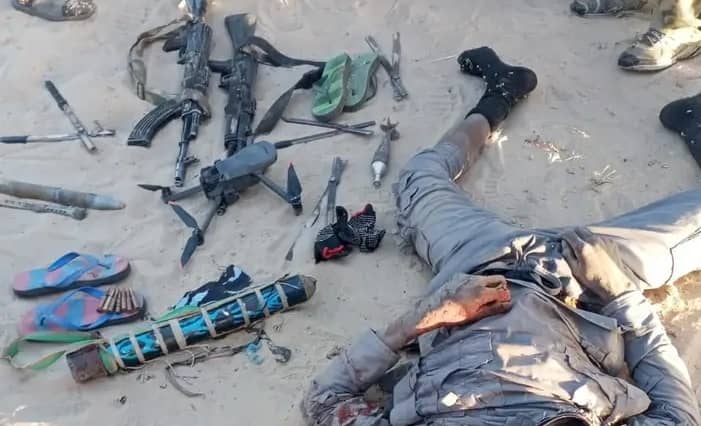
Hours later, at approximately 1:15 a.m. on March 1, terrorists armed with PKT machine guns, rocket-propelled grenades, and armed drones launched a coordinated assault on FOB Gajiram. The attack was repelled by determined troops supported by Nigerian Air Force assets. Three terrorist bodies were recovered along their withdrawal route. Items abandoned by the fleeing fighters included four AK-47 rifles, five anti-tank bombs, three locally made mortar bombs, and one armed drone. Other recovered items ranged from barbed wire cutters and specialized ammunition to poisoned arrows. One wounded soldier was airlifted by a Nigerian Army Aviation helicopter for advanced medical care.

In related offensive operations under Sector 2, troops ambushed terrorist elements around Bulturam Corner and Dadingel in Gujba Local Government Area, neutralizing two fighters and recovering two AK-47 rifles. Separate patrols also led to the destruction of terrorist life-support structures in Kayawa Village and the arrest of two confessed ISWAP logistics suppliers. Items seized in those operations included motorcycles, drugs, and medical supplies intended for treating wounded terrorists.

Military authorities confirmed that all locations are firmly under control. The large scale of weapons recovered and the number of confirmed enemy losses are seen as further evidence of the degrading combat capability of ISWAP in the region.

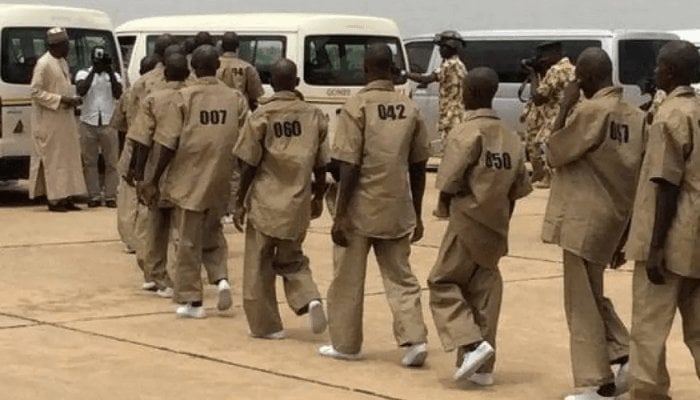
117 repentant terrorists complete rehabilitation programme in Borno

No fewer than 117 former insurgents have concluded the Federal Government’s de-radicalisation, rehabilitation and reintegration programme under Operation Safe Corridor in Borno State.

The development was announced during a high-level stakeholders’ meeting organised by the Defence Headquarters in collaboration with the leadership of Operation Safe Corridor at the Nigerian Army Resource Centre in Abuja.

In a statement issued on Thursday, Samaila Uba, Director of Defence Information, said the coordinator of Operation Safe Corridor, Y. Ali, disclosed that the ex-combatants completed the Disarmament, Demobilisation and Reintegration (DRR) process at the Mallam Sidi Camp.

According to Ali, the meeting focused on finalising arrangements for the transfer of the rehabilitated individuals to their respective national and state authorities for reintegration into society. He noted that the latest development reflects improved cooperation between federal and state governments in the areas of reception, monitoring and community reintegration.

Ali commended the Chief of Defence Staff, Olufemi Oloyede, for what he described as strong leadership and institutional backing. He stated that the progress recorded by Operation Safe Corridor aligns with the CDS philosophy, which promotes enhanced jointness, improved welfare and effective administration within a whole-of-government structure.

He explained that the initiative operates as a multi-agency humanitarian stabilisation programme supported by the 1999 Constitution and relevant international humanitarian and human rights frameworks. The programme draws personnel from 17 services, ministries, departments and agencies.

Since its establishment, he said the initiative has strengthened its screening procedures, reviewed its ideological disengagement modules, enhanced psychosocial recovery systems and expanded coordination among participating agencies. He added that the structure of the programme prioritises accountability, behavioural reform and sustainable reintegration.

Ali also disclosed that the programme has extended to the North-West region. A DRR camp established there in February last year marked what he described as an important stabilisation step. He revealed ongoing discussions with the Zamfara State Government to reposition the facility towards a broader framework that will focus on victim healing, rehabilitation and reintegration, alongside psychosocial recovery, community reconciliation, livelihood assistance and structured monitoring.

He further stated that Benue State has formally requested the establishment of a DRR camp. He said the Defence Headquarters has inspected proposed locations and advised that any approval must align with national standards on infrastructure, security and sustainability.

Ali outlined the objectives of the stakeholders’ meeting. He said participants were expected to define the responsibilities of state authorities and relevant ministries, departments and agencies, develop structured resettlement support systems, determine approaches for community sensitisation and camp visitation, and approve graduation timelines for rehabilitated clients.

The Chief of Defence Staff, represented by Jamal Abdusalam, Chief of Defence Operations, reaffirmed Nigeria’s commitment to a comprehensive government and societal approach to peacebuilding and national recovery. He described Operation Safe Corridor as a vital component of the country’s security framework.

“Since its inception in 2016, operation safe corridor has processed thousands of clients through a controlled and integrity-driven disarmament, rehabilitation and reintegration framework,” he said.

“When properly screened and coordinated, surrender pathways degrade insurgent cohesion, generate actionable intelligence and support long-term stability.”

The meeting attracted representatives from federal ministries, the Office of the National Security Adviser, state governments and neighbouring countries including Burkina Faso, Chad, Niger and Cameroon. International partners such as Norway, the United Kingdom, the European Union, the Foreign, Commonwealth and Development Office, the International Committee of the Red Cross and the International Organisation for Migration were also represented.

Nigerian soldiers launch heavy offensive operations, crush terrorists in Kwara

By Sabiu Abdullahi

Troops of the Nigerian Army’s 22 Armoured Brigade, with strong support from the Office of the National Security Adviser (ONSA), have recorded major successes in sustained offensive operations against terrorist elements in Kwara State.

This is contained in a statement signed by Captain Maureen Ogbuka, for the Acting Deputy Director, 2 Division Army Public Relations, Nigerian Army/Sector 3 Operations FANSAN YAMMA, on 30 January 2026.

The military said the coordinated actions, carried out within the Joint Operations Area, took place between 23 and 29 January 2026 under Operation Igbo Danu, also known as Operation Forest Flush.

The operations were led by the General Officer Commanding, 2 Division Nigerian Army and Commander Sector 3, Operation FANSAN YAMMA, Major General Chinedu Nnebife, alongside the Commander of 22 Armoured Brigade, Brigadier General Nicholas Rume. The Army noted that the leadership demonstrated strong operational drive and commitment to dismantling terrorist networks in the area.

During the engagements, troops working with ONSA carried out fighting patrols across several known bandit enclaves. The Army confirmed that one terrorist was neutralised, while others escaped into surrounding forests with suspected gunshot injuries. Their camps and hideouts were destroyed, forcing the criminals to abandon the locations.

In a related operation, troops cleared Garin Dandi, identified as a major bandit enclave in Ifelodun Local Government Area of Kwara State. The action led to the destruction of logistics bases and supply structures used by the criminals.

The military also moved into remote camps that had previously been inaccessible to security forces. Several abandoned camps and logistics facilities were destroyed, a development the Army said significantly weakened the terrorists’ ability to sustain their activities.

Despite difficult terrain, troops maintained an aggressive presence across forested areas and restricted the movement of bandits. Soldiers intercepted fleeing suspects at multiple blocking points, which led to arrests. The operations also resulted in the rescue of several kidnap victims from different camps across the state.

According to observations from the field, some bandits received assistance from collaborators within nearby communities who supplied intelligence on troop movements. This support, the Army said, allowed the criminals to withdraw early from targeted areas.

The Nigerian Army stated that the outcomes of the operations highlighted the resolve and effectiveness of 2 Division in degrading terrorist elements and restoring security in Kwara State.

The General Officer Commanding, 2 Division Nigerian Army, appealed to members of the public to continue to provide credible and timely information on bandits and their collaborators to support ongoing operations. The Army added that Operation Igbo Danu remains ongoing, with troops determined to decisively deal with all terrorist networks operating within the state.

Nigerian military intercepts terrorist trying to escape, frees 11 kidnap victims after 92 days

By Sabiu Abdullahi

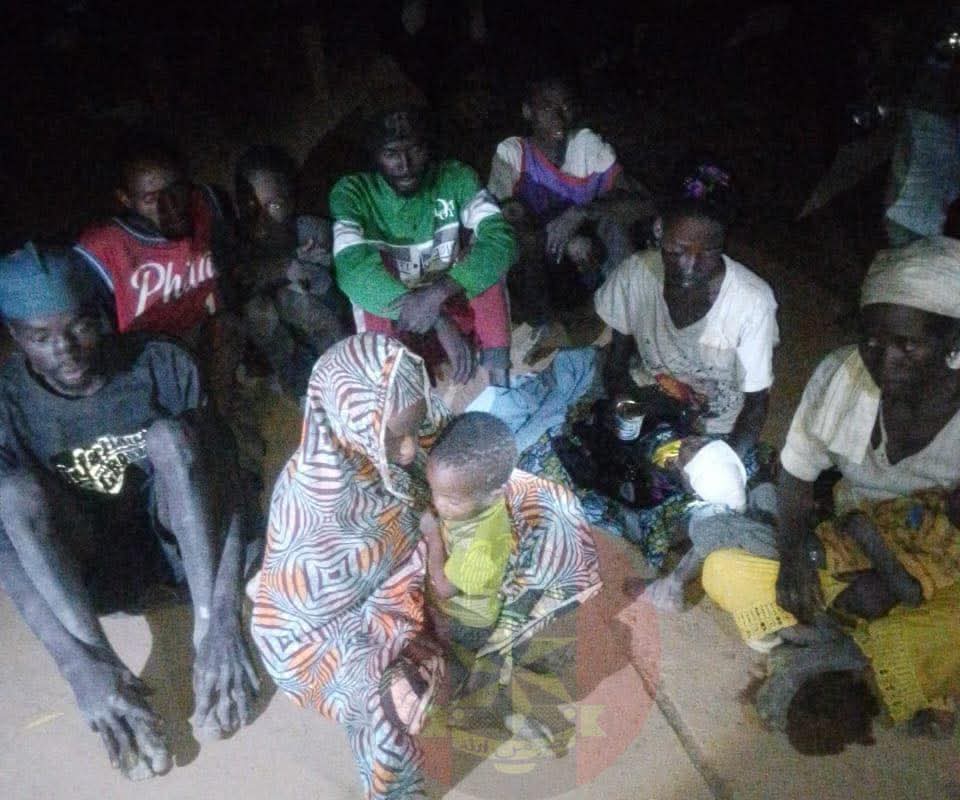
The Nigerian Army has recorded another operational success after troops rescued eleven kidnapped persons during a late-night operation carried out on January 26, 2026, along the Kaduna–Abuja Expressway.

The rescue followed the detection of armed terrorists who attempted to relocate their captives through the Gidan Duna–Amale bush path under the cover of darkness. Troops from the Forward Operating Base, Doka, spotted the movement through high-definition long-range CCTV surveillance and quickly moved to intercept the suspects.

Security sources said the soldiers launched a coordinated pursuit with tactical vehicles and motorcycles. The swift response put pressure on the criminals and forced them to abandon the victims before fleeing into nearby bushes, which stopped their attempt to escape deeper into the hinterland.

Those rescued included five adult men, three adult women, and three children. The victims were abducted from the Gada Mallam Maman Community on October 26, 2025, and had remained in captivity for 92 days.

Military authorities said the operation demonstrated the Army’s ability to combine modern surveillance equipment with effective ground action. They added that the force remains committed to protecting lives, securing major routes, and denying criminal groups any freedom of movement at all times.

On the infringement of Nigeria’s sovereignty

By Zayyad I. Muhammad 

Bandits, Lakurawa, Ansaru (Jama’atu Ansarul Muslimina Fi Biladis Sudan) and other terrorist groups have been terrorising Nigerians through killings, kidnappings, and rape. They have displaced thousands of people, carved out territories for themselves, collected taxes, and effectively governed parts of the North-West and North-Central regions.

For 13 years, the violent separatist group IPOB/ESN, designated a terrorist organisation by the Federal Government, has been operating in southeast Nigeria, terrorising the region through armed attacks on security forces, the enforcement of sit-at-home orders, and the killing and coercion of citizens to obey its directives.

For over 15 years, Boko Haram and ISWAP have established their authority on soft targets in some parts of the North-East, as well as attacking military formations, killing and kidnapping civilians, and carrying out suicide bombings against innocent people.

From the North-East to the North-West and North-Central regions, both local and foreign terrorist groups have carved out territories within Nigeria, killing and kidnapping innocent citizens, collecting taxes, imposing their own laws, displacing hundreds of people and brazenly displaying their weapons in public and on social media platforms.

On December 25, 2025, the United States, with the coordination and approval of the Nigerian government, launched 16 GPS-guided missiles at terrorist targets in parts of Sokoto State. As a result, some debris fell in Jabo and Offa. In Jabo, the debris fell on open fields, while in Offa, two hotels were hit.

Nigeria’s failure to eliminate these terrorists has brought the country to this point. No nation welcomes foreign military intervention on its soil. 

However, which constitutes a greater infringement on Nigeria’s sovereignty: the existence of local and foreign terrorist groups operating freely, killing, kidnapping, conducting suicide bombings, collecting taxes, and displacing innocent citizens from their lands, homes and places of business for nearly two decades, or a few hours of a U.S. missile strike authorised by the Nigerian government?

 Zayyad I. Muhammad writes from Abuja via zaymohd@yahoo.com.

POS operators aiding kidnappers, terrorists — NCTC

By Uzair Adam

The National Coordinator of the National Counter Terrorism Centre (NCTC-ONSA), Maj. Gen. Adamu Laka, has warned that some Point of Sale (POS) operators are playing active roles in facilitating terrorism and kidnapping in Nigeria.

Maj. Gen. Laka raised the alarm on Tuesday during an end-of-year briefing in Abuja, where he disclosed that ransom payments demanded by kidnappers are often routed through accounts owned by POS operators, making it difficult for security agencies to trace the funds.

According to him, investigations have revealed a recurring pattern in which kidnappers provide victims’ families with POS account details for ransom transfers. Once the money is sent, the criminals simply collect the cash from the operators.

“You see a transfer made by terrorists, and when you investigate the account, it belongs to a POS operator.

“The kidnappers give out the POS operator’s number, the money is transferred, and they go to collect it,” he explained.

He said the practice has become a major challenge for counter-terrorism efforts, as it allows criminal networks to move funds discreetly while evading financial tracking mechanisms.

NAF launches night raids, kills 25 terrorists in Borno, Yobe

By Anas Abbas 

The Nigerian Air Force (NAF) has killed more than 25 terrorists in a coordinated night air raid around Bula in Yobe State and the Banki axis of Borno State.

Director of Public Relations and Information, Air Commodore Ehimen Ejodame, disclosed this in a statement issued on Saturday in Abuja. 

He explained that the operation was carried out on September 18, following actionable intelligence provided by ground troops.

According to Ejodame, a combination of Intelligence, Surveillance and Reconnaissance (ISR) assets and strike aircraft tracked terrorist movements and spotted multiple groups north of Banki. The terrorists were then hit in three successive precision strikes along their movement routes and assembly points.

“Real-time updates were relayed to ground forces and base operations, enabling synchronised action. The strike aircraft engaged the terrorists in three successive precision strikes, effectively neutralising more than 25 fighters,” Ejodame stated.

He added that post-strike surveillance confirmed that ground forces had maintained their defensive positions, with no further threats detected.

Ejodame said the operation highlighted the Air Force’s unwavering support for ground troops and its commitment to denying terrorists freedom of action in the North-East.

The operation comes just days after Boko Haram insurgents attacked the Darajamal community in the Bama Local Government Area of Borno on September 8, killing at least 63 people, including five soldiers. The attackers, who rode in on motorcycles, shot indiscriminately, razed houses and vehicles before military reinforcements arrived.

Governor Babagana Zulum had described that incident as “very sad,” confirming the death toll and pledging government support to the affected families.

Jihadist resurgence in Northeastern Nigeria raises alarms

By Muhammad Abubakar

A recent surge in jihadist attacks in northeastern Nigeria has sparked concerns over a potential comeback of extremist groups in the region. Over the weekend, at least 48 individuals lost their lives in coordinated assaults across Adamawa and Borno states, marking one of the deadliest periods in recent months.

Security analysts attribute this uptick in violence to a reduction in infighting between Boko Haram and its splinter group, the Islamic State West Africa Province (ISWAP). The groups have reportedly adopted advanced tactics, including the use of armed drones and roadside explosives, indicating increased tactical support and funding from the Islamic State.

In Borno State, Governor Babagana Zulum has warned of militant regrouping in the Lake Chad and Sambisa Forest regions, noting a lack of strong military response. The Nigerian military has yet to comment on the situation.

The resurgence of these extremist groups poses a significant threat to the stability of northeastern Nigeria, a region that has endured over 15 years of insurgency.

Analysts caution that without a robust and coordinated response, the region may witness a return to the heightened levels of violence experienced in previous years.