Tax Reform Bill

NRS unveils new logo, marks transition from FIRS

By Muhammad Abubakar

The Nigeria Revenue Service (NRS) has officially unveiled its new institutional logo, formally marking its transition from the Federal Inland Revenue Service (FIRS) to a newly established revenue authority.

The unveiling ceremony took place in Abuja on Wednesday and was announced in a statement by Dare Adekanmbi, special adviser to the chairman of the NRS.

Speaking at the event, Zacch Adedeji, executive chairman of the NRS, described the new brand identity as a major milestone in the ongoing reform of Nigeria’s revenue administration framework, reflecting a renewed mandate and institutional vision.

Adekanmbi noted that the service became operational after President Bola Tinubu signed the Nigeria Revenue Service Establishment Act 2025 in June, paving the way for the transition from FIRS to NRS.

The new logo, officials said, symbolises efficiency, accountability, and a modernised approach to revenue generation in Nigeria.

On the gazetted tax laws: What if Dasuki was indifferent?

By Isah Kamisu Madachi

For over a week now, flipping through the pages of Nigerian newspapers, social media, and other media platforms, the dominant issue trending nationwide has been the discovery of significant discrepancies between the gazetted version of the Tax Laws made available to the public and what was actually passed by the Nigerian legislature. Since this shocking discovery by a member of the House of Representatives, opinions from tax experts, public affairs analysts, activists, civil society organisations, opposition politicians, and professional bodies have been pouring in.

Many interesting events that could disrupt the pace of the debate have recently surfaced in the media. Yet the Tax Law discussion persists because public interest is deeply entrenched in the contested laws. However, while many view the issue from angles such as a breach of public trust, a violation of legislative privilege by the executive council, the passage of an ill-prepared law and so on, I see it from a different, narrower, and governance-centred perspective.

What brought this issue to public attention was an alarm raised by Hon. Abdulsammad Dasuki, a Member of the House of Representatives from Sokoto State, during a House plenary on 17 December 2025. He called the attention of the House to what he identified as discrepancies between the gazetted version of the Tax Laws he obtained from the Federal Ministry of Information and what was actually debated, agreed upon, and passed on the floor of both the House and the Senate. He requested that the Speaker ensure all relevant documents, including the harmonised versions, the Votes and Proceedings of both chambers, and the gazetted copies, are brought before the Committee of the Whole for scrutiny. The lawmaker expressed concern over what he described as a serious breach of his legislative privilege.

Beyond that, however, my concern is about how safe and protected Nigerians’ interests are in the hands of our lawmakers at the National Assembly. This ongoing discussion raises a critical question about representation in Nigeria. Does this mean that if Dasuki had also been indifferent and had not bothered to utilise the Freedom of Information Act 2011 to obtain the gazetted version of the laws from the Federal Ministry of Information, take time to study it, and make comparisons, there would have been no cause for alarm from any of Nigeria’s 360 House of Representatives members and 109 senators? Do lawmakers discard the confidence we reposed in them immediately after the election results are declared?

This debate serves a latent function of waking us up to the reality of the glaring disconnect between public interest and the interests of our representatives. The legislature in a democratic setting is a critical institution that goes beyond routine plenaries that are often uninteresting and sparsely attended by the lawmakers. It is meant to be a space for scrutiny, deliberation, and the protection of public interest, especially when complex laws with wide social consequences are involved. 

We saw Sen. Ali Ndume in a short video clip that recently swept the media, furiously saying during a verbal altercation with Sen. Adams Oshiomhole over ambassadorial screening that “the Senate is not a joke.” The Senate is, of course, not a joke, and neither should the entire National Assembly be. Ideally, it should not be a joke to the legislators themselves or to us. Therefore, we should not shy away from discussing how disinterested those entrusted with the task of representing us, and primarily protecting our interests, appear to be in our collective affairs.

It is not a coincidence that, even before the current debate over the tax reform law, it has continued to generate controversy since its inception. It also does not take quantum mechanics to understand that something is fundamentally wrong when almost nobody truly understands the law. Thanks to social media, I have come across numerous skits, write-ups, and commentaries attempting to explain it, but often followed by opposing responses saying that the authors either did not understand the law themselves or did not take sufficient time to study it.

The controversy around the gazetted Tax Reform Laws should not end with public outrage or media debates alone. It should prompt deeper reflection on how laws are made, scrutinised, and defended in Nigeria’s democracy. A system that relies on the alertness of a single lawmaker to prevent serious legislative discrepancies is neither resilient nor reliable. Representation cannot be occasional, and vigilance cannot be optional. 

Nigerians deserve a legislature that safeguards their interests, not one that notices breaches only when a few individuals choose to be different and look closely. If this ongoing debate does not lead to formidable internal checks and a renewed sense of responsibility among lawmakers, then the problem is far bigger than a flawed gazette. When legislative processes fail, it is ordinary Nigerians who bear the cost through policies they did not scrutinise and consequences they did not consent to.

Isah Kamisu Madachi is a public policy enthusiast and development practitioner. He writes from Abuja and can be reached via: isahkamisumadachi@gmail.com.

NIN to serve as tax ID for Nigerians from January 2026

By Muhammad Abubakar

The National Identification Number (NIN) issued by the National Identity Management Commission (NIMC) will automatically function as a Tax Identification Number (Tax ID) for Nigerians starting from January 2026, the Federal Inland Revenue Service (FIRS) has announced.

According to the FIRS, the policy is part of broader efforts to harmonise government databases, improve tax administration, and expand the country’s tax net. By linking tax records directly to the NIN, authorities aim to reduce duplication, enhance compliance, and make it easier for individuals and businesses to fulfil their tax obligations.

Officials said the integration would streamline identification across government services while strengthening transparency and efficiency in revenue collection.

Nigerians are therefore encouraged to ensure their NIN details are accurate and up to date ahead of the January 2026 implementation.

The move aligns with ongoing digital reforms by the Federal Government to modernise public administration and improve service delivery nationwide.

Tax reform, content creators and the rest of us

By Isyaka Laminu Badamasi

It is becoming glaring that the Federal Government is taking Nigerians for granted. A few months back, we were all here condemning the new tax reform introduced by the APC administration led by President Bola Ahmed Tinubu, a reform whose implications will be deeply felt by Nigerians, especially the downtrodden.

Though some analysts and experts argue that the new tax reform is the right step, particularly for an economy whose revenue depends almost 70% on crude oil, my little contribution to the debate is not to analyse the reform or weigh its positive and negative impacts on our well-being. Rather, it is to raise a few critical questions arising from my thoughts on the matter at hand.

My concern is specifically about content creators who were engaged to sensitise Nigerians on the new bill—a development that sparked another debate, one that again exposed our disunity as a people and our lack of seriousness about matters of national importance and those inimical to our well-being. Nigerians, especially Northerners, instead of examining the bill and preparing for constructive criticism, began complaining that none of the selected content creators was from the core North. As if having a core Northern content creator in the sensitisation team would somehow change or reduce the taxes that will eventually be imposed on core Northerners.

With or without any sensitisation or awareness campaign, the new tax reform has come to stay. Regardless of how people accept or reject it, it will be implemented as planned. The content creators engaged by the government may not even understand the policy themselves, let alone be able to sensitise the public properly.

For me, therefore, this entire conversation about the “selection of content creators” is unnecessary. To my understanding, it was technically designed to divert Nigerians’ attention. Instead of focusing on constructive criticism of this inhumane policy, we have been pushed into arguing over who should be involved, when, and how—a distraction that does not help an already fragmented country.

Let us not forget that we are in 2025, in the 21st century—111 years as an amalgamated entity and 65 years as an independent nation, with more than two and a half decades of an uninterrupted democratic dispensation. It is high time we appreciate our togetherness despite the odds and chart a path toward unity. This is especially crucial at this moment, when we are facing serious and multidimensional security challenges, particularly here in the North, ravaged by bandits, insurgents, and kidnappers, with pockets of ethnic and religious conflicts here and there. Do we so easily forget that Nigeria was once declared a “country of particular concern” by the US President, Donald Trump?

It is important for policymakers and implementers to avoid introducing issues that, instead of fostering peaceful coexistence, end up dividing us. Meanwhile, those in positions of authority continue siphoning our meagre resources—resources that have failed to address our critical challenges in health, education, security, and other essential sectors.

On the issue of not engaging or selecting content creators from the core North for this “all-important” sensitisation campaign, the situation is both baffling and questionable. It is strange that the PR unit of the FIRS/FGN did not consider the three major languages—Hausa, Igbo, and Yoruba—alongside English, our official language, as part of their information-dissemination strategy. However, it is still not too late to make corrections.

Whatever the reasons may be, Nigerians—regardless of region or religion—should prepare themselves, as the policy will take effect come January 2026.

Isyaka Laminu Badamasi wrote via makwalla82@gmail.com.

Tinubu’s new tax reforms and the North

By Zayyad I. Muhammad

On Thursday, June 26, 2025, President Bola Tinubu signed into law four landmark tax bills that the National Assembly had recently passed.

Whether one agrees or disagrees with Tinubu’s style of governance, the new tax bills signal a new beginning for Nigerians, businesses, and governments, both at the subnational and federal levels.

Some key  highlights of the Reforms are:

Elimination of Duplication in Tax Collection: One major reform is the establishment of the new Nigeria Revenue Service (NRS), which will now collect revenues that were previously handled by numerous agencies, such as the Nigeria Customs Service, Nigerian Ports Authority (NPA), Nigerian Upstream Petroleum Regulatory Commission (NUPRC), NIMASA, and others.

Tax Exemption for Low-Income Earners: With the new provisions, individuals earning ₦800,000 or less per year are now fully exempt from income tax. This is a masterstroke, especially for many people in the North. It removes a huge burden and creates space for their small and medium-sized businesses to grow and flourish.

New Personal Income Tax Rate: 

Only those earning above ₦50 million annually will be required to pay the new 25% personal income tax rate. This is both fair and reasonable.

Another significant win for the North, which has the highest concentration of impoverished people in Nigeria, is the removal of VAT on essential goods and services, including school fees, medical services, food, pharmaceuticals, and electricity. This is a significant relief for the poor and small to medium-sized businesses.

The corporate tax rate will now be reduced from 30% to 25%, and small businesses will be fully exempt from paying income tax.

The controversial VAT issue has now been ‘fairly’ settled, and again, it’s a big win for the North, which had previously raised concerns. The new revenue-sharing formula is as follows:

Federal Government: 10%

States: 55%

Local Governments: 35%

Even more importantly, the VAT sharing formula has been revised in a way that favours the North. If northern states seize the opportunity to harness and develop their economies and markets, especially in agriculture, they will benefit significantly.

The new sharing criteria are:

50% of VAT is shared equally among all states

20% is based on population

30% is based on where goods/services are consumed

One of the most important features of these tax reforms is how they protect and uplift the poor and small businesses,especially in the North, where:

About 65% of Nigeria’s poorest people live

Over 52% of the country’s states are located

More than 60% of the population resides

Nearly 70% of Nigeria’s landmass is found

And almost 80% of agricultural production takes place

It’s time for northern states to tap into local knowledge and deploy homegrown experts to thoroughly study the four landmark tax laws in line with each state’s peculiarities and needs, yet with the whole North as the unifying objective.

If well studied and strategically implemented, Tinubu’s new tax reforms could be the silver bullet the North has been waiting for.

They offer fiscal justice, decentralisation of revenue, protection for the poor, incentives for businesses, and a practical opportunity to lift millions out of poverty.

However, as always, it will take visionary leadership, technical expertise, and political will to translate policy into meaningful impact. The opportunity is here. The North must not waste it.

Zayyad I. Muhammad writes from Abuja via zaymohd@yahoo.com.

President Tinubu signs tax reform bills into law

By Anwar Usman

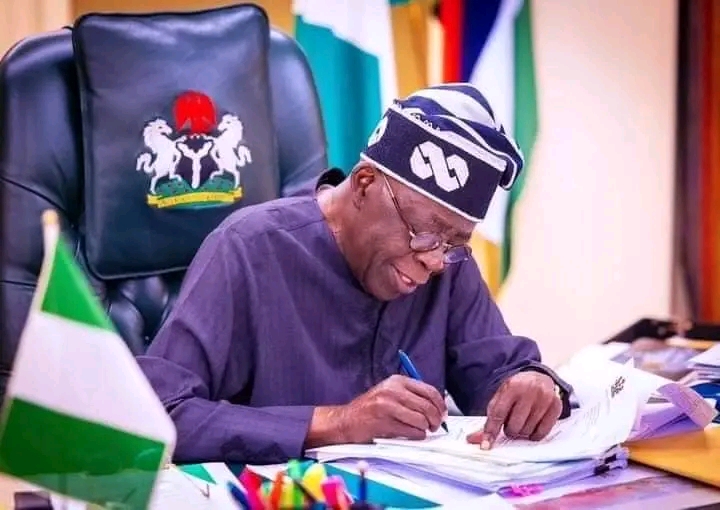
The President of Nigeria, Bola Ahmed Tinubu, has today signed the four tax reform bills into law.

The bills, which he said will transform Nigeria’s fiscal and revenue framework, were signed at the Presidential Villa in Abuja on Thursday afternoon.

The four bills include the Nigeria Tax Bill, the Nigeria Tax Administration Bill, the Nigeria Revenue Service (Establishment) Bill, and the Joint Revenue Board (Establishment) Bill, which were recently passed by the National Assembly.

Those present at the signing ceremony were Senate President Godswill Akpabio, Speaker of the House of Representatives, Tajudeen Abbas; Senate Majority Leader, House Majority Leader, chairman of the Senate Committee on Finance, and his House of Representatives counterpart.

On Wednesday, Bayo Onanuga, Special Adviser to the President on Information and Strategy, stated that the implementation of the new tax laws would significantly transform tax administration in the country, leading to increased revenue generation, an improved business environment, and a boost in domestic and foreign investments.

Tinubu defies critics, declares tax reforms unstoppable

By Uzair Adam

President Bola Ahmed Tinubu has reiterated his administration’s unwavering commitment to implementing tax reforms, emphasizing their importance for Nigeria’s economic transformation.

The Daily Reality reports that the president made this assertion during his first presidential media chat on Monday night in Lagos State.

The proposed reforms, encapsulated in several bills before the National Assembly, include the Nigeria Tax Bill, Nigeria Tax Administration Bill, Nigeria Revenue Service Establishment Bill, and the Joint Revenue Board Establishment Bill.

Despite facing backlash, particularly from Northern leaders, and prompting calls for further consultation, Tinubu defended the reforms as being pro-poor and aimed at restructuring outdated colonial tax structures.

“Tax reform is here to stay,” Tinubu stated, adding, “In today’s economy, we cannot continue to rely on outdated systems.

“The essence of these reforms is to eliminate colonial-based assumptions in our tax environment. The vulnerable will not be subjected to taxation.”

Addressing concerns about the controversial Value-Added Tax sharing model, the President expressed his willingness to engage in negotiations but insisted that the reforms would proceed.

“Tax matters are subjects of debate, reviews, and negotiations until consensus is reached,” he said.

Tinubu also remarked that good leadership requires decisive actions at critical moments.

“The hallmark of a good leader is the ability to do what you have to do when it needs to be done. That is my philosophy,” he added.

The proposed tax reforms aim to create a fairer tax system, though Tinubu acknowledged that they might not be universally accepted.

Tinubu: No regrets over fuel subsidy removal—it was a must-do reform

By Uzair Adam

President Bola Ahmed Tinubu has reaffirmed the necessity of his administration’s decision to remove the fuel subsidy, describing it as an unavoidable step to secure Nigeria’s economic stability.

During his first presidential media chat on Monday night, Tinubu maintained, “I have no regrets whatever removing subsidies. It was necessary.”

The President explained that the subsidy system was unsustainable and akin to jeopardizing the nation’s future for immediate gratification.

“We were not investing; we were just deceiving ourselves. The reform was necessary. We cannot have expenditures we don’t have revenue for,” he stated, urging Nigerians to embrace fiscal discipline and prudent financial management.

“Cut your coat according to your size,” Tinubu advised, adding that the removal was imperative to ensure a sustainable future for upcoming generations.

He acknowledged the challenges posed by the reform, including resistance from smugglers, and emphasized the need for stringent enforcement and structural adjustments.

“I can see smugglers fighting back,” Tinubu remarked, vowing to address these challenges through necessary reforms and strong measures.

The President also extended his condolences to the families of victims of recent stampede incidents at a charity event, calling for improved organization and contingency planning to avoid similar tragedies.

“It is sad that people are not respected or are abused in situations like this. If you don’t have enough to give, don’t publicise it,” he said, urging event organisers to prioritise safety and crowd control.

Tinubu reiterated his administration’s commitment to making difficult but essential decisions, asserting, “No matter how you phase it, you still have to meet the bill.”

Debunking the claim that 90% of Nigerians support the controversial tax reform bill

By Adamkolo Mohammed Ibrahim

The Truth Behind Nigeria’s Controversial Tax Reform Bill

Professor Taiwo Oyedele, Chairman of the Presidential Committee on Fiscal Policy and Tax Reforms, recently claimed that 90% of Nigerians support the contentious tax reform bills currently before the National Assembly. This claim is not only misleading but also contradicts the palpable opposition across various sectors of the country. As a university lecturer, researcher, public policy critic, and advocate of public accountability, I find it imperative to refute these unfounded assertions with facts and context.

Professor Oyedele and his team have lauded the proposed tax reform bill as a transformative framework, but it has sparked nationwide outrage, including on social media platforms. Far from the purported overwhelming support, the bill faces staunch opposition from key stakeholders across Nigeria, particularly in the 19 states in northern Nigeria. Among those voicing their discontent are the 19 northern governors, traditional rulers such as emirs, religious organisations, youth groups, business associations, and a myriad of concerned citizens, both in real life and on social media platforms.

Nigeria’s Vice President, Senator Kashim Shettima, who also chairs the National Economic Council (NEC), offered a particularly significant perspective. In alignment with the collective stance of northern governors (drawing from his deep understanding of the region as a proud son of the northeast of Nigeria) and other national stakeholders, he emphasised the importance of ensuring inclusivity and fairness in the proposed tax reform process. 

The Vice President firmly advised against submitting the bill to the National Assembly without wider consultations. During one of NEC’s monthly sessions, a unanimous decision was reached: the bill should be halted to ensure no region or demographic is marginalised in our democratic process. Despite this well-articulated stance, the President disregarded this advice and pushed ahead with the submission of the bill. This move has understandably deepened mistrust and resentment.

Critics argue that the tax reform bill is structured to disproportionately benefit Lagos State to the detriment of 35 other states and the Federal Capital Territory. For northern governors, this directly threatens their ability to sustain basic governance functions, including the payment of salaries and provision of essential services. Governor Babagana Zulum of Borno State is one of the most vocal opponents, warning that the bill if passed, would cripple northern states economically.

Such criticisms are not baseless. Deep inequalities mark Nigeria’s economic landscape, and any policy perceived to exacerbate these disparities inevitably meets with resistance. The tax reform bill appears to reinforce these fears, offering no clear mechanisms to balance its purported benefits with the realities of Nigeria’s diverse socio-economic terrain.

Questionable Survey Claims

Professor Oyedele’s assertion of a 90% approval rating for the bill demands rigorous scrutiny. According to his statement, the survey involved over 3,000 participants, a mix of online and offline respondents, with approval rates ranging from 76% among passive readers to 100% among in-person attendees. These figures raise more questions than they answer.

Who exactly were the survey respondents? What methodology was employed? How representative was the sample of Nigeria’s diverse population? What strategies were used for data collection and analysis? These critical details remain conspicuously absent, leaving the legitimacy of the survey in serious doubt.

Nigerians deserve transparency in policymaking. If this survey indeed reflects national sentiment, Professor Oyedele and his committee should publish the raw data, methodology, and results for independent verification. If they have not done so, this can only be interpreted as an attempt to mislead the public using propagandistic executive intimidation and push through an agenda that lacks popular support.

The Case for Wider Consultation

The NEC’s earlier recommendation to halt the bill and engage in broader consultations was wise and democratic. Policymaking in a pluralistic society like Nigeria requires inclusivity, transparency, and sensitivity to regional and socio-economic disparities. By bypassing these principles, the federal government risks deepening the divisions that have long plagued the nation.

Wider consultation is not just a procedural formality but a necessity. It allows for the incorporation of diverse perspectives, ensuring that no part of the country feels short-changed. Given the widespread criticism of the bill, particularly from regions like the North that stand to lose the most, the government’s failure to heed this advice represents a glaring lapse in leadership.

Furthermore, President Bola Ahmed Tinubu’s policy direction, particularly concerning the contentious tax reform bill, raises critical questions about his government’s approach to governance and inclusivity, especially regarding the northern region of Nigeria. It is a region that not only demonstrated overwhelming support for his candidacy in the 2023 general election but also provided the majority of the votes that secured his presidency.

In the 2023 presidential election, President Tinubu garnered a significant 8,794,726 votes, with the northern region contributing the bulk of this figure. Northern voters cast over 4.9 million votes — approximately 55.7% of his total votes — in his favour. These numbers highlight the region’s decisive role in his electoral victory. Yet, it is disheartening to observe the implementation of policies that appear inimical to the socio-economic interests of this same region.

The adage “do not bite the finger that feeds you” is not only a moral maxim but a practical guide for leadership in a diverse democracy like Nigeria. Unfortunately, recent government actions, particularly the insistence on the controversial tax reform bill, seem to disregard this wisdom. The northern region, often referred to as the agricultural and cultural heartland of the nation, stands to bear the brunt of these policies. Stakeholders, including northern governors, traditional rulers, and socio-political groups, have consistently voiced their opposition, warning that the bill could exacerbate regional inequities and economic hardships.

Rather than recognising and addressing these legitimate concerns, the administration appears determined to forge ahead. This approach not only undermines the trust of a region that played a pivotal role in President Tinubu’s electoral success but also risks alienating key stakeholders whose support is crucial for national stability. It is worth noting that governance is a reciprocal relationship; the trust and support of the people should be met with policies that prioritise their welfare and reflect their collective aspirations.

Every action or inaction in politics has consequences, and the grievances of the northern region should not be underestimated. Leaders must remember that political capital is not an endless resource; it must be replenished through equitable and inclusive governance. President Tinubu’s administration must demonstrate its commitment to Nigeria’s unity and progress by re-evaluating policies that could harm the very citizens whose votes propelled him to power.

The northern region’s contribution to President Tinubu’s mandate was not a token gesture but a profound expression of trust and hope in his leadership. To erode that trust through policies perceived as neglectful or exploitative is to undermine the very foundation of the democratic pact. As the government moves forward, it must prioritise consultation, transparency, and equity to ensure that all regions of the country, especially the North, feel represented and valued. Anything less would not only be a betrayal of the region’s support but a potential threat to the unity and stability of the nation.

The Way Forward

To restore public trust and ensure equitable governance, the Federal Government must take the following steps:

  1. Publish the Survey Data: Nigerians have the right to scrutinise the data underpinning claims of popular support for the bill. Transparency is non-negotiable.
  2. Engage Stakeholders: Governors, traditional rulers, religious leaders, youth organisations, business associations, students, and other demographics must be actively involved in refining the bill. Their insights are crucial for crafting a policy that benefits all Nigerians.
  3. Reassess the Bill: The tax reform must be revisited to address its perceived regional biases. Mechanisms should be introduced to ensure that no state or region is disproportionately disadvantaged.
  4. Strengthen Regional Equity: Any reform should prioritise clear, open, transparent, unambiguous, and sincere equitable distribution of resources and revenue, balancing the needs of economically vibrant states like Lagos with those of less developed regions.
  5. Promote Public Dialogue: The government should organise town hall meetings and public forums across all geopolitical zones to educate citizens about the bill and solicit their input. Relying solely on the National Assembly’s public hearings will not be sufficient to ensure broad-based participation and understanding.

Therefore, the claim that 90% of Nigerians support the tax reform bill distorts reality. The widespread opposition from across Nigeria, including key voices in northern governance, traditional institutions, and civil society, underscores the contentious nature of this legislation. Rather than pushing ahead with a deeply flawed policy, the Federal Government must prioritise inclusivity, transparency, and equity in its approach to fiscal reform.

Cherry-picked survey results, lofty rhetoric, or political propaganda will not silence Nigerians. Democracy thrives on accountability, and the people deserve nothing less than policies that genuinely reflect their collective will and serve their common good. Professor Oyedele and his committee must heed this call, for the integrity of Nigeria’s democratic process and the future of its fiscal stability depends on it.

Adamkolo Mohammed Ibrahim, a Lecturer at the Department of Mass Communication, University of Maiduguri, wrote in from Pompommari Sabon-Fegi, Damaturu, Yobe State, and can be reached via adamkolo@unimaid.edu.ng.

ACF takes step toward tax reforms with new committee

By Abdullahi Mukhtar Algasgaini

The Arewa Consultative Forum (ACF) has established a Tax Reform Committee to tackle the challenges of taxation in Nigeria, especially the four proposed tax bills currently undergoing legislation. 

The committee, chaired by Senator Ahmed Muhammad Makarfi, former Governor of Kaduna State, comprises members with diverse expertise in finance, law, taxation and economics.

Other members of the committee include:

Dr. Mansur Mukhtar former Minister of Finance, Dr. Yerima Ngama, former Minister of State Finance, Joe-Kyari Gadzama SAN, Prof. Kabir Isa Dandago, Gambo Hamza, Kabiru M Ahmed, Mouftah Baba-Ahmed, Tajuddeen A Dantata, Chris Umar SAN and Abdullahi Ali Gombe, mni

The establishment of the Tax Reform Committee is a significant step towards addressing the tax challenges facing the region and Nigeria as a whole. 

The committee’s recommendations are expected to contribute to developing a more effective tax system in the country.