Sudan

The Caliphate did not die in Burmi: My travelogue to Maiurno

By Abdulrahman Sani

I went to Sudan to study Arabic. That was the beginning, simple and deliberate. But in truth, Arabic was only the surface. Sudan offered more than language. It stirred old questions I had carried with me since adolescence. Questions about memory, exile, and what remains after collapse.

My first encounter with the Sokoto Caliphate’s legacy wasn’t through archives or oral traditions. It was through theatre. I was in secondary school when I read Attahiru by Ahmad Yerima. The image of the Caliph fleeing colonial forces, defiant to the end, burned itself into my mind. I didn’t fully understand the politics then, but I felt the tragedy. That single text became a spark.

Later, I found the writings of Dr. Usman Bugaje, measured and searching. And then came Muhammad Shareef, the African American founder of Jamaa’at Danfodio in the United States, whom I had the pleasure of interviewing [here: https://youtu.be/_5Uj1S0lXQM?si=1BpJ9vusnW2HqWf4]. His writings were rich, wide-ranging, and full of overlooked geographies. It was through him that I first read about Maiurno, a small village in Sudan that held the echoes of Sokoto’s fall.

The very idea of it intrigued me. Remnants of the Caliphate had not only survived but also resettled, rebuilt, and renamed. I wanted to know what happened after Burmi. I wanted to know what exile looked like, generations later.

I mentioned this to my friend Malam Hassan, and soon after, we were on our way — me, him, and our guide. Before Maiurno, I spent some time in a Hausa village in Sudan. The familiarity was immediate. I saw areas named after Illela, heard idioms that sounded like home. It was as though Sokoto had sent a whisper into the desert, and it had echoed back in Sudanese tones.

Maiurno came into view quietly, without ceremony—a flat, sun-beaten village, carrying itself without fanfare. But history rarely announces itself. You feel it in the silences.

We made our way to the Sultan’s palace early in the morning. As we approached, an elderly man greeted me in Fulfulde. I hesitated, then responded in Arabic, admitting I didn’t understand. It was one of those quiet humiliations. A Fulani, abroad, unable to answer in the language of his own people. He smiled politely and said nothing.

We waited. There were others before us, people from another town in Sudan who had come to report a case. In the meantime, I noticed the crocodiles. Yes, crocodiles. They lay in their enclosure like royal guards, unmoving. It felt surreal but somehow fitting. The Sultan was no mere figurehead. He was the acknowledged leader of Hausa and Fulani communities in Sudan, a man of both presence and authority.

When he finally emerged, he received the guests before us. He listened without interruption or impatience. Then he settled their matter with a wisdom that didn’t need to explain itself. That kind of clarity is rare.

Then he turned to me.

I told him why I had come. I said I was interested in the Fodiyawa manuscripts said to be preserved in Sudan. He nodded with understanding, but explained that the key lay with the Sardauna of Maiurno, a scholar of great standing who, ironically, had travelled to Nigeria, my own country.

The Sultan was fluent in Hausa, Arabic, and Fulfulde. He spoke with the calm rhythm of someone used to being listened to. He smiled and said, “I know in Sokoto your Fulfulde doesn’t go beyond Balinjam.” It was said lightly, but it landed with accuracy.

He spoke of his relative, Professor Mukoshay, the author of the Fulani-Hausa dictionary. Then, briefly about Hayat ibn Sa‘id, a name that deserves more telling than time allowed. Before long, I realised I should be recording this. I asked his permission. He agreed with grace.

He began narrating how their ancestors had come to Maiurno after the fall of the Caliphate, how they had built their homes, mosques, and memory on Sudanese soil, and how they still kept contact with their families in Nigeria. He spoke too of the Jamaa’at Danfodio in America with quiet admiration, amused by how history had found new shapes and tongues.

After the conversation, he did something unexpected. He asked, gently, for my contact. I gave it. We shook hands, and I took my leave.

What struck me wasn’t just the story. It was the clarity with which he carried it. My visit to Maiurno took place in 2019. At the time, the country was in a fragile transitional moment, unsure of what lay ahead. But even then, the Sultan stood out–quiet, composed, and principled. In later years, during the war with the RSF militia, I would hear that he remained steadfast and stood with the state when others hesitated. The president himself visited to thank him.

Maiurno wasn’t just a trip. It was a quiet, necessary crossing, from curiosity to memory, from story to place. The Sokoto Caliphate may have fallen in Burmi, but it lives on. In names. In speech. In places like Maiurno, where its sons still remember.

Abdulrahman Sani can be reached via X: @philosopeace.

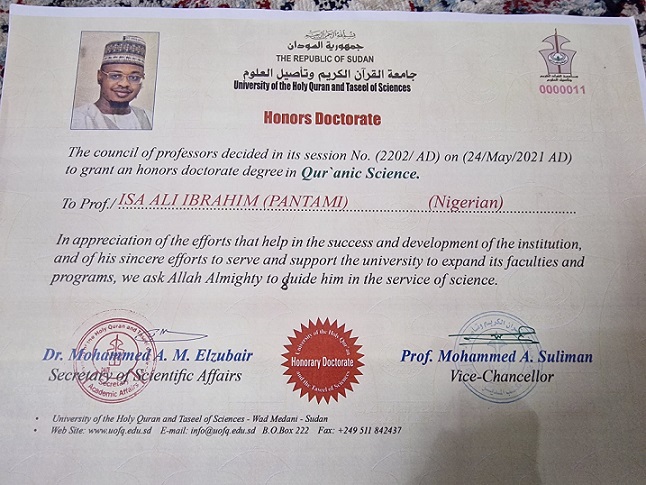
Holy Qur’an University confers honorary doctorate on Sheikh Pantami

By Abdurrahman Muhammad

The University of the Holy Qur’an and Taseel of Sciences of the Republic of Sudan awarded Nigeria’s Minister of Communications and Digital Economy and renowned Islamic cleric, Professor Isa Ali Ibrahim (Pantami), with an Honorary Doctoral Degree in Qur’anic Science.

While the Honourable Minister was awarded in May 2021, he received the award certificate and shared the same on social media only recently.

According to the official social media handles of the Minister, he was the first person in sub-Saharan Africa to receive the award. The statement, in part, reads:

“With the exemption of North Africa, he was the first African to receive the recognition on the Glorious Qur’an.”

During Ramadan, Sheikh Pantami delivers Tafsir at the Annur Masjid in the Nigerian capital, FCT Abuja. He also holds other preaching sessions outside the Holy Month at the same mosque or elsewhere.

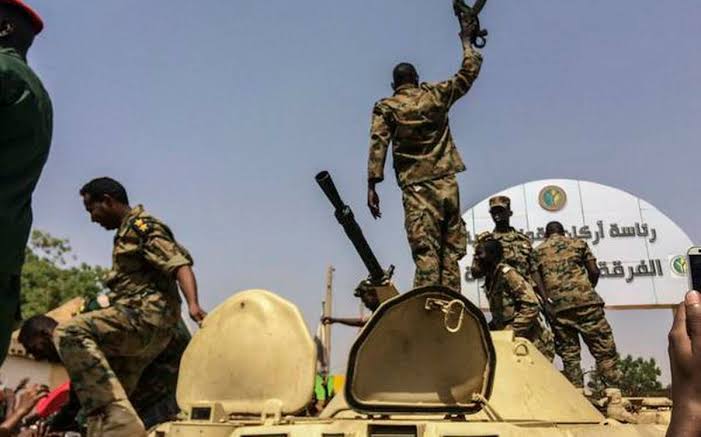
Breaking News: Military coup in Sudan

Through out last week, there were rising fears among the Sudanese as the military were about to intrude into the civilian spaces. Tension was so high, a situation that led to the closure of businesses, offices and many people remained indoors in the Capital city of Khartoum. However, earlier in the morning, there was a reported military coup.

According to CAIRO (AP) — Military forces arrested Sudan’s acting prime minister and senior government officials Monday, disrupted internet access and blocked bridges in the capital Khartoum, the country’s information ministry said, describing the actions as a coup.

In response, thousands flooded the streets of Khartoum and its twin city of Omdurman to protest the apparent military takeover. Footage shared online appeared to show protesters blocking streets and setting fire to tires as security forces used tear gas to disperse them.

Protesters could be heard chanting, “The people are stronger, stronger” and “Retreat is not an option!” as plumes of smoke from burning tires filled the air.

A takeover by the military would be a major setback for Sudan, which has grappled with a stop-and-go transition to democracy since long-time ruler Omar al-Bashir was toppled by mass protests two years ago.

The United States and the European Union expressed concern over Monday’s developments.

Jeffrey Feltman, the U.S. special envoy to the Horn of Africa, said Washington was “deeply alarmed” by reports. Feltman had met with Sudanese officials over the weekend in an effort to resolve a growing dispute between the country’s civilian and military leaders. EU foreign affairs chief Joseph Borrell tweeted that he’s following events with the “utmost concern.”

The first reports about a possible military takeover began trickling out of Sudan before dawn Monday. By mid-morning, the information ministry confirmed that the prime minister, Abdalla Hamdok, had been arrested and taken to an undisclosed location. Several senior government figures were also detained, the ministry said in a Facebook post. It said their whereabouts were unknown.

In other hallmarks of a takeover, internet access was widely disrupted and the country’s state news channel played patriotic traditional music. At one point, military forces stormed the offices of Sudan’s state-run television in Omdurman and detained a number of workers, the information ministry said.

Monday’s apparent takeover came after weeks of rising tensions between Sudan’s civilian and military leaders. A failed coup attempt in September fractured the country along old lines, pitting more-conservative Islamists who want a military government against those who toppled al-Bashir in protests. In recent days, both camps have taken to the street in demonstrations.

Under Hamdok and the transitional council, Sudan had slowly emerged from years of international pariah status in which it existed under al-Bashir. The country was removed from the United States’ state supporter of terror list in 2020, opening the door for badly needed international loans and investment. But the country’s economy has struggled with the shock of a number economic reforms called for by international lending institutions.

There have been previous military coups in Sudan since it gained its independence from Britain and Egypt in 1956. Al-Bashir came to power in a 1989 military coup that removed the country’s last elected government.

Among those detained Monday, in addition to Hamdok, were five senior government figures, according to two officials who spoke on condition of anonymity because they were not authorized to share information with the media.

Those detained included Industry Minister Ibrahim al-Sheikh, Information Minister Hamza Baloul, and Mohammed al-Fiky Suliman, member of the country’s ruling transitional body, known as the Sovereign Council, as well as Faisal Mohammed Saleh, a media adviser to Hamdok. Ayman Khalid, governor of the state containing the capital, Khartoum, was also arrested, according to the official Facebook page of his office.

After news of the arrests spread, the country’s main pro-democracy group and the Sudanese Communist Party issued separate appeals for Sudanese to take to the streets.

Separately, the Communist Party called on workers to go on strike in an act of mass civil disobedience after what it described as a “full military coup” orchestrated by the Sovereign Council’s head Gen. Abdel-Fattah Burhan.