By Lawan Bukar Maigana
“We are not coming into government to represent the Muslim or Christian faith. The Sultan of Sokoto and the CAN President are competent to represent their faiths. We are the Nigerian dream team that will catapult the country to a higher pedestal, and we will redefine the concept of modern governance. The Christians have nothing to fear, and there is no cause for alarm because we are one people with a common destiny.”
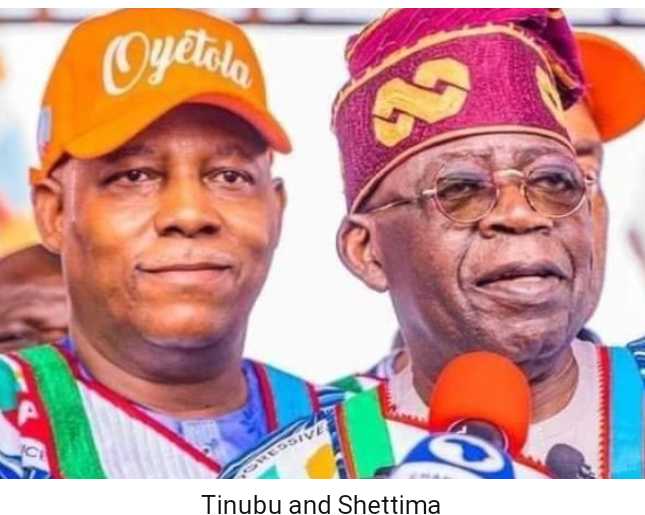
That was vintage Kashim Shettima, the Vice-Presidential candidate of the All Progressives Congress (APC), in one of his numerous efforts to push back the insinuation of a sinister motive behind the Muslim-Muslim arrangement of the party. In fact, based on his determination to deflect attention from the Muslim-Muslim ticket controversy, Shettima has been using every platform available to him to tell everyone who cares to listen that we should all focus on the issues – issues of governance and how to move the country forward.
But beyond the irritation that engulfs his face each time the issue of religion is brought up and his insistence that real issues, not inanities, should be discussed, Shettima also needs to come up with the issues he wants Nigerians to focus on and, most importantly he should lead the conversation.
Is Shettima himself or Ahmed Bola Tinubu discussing the issues? Beyond saying he and his running mate would tackle insecurity and fix the economy using their experience and the pedigree they have garnered over the years, what specifics has Shettima been discussing? What timelines?
What bold ideas are Tinubu and Shettima bringing to the table to tackle insecurity, fix the economy, power, etc.? What specific promises are they making that Nigerians can hold them accountable for?
APC is the ruling party. Tinubu/Shettima ticket is deemed to be the leading ticket in this election, and Shettima himself is believed to be the ‘Golden Boy’ of the ticket, and he deserves that accolade. So it is appropriate for Nigerians to expect a lot from him, knowing full well that he is a very sound, visionary, and modern-day leader.
Nigerians would like to know exactly what Tinubu and Shettima want to do to make their lives better and change the Nigerian condition. Nigerians want them to elevate the conversation beyond the media and public forum rhetorics.
For instance, public universities have been shut for the last six months, and the misery of our undergraduates knows no bounds. Any candidate that comes to say he would ensure they call off the strike is a lazy thinker and should not be taken seriously. That is like treating headaches and ignoring malaria, which is tantamount to leaving fundamental issues and doing window dressing for some temporary gains. ASUU crisis has been a recurring problem for decades, and Shettima and co need to tell Nigerians what they will do differently to fix the rot in the tertiary education sector and take lecturers back to classrooms and also ensure that our campuses stop producing half-baked graduates. I am talking about permanent solutions, not cosmetic measures that will last for a few months.
Nigerians are desperate to know how much Shettima and his running mate are planning to invest in tertiary education over the next four years and how they intend to raise the money that will run them. Nigerians need to know Shettima’s plans to return the universities to the glorious old days when they were some of the best research institutions in the world and where human problems were solved. When the Covid-19 pandemic and other zoonotic diseases are rocking the world, what Nigerian universities and their research institutes are doing in terms of producing vaccines to cure them? Why the over-reliance on the West?
What is Shettima’s opinion on restructuring education, federal universities, legislature, fiscal federalism, state/regional policing, power generation, distribution, and transmission?
Security challenges have also become intractable in recent years. Nigerians would like to know the bold ideas Shettima and his running mate are bringing to the table. Nigeria is said to be under-policed and under-protected generally. What Shettima’s action plans would look like in terms of empowering the Nigerian army, police and other security agencies?
The 1999 Constitution of the Federal Republic of Nigeria (as amended), makes it mandatory for the Vice President, not the President, to chair the National Economic Council, the highest decision-making body (on the Economy) in the country that has all 36 states governors, the FCT Minister and a few other ministers as members. Aside from that, successive presidents since 1999 have made it a tradition to put their deputies in charge of the entire economy. That tradition has not changed, with Vice President Yemi Osinbajo playing that role at the moment. It may not change with Shettima, and the former Borno state governor will have his job cut out for him.
Shettima stole the show at the recent Nigerian Bar Association (NBA) conference in Lagos as he dwelt on some of the issues. But Nigerians would like to see the APC blueprint and know the policies Shettima and his running mate are proposing to tackle negative macroeconomic indices such as rising inflation, poor growth rate, unemployment, underemployment, etc. What about the exchange rate and CBN policies on the monetary side of the economy? How does the APC duo intend to ensure proper fiscal supervision of the monetary side of the economy, and how is the CBN handling it?
Core inflation, headline inflation, and food inflation are all in the excess of 20 per cent in the face of dwindling purchasing power and a national currency that is always in a free fall! It would be interesting to know what Shettima’s ideas are on how to fix these multifaceted problems. What does Shettima want to do to boost local manufacturing and make Nigeria export-competitive in the global market, which is the ultimate, final solution to the twin problems of the exchange rate crisis and high rate of unemployment?
What is Shettima’s opinion on the country’s debt crisis? Do they intend to take more foreign loans? If yes, why?
The current managers of the economy have for years been spending over 90 per cent of the country’s revenue on debt servicing while they keep taking more and more loans and claiming the country’s debt to GDP ratio is okay without paying attention to the revenue end of the argument. Now, the worst has just happened with the 2022 first quarter reports revealing that the government spent more on debt servicing than what it generated as revenue within the quarter, and the difference was in the region of 300 billion nairas! That means aside from the already known scandal of borrowing to pay salaries, they have been borrowing more to service previous debts, a terrible vicious cycle that is highly unsustainable!
This shows that the problem is more on revenue generation than the present government‘s obsession with foreign loans. Shettima must have a couple of ideas about how to boost the country’s revenue from both oil and non-oil sources.
Talking about oil and gas, what about oil theft? It is crystal clear that it is the reason why Nigeria cannot meet her OPEC quota of 2 million barrels per day, and that is the reason for the country’s revenue shortage. Nigeria is the only country in OPEC that is losing up to 400,000 barrels of crude oil per day to the organised, exotic, white-collar crime called oil theft! And this is the major reason the country’s revenue base is wobbling. Shettima should tell us if their administration would be able to summon the political will to confront the highly placed, untouchable monsters behind the evil of oil theft and save Nigeria from becoming another Sri Lanka or Venezuela!
Yet, this same broke country is spending trillions of naira on the corruption-prone, an opaque scam called fuel subsidy. While failing to fix ailing refineries and importing refined products, and killing the naira, the country is spending billions of naira on a monthly basis to sustain hundreds of redundant staff members of these refineries that are not producing up to a drop of refined petroleum!
While not attacking or seeming to be openly disagreeing with the sitting government since they are of the same political party, the duo of Tinubu and Shettima have a duty to let Nigerians know their proposed choices among the difficult options that will be available to the country from next year.
In a nutshell, the APC duo needs to come up with a robust policy or action plan that will answer a lot of questions in the minds of Nigerians. They need to tell Nigerians what they should expect from them within the first hundred days in office, the first six months, the first year, and so on. While marking their first hundred days, how many executive bills would they have sent to the National Assembly? Which of the troubled sectors will they declare a state of emergency? Is it security, power, aviation, education, oil, and gas, or all of the above? Nigerians need to know!
I am urging Shettima and his running mate to come clean on their implementable plans so that Nigerians can scrutinize them accordingly and fairly when they get into office. Doing so now will send a strong signal to the electorates that they will be transparent and accountable to the people when they occupy the highest offices in the land.
May Nigeria succeed!
Lawan Bukar Maigana writes from Wuye District Abuja. He can be reached via lawanbukarmaigana@gmail.com.