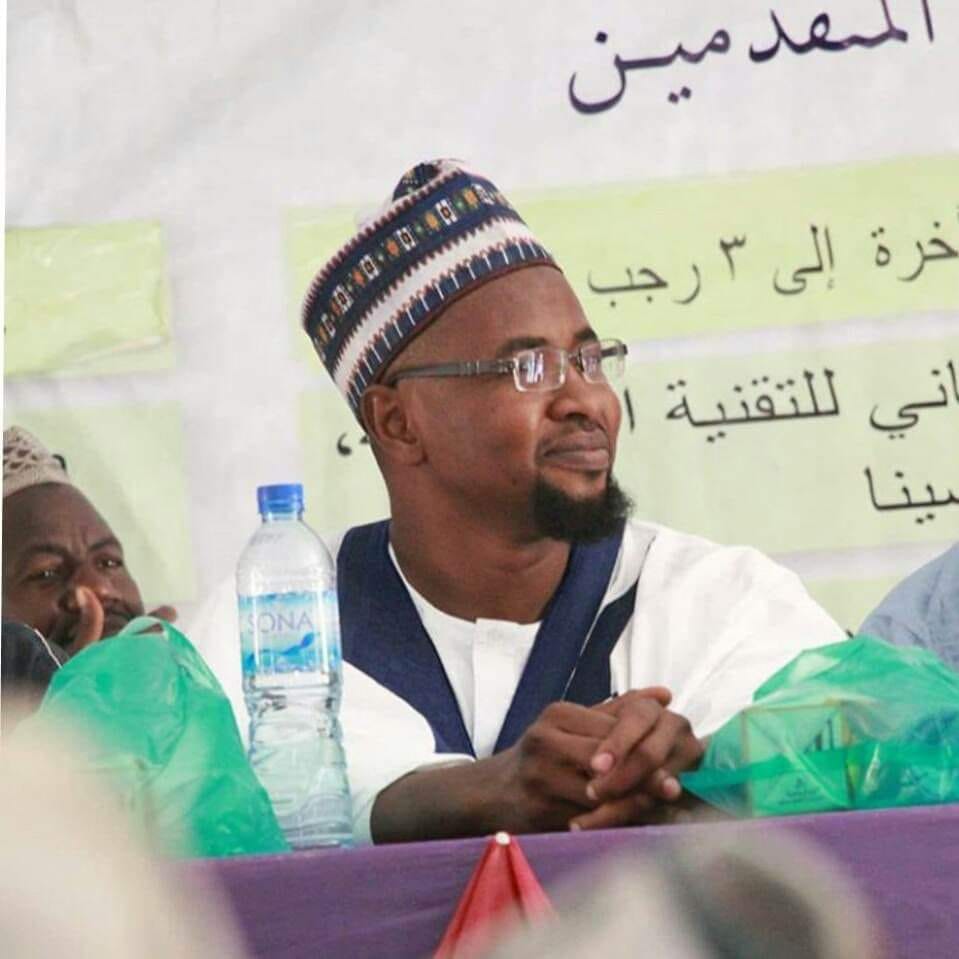
Sheikh Abduljabbar Kabara

On the Abduljabbar debate – Binta Spikin

I have never seen the devil. In fact, my assumption is mortals do not get a chance to have a one-on-one chat with him. However, sometimes, I wish I could see him – even if it is only to call in a conversation. See, he’s misguided from the old and young, men and women, rich and poor, from all strata of life and social circles. Hence I wish it were possible to call him to order – you can imagine us sitting him down and telling him point-blank something like: “hey dude, you’ve caused enough havoc in this world, so leave us be, or some similar stuff”. But that is just on a lighter mode.


On a serious note, sometimes, we are quick to heap every blame for our wrongdoings on the devil. However, there are those of us who are headstrong, those who, if given a chance, could beat the devil at his turf when it comes to misleading people. We all witnessed a similar scenario this weekend when a united group of Kano Islamic Scholars took on M. Abduljabbar Nasiru Kabara in a debate organised by the Kano State Government to put to bed some spurious claims Abduljabbar made against the Person of the Prophet (SAW) while making reference to some Hadith.


For the non-Muslims who could be reading this, I would like to explain that Islamic Jurisprudence is premised on four sources, and it is from there, the Shari’a (Islamic law) takes its root. They are:1- The Qur’an, which is the Holy Book revealed to Prophet Muhammad (S.A.W); 2- Hadith, which are the sayings and deeds of the Holy Prophet, and that which met his silent approval; 3 – The Ijma’, which is the consensus of opinions of Islamic scholars on issues; 4 – The Qiyas, which encapsulates all that which sits right on the conscience.

 
From goings-on, what Abduljabbar is (was?) challenging borders on the authenticity of some Hadith. However, in the process, he ends up violating every right-thinking Muslim by making some unsavoury and disrespectful statements regarding the person of the Prophet and his companions. I have never taken out time to really listen to him outside the “gaba-gadi” rant he was famous for. So when the audio clips were played during the debate, like most Muslims, I was hurt and disgusted by his utterances, the sheer abundance with which he makes the claims, with mirth and confidence is belittling. Those utterances were abusive to all Muslims with a conscience. 

On this note, we must commend Dr Abdullahi Umar Ganduje, OFR, Khadimul Islam, the Governor of Kano State, who made the debate possible, and through it, made the Muslim Ummah a united family. Those young gentlemen and scholars who participated in the discussion, despite specific ideological differences, united in protecting the sanctity of the religion and the honour of the Prophet. May Allah reward you for your service to Islam. Every right-thinking Muslim, globally, should be proud of what you have done. 


As for the Government of Kano State, I’d say this is a significant breakthrough. Our Governor, the Khadimul Islam, stood in for us using wisdom and skill; the debate was organised down to every detail, security was more than adequate, especially for the participants, etc. But the most significant victory for the Governor is that the people appreciate this act of service to religion and humanity.  

To M. Abduljabbar Nasiru Kabara, who is in fact the son of the late leader of the Kadiriyya movement, I hope this is a turning point for him. I hope this puts a stop to his skewed, misleading, contentious sermons. May Allah forgive him and us. May all our ailments heal. May our society be more prosperous. May Allah enrich our leaders with foresight. 
Masha Allahu la quwwata illa billah. 

Hajiya Binta Spikin is a Senior Special Assistant on Research and Documentation, Kano State. She can be contacted via bintaspikin@gmail.com.
The Abduljabbar Saga: Where he got it wrong – Prof. Yakubu Azare

By Prof. Yakuri Azare

I followed the entire debacle that lasted slightly over five hours with the attendant result from the moderator, Professor Salisu Shehu. It was thorough and the laid down procedural regulations were apt and full. I don’t intend to review what happened there; I intend to explain a phenomenon I viewed to have made Abduljabbar slipped. The entire dispute revolves around the concept of translation, which is seen as a primary machine that allows us to decipher messages encoded in another language. The whole concept of understanding religious principles is encapsulated in its translation into the language we fully understand. For any text to be wholly deciphered, there has to be suitable communicative translation and faithful in some instances—failure of translation results in catastrophe. As we often tell our students, a slight mistake in translation could trigger unrest. The case of Abduljabbar is one pointer.

Sacred texts should be translated with the uttermost caution to avoid pitfalls and possible uproar. Therefore, aspects of semantic addition and omission are not so much at the liberty of the translator. Of course, the translation author can be – and is – allowed to make additions or omissions, where necessary, to press meaning to the audience; however, in the case of sacred texts (mostly religious documents), such liberties are highly restricted. 

Overall, the whole saga was about Abduljabbar making unsubstantiated claims about certain prophetic traditions, which he claimed were mistakes by some of the finest scholars that history can never forget. He attributed certain heavy libellous statements to these scholars. Abduljabbar often reads the Arabic rendition with subsequent translation and exegesis of the tradition. This is a usual trend by all Ulamas intending to communicate across people of diverse linguistic backgrounds. What is worthy of noting here is how the original message is rendered and transmitted into the receptor language, in this case, Hausa.

Almost throughout the debate, there was a conspicuous absence of direct utterances of Abduljabbar in the original Hadith. This narrows down the accusing finger to Abduljabbar. No amount of denial or persistent argument would absolve him from the shackles of law and accusations. The exegesis cum translations here are, therefore, the root cause. Cultural nuances are essential to issues worthy of consideration when translating, as diverse cultures have varying ways of apportioning meaning to certain utterances. Abduljabbar was, quite evidently, never considerate of such slippery edges. Instead, he translated, explained and attributed conclusions to statements entirely out of context in the bid to attain heroism, demonstrate a more profound or better understanding of the scriptures.

Adding so much into translation in most instances has the tendency of making meaning obscure and or vague. Sacred texts are not only carefully knitted but are sometimes seen as dogmatic. In other words, religious texts express what they appear to have said. Making unnecessary additions may result in meaning change. Abduljabbar was attacked based on his utterances throughout, and in all the challenges posed to him, the central question is, where did you see this or that. Wrong translation understandably played a key role. In one such case, the moderator drew his attention to the contextual meaning and differences between “Haajaa and Shahawaa“. He explained that the former could not be given the contextual meaning of the latter. Each has its way of being expressed to denote what is intended.

Thus, between Hausa and Arabic, some cultural differences arise in how they attach meanings to ideas, subjects and so on; nonetheless, Abduljabbar was not so keen on that. Instead, he occupies the Arabic messages with haphazard translations that devour our cultural and religious context and, often, sensibilities. Both in our religion and culture, the place of the Prophet (SAW) is sacred, secure and untouchable. Therefore, making and creating controversial statements to his person is not only wrong but blasphemous. All the traditions cited by Abduljabbar and the other clerics, there was no one place, and I mean one place, that equates the heavy words of Abduljabbar in his Hausa explanation.

The central point here is, wrong and mismanaged translation played a significant role in this saga. It suffices to say, “Translation is a serious business and is not haphazardly done.” Understand, and master its art before engaging in it. Be vast in the cultural nuances of both languages, and understand that pragmatics is key to assigning meaning to words in certain situations. Also, know that sacred texts do not go with our whimsical preferences. Additions or omissions are made with caution to avoid slippery edges.

May Allah guide us always. May peace and blessings be on our most revered Prophet.

Prof. Yakubu Magaji Azare wrote from Bayero University, Kano. He can be reached via ymazare@yahoo.com.

Abduljabbar Saga: Another fresh perspective

By Dr Muhammad Sulaiman Abdullahi


Abduljabbar wanted to hide behind some distorted and concocted sayings. Even if there are sources, he will not dare reveal their sources to discredit Bukhari, Muslim, and most prominent Muslim scholars and even the Prophet’s companions. He concocted naked lies against the Holy Prophet directly, but claiming that he was defending the Holy Prophet! What a twisted-childish mentality.


In reality, what he was trying to do was not a direct attack on the personality of the Noble Prophet; it was indirect. This is because he accused others of saying what he said. He was asked to SHOW just a SINGLE line, where such lies were reported, but he woefully failed to do that. This is the reason why some of his sympathisers feel like he holds some valid arguments.


The problem is that most Muslims have forsaken Islamic Studies for a long time. They resort to google-google is inadequate for in-depth learning – it is a teach yourself style. This cannot take a real Islamic student anywhere. Someone needs to go to a real school.


Abduljabbar has eventually met his Waterloo. He asked for it and got it. He said he was prepared to meet all the scholars in the world to defend whatever people find heretic in his sermons. Therefore, those who try to defend him are now telling us that he wasn’t prepared. He said he was ready at first lie; he later realised his fall and said he wasn’t. These blanket followers accept whatever rubbish he spat. I pitied him, but I pitied those who felt and hoped he would win. It is a clarion call to all of us not to delve into Islamic affairs anyhow. We try very hard to know our areas of specialisation but take Islamic teachings for granted, thinking that we can manipulate them the way we manipulate our followers.


Another point that shows the super-amazing-human-position of the Holy Prophet (S.A.W) was that yesterday’s sitting was more of vindication to the most revered Islamic Muhaddithin – Bukhari and Muslim – who Abduljabbar sought to malign. He has been insulting them, the way I never heard anyone insulting his respected father, despite the sectarian differences. We still have respect for his father, whom even Sheikh Gumi admitted was a great scholar. May Allah have mercy on both of them. Abduljabbar thought he could go scot-free by insulting Bukhari and Muslim and even Anas bn Malik, not knowing that Allah will vindicate, protect and defend them. Allah says, “Inna lanansuru rusulana wallaziyna aamanu”, we will surely help our messengers and those who believe […]. Bukhari, Muslim and all those who Abduljabbar ignorantly and mercilessly abused were clearly assisted, defended and vindicated by Allah the almighty through his servants.


It was not only Abduljabbar who hate Islam/some Ahadith which stop them from doing bad. I am amazed by how these poor victims of Nigerian corruption think. With or without Bukhari and Muslim, they are already doomed. With or without Bukhari and Muslim, they are not enjoying life. Such people should focus on their insecurity and kidnappings, lack of good electricity, and then return to tarnish Islam’s image ignorantly.

It is now up to those who rant and insist on mischief even after seeing clear and undeniable proofs beyond any reasonable and even unreasonable doubts. Some accepted the truth wholeheartedly, while others insist on their mischief and being “strong-headed”. This shows the diversity of human understanding and the sincerity/insincerity of individual mortals. Some agree quickly, while others will never agree. Allah says: innal laziyna haqqat alaihim kalimatu rabbika layu’minuwn. Walau jaa’at’hum kullu aayatin hatta yarawul azabal aliym. Some will never agree until when they see real punishment and disastrous ending. 


To those who keep beating about the bush on the chairman of the occasion, the timing, lack of live broadcast, Abduljabbar wiping buckets of sweat, not allowing Abduljabbar to go and pee while he practically show the signs of that need and many other baseless and silly excuses should go and complain to Baba Ganduje. Such and some will never understand.


I am happy that many people accept this with transparent and open minds. Some hoped that Abduljabbar won. But, alhamdulillah, he didn’t, and he woefully failed. I am happy because I see the shameful end of two – most recent – people with blasphemous dispositions. One is in faraway France. He received a heavy and dirty slap which was equal to his position, while the other received a super intellectual blow which shattered his many years of madness.


The holy Prophet (S.A.W) is a human being like no other. Allah promised to protect his mention anywhere. Abduljabbar manipulated things beyond what can be accepted. And in this case, there is no “moderate” or “neutral” stand. It is like what Bush said, “it is either you belong to us, or you belong to the terrorists”.

May the Almighty Allah continue to help the truth even when everyone is against it, amen. Abduljabbar – the cave owner – dug his grave, and I hope he alone would fall into it. But, unfortunately, he failed, and wallahi, we are happy, alhamdulillah.

I wish Abduljabbar will truly repent – Dr Muslim

A leading member of the Coalition of Kano Ulama and an academic, Dr Muhammad Muslim Ibrahim, who also attended the dialogue between Sheikh Abduljabbar Kabara and representatives of the Coalition, said in an interview with The Daily Reality that Kano Ulamas had done their parts. The rest was for the Kano State government to make the final decision.

Dr Muslim said, “The debate was well-organized and was just. Each contestant was allocated ten minutes to present their argument, followed by an additional five minutes for clarification, etc. Malam Abduljabbar was aware of the questions to be asked. They were nine questions formed from his blasphemous translations and utterances on Prophet Muhammad (S.A.W), his companions and famous Hadith books – Sahihul Bukhari and Muslim. He said all this in his lessons, preachings and sermons.”

In the dialogue held on July 10, 2021, Sheikh Abduljabbar persistently complained about insufficient time to answer questions. He further protested that he was not aware of the debate’s guidelines. However, Dr Muslim countered these claims.

“This is nothing but denial and a look for a way out. The questions had been with him for months, and he was the one who urged that this debate should be held. Thus, he had to be more prepared than any of these scholars. Similarly, nobody was aware of the specifics of the arrangement of the debate as everything was in the hand of the government. Of course, we also wanted to have equal time for both parties, but he had more.”

Dr Muslim emphatically added that “Our representatives should have more time than Abduljabbar because his task was to defend those blasphemous remarks, but the judge of the sitting outrightly rejected our demand.”

On his expectation as the dialogue was over now, the cleric responded thus, “There are many views. Some say the government intended to have a reasonable point with which Abduljabbar can be legally convicted for making those blasphemous statements. However, now that it has been confirmed that Abduljabbar fabricated all those statements, it is the Kano State government that will decide his fate. So though some say the punishment of blasphemy in Islam is killing, I don’t think it will be possible here in Nigeria. So we should not talk about it because we will end up wasting our time.

But what I expect from the Kano State government is to continue banning him from leading prayers, giving lessons and or posting on social media. It is none of our intent for Abduljabbar to be jailed; we are afraid that he will use this opportunity to corrupt the inmates. But, If we are to follow what Allah says, the only option for Abduljabbar is to either repent or be killed if he refused. How I wish he will repent,” concluded Dr Muslim.